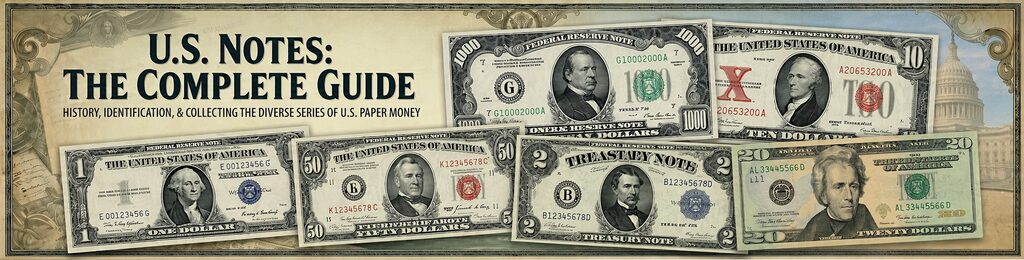
US Notes

Insufficient Margin Errors on Large-Size Notes: How Sheet Registration Failures Created Cutting Oddities Before 1929

Before the Bureau of Engraving and Printing standardized its cutting procedures in the small-size era, large-size notes were vulnerable to dramatic sheet registration failures that produced some of the most visually striking error currency in American numismatic history. Understanding how these cutting oddities occurred, which series are most affected, and what separates a genuine error from post-issuance trimming is essential knowledge for any serious collector of pre-1929 paper money.

Read More →

The PMG Population Report: Using Census Data to Find Conditionally Rare Notes

The PMG Population Report is one of the most powerful and underused tools in a currency collector’s arsenal, revealing which notes are genuinely scarce in top grades versus merely old. This guide shows you exactly how to read pop report data, identify conditionally rare opportunities, and build a smarter collection using real census numbers.

Read More →

The Signatures on US Currency: A Visual History of How Treasury Secretary and Register Autographs Changed from Handwritten to Engraved

The signatures appearing on United States paper money tell a surprisingly rich story about the evolution of American currency production, from hand-signed notes of the 1860s to the precision-engraved facsimiles of today. Understanding signature combinations, their dates of use, and their relative scarcity is one of the most rewarding areas of study for serious currency collectors.

Read More →

Portraits Removed from US Currency: Chase, Stanton, and the Figures No Longer on American Notes

From Salmon P. Chase’s brief appearance on high-denomination Federal Reserve Notes to Edwin Stanton’s forgotten presence on Fractional Currency, several prominent Americans once graced US paper money before being quietly replaced. Understanding who appeared, when, and why they were removed gives collectors a fascinating lens into the political and institutional history behind every piece of American paper money.

Read More →

The Changeover Pair: Collecting Sequential Notes Spanning Two Signature Series

A changeover pair is one of the most fascinating and underappreciated finds in paper money collecting, capturing the exact moment the Bureau of Engraving and Printing transitioned from one Treasurer-Secretary signature combination to another. This guide explains what makes these consecutive-serial-number pairs so compelling, how to identify them, and which combinations command serious premiums in today’s market.

Read More →

Federal Reserve Notes Series 2003 $2: Why This Low-Print-Run Issue Is Already Attracting Serious Collector Attention

The Series 2003 $2 Federal Reserve Note is one of the most overlooked yet genuinely scarce modern issues in circulation-era United States currency, with several district printings so small they rival classic low-mintage notes from decades past. Understanding which districts printed and why the numbers matter can help collectors identify real sleepers before prices fully reflect their rarity.

Read More →

Why Is American Money Green? The BEP’s Ink Chemistry and the Colorful History Behind U.S. Currency

The green color of U.S. paper money is so iconic that ‘greenback’ became a permanent part of the American lexicon, yet few collectors understand the actual chemistry, historical decisions, and security science behind that distinctive hue. This deep dive covers everything from the Civil War-era origins of green ink to the modern magnetic and ultraviolet properties that make counterfeiting so difficult.

Read More →

Federal Reserve Notes Series 1985 and 1988: Pre-Security Thread Issues and Their Overlooked Varieties

The Series 1985 and 1988 Federal Reserve Notes represent the final era of large-scale, thread-free currency production before the U.S. Treasury began embedding security features in 1990. Collectors who dig into the signature combinations, star notes, and district varieties of these transitional issues will find surprising scarcity hiding in plain sight.

Read More →

Third Printing Errors: Misaligned Serial Numbers and Seals on Modern Federal Reserve Notes

When the Bureau of Engraving and Printing’s third printing stage goes wrong, the result is some of the most visually dramatic and collectible error currency in modern numismatics. This guide breaks down exactly how misaligned serial number and seal errors occur, which specific series to hunt for, and what these striking mistakes are worth in today’s market.

Read More →

How the GI Bill of 1944 Triggered a Wave of New National Bank Formations and Reshaped Postwar Currency Circulation in Suburban America

The Servicemen’s Readjustment Act of 1944 did far more than send veterans to college and hand them home loans. It quietly detonated a revolution in American banking that flooded postwar suburbs with freshly chartered national banks, producing some of the most collectible and historically resonant currency the Federal Reserve era ever issued.

Read More →