📷 Image source: National Numismatic Collection, National Museum of American History (via Wikimedia Commons). Images are selected by AI to represent the article topic and may not depict the exact note(s) described.
On September 18, 1873, Jay Cooke and Company, the most powerful banking house in the United States, locked its doors and posted a notice of failure. Within hours, the New York Stock Exchange spiraled into panic, brokerages collapsed, and lines of frightened depositors formed outside banks from Philadelphia to Chicago. What followed was the longest and most severe economic depression the United States had experienced to that point, a contraction that lasted nearly six years and fundamentally reshaped American monetary policy. For collectors of United States paper money, the Panic of 1873 is not merely a historical backdrop. It is the engine behind some of the most consequential printing decisions ever made by the Treasury Department, decisions that left behind a rich and collectible legacy of Legal Tender Notes, Fractional Currency, and transitional series that speak directly to those terrifying years.
The Greenback in the Years Before the Panic
To understand what 1873 meant for Legal Tender Notes, collectors need a firm grip on where the currency stood beforehand. The original Legal Tender Act of February 25, 1862 had authorized the first true United States paper currency not backed by specie, the so-called greenbacks named for the distinctive green ink on their reverses. By the war’s end the government had issued roughly $450 million in these notes. Political pressure through the late 1860s gradually forced that figure downward, and the Currency Act of 1869 set a ceiling of $356 million in outstanding Legal Tender Notes, a compromise that satisfied neither hard-money conservatives who wanted full contraction nor soft-money inflationists who wanted expansion.
The Series 1869 Legal Tender Notes, sometimes called the “Rainbow Notes” by modern collectors for their vivid multicolor counters, were printed under the Allison-Spinner signature combination (Register of the Treasury John Allison and Treasurer Francis Spinner). These notes are among the most visually dramatic issues in American currency history. The $1 features a portrait of George Washington at center with a large red floral counter, while the $100 displays Abraham Lincoln on the left and an allegorical figure representing architecture on the right. These were the notes circulating when Jay Cooke’s bank failed.
Series 1869 Legal Tender Notes in grades VF-20 or better are genuinely scarce across all denominations. The $1 and $2 face the additional challenge of having been heavily circulated during the crisis years. When buying, pay close attention to paper quality: many survivors have been pressed or cleaned, and original embossed paper with natural folds commands a significant premium over “processed” examples.
Cooke’s Collapse and the Immediate Currency Scramble
Jay Cooke had staked his firm’s survival on financing the Northern Pacific Railroad, a transcontinental line that was consuming capital far faster than bond sales could replenish it. When European investors, already rattled by financial crises on the continent, stopped buying American railroad bonds in 1873, Cooke’s leverage became fatal. His failure triggered cascading bank runs. The New York Stock Exchange suspended trading for ten days beginning September 20, 1873, the first such closure in its history.
In this environment, the public’s appetite for tangible, government-issued Legal Tender Notes surged dramatically. National bank notes, also circulating at the time, were obligations of private institutions that might fail at any moment. Legal Tender Notes bore the full faith of the United States government, and frightened citizens understood that distinction. Hoarding of greenbacks became widespread, tightening the money supply precisely when liquidity was most needed, a classic deflationary spiral that Treasury officials watched with alarm.
Secretary of the Treasury William Richardson responded almost immediately by releasing $26 million in previously retired Legal Tender Notes back into circulation, pushing outstanding greenbacks close to the $400 million level and triggering fierce political debate. Hard-money advocates in Congress were outraged. The temporary expansion nonetheless provided crucial breathing room for solvent businesses trying to meet payrolls and settle debts.
The Inflation Bill, Grant’s Veto, and the Series 1874 Notes
Congress attempted to formalize the expanded greenback supply with the Inflation Bill of 1874, legislation that would have raised the Legal Tender ceiling to $400 million permanently. President Ulysses S. Grant’s veto of that bill on April 22, 1874 was one of the most consequential fiscal decisions of the Gilded Age. Grant, persuaded by hard-money advisors including future Treasury Secretary Benjamin Bristow, chose deflation over expansion, a decision that prolonged the depression but set the stage for eventual specie resumption.
The Series 1874 Legal Tender Notes that followed reflect the immediate post-veto environment. They carry the Allison-Spinner signature combination on earlier printings and transition to Allison-New (Treasurer John C. New) on later sheets. The red Treasury seal with rays, a design feature introduced in the late 1860s series, continued through these notes. The $5 denomination features the famous “Woodchopper” back design, a bucolic scene that strikes modern collectors as charmingly incongruous given the financial catastrophe surrounding its printing. Circulated examples of the $5 and $10 Series 1874 are fairly obtainable in grades up to VF, but uncirculated survivors are legitimately rare given how hard these notes worked during the depression years.
Signature combinations are your best tool for dating specific printings within a series. Series 1874 notes bearing the Allison-Spinner combination were printed before Spinner’s retirement in June 1875, making them earlier production runs. Notes signed Allison-New represent a brief window from mid-1875. Learn to identify signatures confidently before buying, as dealers occasionally mislabel these, and the distinction can affect value by 20 to 40 percent in higher grades.
The Specie Resumption Act of 1875 and the Series 1875 Notes
January 14, 1875 brought the Specie Resumption Act, which committed the United States to redeeming Legal Tender Notes in gold coin beginning January 1, 1879. To facilitate this, the Act also authorized a gradual reduction in outstanding greenbacks as national bank note circulation expanded. The political fight over this legislation was intense: Greenback Party organizers used the depression as evidence that contraction was killing farmers and workers, and the party would poll over a million votes in the congressional elections of 1878.
The Series 1875 Legal Tender Notes are a fascinating collecting category precisely because they bridge the panic era and the road toward resumption. Multiple signature varieties exist within this series, including Allison-New, Allison-Wyman (Treasurer James Gilfillan served briefly, then John C. Wyman), and on the $1 and $2 denominations, some of the lowest print runs of any Legal Tender issues of the decade. The Series 1875 $1, signed Allison-New, is considered a significant scarcity in grades above Fine, with auction records confirming fewer than a dozen Uncirculated examples documented across major collections.
Fractional Currency During the Crisis
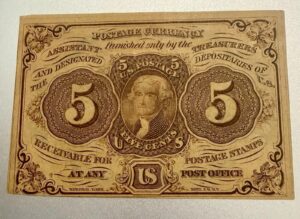
No discussion of 1873-era paper money is complete without acknowledging the role of Fractional Currency. The Fifth Issue Fractional Currency, printed from 1874 to 1876, was a direct response to the coin hoarding that accompanied the panic. Denominations of 10, 25, and 50 cents served as substitute coinage when silver and copper largely vanished from commerce. The 50-cent Fifth Issue notes featuring William Hamill Crawford are among the more commonly encountered pieces today, but the 10-cent denomination with William Meredith is genuinely scarce in grades above VF-30. Collectors building a comprehensive depression-era currency collection should include Fractional Currency as an integral component, not an afterthought.
Fifth Issue Fractional Currency suffered from a pervasive printing problem: the green backs were applied with inks that reacted to humidity over time, causing discoloration and toning along the edges. When evaluating Fractional Currency from this period, examine the back color critically under good lighting. Notes with vibrant, evenly printed greens without edge toning will carry substantial premiums and are far harder to find than raw auction estimates might suggest.
The Series 1878 Legal Tender Notes and the Path to Resumption
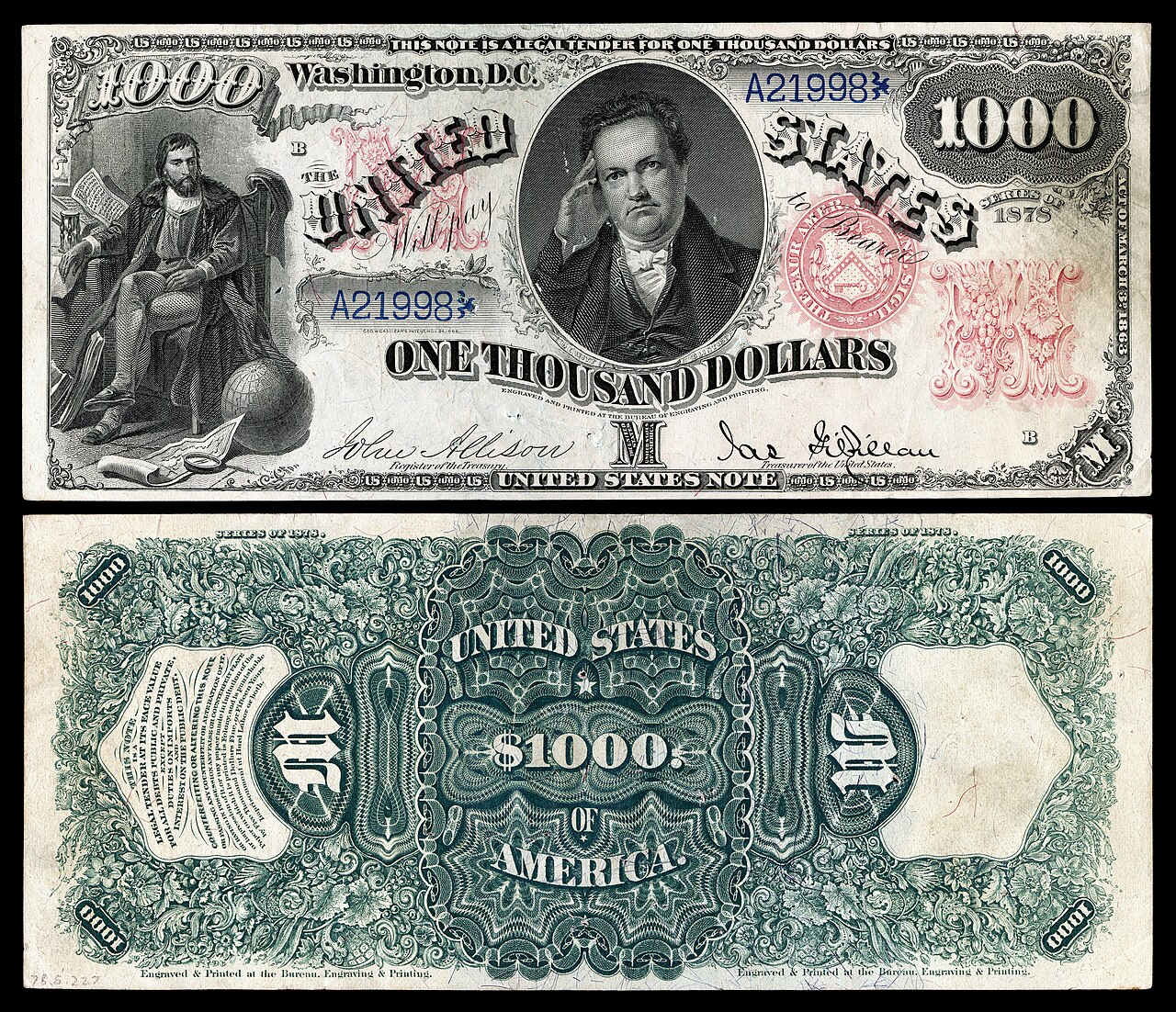
By 1878, with specie resumption just months away, Treasury printing shifted again. The Series 1878 Legal Tender Notes were issued across denominations from $1 through $1,000, and they carry the Allison-Gilfillan signature combination (Register Allison and Treasurer James Gilfillan). The $1 Series 1878 is noteworthy for its relatively large print run compared to earlier 1870s issues, reflecting both the stabilization of the economy and the administrative need to maintain adequate small-denomination currency as silver coinage gradually returned to commerce. The high denominations, particularly the $500 and $1,000 Series 1878 Legal Tender Notes, are among the most coveted pieces in American large-size collecting, with surviving examples numbering in the dozens rather than the hundreds.
Specie resumption actually proceeded more smoothly than its opponents predicted. When January 1, 1879 arrived, relatively few holders of Legal Tender Notes rushed to exchange them for gold, partly because the economy had stabilized enough that the notes themselves were trading at or near par with coin. The crisis had lasted six years, reshaped American politics, given birth to a third political party organized entirely around monetary policy, and left behind a paper money legacy that collectors continue to study and prize more than 150 years later.
| Series | Denomination / Variety | Approx. Print Run | Rarity |
|---|---|---|---|
| 1869 | $1 (Allison-Spinner) | Approx. 26 million | Scarce |
| 1869 | $100 (Allison-Spinner) | Approx. 400,000 | Rare |
| 1874 | $5 (Allison-Spinner) | Approx. 12 million | Scarce |
| 1874 | $50 (Allison-New) | Approx. 200,000 | Rare |
| 1875 | $1 (Allison-New) | Approx. 4.8 million | Key Date |
| 1875 | $2 (Allison-Wyman) | Approx. 3.2 million | Key Date |
| 1878 | $1 (Allison-Gilfillan) | Approx. 60 million | Common |
| 1878 | $500 (Allison-Gilfillan) | Fewer than 10,000 | Key Date |
| 1878 | $1,000 (Allison-Gilfillan) | Fewer than 5,000 | Rare |
| 5th Issue Fractional | 10-cent (Meredith) | Approx. 8 million | Scarce |
Building a Depression-Era Currency Collection
Assembling a focused collection around the Panic of 1873 offers a thematically coherent and historically meaningful approach that appeals to numismatists and economic history enthusiasts alike. A thoughtfully constructed set might include a circulated Series 1869 “Rainbow Note” in a denomination the collector can afford, at least one Series 1874 note in each of its primary signature varieties, a Series 1875 representative from the scarcer combinations, a Fifth Issue Fractional piece to represent small-denomination commerce during the crisis, and a Series 1878 note to close the narrative arc. Framed alongside period newspaper accounts of bank failures or reproductions of the famous Harper’s Weekly engravings of bread lines, such a collection tells a complete and compelling story.
Population reports from PCGS Currency and PMG are essential research tools for this era. Because many of these notes spent years in heavy circulation before eventually retiring to attics and shoeboxes, the gap between the number of notes printed and the number surviving in grades above Fine is enormous. A note certified VF-30 that crossed a hundred hands during the depression years carries a kind of worn authenticity that gem examples, however beautiful, cannot fully replicate.
Why This History Still Matters to Collectors
The Panic of 1873 was not an abstraction. It destroyed the livelihoods of millions of Americans, ended Reconstruction by diverting political attention from civil rights to monetary policy, and forced the United States to make fundamental choices about the nature of its currency that echoed well into the twentieth century. Every Legal Tender Note printed between 1873 and 1878 passed through an economy under severe stress. The wear on a Series 1874 five-dollar note is not merely the result of handling. It is evidence of commerce continuing to function, barely, in the teeth of catastrophe.
Collectors who understand this context hold something richer than paper and ink. They hold material evidence of one of the most consequential financial crises in American history, a crisis that shaped the monetary system that eventually produced the Federal Reserve, the gold standard, and ultimately the fiat currency system under which Americans live today. That lineage, traced through the red Treasury seal and the confident engraving of a Legal Tender Note from 1874, is what makes this corner of numismatics so endlessly rewarding.