Imagine being handed a crisp new $5 bill in the spring of 1862, one of the first-ever federal Legal Tender Notes, and having absolutely no reliable way to know if it was genuine. No ultraviolet strips, no color-shifting ink, no embedded security threads. Just paper, ink, and an engraver’s skill standing between you and financial ruin. That was the reality facing ordinary Americans in the opening months of the Civil War, and it created one of the most remarkable and underappreciated crises in the history of United States currency.
A Currency Born in Crisis
The Legal Tender Act of February 25, 1862, signed by President Abraham Lincoln and championed by Treasury Secretary Salmon P. Chase, authorized the issuance of $150 million in United States Notes, the so-called “Greenbacks” named for the distinctive green ink applied to their reverses. The federal government had not issued paper money since the troubled Treasury Notes of the 1830s and 1840s, and there was no established national infrastructure for detecting fakes. State-chartered bank notes, which had served as the de facto currency of the nation for decades, had spawned an entire cottage industry of counterfeit detection. Publications like Bicknell’s Counterfeit Detector and Thompson’s Bank Note Reporter had subscribers throughout the merchant class precisely because fake bank notes were endemic. But those notes were issued by hundreds of different institutions, making the problem diffuse. Now, suddenly, there was a single national currency, and that centralization was both a strength and a spectacular vulnerability.
The first Series 1862 Legal Tender Notes to reach circulation featured the portrait of Salmon Chase himself on the $1 note, an act of bureaucratic self-promotion that Chase would later find embarrassing enough to order removed. The $5 featured a vignette of “The Landing of Columbus,” the $10 bore an eagle and the face of Abraham Lincoln, and the $20 displayed a running Locomotive. These design choices were made hastily, sometimes in a matter of weeks, and the security features incorporated into them were, by even the standards of the era, inadequate.
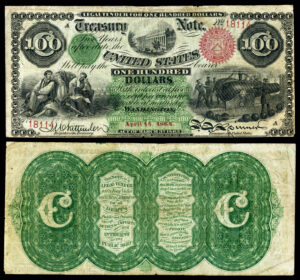
When examining Series 1862 Legal Tender Notes, pay close attention to the red Treasury seal on the obverse. Genuine seals exhibit sharp, fine-line engraving with consistent ink saturation. Counterfeit examples known from the period often show blurry seal perimeters or uneven color. Modern collectors can use a 10x loupe to inspect the fine geometric lathe work surrounding the seal, which period counterfeiters struggled to replicate accurately.
Why the Notes Were So Vulnerable
To understand why counterfeiting exploded so quickly, you have to appreciate the technical and logistical constraints of 1862. The Bureau of Engraving and Printing, as collectors know it today, did not yet exist. It would not be formally established until 1862, and even then it spent its early years as a tiny operation inside the Treasury Building, initially doing little more than separating and sealing notes printed by private contractors. The actual printing of the first Greenbacks was contracted to the American Bank Note Company and the National Bank Note Company, both based in New York. This meant that the Treasury had limited control over the full production process and, critically, limited ability to standardize quality in ways that would help the public authenticate notes.
The paper itself, while distinctive, was not impossible to approximate. It was not until later in the 1860s and into the 1870s that the Treasury worked with papermakers to develop the distinctive fiber-embedded paper that became a cornerstone of US currency security. In 1862, the paper used for Greenbacks, while of high quality, could be reasonably approximated by skilled counterfeiters who had access to good linen-cotton stock. The green ink on the reverse was intended as a deterrent, as early photographic reproduction processes could not capture color, making photographic counterfeiting theoretically impossible. But that assumption underestimated the skill of hand engravers and lithographers.
The Counterfeiters Respond
Contemporary Treasury Department records and newspaper accounts from mid-1862 document an astonishing proliferation of fake Greenbacks. By August 1862, just six months after the first notes reached circulation, the Secret Service, which would not officially exist until 1865, had no federal law enforcement body dedicated to the problem. Local police and customs officials were the only line of defense, and they were wholly unprepared. Estimates from period sources, including reports compiled later by the newly formed Secret Service in 1865, suggested that by the end of 1862, there were well over 1,600 distinct varieties of counterfeit notes in circulation on various denominations of state bank notes and the new federal issues combined.
The most heavily counterfeited of the early Legal Tender denominations were the $5 and $10 notes. The $5 Series 1862 note, signed by Register of the Treasury Lucius Chittenden and Treasurer Francis Spinner (the Chittenden-Spinner signature combination being the first for this series), was particularly targeted. Its relatively modest face value made it useful in everyday commerce, meaning it changed hands frequently and was scrutinized less carefully than larger denominations. Counterfeit $5 notes of this period were produced using both intaglio engraving, by highly skilled operators, and the far cruder lithographic process, which produced notes that a careful merchant could detect but that passed easily in dim light or hasty transactions.
The Chittenden-Spinner signature combination on Series 1862 Legal Tender Notes is historically significant as the very first signature pairing on US Legal Tender Notes. Notes bearing this combination in Fine or better condition are genuinely scarce, particularly in the $1 and $2 denominations. When buying, ensure signatures show clean, sharp engraving without the ghosting or doubling sometimes introduced during reprinting of depleted plates.
The Government Fights Back: Security Measures and Their Limits
The Treasury Department was not passive in the face of this crisis. Chase and his deputies moved on several fronts simultaneously. First, they pushed the printing contractors to refine the lathe work, the intricate geometric patterns produced by geometric lathes that were notoriously difficult to replicate by hand. The fine-line engine turning visible in the background of genuine Series 1862 notes represented the cutting edge of anti-counterfeiting technology, and when properly printed it was genuinely difficult to fake. The problem was consistency: pressure variations during printing meant that some genuine notes had less crisp lathe work than others, inadvertently making the public more tolerant of imprecise designs.
Second, the Treasury began publishing and distributing counterfeit detection literature directly, rather than relying on private publishers. The Treasury Department Circular issued in the summer of 1862 described known counterfeits in detail, down to the specific flaws in the fake seals and the slightly wrong shade of green used on certain lithographic fakes. This was a genuinely modern approach to the problem, treating public education as a security tool. Merchants were encouraged to obtain genuine notes directly from banks and compare them side by side with notes they received in trade.
Third, and most consequentially for the long-term future of US currency security, the crisis of 1862 directly accelerated the federal government’s move to take printing entirely in-house. By 1863, the nascent Bureau of Engraving and Printing had begun taking on more of the actual printing work, and by 1877 it held a complete monopoly on the production of US paper money. Centralized production meant better quality control, tighter security around printing plates, and eventually the development of the special security paper that remains a cornerstone of US currency to this day.
A Collector’s Perspective on the 1862 Notes
For today’s numismatist, the Series 1862 Legal Tender Notes occupy a unique position in the US currency canon. They are the foundation stones of the modern American monetary system, the direct ancestors of every bill in your wallet. They are also genuinely scarce. Notes in grades of Very Fine (VF-20 to VF-35 on the PCGS and PMG scales) command strong premiums, and examples in Extremely Fine or better condition are legitimately difficult to find. The $1 and $2 denominations, while the lowest face values, are in some ways the most historically resonant, as these were the denominations most likely to have passed through the hands of ordinary citizens, soldiers, and merchants during the Civil War years.
The serial number format on Series 1862 notes is worth understanding. Serial numbers appear in red ink, consistent with the red Treasury seal, and are printed in a relatively large, plain typeface compared to later series. Notes from the first print runs carry lower serial numbers, and while there is no strict premium for low serials the way there is in some later series, numismatists who focus on this era do value examples that can be documented to early production. The absence of a series date printed on the note itself, a feature that would not appear until later United States Notes, means dating must rely on signature combinations and other contextual details.
Series 1862 Legal Tender Notes were never officially recalled and theoretically remain legal tender today, though no collector should ever spend one. When purchasing raw (ungraded) examples, submit them to PMG or PCGS Currency before paying significant premiums. The counterfeiting crisis of 1862 means that genuine period fakes exist in the marketplace, some of them over 160 years old and superficially convincing. Professional grading services have the reference materials and expertise to distinguish genuine from contemporary counterfeit.
The Legacy of 1862
The counterfeiting crisis of 1862 is not merely a historical curiosity. It was a foundational stress test that revealed every weakness in the young federal currency system, and the government’s response to it shaped US currency design and security philosophy for the next century and a half. The red seal, the lathe work, the move toward in-house printing, the public education campaigns: all of these responses to 1862 are the direct ancestors of the color-shifting ink, the security threads, and the public awareness campaigns that protect US currency today. The counterfeiters of 1862 forced the Treasury Department to become, out of necessity, the world leader in currency security technology. It is a legacy worth understanding, especially when you hold one of those original Greenbacks in your hands.
| Series / Denomination | Signature Combination | Est. Known in VF or Better | Rarity |
|---|---|---|---|
| 1862 $1 | Chittenden-Spinner | Fewer than 200 examples | Rare |
| 1862 $2 | Chittenden-Spinner | Fewer than 150 examples | Rare |
| 1862 $5 | Chittenden-Spinner | 200 to 400 examples | Scarce |
| 1862 $10 | Chittenden-Spinner | 300 to 500 examples | Scarce |
| 1862 $20 | Chittenden-Spinner | 150 to 250 examples | Rare |
| 1862 $50 | Chittenden-Spinner | Fewer than 80 examples | Key Date |
| 1862 $100 | Chittenden-Spinner | Fewer than 60 examples | Key Date |
| 1862 $500 | Chittenden-Spinner | Fewer than 15 examples | Key Date |
| 1862 $1 (Second Obligation reverse) | Chittenden-Spinner | Fewer than 100 examples | Rare |
| 1862 $2 (Second Obligation reverse) | Chittenden-Spinner | Fewer than 75 examples | Key Date |
Conclusion: Holding History
When a collector acquires a genuine Series 1862 Legal Tender Note today, they are holding a document that survived not only 160-plus years of time, but also a crisis of confidence that could have destroyed the American paper money experiment in its infancy. The counterfeiters of 1862 nearly won. They were skilled, they were fast, and they faced a federal government that had almost no tools to stop them. That the Greenback survived, that it became the foundation of the world’s reserve currency, is a story of institutional resilience, technological innovation, and yes, a little bit of luck. These notes deserve their place in every serious collection of American monetary history.