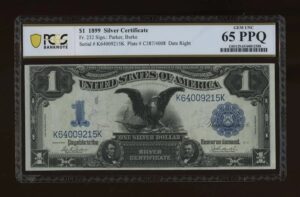
Pull a well-circulated large-size note from an old dealer’s stock and you will almost certainly encounter it: a front that looks nearly problem-free, crisp at the edges, with bold color and sharp design detail, paired with a back that took the brunt of a century’s worth of folding, pocket wear, or handling. The two sides tell completely different stories. So how does a grading service like PMG reconcile those competing narratives into a single number on a green label? The answer lies in what the hobby calls a split grade, and understanding how it works will make you a sharper buyer and a more informed seller.
What Exactly Is a Split Grade?
A split grade occurs when the obverse (face) and reverse (back) of a banknote display meaningfully different levels of preservation. On a physical coin, both sides generally experience wear at similar rates because coins circulate in direct contact with other surfaces on every side. Paper money behaves differently. A note folded and kept in a wallet with the face inward protects that side from abrasion while exposing the back to constant friction. A note framed under glass and displayed for decades fades on the face from light exposure while the back stays pristine. These real-world storage and circulation patterns create genuine, sometimes dramatic, differences between the two surfaces.
PMG, the industry’s leading third-party grading service for paper money, formally acknowledges this reality in its grading standards. Rather than simply ignoring the discrepancy or always grading to the worse side, PMG has developed a methodology that attempts to be fair to both the note and the collector who wants an honest assessment.
How PMG Graders Evaluate Each Side
When a note arrives at PMG, it goes through a multi-grader process. Each grader examines the note holistically, but experienced graders are trained to mentally assign a preliminary grade to the face and the back independently before arriving at a combined assessment. The criteria applied to each side are identical: fold count and crispness, surface preservation, paper quality, color intensity, centering relative to margins, and any evidence of cleaning, pressing, or restoration.
For a note like a Series 1934 Federal Reserve Note in a mid-grade range, a grader might observe a face that exhibits only two light folds, bright green Treasury seal color, and minimal surface soiling, consistent with a Very Fine 30 or even Extremely Fine 40 designation. The back, however, might show four or five intersecting folds, more pronounced paper softening, and corner rounding that alone would pull a grade down toward Fine 15 territory. These are not trivial differences; in PMG’s numerical system, a 15-point swing on the 70-point scale represents a substantial divergence in preservation quality.
When buying raw (ungraded) notes, always examine the back first. Many sellers photograph the more attractive face prominently and include only a small or poorly lit image of the reverse. A note that grades EF-40 on the face but Fine-15 on the back will almost certainly come back from PMG well below what the face alone suggests.
The Averaging Formula: Where the Final Number Comes From
PMG does not publish a rigid mathematical formula for public consumption, but through years of submitted notes, collector feedback, and statements from PMG’s own grading team, the general methodology has become fairly well understood in the hobby. The final grade is a weighted average of the two sides, with the face typically receiving a modestly greater weight than the back. In practical terms, this often means the two individual grades are averaged, and then the grader exercises judgment about whether to round up or down based on the overall visual appeal of the note.
Consider the example above: a face grading EF-40 and a back grading F-15. A strict mathematical average yields 27.5, which PMG would likely place in the Very Good 25 range, possibly bumped to Very Fine 25 or staying at Very Good 20 depending on overall eye appeal. The critical point is that the final grade is lower than the face grade and higher than the back grade. Neither side alone determines the outcome.
It is worth noting that for notes with only minor differentials, say a face at Gem Uncirculated 65 and a back at Choice Uncirculated 63, PMG will typically assign a final grade of 64. The one-point difference is real but not dramatic enough to create a visually jarring result on the label. The greater the gap between the two sides, the more the averaging pulls the final grade toward the middle, and the more likely the note is to receive a comment or qualifier on its PMG label noting the condition discrepancy.
When the Reverse Grades Higher Than the Face
The reverse-better-than-face scenario is less common but equally instructive. It occurs most often with notes that were stored face-down in albums or stacked in drawers where the obverse made direct contact with a surface over many years. Large-size Gold Certificates from the 1882 and 1922 series are frequently encountered this way; their vivid gold-ink reverses were sometimes kept face-down by collectors who feared the gold printing would offset onto adjacent notes. The result can be a stunning back paired with an obverse that shows album or box rub.
Federal Reserve Bank Notes from the 1918 series, particularly the $1 and $2 denominations, also turn up with this profile. The large, ornate blue Treasury seal on the face was a prestige element that many early collectors displayed facing up under glass, inadvertently fading the face from UV exposure while the reverse remained protected. A grader encountering a 1918 $2 FRBN with a VF-30 face and an EF-45 back will apply the same weighted averaging process, yielding a result somewhere in the VF-35 range.
Series 1918 Federal Reserve Bank Notes are a prime hunting ground for split-grade bargains. Because the $1 and $2 denominations were widely saved as curiosities rather than spent, many examples show uneven preservation. A note graded PMG VF-30 with an EF-quality reverse can be a legitimate value play if you are building a type set and care more about visual impact than the label number.
How PMG Labels Communicate Split Grades
PMG does not always display split grades as a fraction (such as 40/25) on the holder label the way some coin grading services note split designations. Instead, PMG assigns a single final grade and may append a comment such as “Minor Ink Smear” or “Folds” that hints at a localized condition issue. For notes where the disparity is particularly pronounced, PMG graders have the discretion to add descriptive language that signals to buyers that the grade reflects a compromise between unequal sides.
This is one area where PMG’s approach differs from the practices of some vintage coin grading services and from PCGS Currency, which has historically used slightly different notation conventions. Collectors accustomed to coin split grades listed explicitly as “MS-64/63” should not expect to see that exact format on a PMG note holder. The single number is the final answer, but the supporting comments and the note’s census position relative to population reports provide additional context.
Practical Impact on Value
The market has largely internalized split-grade dynamics, though not always in a perfectly efficient way. A note that a dealer or collector suspects will split-grade significantly often sells at a discount to its face-grade equivalent before submission. Once holdered, the final PMG number anchors the price, and buyers who did not examine the raw note firsthand may not immediately appreciate why a PMG-30 example of a particular type looks so much better on the face than another PMG-30 in a dealer’s case.
This creates genuine opportunity for knowledgeable collectors. A 1929 National Bank Note graded PMG Very Fine 30 because its back dropped the average might display almost as well as an Extremely Fine 40 in a frame or album, at a meaningfully lower price. Conversely, a note where the back grades much higher than the face will look disappointing in hand despite carrying a respectable label number. Neither outcome is dishonest on PMG’s part; the grade is accurate. But understanding why the number landed where it did requires looking at both sides of the story.
Before submitting a raw note to PMG, photograph both sides under raking light (a light source held nearly parallel to the paper surface). This reveals folds, creases, and surface disturbances that are invisible under normal lighting. If the two sides look dramatically different under raking light, budget your grade expectation accordingly and consider whether the submission fee makes economic sense at the likely final grade.
Large-Size Notes: The Split-Grade Hotspot
Large-size notes issued before 1929 are the category most likely to exhibit meaningful split grades, for several interconnected reasons. First, their sheer physical size (approximately 7.375 by 3.125 inches) means more surface area exposed to handling and folding stress. Second, many were saved as collector items from the moment of issue, stored in ways that inadvertently preserved one side better than the other. Third, the complex multicolor printing of many large-size types, including the ornate backs of Legal Tender Notes and the intricate vignettes on National Bank Notes, means that any surface difference between face and back is visually pronounced and easy for a grader to quantify.
The 1896 Educational Series Silver Certificates ($1, $2, and $5) deserve special mention. Their allegorical face designs, printed with extraordinary engraving detail, were immediately recognized as artistic masterpieces and were often displayed. The reverses, carrying portrait vignettes of historical figures, were frequently pressed against backings. Today it is not unusual to find 1896 $1 Silver Certificates where the face grades in the Fine-to-Very Fine range from display-related toning and light soiling, while the back grades Choice Fine or better from protected storage. PMG graders handling these notes must weigh the artistic significance of the face condition against the genuine superiority of the reverse.
| Series / Type | Denomination / Variety | Typical Split Scenario | Rarity |
|---|---|---|---|
| 1896 Educational Silver Certificate | $1, $2, $5 | Face lower from display, back protected | Scarce |
| 1918 Federal Reserve Bank Note | $1 and $2 | Face UV-faded, reverse VF to EF quality | Scarce |
| 1882 Gold Certificate | $20, $50, $100 | Reverse stored face-down; back grades higher | Rare |
| 1922 Gold Certificate | $10, $20, $50 | Face soiling; reverse crisp from protective storage | Scarce |
| 1929 National Bank Notes (Ty. 1 and 2) | $5, $10, $20 | Back folds from cash-drawer circulation | Common |
| 1934 Federal Reserve Note | $500, $1000 | Face crisp; reverse worn from infrequent but rough handling | Rare |
| 1863 Legal Tender Note (Fr. 73) | $5 “Woodchopper” | Face VG to F; back Fine to VF from fold patterns | Key Date |
| 1880 Legal Tender Note | $50 and $100 large red seal | Face faded; reverse bold color retained | Rare |
| Series 1935A Hawaii SC | $1 WWII Emergency | Face well-handled; back from lower-contact position in wallets | Scarce |
The Grader’s Judgment: Where Science Meets Art
It would be convenient if split-grade resolution were purely mechanical, a formula you could replicate at home. In practice, experienced PMG graders bring substantial human judgment to the process. A note that splits 45/30 and has exceptional paper quality, original color, and strong centering might receive a final grade of 40 rather than the mathematical average of 37.5. Conversely, a note that splits 40/25 but shows evidence of light cleaning on the better side might land at 25 rather than the expected 32 or 33, because the cleaning affects the integrity of the overall grade in ways the numbers alone cannot capture.
This is precisely why PMG employs multiple graders on the same note for higher-value submissions and why the company’s grading notes and comments matter as much as the final number. A PMG 35 with no comments on a 1918 Federal Reserve Bank Note is a different animal than a PMG 35 with a “Folds” notation that signals graders identified a specific localized issue. Reading the full label, not just the grade, is a discipline every serious collector should practice.
Conclusion: Grade the Note, Not Just the Number
Split grades are not a flaw in PMG’s system; they are an honest reflection of the real complexity of paper money preservation. A note that has lived a long life does not always age uniformly, and a grading service that pretended otherwise would be doing collectors a disservice. Understanding how PMG weighs face against back, how the final number is derived, and how label comments fill in the gaps allows you to interpret a PMG holder with genuine sophistication rather than simply reading a single digit as if it tells the whole story. The number is the conclusion. The split grade methodology is the reasoning behind it, and in numismatics as in most things, the reasoning matters as much as the result.