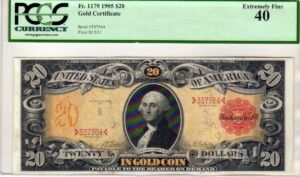
There is a moment every experienced collector dreads: you are holding a note that looks pristine, the paper seems crisp, the colors appear vibrant, and the corners look sharp enough to cut paper. Then you tilt it under a raking light and the truth reveals itself in a lattice of compressed fiber lines running like a ghost map across the face of the bill. You are looking at a pressed note, and what appeared to be a Gem Uncirculated 65 is almost certainly a Very Fine 25 in disguise. Artificial pressing is among the most common and consequential forms of note manipulation in paper money collecting, and understanding it thoroughly is not optional for anyone who wants to protect their investment.
A Brief History of the Problem
Pressing is not a modern invention. Reports of manipulated currency appearing at auction date at least to the 1930s, when the organized collector market for United States paper money was beginning to solidify. Early dealers such as Tom Bain and Amon Carter Sr. documented suspiciously flat examples of Lazy Deuce $2 United States Notes (Fr. 41 through Fr. 51) and National Bank Notes circulating among collectors at inflated prices. By the 1970s, when the paper money hobby exploded in popularity following the first comprehensive Friedberg catalog revisions, pressing had become systematic enough that the Numismatic News began running cautionary columns about it.
The real escalation came in the 1980s and 1990s, when Large Size note prices began climbing steeply. A Series 1901 $10 Bison Note in Fine-12 might sell for $800, while the same note in Choice Uncirculated-63 could command $18,000 or more. That spread made pressing economically worthwhile for unscrupulous sellers, and the techniques grew more sophisticated in response to a more educated buyer base.
How Pressing Is Actually Done
Understanding the methods helps collectors recognize the residual evidence. The three most common techniques are dry pressing, moisture pressing, and heat pressing, and each leaves its own forensic fingerprint.
Dry Pressing
The simplest method involves placing the note between sheets of heavy acid-free blotter paper or even standard office paper, then applying sustained pressure with a heavy book, a hydraulic press, or even a specially constructed plate vise. Dry pressing removes some of the visual evidence of folds but cannot fully eliminate the cellular damage to the cotton-linen fiber matrix. The fold lines remain visible under raking light because the compressed fibers refract light differently than undisturbed paper. Dry pressing also tends to flatten the intaglio printing relief that is one of the surest signs of a genuine uncirculated note.
Moisture Pressing
A more sophisticated approach involves lightly humidifying the note, sometimes by placing it in a sealed container with a damp sponge for several hours, before pressing. The moisture relaxes the fibers and allows them to be repositioned more convincingly. The result can fool the naked eye almost completely. However, moisture pressing often introduces subtle rippling at the margins where drying was uneven, and in high-magnification examination it tends to show what conservators call fiber displacement, where the individual paper strands have been pushed laterally rather than lying in their original formation.
Heat Pressing
Using a dry iron or a heated plate, some manipulators apply heat along with pressure. Heat pressing is the most destructive method and paradoxically the easiest to detect under ultraviolet light. The heat can slightly alter the fluorescence characteristics of the paper and can caramelize trace amounts of organic material in the fiber, creating faint brownish discoloration visible under UV at 365 nanometers. It also has a tendency to soften the ink slightly, which can cause minor smearing detectable under 10x magnification.
Invest in a high-quality loupe with at least 10x magnification and a strong single-LED raking light source. Hold the note at a nearly flat angle to the light beam and rotate it 360 degrees. Genuine fold lines almost always appear as bright reflective lines running across the entire note, while pressed folds may appear as faint ridges or valleys. This single technique will catch the majority of pressed notes before purchase.
The Physical Evidence Pressed Notes Leave Behind
Even the best pressing job leaves traces. Knowing exactly what to look for transforms a casual inspection into a rigorous forensic examination.
Loss of Intaglio Relief
Federal Reserve Notes, United States Notes, Silver Certificates, and virtually all U.S. currency produced through the Bureau of Engraving and Printing use intaglio printing for at least the primary face design. The ink is physically raised above the paper surface, sometimes by as much as 0.001 inches on a fresh uncirculated note. Run your fingertip lightly across the portrait on a genuine uncirculated note and you will feel a distinct texture, almost like fine sandpaper. A pressed note that began life in circulation will have had that relief partially or fully compressed. The portrait area, the numerals, and the fine line work in the border will feel noticeably flatter than a genuine CU example, even when the note appears visually crisp.
Compressed Corner Fibers
The corners of a circulated note that has been folded accumulate damage at the fold intersections. Pressing flattens the corner but cannot restore the individual fibers that were broken or displaced. Under 10x magnification, look at the corner tips. On a genuine uncirculated note, the fibers at the corners run cleanly to the point with no disruption. On a pressed note, even one that appears to have sharp corners, the fiber ends at the tip will show a slightly fuzzy, irregular, or compressed texture. This is sometimes called corner fuzz by dealers, and it is a reliable indicator of prior handling.
Ghost Fold Lines
This is the classic telltale sign discussed in every advanced grading guide. Hold the note so that a strong light source strikes it at an angle of roughly 10 to 15 degrees from the surface plane. Genuine fold lines, even when pressed, create a discontinuity in the fiber that reflects light differently from the surrounding paper. On a circulated note pressed to appear uncirculated, you will typically see anywhere from two to six linear reflective traces crossing the note, often in a pattern corresponding to how the note was carried: a horizontal center fold from wallet storage, two vertical quarter folds, and sometimes a diagonal from pocket carry.
Ink Cracking
Older notes, particularly Large Size notes printed before 1929, used ink formulations that were more susceptible to cracking when the paper was repeatedly folded and then pressed flat. Examine the serial numbers, the Treasury seal, and any red or blue overprints (such as the red seal on Legal Tender issues or the blue seal on Silver Certificates) under magnification. On a genuine circulated note that has been pressed, the ink at fold intersections will often show hairline cracks running perpendicular to the fold direction. These micro-cracks are essentially impossible to disguise or repair.
When examining Large Size Gold Certificates from the 1882 and 1907 series, pay special attention to the orange-gold ink used in the back design. This particular ink formulation is exceptionally brittle and shows fold-induced cracking even on lightly circulated notes. If a high-denomination 1882 Gold Certificate in a raw holder shows no ink cracking whatsoever under magnification, treat that as a red flag worthy of additional scrutiny rather than a green light.
Which Notes Are Most Frequently Targeted
Pressing is an economically motivated crime, and the targets reflect the price spreads in the catalog. The notes where the grade jump from VF to CU represents the greatest dollar differential are the ones most frequently manipulated.
Large Size United States Notes (Legal Tenders) from the 1862 through 1923 series are common targets, particularly the $5 and $10 denominations with their iconic designs. The Fr. 60 through Fr. 67 series of $5 Legal Tenders and the Fr. 95 through Fr. 122 $10 Legal Tenders command premiums of 500 to 1,000 percent in uncirculated grades versus Fine, making them extremely worthwhile targets. The 1901 $10 Bison Note (Fr. 114 through Fr. 120) is probably the single most frequently pressed Large Size note in the hobby, given its combination of desirability, high catalog value in CU, and relatively common survival in circulated grades.
National Bank Notes from small-town banks with low print runs are another major category. A $5 1882 Brown Back from a bank that issued only a few hundred notes might grade out at $600 in VF and $4,500 in Uncirculated-63, a spread that makes pressing financially attractive to bad actors.
Among small-size notes, the 1928 and 1928-A series Federal Reserve Notes in $500 and $1,000 denominations are popular targets, as are the rare star note varieties of common series where the star print runs were extremely limited. The 1928-A $5 Federal Reserve Note star notes from certain districts, for example, had print runs of fewer than 300,000 notes, and genuine uncirculated examples are worth multiples of circulated grades.
The Grading Services and Pressed Notes
Both major third-party grading services for paper money, PMG (Paper Money Guaranty) and PCGS Currency, have explicit policies regarding artificially altered notes. A note identified as pressed will either receive a “Details” grade with a notation of “Artificially Cleaned or Pressed” or will be returned ungraded in what collectors call a body bag, an opaque holder that returns the note without a numerical grade and with an explanation of the problem.
A PMG or PCGS Currency Details grade for pressing is not just an inconvenience. It is a permanent, public record that the note has been altered, and it dramatically impacts resale value. A 1923 $1 Silver Certificate (Fr. 237) that might sell for $425 in a PMG 40 Extremely Fine holder could bring only $90 to $150 in a Details holder citing pressing, even if the visual appearance is nearly identical to the genuine EF example. The market discount for a Details grade on pressed notes typically runs between 50 and 85 percent of the equivalent clean grade value.
It is worth noting that both services have become significantly more sophisticated in detecting pressing over the past decade. The use of high-resolution scanning, UV fluorescence analysis, and proprietary fiber mapping techniques has made it increasingly difficult to successfully submit a pressed note and receive a numerical grade. However, the volume of raw (ungraded) pressed notes in the secondary market, on platforms like eBay, at smaller regional currency shows, and in estate lots, remains substantial.
Before purchasing any raw high-value note, price in the cost of third-party grading into your acquisition budget. For notes worth over $300 in the grade being offered, the approximately $30 to $65 grading fee at PMG or PCGS Currency is a trivially small insurance premium against buying a pressed note at full uncirculated prices. For notes worth over $1,000, it is essentially mandatory due diligence.
Beyond Pressing: Related Alterations to Know
Pressing rarely travels alone. Experienced manipulators often combine pressing with other alterations to maximize the deception. Chemical washing, which involves treating a note with dilute solvents to remove surface dirt and restore some ink brightness, is frequently paired with pressing. The two treatments together can transform a Fine-15 note into something that superficially resembles an Extremely Fine-40 or even an AU-55 to the untrained eye.
Trimming is another companion alteration, where a note with damaged or uneven margins is trimmed with a straight-edge cutter to simulate original BEP cutting margins. Trimmed notes are slightly smaller than specification and can be identified by measuring against published BEP size standards: a standard small-size note should measure approximately 6.14 inches by 2.61 inches. Any note measuring more than 0.06 inches smaller in either dimension warrants serious scrutiny.
| Note / Series | Friedberg Number | VF-30 Value (Raw) | CU-63 Value (Graded) | Press Risk |
|---|---|---|---|---|
| 1901 $10 Bison (Large Size) | Fr. 114-120 | $1,800 | $18,000+ | Very High |
| 1882 $100 Gold Certificate | Fr. 1214-1218 | $4,000 | $28,000+ | Very High |
| 1923 $1 Silver Certificate | Fr. 237 | $140 | $425 | Moderate |
| 1928-A $5 FRN Star Notes | Fr. 1952-A* | $325 | $2,800+ | High |
| 1882 Brown Back $5 Nationals | Fr. 467-478 | $550 | $4,500+ | High |
| 1896 $1 Educational Silver Cert. | Fr. 224-225 | $900 | $6,500+ | High |
| 1928 $500 FRN | Fr. 2200 | $1,800 | $9,500+ | High |
| 1917 $1 Legal Tender | Fr. 36-39 | $85 | $550 | Low-Moderate |
| 1886 $5 Silver Certificate (Morgan) | Fr. 259-265 | $1,100 | $11,000+ | Very High |
| 1934-A $1,000 FRN | Fr. 2212 | $2,200 | $14,000+ | High |
Building a Detection Routine That Protects You
The best defense against pressed notes is a consistent, systematic examination routine applied before every significant purchase. Start by examining the note under normal diffuse light to assess overall appearance and color. Then move to raking light examination at a low angle, rotating the note to check all orientations. Follow with a tactile examination using clean, dry fingertips to assess intaglio relief on the portrait and numerals. Examine the corners under 10x magnification for fiber condition. Finish with a UV lamp examination at 365 nanometers to check for fluorescence anomalies and any evidence of chemical treatment.
For any note where your examination raises questions, do not allow time pressure or social pressure from a seller to rush your decision. A legitimate dealer will always allow a prospective buyer sufficient time to examine a note properly. Reluctance to allow examination, insistence on quick decisions, or hostility toward requests for grading should all be treated as disqualifying red flags.
Keep records of notes you examine that show evidence of pressing. Photographing them under raking light creates a useful personal reference library that sharpens your detection skills over time. Many advanced collectors maintain image files of known pressed notes they have examined at shows, not to embarrass dealers but to train their own eye to recognize the subtle signs more quickly.
Conclusion: Knowledge Protects Your Collection
Artificial pressing is not a peripheral concern for a small number of high-end collectors. It is a pervasive issue that touches every corner of the United States paper money hobby, from modestly priced obsolete notes to six-figure Large Size rarities. The financial stakes are real: collectors who lack the knowledge to detect pressing routinely overpay by hundreds or thousands of dollars for notes that will never achieve the grades their appearance suggests.
The good news is that pressing is detectable. Unlike some forms of counterfeiting that require laboratory analysis, pressed notes almost always reveal themselves to a collector equipped with the right tools, the right lighting, and a practiced eye. Invest the time in developing your detection skills now, before a significant purchase tests them under pressure. Your collection, and your wallet, will be better for it.