A pristine 1880 $1,000 Legal Tender note in PMG 64 Choice Uncirculated can fetch north of $150,000 at auction. The same note with a hidden repair, a pressed fold, or a chemically treated stain might grade PMG 25 Net, with a “restoration” notation, and sell for a third of that. The stakes are enormous, and yet the terminology collectors encounter, conservation, cleaning, restoration, pressing, is often used interchangeably and incorrectly. That confusion costs money. This guide sets the record straight.
Defining the Terms: Conservation, Restoration, and Cleaning
The paper money hobby borrows language from the worlds of fine art and archival science, but collectors often misapply these words. Let us establish precise definitions as the grading services themselves use them.
Conservation refers to stabilization and preservation treatments applied to halt further deterioration without fundamentally altering a note’s appearance or structure. Think of it as defensive care. Examples include removing a damaging acidic mount from the back of a note, humidifying a tightly folded piece before very gently flattening it to prevent further fiber damage, or applying a micro-crystalline wax barrier to protect fragile ink. The goal is to preserve what is there, not to improve or disguise. PMG’s published standards explicitly note that conservation that is “non-deceptive and disclosed” is acceptable within their grading framework.
Restoration, by contrast, involves active efforts to improve the apparent condition of a note beyond its actual state. Filling in holes with paper pulp, reattaching torn corners with period paper, reinking faded serial numbers or Treasury seals, chemically whitening yellowed paper, and pressing out folds with a heated iron all fall into the restoration category. These techniques may make a note look better to the naked eye, but they misrepresent its true condition. Both PMG and PCGS Currency flag restored notes with qualifier language and will not assign a straight numerical grade.
Cleaning occupies a middle ground that depends heavily on method and intent. Removing loose surface dirt with a very soft brush is generally considered benign. Washing a note in water or solvents to brighten the paper, however, is classified as cleaning and will earn a qualifier. The key question both services ask is: does this treatment deceive? If yes, it is not acceptable.
Before purchasing any pre-owned raw note priced above $500, view it under a handheld 365nm UV light in a darkened room. Repairs, fills, and chemical washes typically fluoresce differently than the surrounding paper, revealing themselves as bright patches, dark voids, or uneven glow patterns invisible in normal light.
What PMG Accepts and What It Flags
Paper Money Guaranty, founded in 2005 and now operating as part of the Certified Collectibles Group, has published relatively detailed standards on this topic. PMG grades notes on a 70-point Sheldon-derived scale and uses several qualifier designations that collectors must understand.
PMG will assign a straight grade (e.g., PMG 30 Very Fine) to a note that has undergone acceptable conservation. According to PMG, acceptable conservation includes: humidification and gentle flattening to relieve stress creases that could cause further tearing, removal of rubber cement or pressure-sensitive tape residue using appropriate solvents (where the underlying paper is undamaged), and stabilization of fragile edges with archival tissue on the reverse where no paper has been added to the face. These treatments are disclosed on the certification label when relevant.
PMG flags and assigns net grades or “details” notations for: chemical washing or bleaching of paper fibers, pressing with heat to simulate an uncirculated surface, filled pinholes or tears using paper pulp or tissue added to the face, reapplied or re-inked seals and serial numbers, and reattached or replaced corners. PMG’s qualifier label reads “Restored” as a catch-all for these issues, though specific notation (e.g., “repaired,” “stain removed”) is often added.
A real-world example underscores the stakes: a 1901 $10 Legal Tender Bison note (Fr. 122) in genuine Very Fine condition trades around $3,500 to $5,000. The same note with a PMG “Repaired” notation in the same apparent grade typically realizes $800 to $1,500 at major auctions. The repair penalty on classic large-size type notes is severe precisely because advanced collectors know the population reports and can spot artificially clean examples immediately.
Always cross-reference a PMG or PCGS Census population report when evaluating a high-grade slabbed note. If a particular series shows a sudden cluster of high-grade examples appearing in census data around the same time, it may indicate that a restored hoard entered the market, which can depress values across the grade range for that series.
What PCGS Currency Accepts and What It Flags
PCGS Currency, established in 2005 by the Professional Coin Grading Service, uses a comparable framework but with slightly different label language. PCGS Currency grades on the same 70-point scale and applies the designation “Apparent” to notes that show evidence of post-issue alteration. An Apparent grade is listed as, for example, “PCGS 30 Apparent Very Fine” with a note describing the issue.
PCGS Currency will straight-grade a note that has received conservative archival stabilization, provided the treatment has not altered the note’s natural appearance or structure. Their guidelines particularly note that the removal of mounting hinges and adhesive strips, common on older collection notes especially those assembled before the 1970s, is acceptable when done without damaging the underlying paper.
PCGS Currency flags: chemical brightening, pressed folds, sewn tears (a technique sometimes seen on large-size notes that passed through circulation and were repaired by hand), and the use of inpainting to disguise faded areas. One notable category unique to PCGS Currency’s labeling is “trimmed,” applied when a note’s margins have been cut to simulate a better-centered specimen. This practice occasionally surfaces with Series 1928 small-size Federal Reserve Notes, where off-center printings are common and collectors sometimes encounter notes with suspiciously clean, square margins.
How to Examine a Note for Conservation or Restoration Yourself
Developing an eye for treated notes is a skill that pays dividends across an entire collecting career. Here is a systematic approach that experienced dealers use when examining raw material.
Step 1: Raking Light Examination
Hold the note at a very low angle under a single directional light source, a desk lamp works well, and look across the surface. Pressed folds will often show as subtle ridges or valleys even after ironing, because the paper fibers are compressed on one side and stressed on the other. Filled areas appear slightly raised or have a matte texture inconsistent with the surrounding paper surface. Inked serial numbers or seals show as slightly raised ink deposits that lack the crispness of original intaglio printing.
Step 2: UV Fluorescence
Under a 365nm UV lamp, original pre-1950 US currency paper typically shows a dull, even glow because it contains no optical brighteners. Chemically washed areas often glow noticeably brighter due to brightener residue. Filled areas frequently appear as dark, non-fluorescent patches because the added material does not match the original paper’s composition. Tape repairs, even after the tape itself is removed, leave a fluorescent ghost from adhesive residue.
Step 3: Transmitted Light
Hold the note up to a strong light source and look through it. Filled pinholes and tears become visible as areas of greater opacity or irregular texture. Genuine watermarks in older paper appear as consistent, intended patterns. Thickness inconsistencies from layered repairs show as shadow zones.
Step 4: Feel and Paper Texture
Genuine circulated currency develops a characteristic soft limpness from handling. A note that shows wear under examination but feels stiff or crinkle-free has almost certainly been pressed. Notes that have been washed sometimes feel slightly stiff or have a “slick” surface texture, particularly on Federal Reserve Notes from the 1950s through 1970s where the paper composition is well documented.
For large-size notes from the National Bank Note and Legal Tender series (1861 to 1929), pay particular attention to corner tips under UV light. Replaced corners are one of the most common and economically motivated repairs on these issues, since a note with four intact corners commands a significant premium over one with a missing tip.
Common Problem Types by Series and Era
Certain series are more frequently encountered with restoration issues due to their age, collector demand, or the nature of their circulation history.
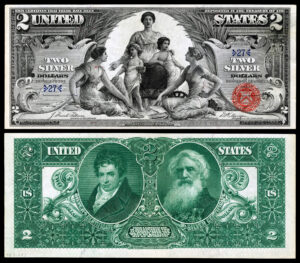
Large-Size Legal Tender and Silver Certificate Notes (1862 to 1923): Pressed folds and corner repairs are the most common issues. The 1896 Educational Series Silver Certificates (Fr. 247 for the $1, Fr. 248 for the $2, Fr. 249 for the $5) are particularly targeted because of their extraordinary engraved artwork and the premium attached to high-grade examples. A PMG 64 Choice Uncirculated $1 Educational Certificate can exceed $25,000, creating powerful financial incentives for restoration.
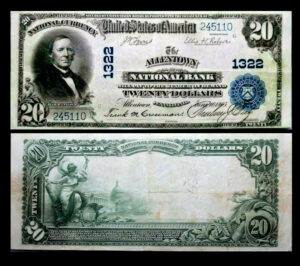
National Bank Notes (1863 to 1935): Notes from small-town banks with tiny print runs are often found with tape repairs, as they circulated heavily and were sometimes repaired by bank staff or local residents. The Fr. 380-equivalent Territorial National Bank Notes from states like Arizona, New Mexico, and Hawaii prior to statehood are especially vulnerable to this problem.
Series 1928 and 1934 Small-Size Federal Reserve Notes: Chemical washing is more common in this era because the paper is more uniform and easier to treat. High-denomination examples, $500 and $1,000 notes from the 1928 series especially, are sometimes encountered with brightened paper that masks genuine wear.
Confederate Currency and Obsolete Notes: While outside the federal scope, these are important for context: restoration is rampant in Confederate issues and collectors crossing between markets should be especially cautious.
| Series / Issue | Denomination / Variety | Straight Grade Value (VF) | Restoration Risk |
|---|---|---|---|
| 1896 Educational Silver Cert. (Fr. 247) | $1, Tillman-Morgan | $3,500 to $6,000 | Very High |
| 1901 Legal Tender Bison (Fr. 122) | $10, Lyons-Roberts | $3,000 to $5,500 | Very High |
| 1880 Legal Tender (Fr. 346) | $1,000, Large Red Seal | $40,000+ | Very High |
| 1928 Federal Reserve Note (Fr. 2200-G) | $500, Chicago | $5,000 to $8,500 | High |
| 1922 Gold Certificate (Fr. 1200) | $1,000, Large Size | $15,000 to $25,000 | High |
| 1863-1875 National Bank Notes (Territorial) | Various, First Charter | $8,000 to $50,000+ | High |
| 1869 Rainbow Legal Tender (Fr. 27) | $1, Allison-Spinner | $2,500 to $4,000 | Moderate |
| 1886 Silver Certificate (Fr. 259) | $5, Rosecrans-Jordan | $2,000 to $3,500 | Moderate |
| 1934 Federal Reserve Note (Fr. 2202-A) | $1,000, Boston | $4,500 to $7,000 | Moderate |
| Series 1935A Hawaii Emergency (Fr. 2300) | $1, WWII Overprint | $200 to $400 | Lower Risk |
The Debate Over Pressing: Where the Line Gets Blurry
No topic in paper money conservation generates more debate than pressing. Numismatic pressing, the use of controlled humidity and weight to reduce the visibility of folds in a circulated note, occupies a genuine gray zone. PMG and PCGS Currency both consider aggressive pressing that materially changes the apparent grade of a note to be a form of restoration. But gentle humidification and flattening to prevent further tearing of a very fragile note is generally considered acceptable conservation.
The practical test that both services appear to apply is whether the pressing deceives. A note that folds were removed from to the extent that it now appears to grade Extremely Fine when it is actually Very Fine has been deceptively pressed. A note that was gently humidified to relieve a stress crease that was causing ongoing fiber damage, without meaningfully affecting its grade, has been conserved.
For collectors, the safest approach is to submit notes to a reputable professional conservator affiliated with the American Institute for Conservation (AIC) before any grading submission, and to disclose the treatment to the grading service. Both PMG and PCGS Currency offer conservation referral services through their parent organizations, and using these channels ensures treatments are documented and non-deceptive.
If you acquire a raw note that you suspect has been pressed or washed, do not immediately submit it to a grading service. Instead, consult with a dealer who specializes in that specific series first. Experienced specialists in large-size type notes or National Bank Notes can often identify treatments that even TPG graders occasionally miss, and their guidance can help you decide whether submission is worthwhile or likely to result in a damaging details notation.
Buying and Selling Around the Details Grade
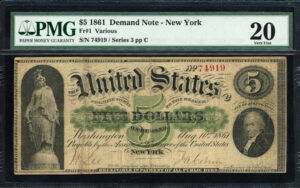
Collectors sometimes ask whether details-graded notes are worth buying at all. The honest answer is: it depends entirely on the note and the price. For extreme rarities where straight-graded examples are nearly unobtainable, a conserved or even restored note may represent the only practical way to own a piece of important currency history. A restored example of the Fr. 1 Demand Note from 1861, one of the first notes ever issued by the United States federal government, might be the only version a collector ever encounters in a lifetime of searching.
For common type notes where straight-graded examples are readily available, however, there is little reason to accept a details grade. The discount rarely compensates for the liquidity premium lost when reselling, and buyers at auction are sophisticated enough to heavily discount details-graded material in competitive series.
When selling a details note, full and proactive disclosure is both ethical and practical. Experienced buyers in this hobby, whether at Heritage Auctions, Stack’s Bowers, or through major dealer networks, will identify any alteration. Attempting to pass a restored note as straight-graded damages reputation irreparably in what is ultimately a small community of specialists.
Conclusion: Knowledge Is the Best Protection
The line between conservation and restoration is not always perfectly bright, but it is navigable. The grading services have established workable standards that protect collectors who do their homework. Knowing how to examine notes under varied lighting conditions, understanding which series carry the highest restoration risk, and developing relationships with knowledgeable specialists in specific areas are the skills that separate collectors who build sound, valuable collections from those who accumulate expensive disappointments.
Paper money collecting rewards the patient and the educated. A genuine, straight-graded note in modest condition will almost always outperform a problem note that appears better than it is. Buy the note, not the story and when you are not certain, buy the holder.