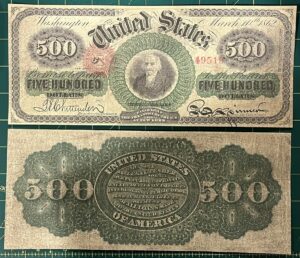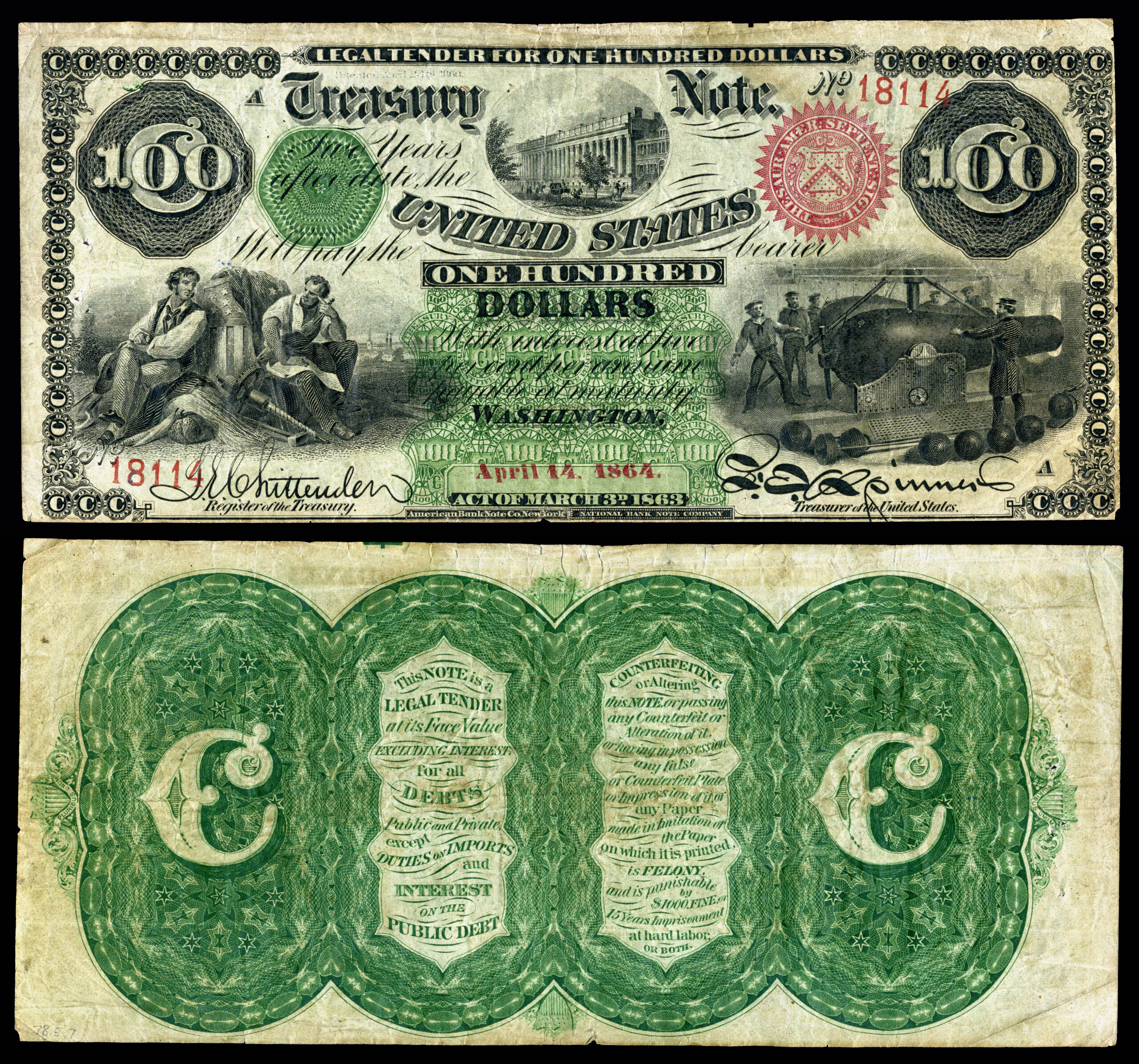
📷 Image source: Wikimedia Commons. Images are selected by AI to represent the article topic and may not depict the exact note(s) described.
Most currency collectors know the name Salmon P. Chase. His portrait graced the $1 Legal Tender Note, his signature appears on foundational Civil War issues, and his ambitions shaped the National Banking System. But when Chase submitted his resignation to Abraham Lincoln on June 29, 1864, and Lincoln surprisingly accepted it, a quieter, less celebrated figure stepped into one of the most demanding financial offices in American history. William Pitt Fessenden served as Secretary of the Treasury for barely eight months, from July 5, 1864, to March 3, 1865, yet his tenure produced reforms whose fingerprints are visible on the paper money of the era. For collectors of Compound Interest Treasury Notes, Interest-Bearing Notes, and the transitional Legal Tender issues of 1864 and 1865, Fessenden is a name worth knowing.
The Crisis Fessenden Inherited
To appreciate what Fessenden accomplished, you need to understand the financial catastrophe he walked into. By the summer of 1864, the Union war effort had consumed staggering sums. The greenback dollar, the Legal Tender Note introduced under the Legal Tender Acts of 1862 and 1863, had depreciated sharply against gold. In late June 1864, it took roughly $2.50 in paper greenbacks to purchase one gold dollar. Inflation was rampant. The Treasury had already authorized three series of demand obligations bearing interest, attempting to keep notes circulating rather than being hoarded or redeemed, but confidence was fragile.
Chase had built the system but had also made enemies in Congress and ultimately lost Lincoln’s confidence through repeated threats of resignation. When Lincoln finally accepted one of those threats, he turned to Fessenden, the chairman of the Senate Finance Committee, a man respected precisely because he was not a self-promoter. Fessenden initially refused the appointment. He was in poor health, he understood the position’s difficulties better than almost anyone, and he had no desire for executive office. Lincoln pressed. The Senate confirmed Fessenden the same day he was nominated, July 1, 1864, a rare demonstration of congressional confidence. He relented and took office four days later.
The Act of June 30, 1864, and Its Currency Implications
Fessenden arrived at the Treasury with a significant piece of legislation already on the books. The Act of June 30, 1864, passed during Chase’s final days, authorized critical changes to the government’s borrowing and currency-issuing apparatus. Fessenden’s role was to implement, refine, and expand these measures with a steady hand. The Act authorized the issuance of Compound Interest Treasury Notes in denominations of $10, $20, $50, $100, $500, and $1,000. These notes, bearing interest at six percent compounded semi-annually over three years, were among the most ingeniously designed obligations the United States government ever produced.
The Compound Interest Treasury Notes issued under Fessenden’s oversight carry the Series of 1864 designation. They are today cataloged in the Standard Catalog of United States Paper Money and Friedberg’s Paper Money of the United States primarily under Fr. 190 through Fr. 202, depending on denomination and variety. The $10 note (Fr. 190-190e) features a vignette of salmon-colored or gold-orange overprints showing the compounding interest due at six-month intervals on the reverse, a table running from six months through three years. The $10 example in Fine-12 condition typically trades in the $1,500 to $2,500 range at auction today, while a Choice Uncirculated example of the same note has brought over $20,000.
When examining Compound Interest Treasury Notes from the 1864 series, pay close attention to the interest table printed on the reverse. Notes that circulated heavily often show wear concentrated at fold lines through this printed table, which can drop an otherwise near-fine note to a Very Good grade. Centering and the vibrancy of the orange overprint are critical to premium value.
Fessenden’s Administrative Reforms at the Bureau of Engraving and Printing
One of Fessenden’s less celebrated but numismatically significant contributions was pushing for greater systematization at the note-production operation within the Treasury building. In 1864, currency printing was still transitioning toward what would become the Bureau of Engraving and Printing, formally organized in 1877, but the in-house operation was expanding rapidly. Fessenden supported increased staffing and advocated for tighter controls over serial numbering and plate accounting, concerns that directly affected the consistency of notes produced during his tenure.
The result is visible in the printing records. Notes produced in the second half of 1864 show more disciplined serial number sequencing compared to some of the more chaotic runs of 1862 and early 1863, when the demands of war printing occasionally overwhelmed administrative controls. Collectors who specialize in serial number research will find that the high-serial runs on 1864-dated Legal Tender Notes, particularly the $1 Legal Tender issues (Fr. 16 through Fr. 17) and $2 Legal Tender issues (Fr. 41 through Fr. 42), reflect production surges authorized under Fessenden’s management of Treasury printing contracts.
The 1864 Interest-Bearing Notes: A Collector’s Deep Dive
Alongside the Compound Interest Treasury Notes, Fessenden’s Treasury continued issuing Interest-Bearing Notes under the Act of March 3, 1863. These came in denominations of $10, $20, $50, $100, $500, and $1,000, bearing interest at five percent in one-year and two-year forms, and six percent in other authorized forms. The three-year five-percent notes issued in 1864 are particularly significant to collectors because they represent some of the highest-denomination paper obligations that saw any meaningful circulation during the Civil War period.
The $500 and $1,000 Interest-Bearing Notes from this era (Fr. 210e and Fr. 212) are genuine rarities. The $1,000 five-percent note is one of the most valuable pieces of American paper money a collector can encounter, with fewer than a dozen examples confirmed across all major collections. A VF example sold at a Stack’s Bowers auction in 2019 for over $300,000. Even the $50 three-year five-percent note (Fr. 203) in Good condition commands $8,000 to $12,000 from specialized collectors.
Interest-Bearing Notes from the 1863 and 1864 series were intended to be redeemed rather than circulated indefinitely, so the vast majority were turned in and destroyed. Notes that survived did so largely by accident, often in estate collections or institutional archives. When you encounter one, always seek third-party grading (PCGS or PMG) and a detailed provenance search before purchasing, as alterations and counterfeits targeting high-value Civil War notes are documented.
Signature Combinations: Identifying Fessenden-Era Notes
Here is where the numismatic record becomes technically interesting for collectors who study signature combinations. The Secretary of the Treasury did not personally sign currency during this period. Notes bore the signature of the Register of the Treasury and the Treasurer of the United States. Francis E. Spinner served as Treasurer continuously from 1861 through 1875, his distinctive, nearly illegible signature appearing on notes across multiple administrations. The Register during Fessenden’s tenure was Lucius E. Chittenden through August 1864, succeeded by S. B. Colby, who served from 1864 through 1867.
This means that notes bearing the Colby-Spinner signature combination, which collectors encounter on the 1864 and 1865 Legal Tender series, were first authorized for production during Fessenden’s stewardship. The Colby-Spinner pairing appears on Fr. 16 ($1 Legal Tender, 1862-1863 series but carrying over into 1864 production), Fr. 41-42 ($2 Legal Tender), and notably on the transitional $5 Legal Tender Notes (Fr. 64-65). Understanding this signature timeline allows collectors to place a note chronologically within the administrative history of the Lincoln Treasury with reasonable precision.
The Gold Crisis of 1864 and Its Impact on Currency Policy
No discussion of Fessenden’s currency reforms is complete without acknowledging the Gold Room crisis of June and July 1864. Gold speculation in New York had driven the premium on gold to extraordinary heights, reaching 285 on July 11, 1864, meaning $285 in greenbacks was required to purchase $100 in gold coin. This was the worst depreciation the greenback ever suffered. Congress had passed the Gold Room Act of June 21, 1864, attempting to suppress speculation by prohibiting certain gold contracts. The law backfired spectacularly, worsening confidence, and was repealed within two weeks.
Fessenden, who took office as this crisis reached its peak, immediately worked to restore market confidence through a combination of bond sales, careful management of greenback issuance, and coordination with New York financial houses. His steady, non-theatrical approach worked. By late August 1864, the gold premium had receded to around 190, and by the end of the year it had stabilized further. For collectors, this economic context explains why some 1864 note printings show evidence of haste, with slightly irregular plate alignments or ink inconsistencies, as the Treasury printing operation was under intense pressure to produce obligations that could support borrowing even as confidence wavered.
Notes from the July to September 1864 production window can sometimes be identified by minor printing irregularities reflecting the pressure-production environment. While these are not errors in the collectible sense, they can be points of historical interest for Civil War currency specialists. Serial numbers on $1 and $2 Legal Tender Notes from this period often fall in the high-end ranges of known plate runs, and cross-referencing with the Friedberg variety listings can help narrow production dates.
Fessenden’s Departure and the Currency He Left Behind
Fessenden resigned from the Treasury on March 3, 1865, returning to the Senate in time to play a prominent role in Reconstruction debates. He is perhaps best remembered historically for voting against the conviction of Andrew Johnson during the impeachment trial of 1868, a politically courageous act. But for currency historians, his legacy is the stabilized, better-administered note-production system he handed to his successor, Hugh McCulloch, and the specific series of Compound Interest Treasury Notes and Interest-Bearing Notes that bear the administrative DNA of his eight months in office.
McCulloch would go on to pursue a contraction policy, actually reducing the volume of greenbacks in circulation, a policy that created its own collecting implications. But the foundation of systematized currency management that made contraction even administratively possible owed a genuine debt to Fessenden’s organizational work in the second half of 1864.
| Friedberg No. | Description | Approx. Known Examples | Rarity |
|---|---|---|---|
| Fr. 190 | $10 Compound Interest Treasury Note, 1864 | 300-500 est. | Scarce |
| Fr. 191 | $20 Compound Interest Treasury Note, 1864 | 200-350 est. | Scarce |
| Fr. 192 | $50 Compound Interest Treasury Note, 1864 | 80-120 est. | Rare |
| Fr. 193 | $100 Compound Interest Treasury Note, 1864 | 50-80 est. | Rare |
| Fr. 203 | $50 Interest-Bearing Note, 3-Year 5%, 1864 | 30-50 est. | Rare |
| Fr. 210e | $500 Interest-Bearing Note, 3-Year 5%, 1864 | Under 15 known | Key Date |
| Fr. 212 | $1,000 Interest-Bearing Note, 3-Year 5%, 1864 | Under 10 known | Key Date |
| Fr. 16 | $1 Legal Tender, Colby-Spinner, 1862-1864 | Thousands surviving | Common |
| Fr. 41 | $2 Legal Tender, Colby-Spinner, 1862-1864 | Hundreds surviving | Scarce |
| Fr. 64 | $5 Legal Tender, Colby-Spinner, 1863-1864 | Hundreds surviving | Scarce |
Building a Fessenden-Era Collection: Practical Advice
For collectors interested in assembling a thematic set focused on the Fessenden period, the most accessible entry point is the Colby-Spinner signature combination on lower-denomination Legal Tender Notes. A presentable circulated example of Fr. 16, the $1 Legal Tender with Colby-Spinner signatures, can be acquired for $150 to $400 in Fine condition, making it genuinely affordable as a historical artifact directly connected to the transitional 1864 Treasury administration.
The Compound Interest Treasury Notes represent the next tier of ambition. The $10 (Fr. 190) in a VG or Fine holder from PMG or PCGS represents a realistic collecting goal for intermediate collectors, typically requiring a budget of $1,800 to $3,500. These notes are visually spectacular, with their distinctive orange overprinted interest tables, and they connect directly to the fiscal mechanics Fessenden was managing in real time.
For advanced collectors with serious budgets, a $50 or $100 Compound Interest note in mid-grade represents a trophy acquisition. Pieces of this caliber appear at major currency auctions two to four times per year. Heritage Auctions, Stack’s Bowers, and Lyn Knight Currency Auctions are the primary venues where fresh examples surface. Monitoring the major auction house archives for realized prices over the past five years gives the best baseline for current market values, which have appreciated steadily as the Civil War sesquicentennial generated renewed collector interest that has not yet fully subsided.
Conclusion: Restoring Fessenden to the Numismatic Conversation
William Pitt Fessenden spent only eight months as Secretary of the Treasury. He accepted the position reluctantly, served through one of the worst gold crises in American financial history, systematized the production of some of the most visually and historically compelling notes ever issued by the United States government, and then quietly returned to the Senate. His name does not appear on a single note in your collection. But the notes that were printed, authorized, and refined during his tenure tell a story of competent, principled financial stewardship at a moment when the Union’s capacity to fund its own survival was genuinely in doubt.
Next time you hold a Compound Interest Treasury Note or an Interest-Bearing Note from 1864, remember that behind the engraved portraits and the careful printing lies the administrative will of a reluctant Treasury Secretary from Maine who steadied the ship when steadiness was everything the republic needed.