📷 Image source: Wikimedia Commons. Images are selected by AI to represent the article topic and may not depict the exact note(s) described.
Pull a worn Series 1974 dollar from your change jar and you might see nothing special. Flip it over, check that serial number, and if it ends with a star symbol, you have stepped into one of the more nuanced corners of small-size Federal Reserve Note collecting. The Series 1974 $1 FRN was printed during a transitional period in Bureau of Engraving and Printing output, and the star replacement notes produced for each of the twelve Federal Reserve districts vary wildly in survival rates, print quantities, and collector demand. Some districts issued star notes in the millions; others produced runs so modest that finding a choice example in today’s market requires patience and a little luck.
Setting the Stage: The Series 1974 Dollar in Context
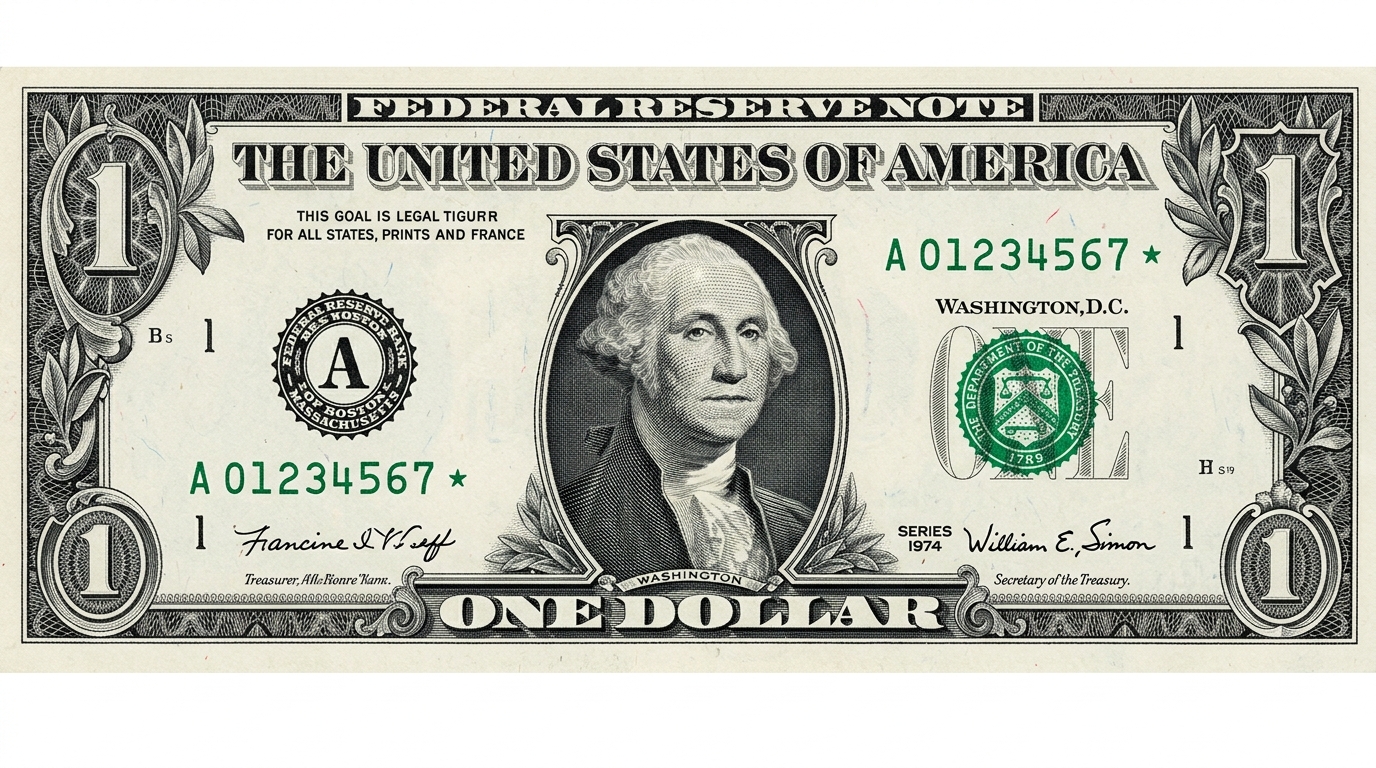
The Series 1974 $1 Federal Reserve Note carries the signatures of Treasurer Francine Irving Neff and Secretary of the Treasury William E. Simon. Neff was appointed Treasurer in June 1974, replacing Dorothy Andrews Elston Kabis, and Simon had been in place since May 1974 following William Shultz’s departure. This signature pairing is the only combination found on Series 1974 notes, making variety attribution on this series relatively straightforward compared to some earlier issues where multiple signature combinations exist within a single series designation.
All Series 1974 $1 notes were printed exclusively at the Bureau of Engraving and Printing’s Washington, D.C. facility. The Fort Worth satellite facility, which opened in 1991, had not yet come into existence, so collectors do not need to worry about distinguishing between production sites on this series. Plate numbers appear in the lower right quadrant of the face, and the Federal Reserve district letter and number appear in the seal to the left of the portrait and repeated in the four corner quadrants.
Star notes for this series were printed as replacements for notes that were damaged or found defective during the manufacturing process. The BEP used star serial numbers, where an asterisk replaces the suffix letter, to keep accurate accounting of the total notes delivered to each Federal Reserve Bank. Understanding which districts received large versus small star note deliveries is the heart of this survey.
When examining Series 1974 star notes, always check the serial number block carefully. The prefix letter identifies the district (A through L), and the serial runs within each block are independent between districts. A low serial number within a district star block, such as A00000100*, can carry a premium beyond the standard star note premium.
Understanding the Twelve Federal Reserve Districts
The twelve Federal Reserve Banks each received their own distinct prefix letter: A for Boston, B for New York, C for Philadelphia, D for Cleveland, E for Richmond, F for Atlanta, G for Chicago, H for St. Louis, I for Minneapolis, J for Kansas City, K for Dallas, and L for San Francisco. Each district’s star notes carry that same prefix letter followed by an eight-digit serial number and the distinguishing asterisk suffix.
Production levels for regular issue notes across districts already varied considerably based on the regional economy and currency demand, and those differences were reflected proportionally in star note runs. High-volume districts like New York and Chicago predictably printed more stars; low-volume districts like Minneapolis and Kansas City produced comparatively tiny quantities. The challenge for collectors is that surviving populations do not always mirror original print runs because high-circulation districts also experienced higher attrition.
District-by-District Breakdown
District A: Boston (First Federal Reserve Bank)
Boston star notes for Series 1974 were printed in relatively modest quantities, with documented deliveries in the range of approximately 640,000 notes. This makes Boston one of the more collectible districts in the series without pushing into genuine rarity territory. Examples in circulated grades from Very Fine to Extremely Fine trade regularly, and finding a Crisp Uncirculated specimen requires some searching but is not prohibitively difficult. The Boston district has a loyal regional collector base, which keeps demand steady.
District B: New York (Second Federal Reserve Bank)
New York generated the highest star note print run in the Series 1974 dollar program, consistent with its role as the largest currency-consuming district in the country. Multiple delivery blocks brought total New York star note production to over 12 million notes across the series. Because of this abundance, New York stars are the easiest to find in all grades and typically command only modest premiums over face value in circulated condition. Gem Uncirculated examples remain affordable entry points for collectors new to star note collecting.
District C: Philadelphia (Third Federal Reserve Bank)
Philadelphia star notes occupy a middle tier in the Series 1974 rarity spectrum, with print runs estimated around 1.28 million notes. Choice circulated examples are available at most major currency shows, and CU examples can be found with patience. Philadelphia collectors tend to pursue these notes competitively, so premium grades do attract healthy bidding at auction.
For any Series 1974 star note you plan to add to a collection as a key piece, consider third-party grading through PCGS Currency or PMG. Encapsulated examples provide authentication confidence and make resale significantly easier, particularly for the scarcer districts like Minneapolis and Kansas City where counterfeiting of better-grade notes is a real concern.
District D: Cleveland (Fourth Federal Reserve Bank)
Cleveland produced star notes in quantities similar to Philadelphia, with deliveries in approximately the 1.0 to 1.5 million range. This is a moderately collectible district with no specific varieties that push it into premium territory for Series 1974. Circulated examples are accessible; high-grade CU notes in the MS-65 EPQ or Gem-65 range are modestly challenging to locate.
District E: Richmond (Fifth Federal Reserve Bank)
Richmond is one of the more interesting districts for Series 1974 star note collectors. Delivery records suggest production around 1.92 million notes, placing it solidly in the middle of the pack. Richmond note demand has grown as mid-Atlantic collectors have shown increasing interest in assembling district sets, so pricing has firmed up in recent years for better-grade examples.
District F: Atlanta (Sixth Federal Reserve Bank)
Atlanta generated substantial star note quantities for Series 1974, with deliveries estimated above 3.2 million notes. This makes Atlanta stars relatively common in circulated grades. The district’s notes circulated heavily across the Southeastern United States, so finding pristine uncirculated examples takes more effort than the raw production numbers might suggest.
District G: Chicago (Seventh Federal Reserve Bank)
Chicago star notes are the second most plentiful in this series after New York, reflecting the enormous currency demands of the Midwest’s largest financial center. Production estimates place Chicago stars above 7.6 million notes. For a collector building a complete twelve-district set, Chicago and New York are the easiest checkboxes to fill. The abundance does mean that even high-grade Chicago examples are reasonably priced.
District H: St. Louis (Eighth Federal Reserve Bank)
St. Louis produced star notes in quantities around 640,000 for Series 1974, mirroring Boston in approximate scarcity. The district covers a geographically large but less densely populated area, which kept overall currency demand, and therefore star note replacements, lower than coastal or Great Lakes districts. Finding a St. Louis Series 1974 star note in grades of Very Fine or better is achievable but requires deliberate searching.
District I: Minneapolis (Ninth Federal Reserve Bank)
Minneapolis is arguably the single most challenging district to find in premium grades for Series 1974 star notes. Production ran to approximately 640,000 notes or fewer in some documented delivery runs, and the region’s harsh climate and high circulation rates in agricultural communities meant many of these notes returned to the BEP in poor condition rather than being preserved. Collectors targeting a complete gem set of all twelve districts will find Minneapolis the sticking point. Prices for Minneapolis Series 1974 stars in CU grades have climbed steadily, with auction results in the $75 to $150 range for PMG or PCGS-graded gems not unusual.
District J: Kansas City (Tenth Federal Reserve Bank)
Kansas City rivals Minneapolis for scarcity in this series. Delivery quantities came in at approximately 640,000 or fewer notes, and the agricultural heartland circulation pattern is similar to Minneapolis: high usage, lower preservation rates. A Kansas City Series 1974 star in grades above Extremely Fine is a genuinely scarce item, and a gem uncirculated example certified by a major grading service is a legitimate key to a complete set.
When hunting for scarce districts like Minneapolis (I*) and Kansas City (J*) in Series 1974, do not overlook estate sales, smaller regional auctions, and dealer stock at smaller coin shows. Many dealers who do not specialize in paper money may price these notes based only on grade without factoring in district scarcity, creating genuine bargain opportunities for informed collectors.
District K: Dallas (Eleventh Federal Reserve Bank)
Dallas star notes for Series 1974 were produced in quantities estimated around 1.28 million notes, placing the district in a moderate scarcity tier. Texas has a strong numismatic culture, and Dallas district notes enjoy steady local demand. Circulated examples are available at most paper money shows, and uncirculated examples are findable without extraordinary effort or expense.
District L: San Francisco (Twelfth Federal Reserve Bank)
San Francisco generated star note quantities comparable to Atlanta, with production in the range of 2.56 to 3.2 million notes. The Pacific Coast district’s notes circulated across a broad geographic area including Hawaii and Pacific territories, contributing to moderate attrition. San Francisco stars in circulated grades are common; gem examples are plentiful enough to keep prices reasonable, making them a good starting point for collectors new to the series.
Grading Considerations for Series 1974 Star Notes
Because these notes entered circulation nearly fifty years ago, finding original uncirculated examples requires digging into old bank-wrapped packs that have been held by dealers, collectors, or estate holders. The Series 1974 dollar was printed on the standard 75 percent cotton, 25 percent linen Federal Reserve note paper stock, and the black and green inks are relatively stable. However, folds, edge wear, and corner rounding appear quickly on circulated examples.
For grading purposes, collectors should familiarize themselves with the PMG and PCGS Currency standards as they apply to small-size notes. A note graded PMG 64 Choice Uncirculated may show a single counting fold or a minor corner bend that prevents the full EPQ (Exceptional Paper Quality) designation. Notes graded 65 Gem Uncirculated EPQ represent the most desirable grade tier for registry set collectors and command premiums over non-EPQ 65 examples, sometimes significantly so for scarcer districts.
Circulated examples grading Very Fine 20 to Extremely Fine 40 are the most commonly encountered grades for Series 1974 star notes in dealer stock, and these represent an affordable way to assemble a complete district set without the premium of gem grades. A circulated twelve-district set of Series 1974 $1 star notes can realistically be completed in the $150 to $300 range depending on condition and sourcing.
Assembling a complete twelve-district set of Series 1974 $1 star notes is a rewarding and achievable goal for intermediate collectors. Focus on securing the Minneapolis and Kansas City districts first, in whatever grade you can afford, and fill in the common districts like New York, Chicago, and Atlanta last. Reversing this strategy often leaves collectors spending months hunting the scarce districts while sitting on duplicates of easy ones.
Market Context and Value Ranges
The Series 1974 $1 FRN star note market is active but not overheated. The series predates the era of widely documented BEP delivery records, so some print run figures represent best estimates based on serial number analysis and partial BEP records rather than confirmed production logs. This uncertainty adds a layer of research interest for serious collectors. As more examples are submitted to grading services and population reports accumulate, the relative scarcity of certain districts becomes clearer.
In Very Fine condition, most districts trade in the $3 to $8 range, with Minneapolis and Kansas City fetching $10 to $20 for VF examples. Uncirculated examples of common districts like New York and Chicago can be found for $5 to $15; scarce districts like Minneapolis and Kansas City in certified gem condition have realized $100 and above at major currency auctions.
| District | Federal Reserve Bank | Est. Star Print Run | Rarity |
|---|---|---|---|
| A (Boston) | First, Boston | ~640,000 | Scarce |
| B (New York) | Second, New York | ~12,000,000+ | Common |
| C (Philadelphia) | Third, Philadelphia | ~1,280,000 | Common |
| D (Cleveland) | Fourth, Cleveland | ~1,000,000-1,500,000 | Common |
| E (Richmond) | Fifth, Richmond | ~1,920,000 | Common |
| F (Atlanta) | Sixth, Atlanta | ~3,200,000 | Common |
| G (Chicago) | Seventh, Chicago | ~7,600,000 | Common |
| H (St. Louis) | Eighth, St. Louis | ~640,000 | Scarce |
| I (Minneapolis) | Ninth, Minneapolis | ~640,000 or fewer | Key Date |
| J (Kansas City) | Tenth, Kansas City | ~640,000 or fewer | Key Date |
| K (Dallas) | Eleventh, Dallas | ~1,280,000 | Common |
| L (San Francisco) | Twelfth, San Francisco | ~2,560,000-3,200,000 | Common |
Building a Complete Set: Practical Strategy
A twelve-district complete set of Series 1974 $1 star notes is one of the more satisfying achievable goals in modern Federal Reserve Note collecting. The series is old enough to carry genuine historical interest, scarce enough in certain districts to provide a real challenge, but not so rare that completing the set requires a substantial investment beyond what most serious collectors can manage.
The Friedberg reference number for the standard Series 1974 $1 FRN is Fr. 1908, and star notes are typically catalogued with an asterisk appended to that number in dealer listings and auction catalogs. When purchasing from dealers or at auction, specify the district prefix letter in your inquiry to ensure you are getting the district you need rather than an unspecified example from dealer stock.
Population reports from PMG and PCGS Currency are valuable research tools for this series. Searching the online population reports for “1974” and “$1” with the star note filter engaged will show you how many examples of each district have been certified and in what grades. For Minneapolis and Kansas City in grades of 65 and above, populations remain thin, confirming the real-world scarcity that collectors in the field have long recognized.
Conclusion
The Series 1974 $1 Federal Reserve Note star program is a microcosm of what makes Federal Reserve Note collecting genuinely rewarding: a single series designation conceals a wide spectrum of availability, from the abundant New York and Chicago issues that any collector can acquire for a few dollars, to the Minneapolis and Kansas City districts that represent legitimate challenges even for experienced numismatists. Armed with the district-by-district data in this survey, collectors at any level can approach the Series 1974 dollar star note market strategically, make smarter buying decisions, and build sets that tell the real story of mid-1970s Federal Reserve currency production. The Neff-Simon signature combination will never be the flashiest credential in the hobby, but the stars these two officials authorized have earned their place in any serious small-size FRN collection.