📷 Image source: banknote.ws (World Banknote Gallery). Images are selected by AI to represent the article topic and may not depict the exact note(s) described.
Some banknotes earn their legendary status through rarity alone. Others achieve it through sheer beauty. The Series 1886 $5 Silver Certificate manages both simultaneously, and after more than a century of active collector pursuit, it still commands a room whenever it appears at auction. The reverse design, featuring five Morgan silver dollars arranged in a bold, graphic pattern against a crisp engraved background, is unlike anything else in American currency history. It is the kind of note that stops non-collectors in their tracks and sends seasoned numismatists reaching for their magnifying loupes.
Historical Context: Silver Certificates in the 1880s
The Silver Certificate series of the 1880s emerged directly from the political and economic tensions of the Gilded Age. The Bland-Allison Act of 1878 had required the Treasury to purchase between two and four million dollars worth of silver each month for coinage, creating a glut of silver that needed monetizing. Silver Certificates were the paper-money solution, each note backed by and redeemable in silver coin deposited with the Treasurer of the United States.
By 1886, the Bureau of Engraving and Printing was hitting its stride as a design institution. The engravers of this era, working under the direction of the BEP, produced some of the most intricate and artistically ambitious currency designs in American history. The five-dollar denomination had previously featured comparatively conventional vignette-based reverses, but the decision to depict actual coinage on the 1886 back was a bold departure. It was a direct visual argument for the note’s metallic backing, saying in imagery what the text on the face declared in words.
The Design: Five Morgan Dollars and Why It Matters
The reverse of the 1886 $5 Silver Certificate is formally cataloged as the “Morgan Dollar Back” or simply the “Dollar Back” design. Five Morgan silver dollars are arranged in a horizontal row, rendered in extraordinarily fine intaglio engraving by the BEP. Each coin is depicted with enough detail that the profile of Liberty, designed by George T. Morgan and first struck in 1878, is clearly recognizable. The surrounding lathe-work geometric patterns, counters, and microtext create a visual density that rewards close examination.
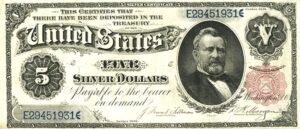
The obverse is equally impressive. The portrait of Ulysses S. Grant appears on the left, flanked by an intricate lathework border. The blue serial numbers contrast sharply against the ornate face printing. The words “Silver Certificate” appear prominently, along with the promise of payment in silver coin. The small red Treasury seal, positioned to the right of center, is a key design element for variety identification.
When examining the reverse Morgan dollar images under magnification, look at the quality of Liberty’s hair detail and the eagle’s feathers on the reverse of the depicted coins. On high-grade examples, the BEP’s engraving is so precise that individual feathers and hair strands are discernible. This level of detail is a good proxy for overall print quality and can help distinguish sharp, well-struck notes from weaker impressions before you commit to a purchase.
The Signature Varieties: Fr. 260, 261, and 263
The Series 1886 $5 Silver Certificate was issued under three distinct Treasury signature combinations, each assigned its own Friedberg catalog number in Robert Friedberg’s foundational reference work, “Paper Money of the United States.” Understanding these varieties is essential for any serious collector, as their relative scarcity and value differ substantially.
Fr. 260: Rosecrans-Jordan
The first variety, Friedberg 260, bears the signatures of William S. Rosecrans as Register of the Treasury and Edward S. Jordan as Treasurer of the United States. Rosecrans served as Register from April 1885 to May 1887, making this the earliest signature combination on the 1886 series. The Rosecrans-Jordan pairing is the most commonly encountered of the three 1886 five-dollar varieties in circulated grades, though “common” is a relative term for any large-size Silver Certificate. In Fine-12 condition, Fr. 260 specimens typically realize values in the range of $350 to $550 at auction, while choice Very Fine examples can approach $900 to $1,200. Uncirculated examples are genuinely scarce and command premiums exceeding $3,500 in grades of MS-63 or better.
Fr. 261: Rosecrans-Hyatt
Friedberg 261 carries the signatures of Rosecrans paired with Conrad N. Jordan’s successor, James W. Hyatt, who served as Treasurer from May 1887 to May 1889. This combination sees lower survival numbers than Fr. 260 in most grade categories, particularly in the Very Fine to Extremely Fine range. A well-centered Fr. 261 in VF-30 is a legitimate prize for any collection. Collectors should expect to pay $500 to $800 for mid-grade circulated examples and $4,500 or more for properly graded Uncirculated notes.
Fr. 263: Rosecrans-Huston
The third variety, Friedberg 263, features the Rosecrans-Huston signature combination, with Daniel N. Huston serving as Treasurer from May 1889 to April 1891. This is the scarcest of the three major varieties in higher grades and commands the strongest premiums in the marketplace. Population reports from PCGS Currency and PMG confirm that certified Fr. 263 examples in grades of VF-35 and above are quite rare, with Gem examples being genuinely exceptional finds.
Before purchasing any Series 1886 $5 Silver Certificate, cross-reference the signatures carefully against verified reference images. The difference between Fr. 260 and Fr. 261 can mean a price gap of several hundred dollars in circulated grades and significantly more in Uncirculated condition. Both PCGS Currency and PMG holders will identify the Friedberg number on the label, which provides useful authentication support, but always verify the label matches the note in hand.
Grading Challenges Specific to This Note
Large-size Silver Certificates from the 1880s present several grading challenges that collectors must appreciate before entering the market. The Morgan Dollar Back is no exception, and in some respects it is more demanding than contemporaneous issues.
First, centering is a persistent problem. The BEP’s printing technology of the 1880s produced significant variation in sheet registration, and notes with borders of equal width on all four sides are the minority rather than the rule. Well-centered examples carry meaningful premium value, sometimes 20 to 40 percent above comparably graded but poorly centered specimens at major auction firms like Stack’s Bowers and Heritage Auctions.
Second, the intricate reverse design tends to show wear in very specific places. The high points of the Morgan dollar engravings, particularly Liberty’s cheek and the eagle’s breast feathers on the depicted coins, are the first areas to exhibit friction. A note that appears Extremely Fine at first glance may reveal concealed wear on these high points under a quality loupe, dropping the grade to Very Fine. This is a classic “buyer beware” situation.
Third, original paper quality and color matter enormously. The paper used by the BEP in 1886 had a characteristic creamy-white appearance that, when original and unrestored, gives properly preserved notes a distinctive look. Notes that have been cleaned, pressed, or “dipped” lose this quality and will often grade lower or carry a “details” qualifier from professional grading services. An original VF note is almost always preferable to a cleaned or pressed example grading EF on paper quality alone.
The Serial Number Story
Serial numbers on the 1886 $5 Silver Certificates are printed in blue ink, a visual hallmark of Silver Certificate issues from this era that distinguishes them from Legal Tender Notes (which used red serial numbers) and National Bank Notes (which used various colors by charter period). Serial numbers on these notes run from 1 through various multi-million ranges across the three signature varieties. Low serial numbers, particularly those below 100 or ending in repeated digits, carry collector premiums independent of grade. A serial number of A00000500B on a Fr. 260 in Fine condition, for example, will outperform a mid-range serial number on an otherwise comparable note.
Fancy serial numbers on large-size Silver Certificates are a growing sub-specialty within the hobby. For the Series 1886 $5 specifically, solid numbers (like 11111111 or 22222222), ladders, radars, and low serials below 1000 all attract bidder interest from crossover collectors who focus on serial number collecting rather than type collecting. If you acquire a note with an interesting serial number, mention it prominently in any resale listing.
Counterfeit Awareness and Authentication
The beauty and value of the 1886 $5 Morgan Dollar Back make it an attractive target for counterfeiters, both contemporary period fakes and modern reproductions. The U.S. Secret Service was established in 1865 specifically to combat currency counterfeiting, and period fakes of popular Silver Certificates were not uncommon by the 1880s.
Modern collectors should be aware of photographic reproductions and lithographic copies that occasionally surface in online marketplaces. These can be distinguished from genuine BEP intaglio-printed notes by the absence of the characteristic ink relief that real engraved notes exhibit. Run your fingertip across the portrait and numerals on a genuine example and you will feel a slight raised texture from the intaglio ink. Flat photographic reproductions lack this entirely. Additionally, genuine notes will exhibit the characteristic red and blue silk fiber threads embedded in the paper, visible with a loupe under good lighting. Third-party certification from PMG or PCGS Currency remains the most reliable safeguard against purchasing a problem note at a significant price point.
The 1886 $5 in Context: Comparison with Other Morgan Dollar Back Issues
The Morgan Dollar Back design was not unique to the five-dollar denomination in 1886. The Series 1886 also produced one-dollar and two-dollar Silver Certificates in the same broad period, though with different artistic approaches. However, the five-dollar “Morgan Dollar Back” is considered the crown jewel of the group because the larger format allowed the BEP’s engravers more real estate to work with, resulting in larger, more detailed depictions of the Morgan dollar design. Collectors building a type set of 1880s Silver Certificates almost universally prioritize acquiring the 1886 $5 Morgan Dollar Back, often as the centerpiece of their collection.
| Friedberg No. | Signature Combination | Estimated Surviving Pop. | Rarity |
|---|---|---|---|
| Fr. 260 | Rosecrans-Jordan | 600-900 (all grades) | Scarce |
| Fr. 260 (CU) | Rosecrans-Jordan, Unc. | 50-80 certified | Rare |
| Fr. 261 | Rosecrans-Hyatt | 400-600 (all grades) | Scarce |
| Fr. 261 (CU) | Rosecrans-Hyatt, Unc. | 30-50 certified | Rare |
| Fr. 263 | Rosecrans-Huston | 250-400 (all grades) | Rare |
| Fr. 263 (VF+) | Rosecrans-Huston, VF or better | Under 100 certified | Key Date |
| Fr. 260-263 (Gem) | Any variety, MS-65 or better | Fewer than 20 total | Key Date |
| Fr. 260-263 (Details) | Cleaned or pressed examples | Significant portion of pop. | Common (avoid) |
Market Performance and Investment Perspective
Heritage Auctions and Stack’s Bowers have both tracked strong long-term appreciation for high-grade 1886 $5 Silver Certificates over the past two decades. A PCGS-graded Fr. 260 in VF-35 that sold for approximately $690 in 2005 would today realistically bring $1,100 to $1,400 at a major auction house, representing meaningful appreciation even against inflationary pressures. Gem examples in grades of MS-64 to MS-65 have appreciated even more dramatically, as the collector base for top-tier large-size notes has grown steadily while the supply of high-grade survivors has not.
It is worth noting that the market for “details” notes, those that have been cleaned, pressed, or otherwise altered, has softened relative to original-surface examples in recent years. The hobby as a whole has shifted toward prioritizing originality, and that trend is particularly evident in the high-profile large-size Silver Certificate market. Budget-conscious collectors who accept details examples for type purposes should be aware that these notes may underperform the broader market over time.
Building Toward the 1886 $5: Entry Points for New Collectors
For collectors who are newer to large-size notes and find the price points for 1886 $5 Silver Certificates daunting, there is a logical progression that builds both knowledge and budget simultaneously. Starting with later-series five-dollar Silver Certificates from the 1890s and 1900s, which are more affordable in circulated grades, develops the eye for grading and paper quality that is essential before committing four-figure sums to a single note. The Series 1896 Educational $5 Silver Certificate, another iconic and widely collected issue, is a natural neighbor to the 1886 in any advanced collection and offers its own deep variety study.
When you are ready to purchase a Series 1886 $5, prioritize originality above grade. A problem-free Fr. 260 in Fine-12 with original paper, good color, and honest wear is a far better long-term acquisition than a pressed or cleaned example grading VF-20 on paper quality. Buy the note, not the holder, and do not hesitate to pass on examples with condition concerns even when the price seems attractive.
Conclusion: A Note Worth the Pursuit
The Series 1886 $5 Silver Certificate Morgan Dollar Back represents everything that makes large-size United States currency collecting so compelling. It combines artistic ambition, historical significance, genuine scarcity, and a rich variety structure that rewards ongoing study. Whether you are a type collector seeking one representative example for a Silver Certificate set, or a specialist building a complete variety run across all three Friedberg numbers, this note will test your patience, strain your budget, and ultimately deliver the kind of satisfaction that only a truly great rarity can provide. The Morgan Dollar Back has been a cornerstone of major collections for over a century. Adding one to yours is a decision you are unlikely to regret.