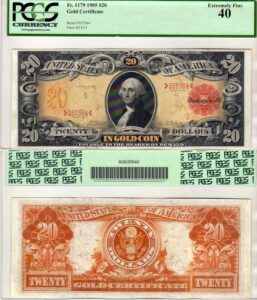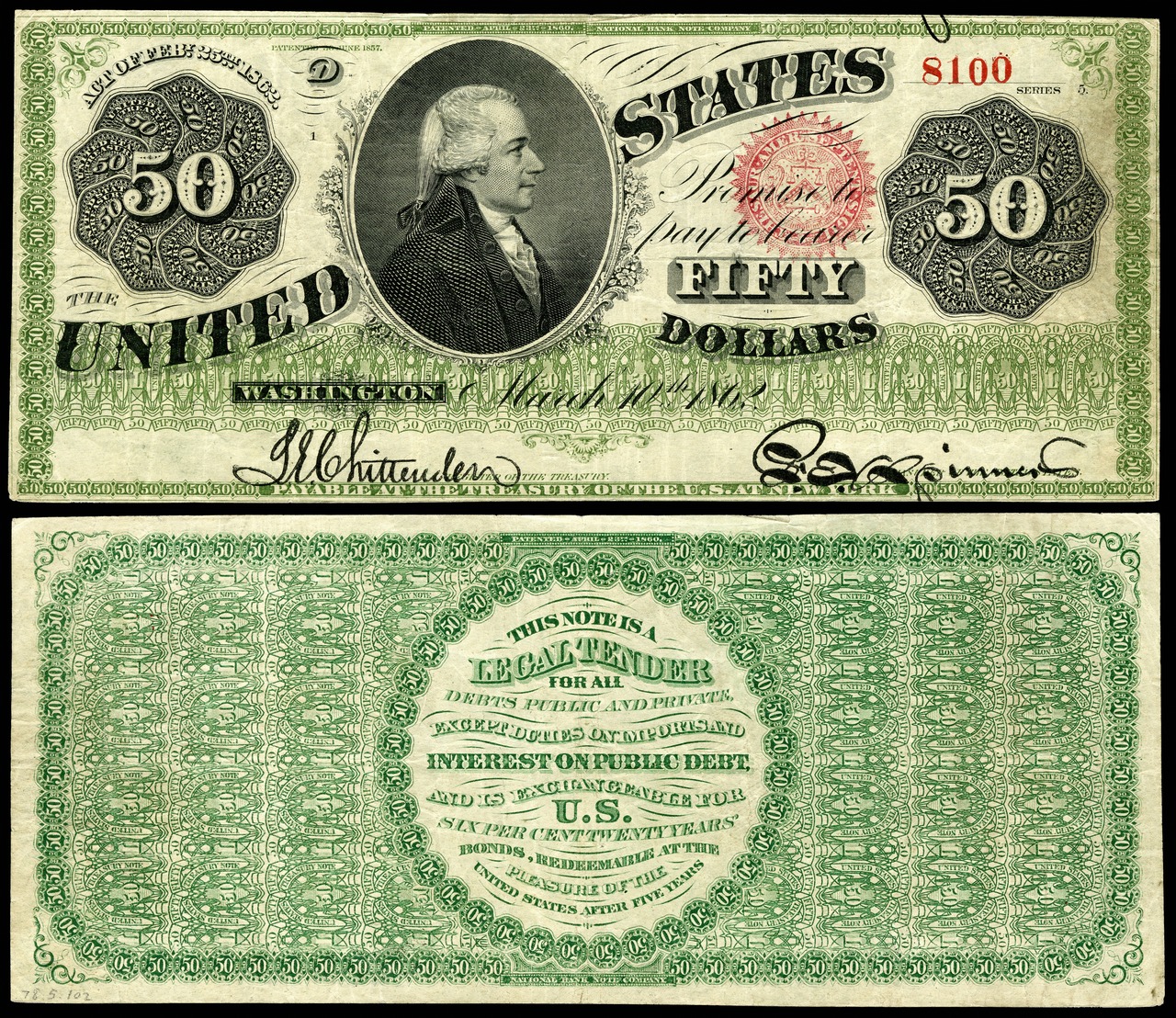
📷 Image source: National Numismatic Collection, National Museum of American History (via Wikimedia Commons). Images are selected by AI to represent the article topic and may not depict the exact note(s) described.
Pick up a Series 1863 $50 United States Note and you are holding something that crossed hands during one of the most turbulent financial periods in American history. These large-format Legal Tender notes, commonly called “Horse Blankets” by collectors for their imposing dimensions, were printed while the Union was simultaneously fighting a war, reconstructing its banking system, and issuing paper currency for the very first time on a nationwide scale. The $50 denomination was serious money in 1863, representing perhaps two months of wages for a skilled laborer, and the notes that survived did so against considerable odds. Wear, fire, floods, and simple destruction claimed the vast majority. What remains today rewards careful study.
Historical Context: Why These Notes Exist at All
The Legal Tender Acts of 1862 and 1863 authorized the Treasury Department to issue paper money that was not directly redeemable in gold or silver on demand. Congress forced the issue out of wartime necessity, and the resulting “Greenbacks” represented a radical departure from the pre-war banking landscape dominated by state-chartered bank notes of wildly inconsistent quality and trustworthiness. The $50 United States Notes of 1863 were part of this unprecedented experiment.
Salmon P. Chase served as Secretary of the Treasury when the groundwork was laid, and his influence on the early design choices was substantial. By the time the 1863 series was printed, the American Bank Note Company and the National Bank Note Company were both involved in production, and the portrait chosen for the $50 was that of Alexander Hamilton, the nation’s first Treasury Secretary. It was an intentional choice: Hamilton’s advocacy for a strong central financial system made him a fitting symbol for the federal government’s first attempt at a national paper currency.
Design Anatomy: Reading the Note
The face of the 1863 $50 Legal Tender note is dominated by a portrait of Hamilton positioned to the left. His image is engraved with the fine detail characteristic of the mid-nineteenth century American Bank Note style, showing considerable depth in the cross-hatching and stippling. A large spread eagle vignette occupies the center of the note, with ornate lathe-work borders typical of the era framing the entire composition. The denomination appears in large counters at each corner, and the obligation text reading “The United States Will Pay to the Bearer Fifty Dollars” runs across the lower portion of the note.
The back of these notes is printed in a vivid green, the source of the “Greenback” nickname that persists in American slang to this day. The reverse design is entirely typographic and geometric, relying on complex lathe work rather than pictorial vignettes. The green ink used on the reverse was specifically chosen because it was difficult to photograph with the photographic technology of the era, deterring a particular method of counterfeiting that had plagued earlier note issues.
When examining a Series 1863 $50 under magnification, pay close attention to the portrait engraving around Hamilton’s collar and coat lapels. Genuine notes show intricate fine-line work that counterfeit copies of the period could not replicate accurately. Blurred or broken lines in this area on a purportedly original note should raise immediate questions.
Friedberg Numbers and Signature Combinations
The standard reference for United States paper money, Robert Friedberg’s “Paper Money of the United States,” assigns specific catalog numbers to the 1863 $50 Legal Tender issues based primarily on the Treasury signature combinations found on each note. These signatures represent the Register of the Treasury and the Treasurer of the United States who were in office when a given batch was printed and signed.
Fr. 148 carries the signatures of Chittenden (Lucius E. Chittenden, Register) and Spinner (Francis E. Spinner, Treasurer). Fr. 149 pairs Colby (Clark Colby, Register) with Spinner. Fr. 150 continues with Colby and Spinner but reflects a distinct printing. Fr. 151 carries the Jeffries-Spinner combination. Each combination represents a different period of production, and some are considerably rarer than others at the surviving population level.
The seal varieties add another layer of complexity. Early impressions carry a large red seal with rays (sometimes called the “rays” seal), while later printings transition to a smaller, more refined red seal without the radiant rays. Collectors who focus on type sets often prioritize the large-seal examples for their visual impact and earlier date of issue.
Do not confuse the Series 1862 and Series 1863 $50 Legal Tender notes when building a collection. Both are large-format red-seal Greenbacks with Hamilton portraits, but the series designation appears in the obligation text on the face of the note. The 1862 examples (Fr. 147 and related) carry slightly different border geometry and obligation wording. Always read the entire face text carefully before attributing a note to its correct Friedberg number.
Survival Rates and the Circulated Collector Market
The brutal reality of 19th-century currency is that most of it circulated hard and was eventually destroyed by the Treasury when returned in worn condition. The $50 denomination circulated less than the $1, $2, and $5 notes simply because fewer transactions required such a large sum, but the notes that did circulate were often passed through many hands across months or years before retirement. The PCGS Currency and PMG population reports confirm that the total number of graded examples across all Friedberg varieties of the 1863 $50 Legal Tender is measured in the dozens, not hundreds.
For practical collectors, this means that finding any example, even one graded VG-10 or F-12, represents a genuine numismatic discovery. A circulated note in Good (G-4 to G-6) condition with honest wear, intact margins, and no missing pieces remains a collectible artifact. The grading services have certified examples in this range that realized between $1,800 and $3,500 at major auction houses in recent sale cycles, depending on eye appeal and the specific signature combination. Fine (F-12 to F-15) examples routinely bring $4,500 to $7,500. Very Fine survivors, which are rare given 160 years of survival odds, have crossed the $10,000 threshold at Heritage Auctions and Stack’s Bowers sales.
Uncirculated examples are essentially trophies. A single CH CU or GEM CU certified 1863 $50 Legal Tender would be a major auction event. The few finest-known examples that have been graded in the Extremely Fine to About Uncirculated range have realized prices in the $25,000 to $60,000 range, and justifiably so. These are Civil War-era survivals of the highest order.
Grading Nuances Specific to This Issue
Grading large-size Legal Tender notes from the 1860s requires attention to factors that do not apply to modern currency. Paper quality in this era varied, and genuine notes can show natural aging, slight waviness from humidity, and minor oxidation of the ink that does not constitute damage in the numismatic sense. The red seal is vulnerable: on circulated examples, the seal wax-based ink sometimes shows flaking or rubbing at the center, which grading services note but which does not automatically disqualify a note from a respectable grade if the surrounding field is clean.
Folds are graded by number and severity. A note with a single light horizontal fold through the center but otherwise bright paper, sharp corners, and full margins might grade VF-20 or better. Multiple folds that intersect and leave visible separation in the paper fiber will anchor a note in the Fine range regardless of other positives. Edge roughness, a small tear that does not extend into the design, or a previously folded corner that has been professionally flattened are all conditions the major grading services will comment on in their holder inserts.
When purchasing raw (ungraded) examples of 1863 $50 Legal Tender notes, insist on examining the note under both direct light and raking side light before committing to a price. Raking light reveals repairs, paper fills, and washed areas that are invisible under flat illumination. At this price level, a pre-purchase submission to PMG or PCGS Currency is almost always worth the grading fee.
Authentication Concerns and Altered Notes
Counterfeits of Civil War-era Legal Tender notes are far less common than alterations. The most historically significant alteration issue involves notes from lower denominations that were chemically or mechanically altered to resemble $50 examples. The Bureau of Engraving and Printing’s security features of the era, while sophisticated for their time, were not designed to resist the kind of sophisticated alterations that became possible as chemical technology advanced in the late 19th and early 20th centuries.
A reputable grading service holder is the most reliable protection for a modern buyer. However, collectors who enjoy handling raw notes should familiarize themselves with the specific paper fiber characteristics of 1860s Treasury notes. Genuine examples were printed on a distinctive fiber-embedded paper with fine red and blue silk threads visible under magnification, a security feature carried over from the earliest Demand Notes of 1861. The presence of these threads does not guarantee authenticity but their absence is a significant red flag.
| Friedberg Number | Signature Combination | Seal Type | Rarity |
|---|---|---|---|
| Fr. 148 | Chittenden – Spinner | Large Red, Rays | Rare |
| Fr. 149 | Colby – Spinner | Large Red, Rays | Rare |
| Fr. 150 | Colby – Spinner | Small Red, No Rays | Scarce |
| Fr. 151 | Jeffries – Spinner | Small Red, No Rays | Key Date |
| Fr. 148 (CU) | Chittenden – Spinner, Unc. | Large Red, Rays | Key Date |
| Fr. 149 (VF or better) | Colby – Spinner, VF+ | Large Red, Rays | Rare |
| Fr. 150 (VF or better) | Colby – Spinner, VF+ | Small Red, No Rays | Scarce |
| Any 1863 $50 (G to VG) | Any combination, circulated | Any | Scarce |
Building a Context Collection Around the 1863 $50
Few collectors focus exclusively on a single note, and the 1863 $50 Legal Tender fits naturally into several rewarding collection themes. A “Civil War Era Currency” collection might pair this note with Demand Notes of 1861, Compound Interest Treasury Notes, and the early Interest Bearing Notes, all of which were in circulation simultaneously. The contrast in design philosophy, denomination structure, and issuing conditions across these note types tells the complete story of Union wartime finance.
A Hamilton-themed collection is another compelling approach. Alexander Hamilton appears across multiple United States note types and denominations from the 19th century through the modern Federal Reserve Note era, and tracing his portrait’s evolution across 150 years of American currency makes for a rich display and an accessible way to explain the collection’s coherence to non-specialist audiences.
Budget-conscious collectors who want a piece of the 1863 $50 Legal Tender story without the four-figure price tag should consider collecting high-quality reproduction examples alongside contemporary newspaper coverage of the Legal Tender Act debates. Original period newspapers from 1862 to 1863 discussing the “Greenback” controversy are surprisingly affordable and provide essential historical context that enhances the display value of any note in this series.
Conclusion: Value, Scarcity, and Why These Notes Still Matter
The Series 1863 $50 United States Note is not a note you stumble across at a coin show for pocket change. It is a deliberate acquisition, one that requires patience, a reasonable budget, and the willingness to accept honest circulation wear as part of the artifact’s story rather than a flaw to be apologized for. Circulated examples in the Good to Fine range represent genuine historical survivals that most collectors of American currency will never have the opportunity to own.
Values have been trending upward for the finest-known examples as the collector base for early Legal Tender issues deepens, and even lower-grade circulated pieces have held their value through multiple auction cycles. The note’s combination of Civil War provenance, Hamilton iconography, and extreme scarcity in any condition above Fine makes it one of the most compelling large-size type coins in American numismatics. For the serious collector of United States paper money, acquiring even a Good-grade example of any Fr. 148 through Fr. 151 variety is a meaningful milestone worth marking.