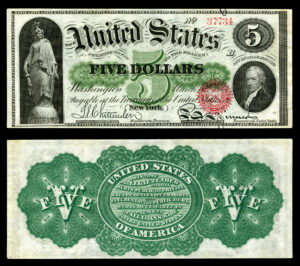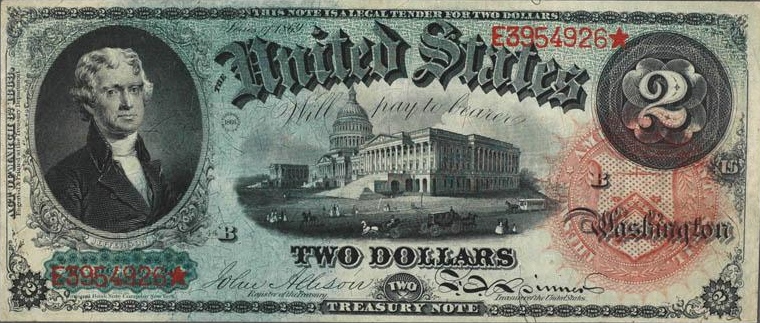
📷 Image source: Wikimedia Commons. Images are selected by AI to represent the article topic and may not depict the exact note(s) described.
Picture a dimly lit study, globes and charts spread across a heavy wooden table, a solitary figure bent in concentration over the tools of discovery. This is the image that American citizens encountered on certain federal banknotes during the 1870s: Christopher Columbus as the archetypal Renaissance man of learning, rendered in meticulous intaglio engraving by the craftsmen of the Bureau of Engraving and Printing. It is an image that speaks volumes about the era that produced it, a United States still stitching itself back together after the Civil War and reaching, almost desperately, for symbols of grandeur, civilization, and destiny.
The Vignette and Its Origins
The “Columbus in His Study” vignette depicts Christopher Columbus seated at a writing table, surrounded by navigational instruments, a celestial globe, and rolled charts. The composition is modeled loosely on European Renaissance portraiture traditions, particularly the genre of the scholar in his study popularized by Flemish and Italian painters. The engravers at the Bureau adapted this iconography to suit the needs of currency art: the image needed to be instantly legible at a small scale, resistant to counterfeiting through its fine line work, and emotionally resonant to a broad public.
The vignette appeared most prominently on the Series 1869 $1 United States Note, sometimes called the “Rainbow Note” by collectors because of its vivid multicolor printing. The face of the note featured a portrait of Salmon P. Chase at left, the Columbus vignette at right, and a large red Treasury seal near center. The overall design was among the most ambitious the Bureau had attempted to that point, and it remains one of the most visually striking pieces of 19th-century American currency.
When examining Series 1869 $1 Legal Tender notes, pay close attention to the vibrancy of the ink colors. Genuine examples show a rich red-orange tint in the serial numbers and Treasury seal, while the back of the note carries a distinctive green and black combination. Faded or washed color on a purported high-grade example is a red flag worth investigating further before purchasing.
Reconstruction-Era Symbolism: Why Columbus?
The choice of Columbus as a currency vignette subject in the late 1860s and 1870s was far from accidental. The post-Civil War United States was engaged in an intense cultural project of national self-definition. Political leaders, artists, and intellectuals all reached back to founding myths and heroic precedents to argue that the nation had a providential destiny. Columbus, as the symbolic discoverer of the New World, fit neatly into this narrative framework.
The image of Columbus not as a conquering mariner but as a studious intellectual was particularly calculated. It positioned American civilization as the heir to Renaissance humanism, learning, and inquiry rather than mere military adventure. Secretary of the Treasury Hugh McCulloch, who oversaw currency design policy during much of this period, was known to favor imagery that projected stability, culture, and legitimacy, qualities the Treasury desperately needed to project as it worked to restore public confidence in the federal currency system after the wartime disruptions of the greenback era.
Columbus imagery was also having a broader cultural moment in American public life. Sculptor Randolph Rogers completed his famous Columbus Doors for the US Capitol in 1858, and the figure appeared repeatedly in paintings, engravings, and public monuments throughout the 1860s and 1870s. The currency vignette was part of this wider iconographic wave.
Series by Series: Where the Vignette Appeared
The “Columbus in His Study” vignette anchored the design of the $1 United States Note across several consecutive series. The Series 1869 is the most famous and most sought by collectors. It carries the signature combination of Allison (Register of the Treasury) and Spinner (Treasurer of the United States), printed in blue ink on the face of the note. The serial numbers on this series appear in red.
The Series 1874 retained the Columbus vignette but introduced subtle design changes, including a revised Treasury seal of smaller diameter. The signature combination shifted to Allison and New. Series 1875 notes, signed by Allison and New or Allison and Wyman depending on the specific run, continued using the same basic obverse layout. By the Series 1878, the vignette was still present but printing and paper quality had evolved, and some minor engraving refinements are detectable under magnification.
Collectors pursuing a type set of 19th-century Legal Tender notes will typically represent this vignette era with a single Series 1869 example, which is the most recognized and desirable of the group. However, specialists in the series often pursue each signature combination as a distinct collectible, which multiplies both the challenge and the satisfaction considerably.
Signature combinations are a crucial variable in valuing 1870s Legal Tender notes. For Series 1875 $1 notes, the Allison-Wyman pairing is considerably scarcer than Allison-New. When buying raw (ungraded) examples, always verify the signature pair before agreeing on a price, as dealers who specialize in other areas occasionally mislabel these combinations.
The Engraving Craft Behind the Image
One of the rewards of collecting these notes is the opportunity to study the engraving itself at close range with a loupe or magnifying glass. The Columbus figure demonstrates extraordinary technical skill. The engravers rendered the folds of his robe, the texture of the globe’s surface, and the subtle foreshortening of the chart-covered table through nothing more than the precise depth, width, and spacing of engraved lines on a steel die. This is the essence of intaglio printing: ink sits in those recessed lines and transfers to dampened paper under enormous pressure, creating the characteristic slight embossing that you can feel on a high-grade original.
Counterfeit detection on these notes depends heavily on understanding this printing process. Genuine Bureau-printed notes exhibit ink that stands slightly proud of the paper surface. Photomechanical reproductions, which became a counterfeiting concern even in the 1870s, tend to show flat, screened ink patterns that are immediately apparent under magnification. The fine crosshatching in the background fields behind the Columbus figure is a particularly reliable authentication point.
Grading Considerations for the Columbus Notes
Grading these 1870s notes presents specific challenges. The paper used in this era was rag-based and relatively durable, but 150 years of potential handling, folding, and storage have created a wide spectrum of condition outcomes. Paper money grading for this series follows the standard Sheldon-adapted scale used by PCGS Currency and PMG, running from Poor (P-1) through Superb Gem Uncirculated (67 EPQ or higher).
For the Series 1869 $1 note specifically, problem-free examples in Fine (F-12) to Very Fine (VF-30) are obtainable in the current market at prices accessible to intermediate collectors. Extremely Fine (EF-40 to EF-45) examples with original paper body and no pinholes or folds represent a significant step up in both rarity and price. Certified Uncirculated examples graded 63 or above by PMG or PCGS Currency are genuinely rare, and Gem (65 EPQ) notes are major showpieces that appear at auction only occasionally. The EPQ (Exceptional Paper Quality) or PPQ (Premium Paper Quality) designations from the major grading services are critically important for this series: original paper surfaces free from cleaning or pressing are far less common than the survival rate of the notes themselves might suggest.
When evaluating a Series 1869 $1 note in any grade, hold the note at an oblique angle under a single light source and look across the surface. Pressed or cleaned notes will often show a slightly glazed or unnaturally smooth paper surface, or faint linear impressions from a press. Original circulated notes have a more random, organic texture even in their worn areas. This simple inspection technique catches a surprising number of artificially improved examples.
Columbus Notes in the Broader Collection Context
For collectors building a thematic collection around American exploration iconography on currency, the “Columbus in His Study” notes pair naturally with several other 19th-century pieces. The 1869 series $2 Legal Tender note, which carries a portrait of Thomas Jefferson alongside a vignette of the Capitol, was printed in the same production run and shares the distinctive Rainbow Note aesthetic. The $5 note of the same series features Andrew Jackson and a pioneer family vignette on the reverse.
Those drawn specifically to Columbus imagery in American numismatics will also want to consider the 1892 and 1893 World’s Columbian Exposition commemorative issues in coins, as well as the various private and territorial banknotes from the mid-19th century that employed Columbus-related vignettes purchased from bank note company catalogs. The American Bank Note Company and the National Bank Note Company both maintained libraries of Columbus-themed vignettes that appeared on thousands of obsolete state bank notes before the National Banking Act reorganized the currency system.
| Series | Signature Combination | Approx. Notes Known / Context | Rarity |
|---|---|---|---|
| 1869 | Allison / Spinner | Survives in large circulated population; Gems are rare | Scarce (Gem) |
| 1874 | Allison / Spinner | Short-lived transitional series; fewer printed overall | Scarce |
| 1874 | Allison / New | Moderate survivor population in circulated grades | Common |
| 1875 | Allison / New | Most available signature pair for the 1875 series | Common |
| 1875 | Allison / Wyman | Substantially scarcer than Allison/New for same series | Scarce |
| 1878 | Allison / Gilfillan | Final series with Columbus vignette; good availability in VF range | Common |
| 1869 | Allison / Spinner (Uncirculated) | Certified examples in 63+ are genuinely rare event lots | Rare |
| 1874 | Allison / Spinner (any grade) | Smallest print run of the Columbus-era $1 Legal Tenders | Key Date |
Where to Find These Notes Today
The major auction houses, including Heritage Auctions, Stack’s Bowers, and Lyn Knight Currency Auctions, bring Columbus-vignette Legal Tender notes to market on a regular basis, particularly in their larger floor sale events. Online platforms such as eBay have abundant raw examples in circulated grades, though buyers should exercise caution and request high-resolution scans of both faces before bidding. For premium certified examples, PCGS Currency and PMG holder populations provide useful benchmarks: checking the online population reports before purchasing a note represented as rare in high grade is always worthwhile due diligence.
Dealer inventories at major shows like the American Numismatic Association World’s Fair of Money and the Chicago Paper Money Expo regularly feature 1869 and 1870s Legal Tender notes, and the ability to handle notes in person remains invaluable for developing the tactile instincts that underpin good condition assessment.
A Living Document of National Aspiration
What makes the “Columbus in His Study” vignette so rewarding as a collecting focus is the density of meaning compressed into a tiny engraved image. Every element of its design was chosen deliberately: the scholarly setting arguing for American intellectual legitimacy, the Renaissance iconography connecting the young republic to the long arc of Western civilization, the masterful engraving technique asserting the technical sophistication of the Bureau of Engraving and Printing. These notes were not merely transactional instruments. They were, in a real sense, arguments. Arguments about what America was and what it aspired to become in the difficult years after the Civil War.
Holding a well-preserved Series 1869 $1 United States Note today, you hold that argument in your hands. The red seal still bright, the Columbus figure still bent in studious concentration, the fine lines of the engraving still crisp under magnification. It is a reminder that currency, at its most ambitious, is as much an art form and a cultural statement as it is a medium of exchange, and that the numismatist who studies it carefully learns something genuine about the society that made it.