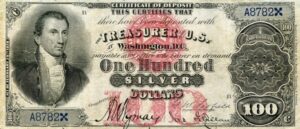
Pick up a Series 1934 $1000 Federal Reserve Note and turn it over. What you see is not flashy. There is no allegorical figure draped in robes, no charging eagle, no elaborate geometric lathe-work screaming for attention. Instead, the Bureau of Engraving and Printing delivered something rarer in government design work: genuine restraint exercised with total confidence. The back of this note is a study in classical proportion, engraved letterforms of exceptional quality, and an architectural sensibility that rewards close examination. For collectors, understanding exactly what is on that reverse, why it looks the way it does, and how the different Federal Reserve district printings compare, transforms a passive appreciation into active, informed pursuit.
Context: Why the 1934 Series Matters Among High-Denomination Notes
The Series 1934 $1000 Federal Reserve Note was not the first $1000 note issued by the United States government, but it became the definitive version most collectors encounter today. Earlier $1000 issues, including the large-size Federal Reserve Notes of 1918 and the Gold Certificates of the 1882 and 1900 series, are dramatically scarcer and command prices that put them beyond most collections. The Series 1934 small-size notes, printed by the Bureau of Engraving and Printing across all twelve Federal Reserve districts, represent the most accessible entry point into four-figure denomination collecting. They circulated, albeit almost entirely between banks and the Federal Reserve System itself, from roughly 1934 through 1945, when wartime exigencies and post-war monetary policy gradually curtailed their use. President Nixon’s Treasury Department formally retired $500 and $1000 notes from circulation in July 1969, though they remain legal tender to this day.
The four distinct series, 1934, 1934A, 1934B, and 1934C, reflect changes in Treasury Secretary and Treasurer of the United States signature combinations rather than fundamental design overhauls. The back design itself remained essentially constant across all four series, which makes it an ideal object for detailed aesthetic analysis independent of the signature variation question that dominates so much collector discussion of these notes.
The Architecture of the Back: A Detailed Visual Inventory
The dominant visual element on the reverse of the Series 1934 $1000 Federal Reserve Note is the large denomination panel. The numeral “1000” is engraved at the center in a bold, serifed roman typeface with subtle geometric underpinning. This is not simply a printed number; it is an engraved construction in which the thick and thin strokes of each digit were cut individually into the steel die by skilled craftsmen at the Bureau of Engraving and Printing. Under 10x magnification, the quality of the engraving becomes apparent: the serifs terminate cleanly, the stroke weight transitions are smooth rather than mechanical, and the overall letterform reflects a mid-1930s refinement of earlier BEP typographic conventions.
Flanking and surrounding the central denomination panel are guilloche patterns, the fine engine-turned lathe-work that has served as an anti-counterfeiting device since the nineteenth century. On the 1934 $1000 back, these patterns are relatively understated compared to, say, the ornate backgrounds of the 1896 Educational Series Silver Certificates. The guilloche here serves a framing function, creating a visual border that draws the eye inward toward the denomination text rather than competing with it for attention. This choice, whether deliberate or the result of BEP house practice by the 1930s, is precisely what gives the design its elegance. Complexity is present but subordinated to clarity.
When examining a Series 1934 $1000 note under magnification, focus on the guilloche rosettes in the corners of the back design. Original Intaglio printing produces crisp, three-dimensional ink ridges you can feel with a fingertip. Cleaned or pressed notes lose this tactile quality, and that loss is detectable even on notes that otherwise appear visually pristine. Always examine high-denomination notes under raking light before purchasing raw examples.
The inscription text on the back reads, in carefully spaced engraved capitals: “THE UNITED STATES OF AMERICA” across the top register, and “ONE THOUSAND DOLLARS” across the lower register. Both lines of text demonstrate the BEP’s mastery of letter spacing for engraved work. The capital letters are slightly wider-set than contemporary commercial typography of the 1930s, a deliberate choice that accommodates the slight spread inherent in deep Intaglio ink deposits without allowing letters to visually merge at normal viewing distance. This is a technical refinement that takes years of production experience to achieve and maintain consistently across thousands of printed sheets.
Typography in Detail: The Engraved Letterforms
The typeface used for the denomination and obligation text on the back of the 1934 series high-denomination notes belongs to the BEP’s proprietary engraved roman tradition, a style that evolved internally from the mid-nineteenth century onward without direct correspondence to any commercially available typeface. It shares characteristics with classical transitional roman faces such as Baskerville in its moderate contrast between thick and thin strokes, and with neoclassical romans such as Bodoni in its sharp, bracketed serifs. But it is neither, and that distinction matters to a collector trying to understand the BEP’s visual language.
The numerals used for “1000” on the back are particularly well-executed. The zero forms are slightly condensed ovals rather than perfect circles, which gives the denomination panel a slightly more vertical emphasis, visually anchoring it to the vertical format of the note’s border elements. The “1” is rendered with a full serif base and a short angled entry stroke at the top, a form closer to traditional roman numerals than to the plainer modernist “1” that began appearing in commercial typography during the same decade. This choice anchors the note visually in an older, institutional tradition, communicating stability and authority, qualities the Federal Reserve System was particularly interested in projecting during the economic uncertainty of the mid-1930s.
The back plate number on Series 1934 $1000 notes appears in the lower right corner of the reverse. Low back plate numbers, particularly those below 10, are noted by specialists and can carry a modest premium in high-grade examples. Plate number collecting is a specialized but rewarding niche within high-denomination currency collecting that requires no additional cost beyond careful selection at time of purchase.
Color and Ink: The Green Back Tradition
Like all Federal Reserve Notes of the small-size era, the Series 1934 $1000 note features a back printed in the characteristic green ink that gave “greenbacks” their enduring nickname. The specific green used by the BEP in the 1930s and 1940s has a slightly deeper, more olive-tinged quality than the brighter grass-green of some later series. On well-preserved examples, the back ink retains a richness and depth that speaks directly to the quality of the Intaglio printing process. The ink is applied under enormous pressure, embossing it fractionally into the paper’s surface and creating a slight relief that is both visible and tactile.
Collectors grading these notes should pay particular attention to ink quality on the back. Fully original, uncirculated examples show ink that appears almost three-dimensional under strong directional light. Notes that have been lightly circulated but not mishandled retain most of this quality. Heavily circulated examples, while still desirable for the series they represent, show ink compression and paper fiber disruption that flattens the back’s visual impact considerably. The PCGS Currency and PMG grading scales both account for this through their surface quality and eye appeal components, which is why two notes grading the same numeric grade can appear very different in hand.
The Twelve Districts: Uniform Design, Varied Scarcity
One of the most fascinating aspects of the Series 1934 $1000 notes is that all twelve Federal Reserve districts received notes with an identical back design. The back carries no district-specific text or seal; the district identification is entirely a front-of-note matter, encoded in the Federal Reserve seal letter and the district number appearing in the four corners of the face. This means that when you examine the back of a Boston (A) district note alongside a San Francisco (L) district note, you are looking at precisely the same engraved design, printed from the same family of back plates.
The distinction in value and rarity between districts is therefore entirely a function of print run differences, survival rates, and collector demand patterns. Dallas (K) and Minneapolis (I) district notes from the 1934 series are dramatically scarcer than Boston or New York examples, purely because the regional Federal Reserve banks in those districts required fewer high-denomination notes for their interbank settlement operations. A Dallas district 1934 $1000 note in Fine condition is a meaningfully different collecting proposition from a New York district example in the same grade, despite the backs being visually indistinguishable.
If you are building a type collection rather than a district set, the Series 1934 $1000 note in New York (B) or Chicago (G) district offers the best combination of availability and value. These high-mintage districts produce the most market liquidity, meaning more opportunities to find well-centered, attractive examples at fair prices. Avoid paying condition premiums for scarce districts unless your goal is specifically a twelve-district set, where those premiums are genuinely justified.
Condition Considerations Specific to the Back Design
Several condition issues affect the back of the Series 1934 $1000 note specifically. Centering is the first concern. These notes were sheet-printed and guillotined, and the margins on the back can vary from beautifully even to noticeably unbalanced even on uncirculated examples. A note with generous, even margins on the back is a genuinely superior piece regardless of face centering, since collectors and third-party graders assess both sides independently.
Soiling on the back is common on circulated examples, since the back would have been the surface resting on counting room surfaces during the interbank transfer operations these notes facilitated. Light counting smudges in the lower margin area are almost universal on circulated examples and do not significantly affect value. Heavy soiling, ink transfer from other notes, or adhesive residue from prior mounting are more serious concerns that suppress both grade and value substantially.
One back-specific issue worth knowing about is the phenomenon of “ink offset,” where the face design’s Intaglio ink partially transferred to the back of an adjacent sheet during printing or storage. Minor offsets are collected as curiosities; heavy offsets that obscure the back design are condition problems. Third-party grading services note significant offsets on their holders, and the presence of such a notation should prompt careful re-examination of asking prices.
| Series | District / Letter | Est. Known Examples | Rarity |
|---|---|---|---|
| 1934 | New York (B) | 2,500+ | Common |
| 1934 | Chicago (G) | 1,800+ | Common |
| 1934 | Boston (A) | 800-1,200 | Scarce |
| 1934 | Dallas (K) | 200-350 | Rare |
| 1934 | Minneapolis (I) | 175-300 | Rare |
| 1934A | New York (B) | 1,500+ | Common |
| 1934B | Any District | 150-400 per district | Rare |
| 1934C | Any District | 100-250 per district | Rare |
| 1934C | Minneapolis (I) | Fewer than 50 confirmed | Key Date |
| 1934C | Dallas (K) | Fewer than 40 confirmed | Key Date |
What Collectors Pay: Market Values in Context
As of recent major auction results through Heritage Auctions, Stack’s Bowers, and Lyn Knight Currency Auctions, Series 1934 $1000 Federal Reserve Notes in common districts such as New York or Chicago trade in Very Fine grades for approximately $1,400 to $1,800. Uncirculated examples of the same districts, graded PMG 63 or better, regularly achieve $3,000 to $5,000. The premium for exceptional centering and original paper quality in grades of PMG 65 EPQ or PCGS 65 PPQ can push prices to $8,000 or above for particularly fine specimens.
Scarce districts in comparable grades command two to five times those figures. A Minneapolis or Dallas district 1934C example in any grade above Very Fine is a major rarity requiring serious collector resources, with the handful of confirmed examples in institutional and advanced private collections suggesting realized prices well above $20,000 when they appear.
The Understated Elegance: A Final Assessment
The back design of the Series 1934 $1000 Federal Reserve Note succeeds precisely because its creators understood that at the highest denomination then in regular circulation, the note itself was the message. There was no need for allegorical elaboration or competing visual elements. The denomination needed to be unmistakable, the printing quality needed to be beyond question, and the overall presentation needed to communicate the full weight of federal monetary authority. The BEP’s engravers achieved all three goals through classical proportion, superb letterform execution, and disciplined restraint in the use of ornamental elements.
For collectors at any level, the Series 1934 $1000 note represents one of the most attainable entry points into genuine high-denomination American currency. The back design, overlooked in most catalogue descriptions in favor of face signature combinations and district varieties, is in many ways the soul of the note. It is the surface that faced outward on the counting room table, that accumulated the texture of institutional commerce, and that the BEP’s craftsmen executed with the same care they brought to the most celebrated vignettes in American currency art. Turning the note over and giving that back the attention it deserves is, ultimately, the mark of a serious collector.