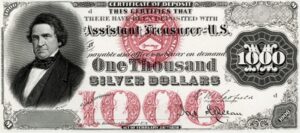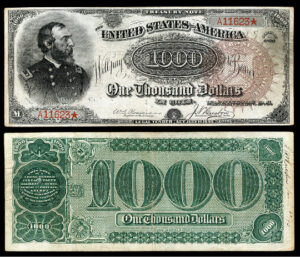
Pick up any piece of United States paper money printed after 1862 and you will find it somewhere on the face of the note: a circular emblem bearing scales, a key, and a chevron of thirteen stars. The Treasury Department seal is so familiar that most handlers never give it a second glance. For currency collectors, however, that seal is a living timeline. Its color, size, style of serrations, Latin motto, and exact placement have changed repeatedly since the first Legal Tender Notes rolled off Bureau of Engraving and Printing presses, and each variation corresponds to a specific issue, series, or monetary era. Learning to read those changes is like learning a new dimension of every note you already own.
The Founding of a Symbol: 1778 and the Original Seal Design
The Treasury Department seal predates paper currency by nearly a century. Congress established the Department of the Treasury in September 1789, but the seal itself traces its iconographic roots to 1778, when a design featuring a balance scale (representing justice in financial matters), a key (representing security and official authority), and a chevron of thirteen stars (one for each original colony) was codified. The Latin motto encircling the design, “Thesauri Americae Septentrionalis Sigillum,” translates roughly to “The Seal of the Treasury of North America,” a phrasing that reflected the new nation’s continental aspirations.
When the federal government finally issued paper currency in 1861 and 1862, the Bureau of Engraving and Printing needed a way to authenticate notes and differentiate them from counterfeits. The Treasury seal, printed in colored ink directly onto note faces, became that authenticating mark. From the very beginning, the seal’s color carried meaning: red for United States Notes (Legal Tender Notes), blue for National Bank Notes and later for Silver Certificates of certain series, and eventually green for Federal Reserve Notes. Understanding those color assignments is the foundation of any serious study of Treasury seal varieties.
1862 to 1869: The First Generation, Red Seals and Ornate Borders
The earliest Treasury seals to appear on American paper money were large, elaborately engraved, and printed in vivid red ink. The Legal Tender Notes of 1862 and 1863, authorized under the Legal Tender Act of February 25, 1862, carried what collectors today call the “large red seal” with a scalloped, ornate outer border. Catalog references in Friedberg’s “Paper Money of the United States” identify the first $1 Legal Tender Note as Fr. 16, while the iconic $5 of the same era is Fr. 61. These notes are immediately recognizable to collectors because the seal design features relatively fine interior engraving with closely spaced serrations around the outer ring.
One important nuance for collectors: within the 1862-1863 issues, there are two distinct seal styles. Early printings used a seal with smaller, more delicate rays or points around the perimeter. Later printings of the same series introduced a seal with slightly bolder, more pronounced serrations. These variations are documented in Friedberg and contribute meaningfully to value differences, particularly in higher grades. A Fine-15 example of Fr. 16 with the earlier seal style might bring $1,800 to $2,400 at auction, while later seal variants on the same denomination fetch somewhat less due to their comparatively higher survival rates.
When examining pre-1900 notes, use a loupe to inspect the serrations around the Treasury seal’s outer ring. The number, sharpness, and spacing of those points can help you distinguish early printings from later ones within the same series, sometimes adding hundreds of dollars in catalog value.
National Bank Notes and the Blue Seal Tradition: 1863-1929
The National Banking Act of 1863 created a parallel universe of currency in which thousands of individually chartered banks issued notes backed by U.S. government bonds. These National Bank Notes used a blue Treasury seal from their first issuance through the end of the National Currency era in 1935. The blue seal was not a random choice: it visually distinguished nationally chartered bank paper from the red-seal Legal Tender Notes and helped bank examiners, merchants, and the general public quickly identify a note’s type at a glance.
The blue seals on National Bank Notes evolved through three broad design periods that collectors call the First Charter Period (1863-1882), the Second Charter Period (1882-1902), and the Third Charter Period (1902-1929). First Charter notes carry a particularly ornate large blue seal with intricate lathe-work around its border. By the Third Charter Period, the seal had become somewhat smaller and cleaner in appearance, anticipating the simplification trend that would accelerate through the twentieth century. The 1929 transition to small-size currency brought a significant change: the seal shrank dramatically to fit the new 6.14 x 2.61 inch note format, though its blue color on National Bank Notes was retained until the series ended.
Silver Certificates and the Shifting Color Story: 1878-1957
Silver Certificates, authorized beginning in 1878 and issued continuously through Series 1957-B, present one of the most colorful seal histories in American numismatics. Early large-size Silver Certificates of 1878 and 1880 carried red seals, visually indistinguishable in color from Legal Tender Notes of the era. Starting with the Series of 1886 issues, many Silver Certificate denominations shifted to brown seals, a short-lived variety that today commands strong premiums. The $1 Silver Certificate of 1886 (Fr. 215-Fr. 221) with its brown seal and “Martha Washington” portrait is among the most prized notes of the nineteenth century; a choice Fine example can realize $3,000 or more at major auction.
By the 1890s, Silver Certificates had largely standardized on blue seals, a color association that persisted through the entire small-size era from 1928 through 1957. The small-size $1 Silver Certificates of Series 1928 through 1957-B, so familiar to mid-century Americans, all carry that crisp blue seal. When Silver Certificates were discontinued and redeemed beginning in 1968, the blue seal essentially exited everyday commerce, making those notes nostalgic touchstones for collectors who remember pulling them from change as children.
Do not confuse the brown seals on 1886 and 1891 Silver Certificates with age-related color shifting. Genuine brown-seal notes have an ink tone that is warm and consistent across the seal face. If a supposed “brown seal” appears muddy, uneven, or suspiciously darkened only at edges, you may be looking at a red-seal note that has been chemically or environmentally altered.
Federal Reserve Notes and the Rise of the Green Seal: 1914-Present
When the Federal Reserve System began issuing currency in 1914, a new seal color entered the American wallet: green. The choice was partly practical (green ink was already associated with U.S. currency in the public mind due to the old “greenback” nickname for Legal Tender Notes) and partly a deliberate effort to create a visually distinct identity for the new central bank’s paper. The original Federal Reserve Note seal of 1914 was large and ornate, matching the aesthetic of other large-size currency of the era, and it appeared alongside a separate Federal Reserve District seal that identified which of the twelve regional banks had issued the note.
The large-size Federal Reserve Notes of 1914 and 1918 featured a green Treasury seal on the right side of the note face and a black Federal Reserve District seal on the left. This two-seal arrangement remained a hallmark of Federal Reserve Notes all the way through to modern issues, though both seals shrank considerably when small-size currency was introduced in 1929. Collectors working the 1914 and 1918 series should pay close attention to the Treasury seal’s position and relative size, as well as the specific signature combinations. The Teehee-Burke signature pair (1914-1918) is particularly collectible, and notes signed by Burke-Glass or Burke-Houston are scarcer in high grade due to shorter printing runs.
The most dramatic change to the green Treasury seal came not in the 1930s or 1940s but in 1963, when the Series of 1963 Federal Reserve Notes introduced what collectors call the “small plain seal” or “simplified seal.” Gone were the ornate scalloped outer border and the finely engraved serrations of earlier decades. In their place came a cleaner, more modern design with evenly spaced, blunter points around the perimeter. This simplified seal, still green, has appeared on every Federal Reserve Note printed from 1963 to the present day. The transition is easy to spot: compare any pre-1963 Federal Reserve Note to a Series 1963 note of the same denomination and the visual difference is immediately apparent even without magnification.
Legal Tender Notes: Red Seals Through the End of Their Run
United States Notes (Legal Tender Notes) kept their red seals from 1862 all the way through their final series. The last regularly issued United States Notes were the Series 1966 and 1966-A $100 bills, which still carried a bold red Treasury seal. These late-era red-seal notes are intriguing collectibles because they represent the end of a 104-year tradition. The Series 1966 $100 (Fr. 1550) had a relatively modest print run of approximately 768,000 notes, and the Series 1966-A (Fr. 1551) had a print run of just 128,000 notes, making the latter a genuine key date that commands $400 to $800 in circulated grades and considerably more in uncirculated condition.
For collectors building a type set that traces Treasury seal colors, a red-seal Legal Tender Note is an essential component. The most budget-friendly entry points are the small-size $2 United States Notes of Series 1928 through 1963-A, which can often be found in Very Fine condition for $15 to $50 depending on series and signature combination. The red seal on these small-size notes has a particularly crisp, almost lacquer-like quality that photographs beautifully and displays well in album pages.
Building a “Treasury seal color” type set is an excellent project for intermediate collectors. You need five notes to cover the major varieties: a red-seal Legal Tender Note, a blue-seal Silver Certificate, a blue-seal National Bank Note, a brown-seal 1886 or 1891 Silver Certificate, and a green-seal Federal Reserve Note. The entire set can be assembled in circulated grades for under $200, excluding the brown-seal note, which requires a more serious budget.
The Motto: Small but Significant Latin Differences
The Latin motto on the Treasury seal, “Thesauri Americae Septentrionalis Sigillum,” has appeared in slightly different typographical treatments across different eras. On the large-size ornate seals of the nineteenth century, the lettering was rendered in a serifed, condensed typeface with relatively fine strokes. On the small-size seals introduced in 1929, the lettering became bolder and more compressed to remain legible at reduced size. On the simplified seals introduced in 1963, the letterforms are cleaner still, with slightly more spacing between characters.
These typographic distinctions are subtle enough that most casual observers never notice them, but under magnification they provide useful confirmation when attributing notes with worn or partially obscured dates. Combined with the seal’s outer border style and color, the motto’s letterform can help an experienced collector confirm a preliminary attribution before consulting signature pairs or serial number ranges.
The Modern Era: Security Features and the Seal’s Diminished but Persistent Role
Beginning with the redesigned $100 Federal Reserve Note of Series 1996, the Bureau of Engraving and Printing began shifting security emphasis away from ink color and toward embedded features like color-shifting ink, security threads, and microprinting. The Treasury seal remained green on all denominations but took on a slightly secondary visual role as larger portrait vignettes and new design elements competed for space on the note face. The 2013 redesign of the $100 note, the most recent major currency update, retained the green seal in its post-1963 simplified form, placing it to the right of Independence Hall on the reverse and to the right of the Franklin portrait on the face.
Some collectors who specialize in modern notes track the precise shade of green used on Treasury seals across different print runs and facilities (the Bureau of Engraving and Printing operates facilities in both Washington, D.C., and Fort Worth, Texas). While the differences are extremely subtle and require controlled lighting and reference notes for comparison, dedicated specialists do document these variations, particularly on star note print runs where quality control occasionally produced slightly off-color impressions.
| Series / Date | Seal Color and Type | Est. Survivors / Print Run | Rarity |
|---|---|---|---|
| 1862 $1 Legal Tender (Fr. 16) | Large Red, ornate serrations | Fewer than 500 known | Key Date |
| 1886 $1 Silver Certificate (Fr. 215-221) | Brown seal, small size, ornate | Fewer than 600 known across varieties | Key Date |
| 1891 $2 Silver Certificate (Fr. 246) | Brown seal, large ornate | Very low; under 400 graded examples | Rare |
| 1914 $5 FRN, Teehee-Burke (Fr. 856-867) | Large Green, ornate; red/blue serial | Print runs varied by district | Scarce |
| 1928 $1 Silver Certificate (Fr. 1600) | Blue seal, small plain | 638,296,908 printed | Common |
| 1966 $100 Legal Tender (Fr. 1550) | Red seal, simplified | 768,000 printed | Scarce |
| 1966-A $100 Legal Tender (Fr. 1551) | Red seal, simplified, last red-seal $100 | 128,000 printed | Key Date |
| 1963 $1 FRN (Fr. 1900-A through L) | Green seal, first simplified style | High volume; common in circulated | Common |
| 1953-B $5 Silver Certificate (Fr. 1657) | Blue seal, small simplified | Relatively low among late Silver Certs | Scarce |
| 1918 $500 FRN, Burke-Glass (Fr. 1132) | Large Green, ornate, high denomination | Fewer than 75 known across all districts | Rare |
Practical Attribution: Using the Seal to Date and Identify Notes
Armed with the history above, here is a straightforward attribution workflow. First, identify the seal color: red points to a Legal Tender Note (or very early Silver Certificate), blue to a Silver Certificate or National Bank Note, brown to a late nineteenth-century Silver Certificate, and green to a Federal Reserve Note. Second, assess the seal’s size: large seals indicate pre-1929 large-size currency, while small seals indicate post-1929 small-size currency. Third, examine the outer border: ornate scalloped borders with fine serrations indicate pre-1963 issues, while blunt, evenly spaced points indicate Series 1963 or later. Fourth, confirm with signature pairs and serial number ranges, which Friedberg’s catalog documents exhaustively.
This four-step process will correctly attribute the vast majority of notes you will encounter. The exceptions, such as the brown-seal Silver Certificates or transitional issues with unusual seal placements, are exactly the notes that reward deeper study and make currency collecting endlessly engaging.
The current edition of Friedberg’s “Paper Money of the United States” assigns specific catalog numbers that encode seal type information. When searching online auction archives like Heritage or Stack’s Bowers, always search by Friedberg number rather than just series and denomination. Two notes that appear identical to the naked eye may have different Friedberg numbers due to seal variety alone, with values differing by a factor of ten or more.
Conclusion: A Small Circle That Tells the Whole Story
The Treasury seal on United States paper money is not merely decorative. It is a compressed record of American monetary history: the shift from nineteenth-century hard-money ideals to the Federal Reserve system, the rise and fall of Silver Certificates, the end of Legal Tender Note circulation, and the ongoing evolution of anti-counterfeiting technology. A collector who truly understands the seal’s changes across 160 years possesses a diagnostic tool that works on every American note ever printed. Whether you are sorting through a shoebox of old bills at an estate sale or examining a $5,000 note at a major auction, a careful look at that small circular emblem will tell you more, faster, than almost any other single feature on the face of the note. That is the power of learning to read what most people never see.