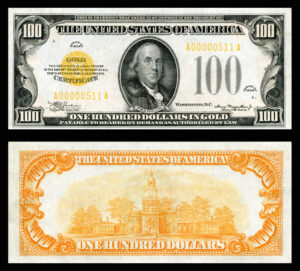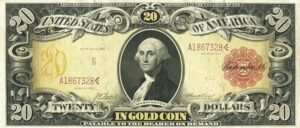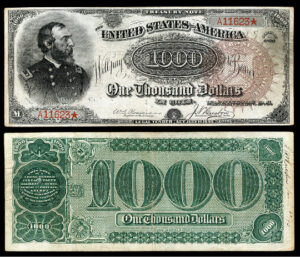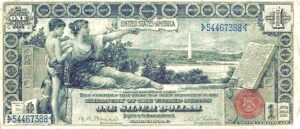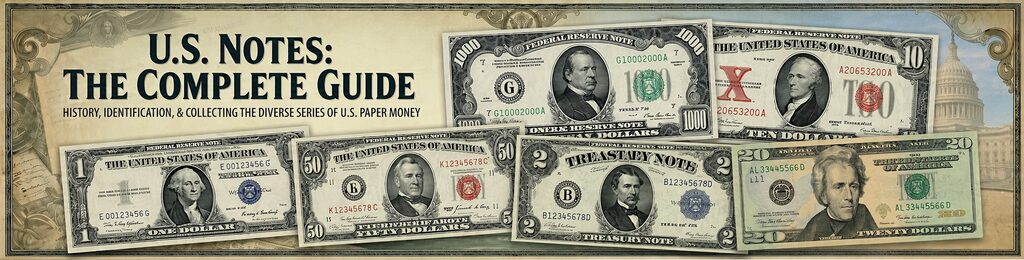
Pull a dollar bill from your wallet right now and check the serial number. If it ends in a small five-pointed star rather than a letter, you are holding what collectors call a star note, a replacement note printed to substitute for a defective sheet that was destroyed during the manufacturing process. That single asterisk-shaped character has been quietly appearing on United States currency since the late nineteenth century, and today it drives some of the most competitive bidding at currency auctions, with certain low-print-run star notes selling for hundreds or even thousands of times their face value.
Why a Star? The Mechanical Logic Behind the Symbol
To appreciate the star note, you have to understand how the Bureau of Engraving and Printing (BEP) manages serial number integrity. Every genuine Federal Reserve Note carries a unique serial number. When a sheet of notes is damaged or fails quality inspection during the intaglio printing process, it must be destroyed. Simply reprinting those sheets with the same serial numbers would risk creating duplicates, which would compromise the entire accountability system the BEP uses to track printed currency.
The solution, adopted officially beginning with the Series 1899 $1 Silver Certificate, was elegant in its simplicity: print a fresh sheet using a serial number drawn from a separate, dedicated replacement sequence and mark those notes with a star symbol so they could be tracked internally. The star was not chosen for aesthetic reasons; it was chosen because it could not be confused with any of the eight letters (A through L) used to designate Federal Reserve districts, nor with the series-year suffix letter appended to most serials.
On early large-size notes from roughly 1899 through the 1920s, the star appeared as a prefix, placed before the serial digits. When the currency format transitioned to small-size notes beginning in 1928, the BEP moved the star to the suffix position, where it has remained ever since. The physical star itself is printed with the same green ink used for the rest of the serial number on modern Federal Reserve Notes, though older issues used different placements and occasionally different inks depending on the note type.
When examining early large-size star notes, look for the star as a prefix character before the serial number digits. On small-size notes from 1928 onward, the star will always appear at the end, after the final digit. Knowing this distinction helps you quickly authenticate notes and spot fakes where a star has been added by altering a regular note.
From Silver Certificates to Federal Reserve Notes: A Brief History
The story of the star note spans multiple currency types issued across more than a century. The first documented star replacements appear on the Series 1899 $1 Silver Certificate, the iconic Black Eagle note. Collectors today pay a significant premium for these large-size stars: a Fine-12 example of the 1899 $1 star note can bring $400 to $700, while an uncirculated Gem example (PMG 65 EPQ or better) has realized over $3,000 at major auction houses such as Heritage and Stack’s Bowers.
Gold Certificates, Legal Tender Notes, and Federal Reserve Bank Notes from the large-size era (pre-1928) all eventually incorporated star replacements as well. The Series 1907 $5 Legal Tender Note with the Woodchopper reverse is a particular favorite among large-size collectors, and star note examples are genuinely rare, with most known survivors being in circulated grades. National Bank Notes are a notable exception: because each National Bank had its own serial number sequence tied to its charter number, the BEP used a different technique for replacements and did not use stars on those issues.
The transition to small-size currency in 1928 standardized the star-suffix format and made record-keeping more systematic. From 1928 through the early 1990s, the BEP did not publicly release detailed print run data for star note series, which meant collectors relied on population reports and auction appearances to gauge rarity. That changed meaningfully in the mid-1990s when the BEP began publishing its annual production reports with star note data broken out by Federal Reserve district. This transparency was a watershed moment for the hobby, giving collectors the data they needed to identify low-print-run stars with confidence.
Reading a Star Serial Number: What Every Digit Tells You
A modern Federal Reserve Note serial number is a coded string. Consider a hypothetical serial number: B 00342718 *. The leading letter B identifies the Federal Reserve Bank of New York. The eight digits form the unique sequential number within the star note run for that district and series. The trailing star confirms replacement status. Some runs begin at 00000001 and run to 00640000 (a standard 640,000-note run), while others are shorter due to smaller replacement demands or print run anomalies.
The series year letter (the small letter after the series year on the face of the note, such as Series 1995 or Series 2009A) is just as important as the district letter when identifying a specific star run. A 1995 $1 star from the Atlanta district (F*) is an entirely different note from a 1995 $1 star from the Boston district (A*), and their print runs and values differ dramatically.
The single most useful free resource for modern star note research is the website moneytopia.com combined with the BEP’s own production reports, which are downloadable from the bep.gov website. Cross-referencing these sources lets you confirm whether a specific district-series combination had a run of 640,000 or a far scarcer run of 128,000 or less before you buy.
The 1995 Atlanta Star: A Modern Classic Rarity
No discussion of star note collecting is complete without the Series 1995 $1 Federal Reserve Note from the Atlanta Federal Reserve Bank, district prefix F. The BEP printed only 128,000 of these notes for the Atlanta district in the 1995 series, making it one of the lowest print runs in the modern small-size era for a $1 star note. For context, most district-series combinations for the $1 denomination in the 1990s had runs of 3.2 million notes. At 128,000 printed, the 1995 Atlanta star is forty times scarcer by quantity.
In circulated grades, Fine to Very Fine, a 1995 F* star note typically brings $150 to $300 depending on eye appeal. In PMG 65 EPQ or PCGS 65 PPQ Gem Uncirculated condition, prices range from $500 to over $1,000, and exceptional examples with low serial numbers or solid/radar serial patterns can push even higher. This is a $1 bill. The face value is literally one dollar. That gap between face value and collector value illustrates perfectly why star notes captivate collectors.
The 1995 series also produced another noteworthy rarity: the Minneapolis district (I*) star note, with a run of 640,000 notes. While less dramatic than the Atlanta figure, it is still substantially scarcer than typical runs and commands a solid premium in high grade.
High Denomination Stars: The $100 and $500 Rarities
While low-denomination star notes dominate most beginner conversations, high-denomination stars from the large-size era represent some of the most valuable pieces in all of paper money collecting. Star notes for the Series 1928 $500 Federal Reserve Note are known in only a handful of examples. The Series 1934 $500 and $1,000 star notes are similarly rare, with most examples held in institutional collections or well-documented private holdings.
Even among more accessible high denominations, the Series 1934A $100 Federal Reserve Note stars from certain districts, particularly the Minneapolis (I*) and San Francisco (L*) districts, present genuine challenges in grades above Very Fine. A PMG 64 Choice Uncirculated example of a 1934A $100 star note from Minneapolis can exceed $4,000 at auction.
When building a type set of small-size high-denomination stars, prioritize getting the best grade your budget allows for key-date districts. A single PMG or PCGS-graded example with a solid grade and the EPQ or PPQ designation (indicating original paper quality) will hold its value far better over time than several lower-grade ungraded examples combined.
Fancy Serial Numbers and the Star Overlay Effect
A star note already carries a collector premium. But when a star note also has a fancy serial number, such as a low number (00000001 through 00000100), a solid number (all identical digits like 77777777), a radar (palindrome like 12344321), or a ladder (12345678), the two premium factors multiply. The numismatic community sometimes calls these overlapping premiums a “double whammy,” and auction results confirm that collectors respond enthusiastically.
A 2017A $1 star note from a low-print-run district with a serial number like F 00000042 * could realistically sell for $200 to $500 depending on grade, versus $15 to $30 for a plain example from the same run. A matching fancy solid serial on a star note from a legitimately rare district can push prices into the hundreds or even low thousands.
The overlap of fancy serial collecting and star note collecting has grown significantly since roughly 2010, driven partly by online platforms and auction aggregators that make it easier for buyers worldwide to compete for specific notes. This has compressed the time between a note entering the market and finding a buyer, which has in turn supported prices across the fancy-star segment.
Grading Stars: What to Watch For
Star notes are graded by the same standards as any other Federal Reserve Note, using the Sheldon-derived 70-point scale. However, a few issues are worth flagging specifically for star note collectors. First, centering matters enormously on many older star note series. The BEP’s cutting tolerances in the 1930s and 1940s were looser than modern standards, so finding a well-centered 1934-series star is genuinely difficult and worth a meaningful grade premium. PMG and PCGS both note centering as a factor in their grades and comments.
Second, the star character itself can show ink weakness or fill on notes from certain press runs. On some Series 1963 and 1969 issues, the star is occasionally partially filled or shows a light strike, which affects eye appeal even if the technical grade is high. Examining the star character under magnification before purchasing a raw (ungraded) note is always worthwhile.
Third, for large-size star notes, the prefix star on the left side of the serial number is a known point of alteration. Unscrupulous sellers have occasionally added stars by stamping or chemical means to regular notes. Always insist on third-party grading (TPG) certification for any large-size star note costing more than about $200.
| Series / Date | Denomination and District | Print Run (Est.) | Rarity |
|---|---|---|---|
| 1899 | $1 Silver Certificate (Black Eagle) | Unknown / Very Low | Key Date |
| 1928 | $500 Federal Reserve Note (All Districts) | Fewer than 50 known | Key Date |
| 1934A | $100 FRN, Minneapolis (I*) | Estimated under 10,000 | Rare |
| 1969 | $1 FRN, Minneapolis (I*) | 640,000 | Scarce |
| 1995 | $1 FRN, Atlanta (F*) | 128,000 | Key Date |
| 1995 | $1 FRN, Minneapolis (I*) | 640,000 | Scarce |
| 2003A | $1 FRN, Atlanta (F*) | 640,000 | Scarce |
| 2009 | $1 FRN, Minneapolis (I*) | 640,000 | Scarce |
| 2013 | $1 FRN, New York (B*) | 3,200,000 | Common |
| 2017A | $1 FRN, San Francisco (L*) | 3,200,000 | Common |
Building a Star Note Collection: Strategies for Every Budget
New collectors often ask whether they should focus on a single denomination, a single series year, or a single Federal Reserve district when building a star note collection. The honest answer is that any of those approaches can work well, but the most satisfying long-term collections tend to follow a clear theme rather than accumulating opportunistically.
A type set approach means collecting one example of each denomination that carried a star note in the small-size era: $1, $2, $5, $10, $20, $50, and $100. This is achievable on a moderate budget if you accept mid-grade circulated examples for the rarer district-series combinations and focus on uncirculated grades for the more common issues. A completed small-size star type set in VF to Gem condition might run $500 to $2,500 depending on your grade targets.
A district run set focuses on collecting star notes from all twelve Federal Reserve districts for a single denomination and series. The $1 1988A series is a popular choice because data is well-documented and most districts had reasonable print runs, making a complete set achievable without hunting down a 128,000-note rarity. Expect to spend $100 to $400 for a complete VF or better set of 1988A $1 stars across all twelve districts.
For advanced collectors, the ultimate challenge is a complete date-and-district run set: one star note from every series year and every issuing district, in the highest grade obtainable. This is a decades-long pursuit pursued by a small number of dedicated specialists. When complete or near-complete registry-quality collections come to auction, they routinely set records.
Before paying a significant premium for any modern star note (post-1990), verify the print run using the BEP’s production records. Some dealers charge “rarity premiums” for notes with runs of 1.28 million or even 3.2 million, which are not genuinely scarce. True key dates have runs under 640,000, and the most desirable modern rarities are under 320,000. Doing your homework takes five minutes and can save you from overpaying by multiples.
Conclusion: A Small Symbol with an Outsized Legacy
The replacement star was born out of bureaucratic necessity, a practical solution to the problem of destroyed sheets and the risk of duplicate serial numbers. But in the hands of collectors across more than a century, it became something far more interesting: a marker of scarcity, a window into BEP production history, and a small but potent symbol that turns an ordinary $1 bill into a numismatic treasure worth many times its face value.
Whether you are searching your daily change for a lucky star note or bidding at auction for a PMG 66 EPQ example of the 1995 Atlanta F*, the fundamental appeal is the same. The star connects you to the physical, mechanical reality of how American currency is made, and to the long tradition of collectors who have recognized that the story printed in green ink at the end of a serial number is worth reading carefully.