10 min read
📷 Image source: banknote.ws (World Banknote Gallery). Images are selected by AI to represent the article topic and may not depict the exact note(s) described.
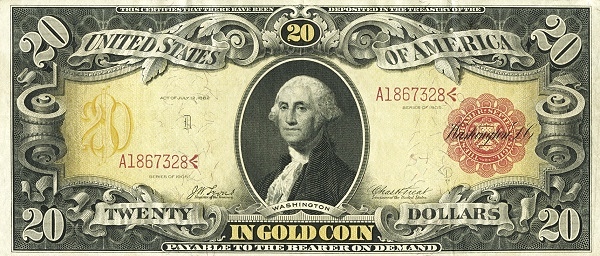
Pick up an 1882 Gold Certificate Brown Back in original Fine condition and the first thing that grabs you is the color. There is nothing quite like it in the whole sweep of American paper money. Where Legal Tender Notes blazed red, and National Bank Notes carried blue ink, the Gold Certificate series wrapped itself in warm amber, ochre, and deep orange-brown tones that seemed, almost literally, to smell of money. That color palette was no accident. It was a deliberate visual language spoken by the Treasury Department, the Bureau of Engraving and Printing, and the political economy of Gilded Age America all at once.
Series
1882 Gold Certificate (Brown Back)
Friedberg Numbers
Fr. 1194 to Fr. 1218c
Denominations Issued
$20, $50, $100, $500, $1,000, $5,000, $10,000
Authorizing Legislation
Act of July 12, 1882
Seal Color
Gold (yellow-orange)
Back Design
Large eagle over brown counters (“Brown Back” type)
A Brief History: Gold Certificates Before 1882
Gold Certificates are among the oldest classes of United States paper money. The first series was authorized under the Act of March 3, 1863, and issued beginning in 1865, though those earliest notes circulated almost exclusively among banks for interbank clearings and were never intended to be held by the general public. The Act of July 12, 1882 fundamentally changed that. Under this legislation, Gold Certificates became fully legal tender for all debts, public and private, between individuals, which opened the door to mass circulation. The Bureau of Engraving and Printing commenced production of the 1882 series almost immediately, delivering the first notes to the Treasury in late 1882 and continuing production through 1922 across several design subtypes.
The 1882 series produced three visually distinct back designs over its long life. Collectors today classify them as the Brown Back (issued roughly 1882 to 1905), the Blue Back (a short transitional run in 1905), and the Gold Back (the final long-running style). Each design evolution was partly aesthetic and partly a response to counterfeiting concerns, but it is the Brown Back that captures the original, philosophically intentional color vision of the Treasury’s designers.
Why Brown and Gold? The Visual Economics of Bullion Convertibility
To understand why the Treasury chose warm amber and orange-brown tones for these notes, you have to understand what a Gold Certificate actually promised. Unlike a Legal Tender Note, which was backed by the full faith and credit of the United States government, a Gold Certificate was a literal warehouse receipt. When you held a $20 Gold Certificate, you held a claim on exactly one ounce of gold coin deposited in the United States Treasury. The note was convertible on demand. That relationship to physical metal was the entire point of the instrument.
The Bureau of Engraving and Printing, working under Treasury Secretary Charles J. Folger and his successors, made a conscious choice to encode that relationship in color. The logic was partly practical and partly psychological. On the practical side, making Gold Certificates visually distinct from all other classes of currency reduced errors in commerce. Merchants, bank tellers, and the public needed to sort notes quickly, and a warm amber back stood out immediately from the green and black backs of National Bank Notes or the elaborate green backs of Legal Tender Notes. Confusion between currency classes could distort reserve accounting and complicate gold flows.
The psychological argument was equally important. Gold, as a cultural signifier, carried associations of warmth, permanence, and intrinsic value that green simply did not. By printing the backs of these certificates in a palette that visually echoed the color of refined gold and raw ore, the designers were reinforcing the certificate’s identity as a surrogate for the metal itself. Economic historians have pointed out that this kind of “visual rhetoric” was not unique to American currency, noting that German and British gold-backed instruments of the same era similarly adopted warm-toned papers and inks to distinguish them from credit-based notes. The Bureau’s designers were working within an international visual grammar.
Collector Tip
When evaluating color on an 1882 Brown Back, look for notes where the orange-brown ink on the reverse retains full saturation with no fading toward tan or gray. Heavily circulated or improperly stored examples often show significant color loss. A well-preserved brown back should display rich, warm tones. Color intensity is factored into technical grades by PCGS Currency and PMG, and a bright, original example often commands a premium above the straight technical grade.
The Printing Technology Behind the Color
Achieving consistent warm amber and orange-brown tones in 1880s intaglio printing was not a trivial challenge. The Bureau used iron-gall-based brown inks mixed with ochre and amber pigments for the distinctive back printing. The face of the note carried a portrait in black intaglio ink, a gold-colored Treasury seal, and the denomination counters in the same warm palette. The gold seal itself was printed using a separate lathework press pass with a specially prepared ochre-gold ink that mimicked, as closely as possible, the actual color of a polished $20 gold double eagle coin.
The paper stock used for the 1882 Gold Certificate series was also slightly different from that used for Legal Tender or Silver Certificate production. Treasury records and surviving examples confirm that the paper had a cream or slightly yellow base tint rather than the near-white stock used for other classes. This warm base tint amplified the amber impression of the printed inks, making the finished note appear more uniformly golden than any individual ink color could achieve on its own. Collectors examining examples under UV light will notice this tint difference clearly.
The “Brown Back” designation itself comes directly from the back printing. The central design element on the reverse of the 1882 series is a large spread eagle perched above the denomination statement, surrounded by elaborate lathe-work counters and scroll borders, all printed in that characteristic warm brown. The overall visual impression is dense, ornate, and distinctly warm-toned. Compare it to the cold blue-green of a Silver Certificate back from the same era and the contrast is immediately striking.
Collector Tip
The 1882 Brown Back $20 (Fr. 1178 through Fr. 1187) is the most accessible denomination for new collectors entering the series. Examples in VG to Fine condition appear regularly at major auction houses, and even problem-free Fine specimens can be found in the $600 to $1,200 range, making them a reasonably affordable entry point into large-size Gold Certificates. The $50 and $100 denominations jump significantly in price for comparable grades.
Signature Combinations and the Friedberg Catalog
The 1882 Gold Certificate Brown Back series spans a long production window, and multiple Treasury Secretary and Register of the Treasury signature combinations appear across the run. Collectors use the Friedberg reference (“Paper Money of the United States” by Arthur Friedberg and Ira Friedberg, now in its 22nd edition) as the authoritative catalog. Key signature pairings include:
- Bruce-Gilfillan (Fr. 1178, $20): The earliest pairings, scarce in all grades.
- Bruce-Wyman (Fr. 1179, $20): Slightly more available, but still condition-scarce.
- Rosecrans-Huston (Fr. 1182, $20): A transitional pairing, moderately scarce.
- Lyons-Roberts (Fr. 1185, $20): One of the more commonly encountered pairings in the $20 denomination, making it a popular choice for type collectors.
- Parker-Burke (Fr. 1187, $20): A late Brown Back pairing, scarcer than the Lyons-Roberts notes.
For the higher denominations, scarcity increases dramatically. The $500 (Fr. 1214 to Fr. 1216) and $1,000 (Fr. 1217 to Fr. 1218c) Brown Backs are major rarities. Only a handful of the $500 and $1,000 examples survive in any grade, and the few $5,000 and $10,000 notes from this era known to exist are effectively museum pieces. The $10,000 denomination 1882 Gold Certificate is one of the rarest notes in all of American numismatics, with population reports from PMG and PCGS Currency showing fewer than five graded examples combined across all signature varieties.
The 1905 Blue Back: A Brief Transitional Moment
In 1905, the Bureau produced a short transitional run of $20 Gold Certificates with a blue back (Fr. 1180), departing briefly from the warm brown palette before pivoting to the fully redesigned Gold Back type. The blue back was issued in extremely limited quantities and is today one of the signature rarities of the entire Gold Certificate series. This brief experiment is relevant to our color story because it confirms that the Bureau was actively reconsidering the color signaling of Gold Certificates around the turn of the century, ultimately deciding that the new Gold Back design, with its deep golden tones on the reverse, was the most effective continuation of the original visual vocabulary. The warm-toned identity of Gold Certificates was thus deliberately preserved even as the specific design was modernized.
Collector Tip
When pursuing higher-grade 1882 Brown Backs, prioritize examples that have been graded by PMG or PCGS Currency over raw notes, particularly in the $50 and above denominations. Cleaned, pressed, or chemically treated notes are a significant risk in this series due to their high values. Both major grading services use the designation “Net” for problem notes, and a PMG 25 Net note may trade at a fraction of the price of a straight PMG 25. Always review the full grading notation, not just the numeric grade.
Collecting the 1882 Brown Back Today
The 1882 Gold Certificate Brown Back series occupies a prestigious niche in large-size type collecting. For a collector building a complete large-size type set, a single example of the Brown Back, typically a $20 in VG or Fine condition, satisfies the type requirement at a manageable price. For the specialist, assembling a complete set by denomination and signature variety represents a formidable but deeply rewarding challenge. A full set by Friedberg number across all denominations would require acquiring some of the rarest individual notes in American numismatics and would represent a collection of extraordinary value and historical significance.
The visual beauty of these notes is a significant part of their enduring appeal. Unlike some series whose historical importance outpaces their aesthetic pleasure, the 1882 Brown Back delivers both. In high grades, the contrast between the black intaglio portrait work on the face, the warm gold Treasury seal, and the rich amber-brown back printing creates a note that is genuinely beautiful as an object. That beauty is inseparable from its meaning: every element of the color scheme is doing numismatic and economic work, communicating the note’s nature to anyone who looks at it carefully.
| Friedberg No. |
Denomination / Signatures |
Known / Est. Print Run |
Rarity |
| Fr. 1185 |
$20, Lyons-Roberts |
Large run, many survivors |
Common |
| Fr. 1178 |
$20, Bruce-Gilfillan |
Moderate run, few survive |
Scarce |
| Fr. 1187 |
$20, Parker-Burke |
Limited late production |
Scarce |
| Fr. 1197 |
$50, Lyons-Roberts |
Moderate, condition-scarce |
Scarce |
| Fr. 1205 |
$100, Lyons-Roberts |
Limited survivors in Fine+ |
Rare |
| Fr. 1214 |
$500, Lyons-Roberts |
Fewer than 20 known |
Rare |
| Fr. 1217 |
$1,000, Lyons-Roberts |
Fewer than 10 known |
Key Date |
| Fr. 1180 |
$20 Blue Back (1905) |
Est. under 200 survivors |
Key Date |
| Fr. 1218c |
$1,000, Vernon-McClung |
Extremely few known |
Key Date |
Conclusion: Color as Currency Language
The warm amber and orange-brown palette of the 1882 Gold Certificate Brown Back was never merely decorative. It was a functional design decision rooted in the realities of bullion-backed finance, the practical needs of commerce, and the psychological logic of visual communication. The Bureau of Engraving and Printing’s designers understood that color could carry meaning in currency the way that no amount of fine print could replicate. When a merchant in 1890 received a Gold Certificate across a counter, the warm tones of the note communicated its nature at a glance: this is not credit, this is not government promise, this is gold on paper.
For collectors today, that history is embedded in every surviving example. Holding an 1882 Brown Back is holding a physical artifact of the gold standard economy, and the colors on the note are part of that artifact’s meaning. Understanding why those colors were chosen enriches the experience of collecting these notes immensely. Whether you are pursuing a single affordable $20 type note or embarking on a serious specialist collection, the 1882 Gold Certificate Brown Back series rewards careful study and genuine engagement with the history it carries in its ink.