📷 Image source: banknote.ws (World Banknote Gallery). Images are selected by AI to represent the article topic and may not depict the exact note(s) described.
Tuck a worn 1863 five-cent fractional note between your fingers and you are holding something that most people overlook: a miniature political manifesto. Printed in haste as silver and copper coins vanished from circulation almost overnight, the United States Fractional Currency issues of 1862 to 1876 were emergency money, stopgap finance, and patriotic statement all at once. Among the most visually striking design elements scattered across these small notes is the Phrygian cap, an ancient symbol of freed slaves and republican revolution that American engravers borrowed from the French and wove into the very fabric of wartime small change. For collectors, understanding that symbol unlocks deeper appreciation for why certain varieties command serious premiums and why these fragile little pieces deserve far more respect than their face value suggests.
What Is the Phrygian Cap and Why Did It End Up on American Currency?
The Phrygian cap, also called the liberty cap or pileus, originated in ancient Anatolia and entered Roman culture as the headgear ceremonially placed on a slave at the moment of manumission, the legal act of freeing him. When a slave pulled on that soft, forward-curving felt cap, he became a freedman. The symbol migrated through centuries of European iconography, appearing on coins of the Roman Republic, in Renaissance allegories of Liberty, and most explosively during the French Revolution, when the bonnet rouge became the emblem of the sans-culottes and the entire radical republican movement. American revolutionaries had already absorbed the cap by 1776, placing it on poles and medallions, and the U.S. Mint put it atop the Liberty staff on the classic Flowing Hair and Draped Bust large cents as early as 1793.
By 1862 the symbol carried an unmistakable double meaning. As the Civil War ground forward and the Emancipation question moved from the margins to the center of national politics, a liberty cap on federal paper money was not decorative filler. It was an argument. Treasury Department engravers, working under Salmon P. Chase, were steeped in the same Unionist-Republican iconography that would culminate in the Emancipation Proclamation of January 1, 1863. Placing the Phrygian cap on fractional currency issued during that same period connected everyday commerce to the war’s evolving moral stakes.
When examining fractional currency for the Phrygian cap design, use a 5x loupe rather than a magnifying glass. The engraved detail on Third Issue 5-cent notes is surprisingly fine, and the quality of that cap device is one of the first things to check when distinguishing the scarce “with surcharge” varieties from the common plain-back examples.
The Five Series at a Glance: Where the Cap Appears
Fractional currency collectors organize their holdings by series, and each series has its own roster of designs, paper types, and printing varieties. The Phrygian cap is not omnipresent across all five issues, which makes its appearances feel more deliberate.
First Issue: Postage Currency (August 1862 to May 1863)
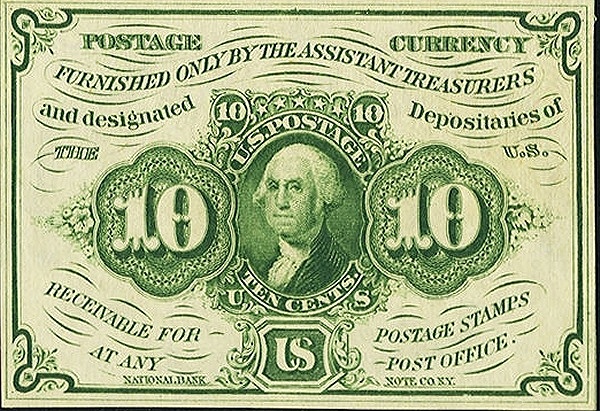
The First Issue, commonly called Postage Currency because its face designs reproduced the postage stamp images then in use, does not feature the liberty cap as a major design element. These notes carried portrait vignettes of Washington (5 cents, Fr. 1228 to 1232) and Jefferson (10 cents, Fr. 1240 to 1244), along with 25-cent and 50-cent values reproducing five-stamp and five-stamp groupings. They were printed by the American Bank Note Company on a perforated-edge format intended to look like stamps. Survival rates are relatively high in circulated grades, but mint-state examples are genuinely scarce because most notes passed through many hands rapidly.
Second Issue (October 1863 to February 1867)
The Second Issue brought the notes fully in-house to the Treasury’s own Bureau of Engraving facilities and introduced bronze oval surcharges printed over the face designs to deter counterfeiting. All Second Issue notes carry a portrait of George Washington on a brass-colored oval. The reverse introduces a more elaborate ornamental geometry, and the liberty cap motif begins appearing in border work, though not yet as a dominant central device. The 5-cent Second Issue (Fr. 1233 to 1239) and the 25-cent Second Issue (Fr. 1283 to 1291) are the denominations where careful study of the surcharge varieties rewards collectors with significant value spreads between varieties differing only by the presence, position, or style of the bronze overprint.
Third Issue (December 1864 to August 1869): The Cap Takes Center Stage
This is where the Phrygian cap collector’s journey becomes genuinely exciting. The Third Issue 5-cent note (Fr. 1238 types through the standard Third Issue sequence beginning at Fr. 1238) places an unmistakable allegorical female head wearing the liberty cap as a central vignette on the reverse of several varieties. The design, engraved by the Bureau of Engraving and Printing under Spencer M. Clark’s supervision, shows the cap perched jauntily forward on a classical female profile, a direct visual quotation of the French Marianne imagery that had circulated through transatlantic radical print culture for two decades. The obverse continues to feature Washington on some denominations, but the reverse liberty-cap figure is the piece’s visual heart.
Third Issue notes were printed in enormous quantities to meet wartime demand, yet survivors in Fine or better condition are not as abundant as raw print-run numbers suggest. Paper quality was inconsistent, and notes that circulated heavily became limp and stained. The 3-cent Third Issue note (Fr. 1226 to 1227) is a particularly challenging denomination to find in collectible condition because its small physical size made it vulnerable to loss and damage.
Third Issue 5-cent notes (Fr. 1238 series) exist with and without a fiber paper variety, and with red or pink backs versus green backs depending on the specific printing. Before purchasing a raw example described simply as “Third Issue 5 cent,” confirm the exact Friedberg number. The fiber paper variety with a green back commands a significant premium over the more common red-back examples at equivalent grades.
Fourth Issue (July 1869 to February 1875)
The Fourth Issue brought larger, more elaborate designs and introduced the distinctive large Treasury seal on the face of most notes. The liberty cap appears prominently in allegorical vignettes on the 10-cent and 15-cent denominations. The 15-cent denomination (Fr. 1267 to 1272), unique to the Fourth Issue and never repeated in American currency history, features a Columbia figure clearly influenced by the cap-and-staff Liberty tradition. Collecting the complete 15-cent type set is a manageable goal for intermediate collectors, though several varieties, particularly those with a large red seal (Fr. 1272), carry retail values of several hundred dollars in Fine condition.
The 50-cent Fourth Issue notes (Fr. 1374 to 1379) are the denomination where serious money enters the picture. The Lincoln portrait variety (Fr. 1374 to 1375) and the Stanton portrait variety (Fr. 1376 to 1378) include ornamental border elements drawing on the same republican iconography as the cap, though the cap itself is not the dominant motif here. Still, the thematic unity of the entire fractional currency program, celebrating Union, liberty, and republican government, is impossible to miss.
Fifth Issue (February 1874 to February 1876)
The Fifth and final issue simplified designs significantly, moving toward cleaner engraving and more uniform formats. The Phrygian cap fades from prominence here as the national mood shifted from wartime urgency to Reconstruction-era pragmatism. The 10-cent and 25-cent Fifth Issue notes (Fr. 1264 to 1266 and Fr. 1308 to 1310) are common in circulated grades and make excellent introductory pieces for new collectors given their affordability, often available for under thirty dollars in Very Good condition.
The Iconographic Argument: Liberty and Emancipation
Historians of American material culture have increasingly recognized fractional currency as a significant propaganda medium. Salmon Chase, Lincoln’s Treasury Secretary and a lifelong antislavery politician, oversaw the design program during its critical early years. Chase had run for president in 1860 on a platform centered on containing slavery, and he understood symbolic politics acutely. The choice to embed liberty-cap imagery into federal currency issued simultaneously with the Emancipation Proclamation process was unlikely to be accidental.
The Phrygian cap on these notes spoke to three overlapping audiences simultaneously: European creditors familiar with French republican imagery, Northern working-class consumers who associated the cap with artisan radicalism and the free-labor ideology, and freed and soon-to-be-freed Black Americans for whom the cap’s original meaning, the headgear of the manumitted slave, carried personal and historical weight that no other symbol could replicate. On a five-cent note changing hands in a Philadelphia market stall or a Cincinnati dry-goods store in 1864, that layered symbolism was compressed into an image barely half an inch tall.
Many fractional currency notes have been cleaned, pressed, or even expertly repaired, since paper conservation techniques have improved dramatically over the past century. When buying Third or Fourth Issue examples in grades above Fine, strongly consider submitting to PMG or PCGS Currency for authentication and grading before paying strong collector premiums. Pressed notes often show artificially sharp folds that betray their treatment under close examination with raking light.
Condition, Grading, and Realistic Price Expectations
Fractional currency grading follows standard PMG and PCGS Currency scales, but several considerations are specific to this series. Edge tears and missing corners are extremely common because notes were often clipped from sheets carelessly. A note graded VF-25 with minor edge nicks by a major grading service is still a desirable example; do not reject circulated fractional currency reflexively. Many dealers price raw examples generously in Fine to Very Fine condition between fifteen and seventy-five dollars for most common Third and Fourth Issue types, making this one of the most accessible series in all of U.S. paper money collecting.
The genuine rarities, including the First Issue 25-cent perforated-edge with straight-edge double-denominations, certain fiber-paper Third Issue varieties, and the Fourth Issue 15-cent large-seal type, trade for hundreds to low thousands of dollars and appear infrequently at major auction. The 2014 Heritage sale of a PMG 65 EPQ Third Issue 5-cent fiber paper note realized over four hundred dollars, a figure that illustrates how condition rarity shapes pricing even within a normally modest series.
| Series / Friedberg No. | Denomination and Variety | Approx. Known or Print Notes | Rarity |
|---|---|---|---|
| First Issue, Fr. 1230 | 5 Cents, Perforated Edges, ABNCo. Monogram | Several thousand known | Scarce |
| Second Issue, Fr. 1233 | 5 Cents, No Surcharge Obverse | Common in circulated grades | Common |
| Third Issue, Fr. 1238 | 5 Cents, Red Back, No Surcharge | High print run, VF+ scarce | Common |
| Third Issue, Fr. 1239 | 5 Cents, Fiber Paper, Green Back | Significantly lower survival | Scarce |
| Fourth Issue, Fr. 1267 | 15 Cents, Large Red Seal, Colby-Spinner | Est. low tens of thousands | Scarce |
| Fourth Issue, Fr. 1272 | 15 Cents, Large Red Seal, Allison-Spinner | Fewer than 5,000 estimated | Rare |
| Fourth Issue, Fr. 1374 | 50 Cents, Lincoln Portrait, Pink Seal | Moderate survivors, condition-rare | Scarce |
| First Issue, Fr. 1228 | 5 Cents, Straight Edge, No Monogram | Widely available in G-VG | Common |
| Third Issue, Fr. 1226 | 3 Cents, Liberty Cap Reverse | Small denom., high attrition rate | Rare |
| Fourth Issue, Fr. 1376 | 50 Cents, Stanton Portrait, Green Seal | Key condition rarity above VF | Key Date |
Building a Thematic Liberty Cap Collection
One of the most satisfying ways to collect fractional currency is around a thematic spine rather than attempting to complete every variety in every series. A Phrygian cap thematic collection might include: a First Issue 5-cent note to represent the origin of the series and its proto-republican imagery; a Third Issue 5-cent note in at least Fine condition to display the central liberty-cap vignette at its clearest; a Fourth Issue 15-cent note in either of its main varieties to capture the unique denomination and its Columbia figure; and a pre-Civil War large cent from 1793 to 1857 showing the cap atop the Liberty staff for historical context. Displayed together in a currency album with explanatory notes, this group tells a coherent story about American iconographic history that spans nearly a century.
Dealers specializing in obsolete and broken-bank currency often have fractional currency in stock at reasonable prices. The major grading services, PMG and PCGS Currency, both maintain population reports that allow collectors to track how many examples of each variety have been certified, which is invaluable for gauging true rarity versus perceived rarity in this series.
Conclusion: Small Notes, Large History
The Phrygian cap on fractional currency is not an accident of design or a decorative afterthought. It is a considered visual argument, printed in millions of impressions and distributed into the hands of Americans living through the most convulsive moment in their national history. Collectors who take the time to understand that argument hold something rare: paper money that was doing ideological work as well as economic work, simultaneously lubricating commerce and insisting on the meaning of the war being fought to preserve the Union and end slavery. For the price of a good lunch, a new collector can own a genuine piece of that history in the form of a Third Issue 5-cent note. For considerably more, a focused collector can build a reference-quality set that documents the full symbolic range of the series. Either way, the Phrygian cap is waiting, a few millimeters tall and a few thousand years old, on a note that once bought a newspaper or a bread roll on the streets of wartime America.