📷 Image source: banknote.ws (World Banknote Gallery). Images are selected by AI to represent the article topic and may not depict the exact note(s) described.
Of all the faces that have appeared on United States paper money, few are as obscure to the general public, yet as fascinating to currency historians, as William Windom. His portrait graces the face of the Series 1891 $2 Silver Certificate, a note that combines genuine rarity, elegant engraving, and a compelling political backstory. If you have encountered one of these notes in a dealer’s case or an auction catalog and wondered who that serious-looking gentleman is, you are not alone. The story behind Windom’s appearance on this note touches on Gilded Age politics, the silver coinage debates of the late nineteenth century, and the peculiar tradition of placing living or recently deceased officials on American currency.
Who Was William Windom?
William Windom was born on May 10, 1827, in Belmont County, Ohio, and came of age during the turbulent decades that would culminate in the Civil War. He studied law, was admitted to the bar, and moved to Winona, Minnesota, in 1855, where he quickly built a reputation as a capable attorney and an ambitious Republican politician. His rise was swift: he served in the United States House of Representatives from 1859 to 1869, developing expertise in finance and appropriations that would define his entire career.
Windom served as a United States Senator from Minnesota for two separate periods, from 1870 to 1881 and again briefly in 1881 and from 1881 to 1883. His Senate work on the Finance Committee gave him national prominence on monetary questions at a moment when the debate over silver coinage was becoming one of the defining political battles of the era. He was a moderate on silver, generally favoring policies that would expand the money supply without fully committing to free and unlimited silver coinage, a position that made him broadly acceptable across Republican factions.
President James Garfield appointed Windom as Secretary of the Treasury in 1881, a tenure cut tragically short by Garfield’s assassination. Windom returned to the Senate and remained a respected voice on economic matters throughout the 1880s. His second and final chapter as Treasury Secretary came when President Benjamin Harrison appointed him to the post in 1889. It was during this second tenure that Windom would preside over the negotiations surrounding the Sherman Silver Purchase Act of 1890, which required the Treasury to purchase 4.5 million ounces of silver per month. Windom supported a version of silver policy that emphasized Treasury notes redeemable in silver, an approach that placed him at the center of the monetary controversies that were reshaping American banking.
When attributing a Series 1891 $2 Silver Certificate, check the signature combination carefully. The Rosecrans / Nebeker pairing (Register of the Treasury / Treasurer of the United States) is considered scarcer than the Tillman / Morgan combination. Both combinations appear with the same Windom portrait, and the difference can significantly affect value in higher grades.
Why Windom Ended Up on the Note
The tradition of placing portraits on paper currency was governed more by politics and timing than by any formal protocol in the nineteenth century. The Act of April 7, 1866, had prohibited the placement of living persons on United States coins, but no equivalent restriction applied to paper money for most of this period. As a result, Treasury officials, including secretaries whose offices oversaw currency design and production, sometimes found their own likenesses on the notes issued during their tenures.
William Windom died suddenly on January 29, 1891, collapsing at a banquet of the New York Board of Trade and Transportation shortly after delivering a speech on silver policy. He had been actively serving as Treasury Secretary at the time of his death. The Bureau of Engraving and Printing had been working on the new Series 1891 Silver Certificate designs, and it became a form of official tribute to place Windom’s portrait on the $2 denomination of that series. The timing meant that Windom was very recently deceased, if not technically still alive during early production planning, when the design was finalized.
This kind of commemorative portraiture was not unusual for the era. The Series 1886 $1 Silver Certificate features Martha Washington, the only woman ever to appear on a circulating United States currency note. The 1886 and 1891 $5 Silver Certificates display General Ulysses S. Grant and General Philip Sheridan respectively. Portrait selection was often tied to the political and cultural moment rather than to any enduring logic about whose face belonged on money.
Describing the Note: Design and Engraving
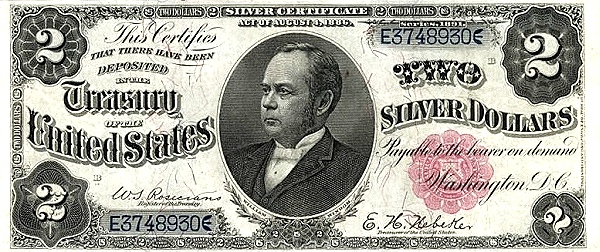
The Series 1891 $2 Silver Certificate is one of the most visually appealing small-denomination notes of the nineteenth century. The face of the note centers on Windom’s engraved portrait, a dignified oval vignette positioned in the center of the note. The engraving is fine work from the Bureau of Engraving and Printing, capturing Windom with the formal bearing expected of a senior official. The large red Treasury seal appears to the right of the portrait, and the word “SILVER CERTIFICATE” is prominently printed across the upper portion of the face. The obligation text reads that the certificate is receivable for customs, taxes, and all public dues, and that the bearer is entitled to receive two silver dollars.
The back of the note is equally striking. The reverse design uses a rich green ink and features highly ornate geometric lathe work surrounding a large central panel with the denomination “TWO” rendered in elaborate scroll engraving. The overall aesthetic is characteristic of the high Victorian period in American banknote design, a period when the Bureau of Engraving and Printing was competing with private bank note companies and invested heavily in complex, visually dense designs as a deterrent to counterfeiting.
The reverse of the 1891 $2 Silver Certificate is highly susceptible to ink oxidation and toning in problem-free circulated examples. When evaluating a note for purchase, examine the green reverse ink under good lighting for uneven fading or staining around the margins, which can affect eye appeal even on technically problem-free notes graded by PCGS Currency or PMG.
The Signature Combinations and Their Significance
Series 1891 $2 Silver Certificates were issued with two distinct signature combinations, both of which are important to understand for proper attribution and valuation. The first pairing is that of Daniel N. Morgan as Treasurer and James Fount Tillman as Register of the Treasury. The second, and generally scarcer, pairing is William S. Rosecrans as Register and Enos H. Nebeker as Treasurer. In United States paper money, the Register’s signature appears on the left and the Treasurer’s signature appears on the right on notes of this era.
Both combinations were produced in relatively modest quantities compared to later Federal Reserve issues, and both are considered genuinely scarce in upper circulated grades such as Extremely Fine 40 or better. In gem uncirculated condition, graded MS 65 or higher by PMG or PCGS Currency, these notes are legitimately rare and command strong premiums at auction. A Rosecrans / Nebeker example in PMG 65 Gem Uncirculated sold for over $18,000 at a major auction in recent years, reflecting genuine collector demand for high-grade examples of this classic note.
Placing the Note in Its Historical Context
The 1891 $2 Silver Certificate was issued during one of the most contentious periods in American monetary history. The battle between gold standard advocates and silver coinage proponents was reaching its peak intensity. The Sherman Silver Purchase Act had just been passed in 1890, expanding Treasury silver purchases significantly. William Windom had been at the center of those negotiations, and the notes bearing his portrait circulated during the very years when the silver question was tearing the Democratic Party apart and setting the stage for William Jennings Bryan’s famous “Cross of Gold” speech at the 1896 Democratic National Convention.
Silver Certificates themselves were a product of the Bland-Allison Act of 1878, which required the Treasury to purchase silver and issue certificates backed by silver dollars held in Treasury vaults. The $2 denomination was never a particularly popular one with the public, which is part of why surviving examples in high grades are scarcer than their $1 and $5 counterparts from the same series. Many $2 notes were returned to banks and eventually redeemed and destroyed, making high-grade survivors all the more prized by collectors today.
If you are building a type set of nineteenth-century Silver Certificates, the 1891 $2 Windom note is the only way to represent this denomination and series. A Fine 15 or Very Fine 20 example offers an accessible entry point into the series without requiring the significant investment of an Extremely Fine or better specimen. Problem-free mid-grade examples with good color are becoming harder to find at reasonable prices as collector awareness of this note increases.
| Series / Signatures | Seal Color / Variety | Est. Known in VF or Better | Rarity |
|---|---|---|---|
| 1891, Rosecrans / Nebeker | Red Seal, Standard Issue | Fewer than 150 | Rare |
| 1891, Tillman / Morgan | Red Seal, Standard Issue | 200 to 350 est. | Scarce |
| 1891, Rosecrans / Nebeker | Red Seal, Gem Uncirculated (65+) | Fewer than 12 graded | Key Date |
| 1891, Tillman / Morgan | Red Seal, Gem Uncirculated (65+) | Fewer than 20 graded | Rare |
| 1891, Any Signatures | Fine 12 to VF 30, Problem-Free | Several hundred known | Scarce |
| 1891, Any Signatures | Good to Very Good, Circulated | Wider survival, still limited | Common (rel.) |
| 1886 $2 Silver Certificate (comparison) | Red Seal, Gen. Hancock portrait | More plentiful than 1891 | Scarce |
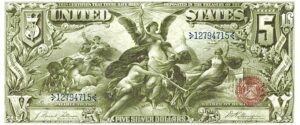
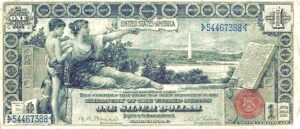
| 1896 $2 Silver Certificate (comparison) | “Educational” Series | Moderate survival rate | Scarce |
Windom’s Legacy Beyond the Note
William Windom did not achieve the lasting name recognition of a Hamilton or a Chase, but his contributions to American fiscal policy during two critical periods were genuine and substantive. His work on the appropriations process in Congress, his advocacy for a measured approach to silver coinage, and his role in shaping the Sherman Silver Purchase Act negotiations all marked him as an important figure in Gilded Age economic history. The town of Windom, Minnesota, named in his honor, remains a small but tangible reminder of his connection to that state.
For currency collectors, however, his legacy is most immediately visible in the engraved oval on the face of the 1891 $2 Silver Certificate. Every note bearing his portrait is a small artifact connecting the holder to one of the most turbulent and consequential monetary debates in American history. Whether you are a specialist in Silver Certificates, a generalist building a representative collection of nineteenth-century type notes, or simply someone who appreciates the intersection of political history and numismatics, the Windom $2 Silver Certificate deserves a place in your study collection.
Conclusion: A Note Worth Knowing
The 1891 $2 Silver Certificate bearing William Windom’s portrait is more than a curiosity. It is a well-engraved, historically significant note that represents a specific moment in American monetary and political history. Windom’s sudden death in January 1891 gave his portrait an added poignancy: the note became, almost immediately upon issue, a memorial to a man who had shaped the very debates that Silver Certificates embodied. Collectors who take the time to understand the man behind the portrait will find that this note rewards deeper attention, both as a piece of fine engraving and as a document of American history. As with so many nineteenth-century issues, the window for acquiring problem-free, attractively graded examples at reasonable prices is not unlimited. The serious collector would do well to keep this note on the want list.