📷 Image source: banknote.ws (World Banknote Gallery). Images are selected by AI to represent the article topic and may not depict the exact note(s) described.
Flip a 1923 $5 Silver Certificate over and you are looking at history twice over. The Lincoln Memorial engraving on its reverse depicts the monument in its earliest days of public life, freshly dedicated on May 30, 1922, and still gleaming with the newness of freshly quarried Colorado Yule marble. When the Bureau of Engraving and Printing incorporated that image into the Series 1923 note, the memorial had been open to visitors for less than a year. The scaffolding was gone, but the landscaping was unfinished, the reflecting pool was not yet complete in its final form, and the surrounding grounds still bore the scars of a construction project that had dragged on since 1914. What you hold in your hand, in other words, is a snapshot of America still deciding what to do with one of its most iconic spaces.
A Monument Still Finding Its Footing
Construction on the Lincoln Memorial began in 1914, though the project was plagued by the kinds of delays that characterized large federal undertakings of the Progressive Era. Architect Henry Bacon drew on classical Greek temple design for the structure, specifying 36 Doric columns to represent each state in the Union at the time of Lincoln’s death. The marble came from three separate sources: Colorado Yule marble for the exterior, Pink Tennessee marble for the floors and walls of the interior, and Indiana limestone for the terrace. Sourcing and transporting these materials stretched the timeline considerably.
The dedication ceremony on May 30, 1922, was attended by President Warren G. Harding and the aging Robert Todd Lincoln, who died just three years later. But dedication did not mean completion in any landscaping or horticultural sense. The long rectangular reflecting pool stretching toward the Washington Monument was still being finished in 1922 and into 1923. Photographic records from that period show bare earth, temporary walkways, and construction equipment lingering at the edges of the site. It is this transitional version of the memorial, cleaned up but not yet fully settled into its permanent surroundings, that the engravers at the Bureau of Engraving and Printing worked from.
When examining the reverse engraving of the 1923 $5, look closely at the rendering of the grounds surrounding the memorial. The simplified treatment of the landscape is not artistic shorthand; it reflects the genuinely unfinished state of the site when the engraving plates were prepared in late 1922 and early 1923. A loupe or magnifying glass at 5x to 10x magnification will reveal fine line work in the colonnade that demonstrates exceptional craftsmanship by the Bureau’s intaglio engravers.
The 1923 Series: Design and Specifications
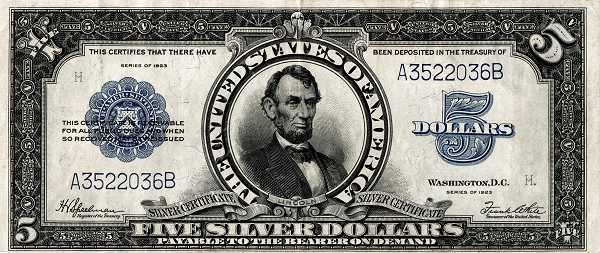
The Series 1923 $5 Silver Certificate is cataloged as Friedberg 282 in the standard reference work by Arthur Friedberg and Ira Friedberg, “Paper Money of the United States.” It belongs to the large-size format that was phased out when the federal government transitioned to small-size currency in 1928. At 7.375 inches by 3.125 inches, large-size notes have a physical presence that modern collectors find immediately striking when compared to the smaller notes that followed.
The obverse carries a portrait of Abraham Lincoln at center, framed by the bold blue serial numbers and blue Treasury seal that identify it as a Silver Certificate rather than a Federal Reserve Note or United States Note. The note was redeemable in silver dollars on demand, a feature that gave Silver Certificates a tangible monetary backing that resonated with the American public during a period of lingering distrust toward purely fiat currency. The signature combination found on Fr. 282 is that of Register of the Treasury H.V. Speelman and Treasurer of the United States Frank White, who served together from 1921 through 1927.
Total print runs for the 1923 series were substantial by large-size standards, but circulation wear took a severe toll. These notes passed through millions of hands during the 1920s and into the early 1930s before the 1928 small-size transition prompted most to be redeemed and destroyed. The survival rate in collectible grades is far lower than the original print figures might suggest.
Series 1923 $5 Silver Certificates are among the last large-size notes produced before the 1928 redesign, which makes them a natural capstone for a large-size type set. A circulated example in Very Fine (VF-20 to VF-35) condition is realistically achievable for most collectors, with retail prices typically ranging from $200 to $450 depending on eye appeal and centering. Gem uncirculated examples graded MS-65 by PMG or PCGS Currency can fetch $3,000 or more at major auction.
The Engraving: A Bureau Masterwork
The reverse engraving of the Lincoln Memorial on the 1923 $5 is widely regarded as one of the finest architectural vignettes in American currency history. The Bureau of Engraving and Printing employed master engravers who worked from detailed architectural drawings and early photographs of the completed structure. The rendering captures the depth of the colonnade, the shallow steps leading to the entrance, and the low-profile terrace walls with a precision that rewards examination under magnification.
What makes the engraving particularly interesting from a historical standpoint is the treatment of the immediate surroundings. Compare the 1923 reverse to the same Lincoln Memorial vignette as it appeared on later small-size Federal Reserve Notes, particularly the Series 1934 and beyond $5 Federal Reserve Notes. By the time those notes were produced, the grounds were fully landscaped, the reflecting pool was long established in public consciousness, and photographic references available to engravers showed a mature, settled monument. The 1923 image has a slightly more austere, architectural quality that reflects its source material: drawings and early photographs rather than a memorial fully embedded in its parkland setting.
Star Notes and Varieties
Collectors seeking additional depth within the 1923 $5 series should be aware of the star replacement notes. Star notes for this issue are cataloged as Fr. 282* and are significantly scarcer than regular issues. Unlike modern Federal Reserve star notes, which are documented with reasonably precise print run data from the Bureau of Engraving and Printing, large-size star note populations are estimated primarily through census data compiled from known survivors. PMG and PCGS Currency population reports as of recent years show fewer than 40 examples of Fr. 282* across all grades, making a choice example a genuinely rare find.
There are no significant plate letter varieties for this issue in the manner of some other large-size series, but collectors should pay attention to serial number prefixes and centering when evaluating individual examples. Notes with serials in the lower ranges can sometimes command a modest premium among specialists who focus on early-production examples.
If you are pursuing a star note example of Fr. 282*, set realistic expectations: you may wait years for a choice example to surface at auction. In the meantime, registering with major auction houses like Heritage Auctions, Stack’s Bowers, or Lyn Knight Currency Auctions for want-list notifications is the most efficient way to track these elusive pieces. A VF example of the star note, when it does appear, will typically sell in the range of $2,500 to $6,000 or more depending on competition.
Grading Considerations for the 1923 $5
Large-size Silver Certificates of this era present specific grading challenges that collectors should understand before purchasing. The most common problems encountered are:
Folds and creases: The large format made these notes susceptible to handling folds along the center both horizontally and vertically. A single sharp center fold drops a note from Fine to Very Good territory under standard third-party grading standards. Always examine scans carefully for evidence of pressed or ironed folds, which can be deceptively hard to detect in photographs.
Margin quality: Centering on 1923 large-size notes varies considerably. The BEP’s sheet-fed printing process of the era was less precisely calibrated than modern currency production, and notes with equal margins on all four sides command a premium over shifted examples. Wide, balanced margins are a positive factor at every grade level.
Paper quality: The distinctive fibrous paper used for large-size notes can develop rust spots, foxing, or edge splits over a century of storage. Notes that have been stored in humid conditions often show toning or staining that suppresses grades significantly. Third-party graded examples in holders from PMG or PCGS Currency provide the best protection against misrepresentation.
| Friedberg Number | Type / Variety | Est. Print Run | Rarity |
|---|---|---|---|
| Fr. 282 | 1923 $5 Silver Cert., Speelman/White, Regular Issue | Approx. 17,600,000 | Common |
| Fr. 282* | 1923 $5 Silver Cert., Speelman/White, Star Note | Est. under 100,000 | Key Date |
| Fr. 271 | 1899 $5 Silver Cert., Chief Running Antelope | Approx. 25,800,000 | Scarce |
| Fr. 278 | 1908 $5 Silver Cert., Speelman/White | Approx. 8,900,000 | Scarce |
| Fr. 1650 | 1934 $5 FRN (small-size), Lincoln Memorial reverse introduced | Over 900,000,000 combined | Common |
| Fr. 282, Low Serial | 1923 $5, Serial A00000100A or below | Under 100 known survivors | Rare |
| Fr. 282, Gem CU | 1923 $5 graded PMG/PCGS 65 EPQ or better | Fewer than 30 certified | Rare |
| Fr. 281 | 1923 $5 Silver Cert., Elliott/Burke signature combo | Approx. 5,600,000 | Scarce |
Placing the Note in a Broader Collection
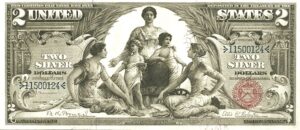
The 1923 $5 Silver Certificate sits at a meaningful crossroads in any serious large-size collection. It is the final series of large-size $5 Silver Certificates, making it the capstone of a run that stretched back to 1886 and included some of the most visually dramatic designs in American currency history, including the 1896 Educational Series and the 1899 Chief Running Antelope note (Fr. 271). For collectors building a type set of large-size Silver Certificates, Fr. 282 is an essential piece, and its architectural reverse subject matter gives it a thematic connection to the small-size $5 notes that followed in 1928 and carried the Lincoln Memorial image on their reverses all the way through 2020.
That continuity is part of what makes the 1923 note so rewarding to study. The Lincoln Memorial engraving that debuted on this series established a visual vocabulary for the $5 denomination that persisted for nearly a century. When the Bureau of Engraving and Printing redesigned the small-size $5 in 2008, adding the commemorative images to the Lincoln Memorial reverse, they were working within a tradition that traced directly back to those engravers of 1922 and 1923 who first studied Henry Bacon’s architectural drawings and translated them into the fine lines of an intaglio printing plate.
A Practical Buying Guide
For new collectors approaching Fr. 282 for the first time, a circulated example in Fine to Very Fine condition represents an excellent entry point. Budget between $175 and $350 for a solid VF example with good color and no major problems. Avoid notes with pinholes, tape repairs, or chemical cleaning, all of which will severely limit resale value and are red flags for condition problems that a seller may be trying to conceal.
Intermediate collectors looking to upgrade should focus on the Extremely Fine to About Uncirculated range (EF-40 to AU-55 in PMG notation), where the note shows minimal handling and retains strong paper quality. Expect to pay between $600 and $1,500 in this range, with the highest prices going to examples with exceptional eye appeal and original paper brightness.
Advanced collectors targeting gem examples should rely exclusively on third-party certified holders from PMG or PCGS Currency and should study population reports carefully before committing to high prices. The combination of a genuine PMG 65 EPQ designation and superb centering on a 1923 $5 is genuinely uncommon, and pieces meeting that standard belong in any serious reference collection of large-size type.
Conclusion: A Note That Tells Two Stories
The 1923 $5 Silver Certificate earns its place in numismatic history for reasons that go beyond its status as the final large-size issue of its type. It documents a specific moment in the life of one of America’s most beloved monuments, capturing the Lincoln Memorial in the first months after its dedication, before the grounds were finished and before the reflecting pool had settled into the iconic image that appears on millions of postcards and film frames every year. For collectors who care about context as much as condition, that narrative dimension makes Fr. 282 something genuinely special: a piece of paper that is simultaneously a financial instrument, an engraver’s masterwork, and a photograph in ink of history still in progress.