📷 Image source: banknote.ws (World Banknote Gallery). Images are selected by AI to represent the article topic and may not depict the exact note(s) described.
Walk through any major currency auction catalog from the past decade and one note stops collectors cold: the Series 1922 $500 Gold Certificate bearing the portrait of James Monroe. It is the only piece of U.S. paper money ever to feature the fifth President of the United States, and it exists at the intersection of political history, monetary policy, and sheer numismatic rarity. For most collectors, this note occupies the same legendary territory as the 1890 $1,000 Treasury Note or the 1863 $1,000 Legal Tender. You may never own one, but you absolutely need to understand it.
A Note That Almost Wasn’t
The Gold Certificate program had existed in various forms since 1865, when Congress authorized the first series to simplify large commercial transactions. By the early twentieth century, Gold Certificates had evolved into some of the most elegantly designed notes the Bureau of Engraving and Printing ever produced. The Series 1922 large-size Gold Certificates represented the final flowering of that tradition before the Federal Reserve era redefined American currency.
The $500 denomination within that series carries Friedberg catalog number 1217 and bears the signatures of Register of the Treasury H.V. Speelman and Treasurer Frank White. Notes were delivered beginning in 1923, which is why collectors and dealers routinely refer to these as the “1923” $500 Gold Certificates even though the series date printed on the face reads 1922. This distinction trips up newer collectors regularly, so it is worth remembering: series date and delivery date are not the same thing.
Why James Monroe? The Politics of Portrait Selection
Portrait selection for U.S. currency in the late nineteenth and early twentieth centuries was rarely random. Treasury officials, the BEP’s master engravers, and occasionally Congress all had input, and the results reflected a combination of aesthetic judgment, political calculation, and simple precedent. Monroe’s placement on the $500 Gold Certificate is generally attributed to a systematic effort to distribute presidential portraits across the large-denomination spectrum, differentiating the high-value Gold Certificate series from the Legal Tender and Silver Certificate issues of the same era.
Monroe was also, from a purely practical standpoint, an excellent subject for engraving. His well-documented portraits, particularly Rembrandt Peale’s 1817 painting and the studio work of John Vanderlyn from around the same period, provided engravers with a strong, clearly defined face that translated well into the intaglio process. The BEP’s portrait engravers of the 1910s and 1920s were true craftsmen, and Monroe’s angular features gave them something to work with.
What makes Monroe’s appearance historically unique is that no other series, before or since, has placed his likeness on a circulating U.S. note. He appears on exactly one Friedberg number: Fr. 1217. Every other president who appears on currency tends to anchor multiple series across decades. Monroe got one note, one series, one brief window, and then the Gold Certificate program ended with Executive Order 6102 in April 1933, which called in gold coin and gold certificates from private ownership.
When researching the Fr. 1217, always verify the signature combination carefully. Only the Speelman/White pairing exists for this note. Any example offered with different signatures should be examined with extreme skepticism, as altered or fraudulently altered notes do occasionally surface at auction.
The Design: Reading the Note Carefully
The face of the Fr. 1217 is dominated by Monroe’s portrait at the center, framed by ornate geometric lathe work that was the hallmark of BEP design in this era. The obligation text reads “This Certifies That There Have Been Deposited In The Treasury Of The United States Five Hundred Dollars In Gold Coin Payable To The Bearer On Demand.” This language is central to the note’s identity as a warehouse receipt for actual gold, not merely a promise backed by gold.
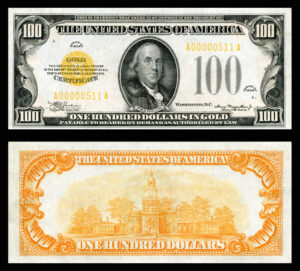
The seal appears in gold ink on the right side of the face, a relatively small seal compared to the large colored seals found on Legal Tender or Federal Reserve Notes of the period. The serial numbers are printed in gold as well, reinforcing the note’s status as a premium instrument. The back of the note is printed in a rich golden-orange color and displays a bold “500” at center, surrounded by geometric guilloche patterns. The overall aesthetic is one of restrained power, appropriate for a note intended to move between banks and large commercial enterprises rather than circulate in everyday commerce.
On genuine examples of Fr. 1217, the gold ink used for the serial numbers and Treasury seal should show slight dimensional texture under a loupe, a characteristic of the BEP’s intaglio printing process. Flat, uniform gold printing is a warning sign worth investigating before any purchase.
Survival Rates and the 1933 Recall
Understanding why the Fr. 1217 is so scarce requires understanding what happened to virtually the entire Gold Certificate population. Franklin Roosevelt’s Executive Order 6102, signed on April 5, 1933, required private citizens to surrender gold coin, gold bullion, and gold certificates to Federal Reserve Banks by May 1, 1933. Penalties for non-compliance included fines of up to $10,000 (equivalent to roughly $230,000 today) and up to ten years imprisonment. Most Americans complied.
The Treasury and Federal Reserve subsequently destroyed the vast majority of returned notes. For a $500 Gold Certificate that saw limited circulation even before the recall, the surviving population is heartbreakingly small. Current census data from PCGS and PMG combined suggest fewer than 50 examples are confirmed to exist across all grades, with perhaps 15 to 20 of those grading VF or better. A few institutional holdings, including examples at the Smithsonian’s National Numismatic Collection and the Federal Reserve Bank of San Francisco’s historical collection, account for some of the finest survivors.
Some examples also survived because they were held by foreign nationals or foreign banks operating in the United States, who were technically exempt from Executive Order 6102. A handful of notes passed through European collections before returning to American collectors in the postwar decades.
Auction Records and Current Market Values
The Fr. 1217 commands serious money whenever it appears at auction, which is not often. Heritage Auctions, Stack’s Bowers, and Lyn Knight have collectively handled fewer than a dozen examples in the past fifteen years. A PMG Very Fine 25 example realized approximately $120,000 at a major 2018 auction. An exceptional PMG Extremely Fine 40 example brought $204,000 in 2014. In Choice Uncirculated condition, which means 63 or better on the PMG/PCGS scale, a Fr. 1217 would likely breach the $400,000 to $500,000 threshold if one came to market today, though no example in that grade range has been publicly auctioned in recent memory.
For context, that places the finest known Fr. 1217 examples in the same conversation as the top-tier 1890 Treasury Notes and the rarest pre-Federal Reserve large-size type notes. It is not a note you stumble across at an estate sale.
If you are seriously pursuing an Fr. 1217, maintain a want list with the major currency auction houses. Heritage, Stack’s Bowers, and Lyn Knight all offer formal want list services. You will want advance notice before an example hits the floor, since private treaty sales also occur and the best deals sometimes never reach public auction at all.
Grading Nuances for the Fr. 1217
Grading a $500 Gold Certificate presents challenges that do not apply to common type notes. The gold ink used for serials and the Treasury seal is particularly vulnerable to oxidation and flaking, and even a note that grades Very Fine for paper quality may show seal and serial problems that affect its eye appeal and market value significantly. Both PMG and PCGS note any such ink issues in their remarks fields, and buyers should read those remarks carefully rather than focusing solely on the numeric grade.
Folds are the most common grade-limiting factor on circulated examples. A single center fold on an otherwise pristine note typically places it in the Fine 15 to Very Fine 20 range. Counting the precise number and severity of folds, combined with any corner wear, soiling, or pinholes, allows experienced collectors to anticipate grades before submission. Paper quality on surviving examples tends to be good, since these notes were not passed hand to hand in grocery stores but rather cleared through banking channels where they received more careful handling.
| Series / Fr. Number | Denomination and Type | Est. Known Population | Rarity |
|---|---|---|---|
| Fr. 1217 (Series 1922) | $500 Gold Certificate, Monroe | Fewer than 50 | Key Date |
| Fr. 1216 (Series 1882) | $500 Gold Certificate, Lincoln | Fewer than 12 | Key Date |
| Fr. 1215 (Series 1863-1875) | $500 Gold Certificate, Eagle | 3 to 5 known | Key Date |
| Fr. 186c (Series 1880) | $500 Legal Tender, Gen. Mansfield | Approximately 20 | Rare |
| Fr. 379b (Series 1890) | $500 Treasury Note, Gen. Sherman | Approximately 7 | Key Date |
| Fr. 1173 (Series 1882) | $100 Gold Certificate, Monroe | Several hundred | Scarce |
| Fr. 1200 (Series 1922) | $100 Gold Certificate, T. Jefferson | Several thousand | Common |
| Fr. 1218 (Series 1922) | $1,000 Gold Certificate, Hamilton | Fewer than 30 | Rare |
Building a Context Collection
Most collectors will never add an Fr. 1217 to their holdings, and that is perfectly fine. The note’s real value to the broader collecting community is contextual. Understanding where the Monroe $500 sits within the Gold Certificate series, the large-size note era (1861 to 1929), and the history of American monetary policy gives every collector a richer framework for appreciating more accessible notes.
If you want to build a thematic collection around the Fr. 1217 without spending six figures, consider assembling a set that tells the story around it. The Series 1922 $10 Gold Certificate (Fr. 1173, featuring Michael Hillegas) is very affordable in lower grades. The Series 1922 $20 Gold Certificate (Fr. 1187) and $50 Gold Certificate (Fr. 1199) are within reach for determined type collectors. Together, these notes frame the world in which the Monroe $500 existed, and they give you a complete narrative of the final large-size Gold Certificate series even if the crown jewel remains out of reach.
The Series 1922 $50 Gold Certificate (Fr. 1199, featuring Ulysses S. Grant) offers similar aesthetic qualities to the Monroe $500 at a fraction of the cost. Circulated examples in Fine to Very Fine grades can be found for $1,500 to $4,000, making it an excellent entry point into the Gold Certificate series for collectors building toward the higher denominations.
Monroe’s Lasting Legacy on Paper Money
There is something genuinely poignant about James Monroe’s solitary appearance on American currency. His presidency, from 1817 to 1825, defined what historians call the Era of Good Feelings, a period of relative political unity and national optimism following the War of 1812. Monroe was the last Founding Father-era president, a veteran of the Revolutionary War who had crossed the Delaware with Washington. His face on a gold-backed note, issued at the peak of American economic confidence in the early 1920s before the Great Depression shattered that confidence, carries a kind of historical irony that collectors of paper money are uniquely positioned to appreciate.
The Fr. 1217 is more than a rarity. It is a document of a specific American moment: when gold backing was still considered inviolable, when paper money aspired to the permanence of the metal it represented, and when a former president’s portrait on a $500 note seemed like an appropriate tribute rather than an anachronism. The Gold Recall of 1933 ended all of that, and James Monroe’s one appearance on U.S. currency went with it, surviving only in the handful of notes that escaped the furnace.
For the serious collector, the study of this note rewards patience, research, and a willingness to engage with history on its own terms. Whether you are fortunate enough to own one someday or simply catalog every confirmed example in the census data, the Monroe $500 Gold Certificate earns its place at the very top of the large-size rarity hierarchy.