Pull a $20 bill from your wallet and you are holding the product of more than 150 years of monetary evolution. The note feels routine, familiar, almost invisible in daily commerce. But trace the denomination backward through series, seal colors, portrait changes, and issuing authorities, and the $20 reveals itself as one of the most historically layered pieces of paper in the American numismatic canon. From the ornate, engraved grandeur of 1860s large-size gold certificates to the ultraviolet-reactive security threads of the current Federal Reserve Note series, the $20 has been redesigned, reissued, counterfeited, debated, and reinvented more times than almost any denomination in U.S. history.
The Civil War Era: Demand Notes and the First $20s
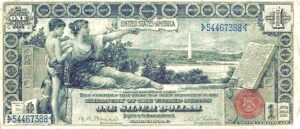
The story begins in the financial chaos of 1861. The federal government, facing the enormous cost of the Civil War and a catastrophic drain on its gold reserves, authorized the first federally issued paper currency under the Act of July 17, 1861. These Demand Notes, so called because they were redeemable on demand in coin, appeared in $5, $10, and $20 denominations. The $20 Demand Note featured a vignette of the Liberty figure on the left and an allegorical depiction of Alexander Hamilton’s Treasury building on the right. These notes were large by modern standards, measuring approximately 7.375 by 3.125 inches, and their intricate engraving was a deliberate anti-counterfeiting measure in an era when sophisticated printing presses were scarce.
Demand Notes were quickly superseded by Legal Tender Notes, commonly known as United States Notes, authorized by the Legal Tender Act of February 25, 1862. The $20 United States Note went through several distinct design iterations. The Series 1862 and 1863 issues bore a portrait of Alexander Hamilton and were printed with a distinctive red Treasury seal. By the Series 1875 and 1878 issues, the note had shifted to a portrait of Alexander Hamilton on the face and an elaborate green geometric lathe-work back. The red seal remained consistent across U.S. Note issues, a design tradition that would persist for decades and serve as a quick visual identifier for collectors today.
When examining large-size $20 United States Notes, pay close attention to the Treasury seal color and the signature combination on the face. Early series feature red seals with signatures like Chittenden-Spinner (1862) or Allison-Spinner (1869). These signature pairings narrow the series attribution and directly affect catalog value, sometimes by thousands of dollars between adjacent combinations.
National Bank Notes: The $20 in Local Hands
Running parallel to U.S. Notes throughout the National Banking Era (1863 to 1935) were National Bank Notes, issued by thousands of chartered banks across the country. A $20 National Bank Note from a small-town bank in Nebraska carries entirely different collector dynamics than one from a major New York City institution. The notes were printed by the Bureau of Engraving and Printing but overprinted with the issuing bank’s name, charter number, and state. Large-size $20 Nationals went through three major design periods: the First Charter (1863 to 1882), Second Charter (1882 to 1902), and Third Charter (1902 to 1929). The First Charter $20 featured a striking “Battle of Lexington” vignette on the back, while Second Charter notes introduced a distinctive blue seal. Third Charter notes are subdivided into Red Seals, Date Backs, and Plain Backs, each with its own scarcity profile by bank and state.
For collectors, $20 Nationals from small towns, territorial banks, or banks with very low charter numbers represent some of the most sought-after pieces in American numismatics. A $20 First Charter note from a Wyoming Territory bank, for example, can command prices well into five figures even in circulated grades, simply because so few banks existed in the territory and even fewer notes survive.
Gold Certificates: The Gilded $20
Gold Certificate $20 notes occupy a special place in currency collecting, blending monetary history with some of the most visually stunning designs ever produced by the Bureau of Engraving and Printing. These notes circulated alongside other currency types and were backed directly by gold coin deposits held by the Treasury.
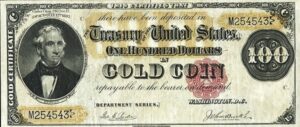
The large-size $20 Gold Certificate series includes some genuinely iconic pieces. The Series 1882 notes feature a portrait of James Garfield on the face with a distinctive orange-gold back, printed in a warm hue that immediately signals their gold-backed status. But the most celebrated is the Series 1905 Gold Certificate, sometimes called the “Technicolor Note” by collectors. This note features a vibrant design with a golden orange reverse and a bright red Treasury seal on the face, alongside a portrait of George Washington. The combination of colors was so striking, and so expensive to produce, that the design was immediately scaled back for subsequent issues. The 1905 $20 Gold Certificate in high grade is a genuinely rare and visually breathtaking note, one that consistently draws strong prices at major auctions.
The Series 1905 $20 Gold Certificate is frequently offered with problems: cleaning, pressing, or pinholes are common due to the note’s age and the attention high-grade examples attract. Always insist on a note holdered by PCGS Currency or PMG before paying a premium. A PMG 25 VF with no qualifiers is worth significantly more than a PMG 30 VF example noted “Apparent” for cleaning.
The Transition to Small-Size Currency: 1928 and the Birth of the Modern $20
The most dramatic single change in the history of the $20 note came with the currency reform of 1928. Under the mandate to reduce paper and printing costs, the Treasury Department introduced small-size currency, scaled to approximately 6.14 by 2.61 inches, in all denominations. The new $20 note adopted a portrait of Andrew Jackson, a choice that has proven controversial in modern times but which has endured for nearly a century. The back design featured a vignette of the White House, which remains on the note today.
The first small-size $20s issued in 1928 were Federal Reserve Notes, printed for each of the twelve Federal Reserve districts with a green Treasury seal. However, the 1928 series also included Gold Certificate $20s, which carried a yellow-gold Treasury seal, and these were recalled and removed from circulation after President Franklin Roosevelt’s Executive Order 6102 of April 5, 1933, which prohibited private gold hoarding. A circulated 1928 Gold Certificate $20 is consequently relatively common, having been returned to banks in large numbers, but genuinely uncirculated examples are elusive and command significant premiums.
Federal Reserve Notes: Series by Series Through the 20th Century
From 1928 onward, Federal Reserve Notes became the dominant form of $20 currency. For decades, the design remained essentially static: Jackson on the face, the White House on the back, green seal, and the only changes were in signature combinations reflecting the serving Treasurer of the United States and the Secretary of the Treasury. Collectors who specialize in this area track those combinations carefully, as certain pairings were produced in much smaller quantities than others.
Star notes, which replace notes with printing errors and carry an asterisk suffix in the serial number, add another layer of collecting depth to 20th-century $20 FRNs. Star notes from low-production Federal Reserve districts, particularly the Minneapolis (I) or Dallas (K) districts in certain series, can be genuinely scarce in high grades. The 1950 series through the 1969 series also feature variations in motto placement and back design detail that reward close examination.
For small-size $20 FRN collectors on a budget, focus on the Series 1928 through 1934-D issues. These older green-seal notes in Fine to Very Fine condition are still accessible at modest prices but represent genuine historical significance as the first generation of the modern $20. A complete district set of Series 1928 $20 FRNs in consistent mid-grade is an achievable and rewarding goal.
The Security Revolution: 1990 to Today
By the late 1980s, advancing reprographic technology made large-scale counterfeiting a genuine threat. The $20 note, as the most commonly used large denomination in everyday retail commerce, was the primary target. The government’s response came in phases. The Series 1990 $20 introduced microprinting and a security thread embedded in the paper, running vertically to the left of the Federal Reserve seal, with the text “USA TWENTY” printed on it. This was a major departure from the relatively simple anti-counterfeiting measures that had served since 1928.
The Series 1996 $20 brought the most comprehensive redesign since 1928. Jackson’s portrait was enlarged and moved off-center, fine-line engraving was added around the portrait, color-shifting ink in the numeral “20” on the lower right changed from gold to green when tilted, and a watermark portrait of Jackson was added to the right of the printed portrait. The security thread glowed green under ultraviolet light and was relocated to the right of center.
The Series 2004 $20 introduced background colors for the first time since the large-size era, with subtle peach and blue tones in the background of both the face and back. Color-shifting ink was upgraded, and additional microprinting was added. This is the design framework that persists today, with the Series 2017A being among the most recently printed issues as of this writing. Plans to introduce Harriet Tubman to the $20 note face, announced in 2016, have faced repeated delays and remain pending as of 2024.
| Series / Date | Type or Variety | Estimated Survivors / Print Run | Rarity |
|---|---|---|---|
| 1861 | Demand Note, “For the” handwritten | Fewer than 100 known | Key Date |
| 1882 | Gold Certificate, Garfield portrait | Very few in EF or better | Rare |
| 1905 | Gold Certificate “Technicolor Note” | Scarce in all grades; CU nearly unknown | Key Date |
| 1902 Red Seal | National Bank Note, Third Charter | Varies dramatically by bank | Rare |
| 1928 Gold Certificate | Small-size, yellow seal | Common circulated; scarce CU | Scarce |
| 1928B FRN | Boston (A) district, star note | Approximately 24,000 printed | Rare |
| 1934A FRN | Hawaii overprint (WWII emergency) | Limited wartime issue | Scarce |
| 1950E FRN | All districts, star notes | Low across all districts | Scarce |
| 1996 FRN | First redesigned small-size issue | Widely available | Common |
| 2004 FRN | First with background color printing | Widely available | Common |
The WWII Hawaii Overprint: A $20 with a War Story
No survey of the $20 note’s history is complete without the remarkable Hawaii overprint issues of World War II. Following the attack on Pearl Harbor in December 1941, the government feared that large quantities of U.S. currency in Hawaii might fall into Japanese hands. The solution was to overprint existing $1, $5, $10, and $20 Federal Reserve Notes with the word “HAWAII” on the back and on both sides of the face, and to replace the normal Federal Reserve seal with a brown-colored seal. These notes were legal tender in Hawaii but could be rapidly demonetized if the islands fell. The $20 Hawaii note from Series 1934 and 1934A represents one of the most popular wartime emergency issues among collectors, and high-grade examples with strong brown seals and crisp overprints bring strong prices at auction.
Building a $20 Type Set: A Collector’s Road Map
For collectors drawn to the $20 denomination, a type set approach offers a manageable and deeply satisfying framework. A comprehensive large-to-small type set might include one example each of the major issuing types: a Demand Note, a U.S. Note (Legal Tender), a National Bank Note, a large-size Gold Certificate, a small-size Gold Certificate, the Hawaii overprint, and Federal Reserve Notes representing pre-security, first-generation security, and color-printing eras. Such a set spans more than 150 years of monetary history and tells a remarkably coherent story of American economic policy, war, and technological change.
Budget-conscious collectors can begin with the more accessible pieces: a circulated large-size U.S. Note in Fine condition can be acquired for a few hundred dollars, a 1928 small-size Gold Certificate in VF for a similar amount, and older FRN series in mid-grade for quite modest sums. The Demand Note and the 1905 Gold Certificate are genuinely expensive in any grade and might serve as capstone acquisitions in a long-term collecting plan.
Conclusion: Continuity and Change in Twenty Dollars
What strikes any serious collector who examines the full arc of the $20 note is how much continuity underlies the obvious changes. The commitment to fine engraving, to anti-counterfeiting innovation, to iconography that reflects national values, threads through every era from the 1861 Demand Note to the 2017A Federal Reserve Note. Andrew Jackson has watched over the denomination for nearly a century, and the White House has graced the reverse for just as long. Whether those images will be joined or replaced by Harriet Tubman in the coming years, the $20 will continue its evolution, adding another chapter to one of the richest stories in American numismatics.