Introduction: A Dollar Bill With a Surprisingly Deep Story
Pick up a Series 1880 $1 United States Note and you are holding a piece of paper that went through at least two distinct design phases during its production run. The large red seal variety came first, bold and commanding, then gave way to a smaller, more refined seal that collectors and catalogers have been tracking ever since. Add in four distinct signature combinations tied to different Treasurer and Register pairings, and you have a single series that rewards careful study far beyond its face value.
This guide walks through every major variety of the 1880 $1 Legal Tender note: what the seals look like, which signature pairs go with which seal type, what the print runs tell us about relative scarcity, and how condition dramatically affects collector value. Whether you are just starting your large-size collection or refining a specialized Legal Tender type set, this is the reference you will want bookmarked.
The Design: What You Are Looking At
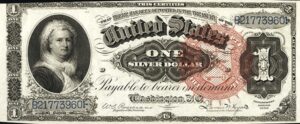
The Series 1880 $1 United States Note carries the same basic large-size format that dominated American currency from the Civil War era through 1928. The obverse features a portrait of Salmon P. Chase, Lincoln’s Secretary of the Treasury and the man most responsible for establishing the national paper money system in the 1860s. It is appropriate, almost poetic, that Chase ended up on the very notes his legislative work made possible.
The reverse is printed in a dark, ink-heavy design sometimes called the “Sabre” or “Woodchopper” reverse, featuring an ornate geometric lathe-work pattern with the large numeral ONE dominating the center. The Treasury seal and serial numbers appear in red on the obverse, and it is the seal that defines the primary variety distinction in this series.
Large Red Seal vs. Small Red Seal: Telling Them Apart
The easiest way to classify a Series 1880 $1 United States Note is to look at the Treasury seal on the right side of the obverse. The large seal variety features a prominent circular seal with spiky rays radiating outward and elaborate detail inside the circle. It occupies a noticeably larger footprint on the note face. The small seal variety has a cleaner, more compact design with less aggressive ornamentation.
Measurement matters here: the large seal typically runs about 40 mm in diameter, while the small seal is closer to 33 mm. In hand, side by side, the difference is immediately obvious. From a single note with no reference, less experienced collectors sometimes second-guess themselves. A jeweler’s loupe or a simple printed reference card can eliminate any doubt.
When examining a Series 1880 $1 note for the first time, measure the Treasury seal diameter with a millimeter ruler before consulting the signature combination. Seal size is the primary sort; signatures are the secondary sort. Getting the sequence right prevents misidentification in mixed lots or dealer cases.
The Signature Combinations: Four Pairs Across Two Seal Types
United States Notes of this era required the signatures of the Register of the Treasury and the Treasurer of the United States. Personnel changes in those offices during the 1880s produced multiple signature combinations, each of which corresponds to a specific production period and, critically, a specific seal type.
Large Seal Varieties
Fr. 29: Scofield-Gilfillan. Lucius E. Scofield served as Register and James Gilfillan served as Treasurer. This combination was carried over from the Series 1875 notes and represents the earliest printings of the 1880 series. The large red seal is prominent, and the serial numbers are typically in red as well. This is one of the more available large seal combinations, with specimens turning up in circulated grades with some regularity. In Very Fine (VF-20 to VF-35), examples trade in the $300 to $500 range. Choice Uncirculated (MS-63) examples can push past $2,000 at major auction houses.
Fr. 30: Bruce-Gilfillan. When Blanche K. Bruce became Register in 1881, his name began appearing alongside Gilfillan’s. Bruce holds a distinguished place in American history as the first Black American to serve a full term in the U.S. Senate, and his presence on currency is of interest beyond numismatics. The large seal version with Bruce-Gilfillan signatures (Fr. 30) is somewhat scarcer than the Scofield-Gilfillan pairing. Fine to Very Fine examples typically bring $350 to $600.
Fr. 31: Bruce-Wyman. When A.U. Wyman replaced Gilfillan as Treasurer in 1883, the Bruce-Wyman combination appeared on a transitional set of notes that still carried the large seal. Fr. 31 notes are considered the scarcest of the large seal 1880 $1 varieties, with substantially fewer Uncirculated survivors known. In grades below Very Fine, expect to pay $400 to $650. An XF-45 example can bring $1,200 or more depending on eye appeal and originality of color.
Bruce-Wyman large seal notes (Fr. 31) are often found with faded or lightened red seal and serial number ink, a consequence of the particular ink batches used during that production window. When grading or purchasing, factor in color vibrancy as a significant eye-appeal consideration; a note graded VF with full, bright red color is worth a meaningful premium over an XF with washed-out tones.
Small Seal Varieties
The Bureau of Engraving and Printing transitioned to the smaller Treasury seal design during the mid-1880s, and the remaining 1880 $1 signature combinations appear exclusively on small seal notes.
Fr. 32: Rosecrans-Huston. William Rosecrans became Register in 1881 and served alongside Nebuchadnezzar Huston, who was Treasurer from 1889 to 1891. The small red seal is sharp and well-defined on most surviving examples of Fr. 32. This is the most available of the small seal 1880 $1 varieties and serves as the classic entry point for collectors building a type set. In Very Fine, examples routinely sell in the $175 to $325 range, and a solid Uncirculated example (MS-63) might bring $800 to $1,200.
Fr. 33: Rosecrans-Nebeker. James Nebeker succeeded Huston as Treasurer in 1891, creating the Rosecrans-Nebeker pairing. Fr. 33 is somewhat less frequently encountered than Fr. 32 but remains a manageable find in circulated grades. Collectors building a complete 1880 $1 signature set will want this one and typically find it without undue difficulty. Values in VF run $225 to $400.
Fr. 34: Tillman-Morgan. John Tillman became Register in 1893, paired with Daniel Morgan as Treasurer. Fr. 34 is a considerably tougher note than the Rosecrans-Huston combination that precedes it in the catalogs. Print runs were much lower by this period as Legal Tender circulation began declining. In Fine to Very Fine condition, expect $400 to $700, and Uncirculated examples are genuinely scarce.
Fr. 35 and Fr. 36: Bruce-Roberts and Lyons-Roberts. These final two combinations represent the tail end of the series. Fr. 35 (Bruce-Roberts) and Fr. 36 (Lyons-Roberts) are among the hardest 1880 $1 notes to track down in any grade. Production numbers were limited, survivors are few, and high-grade examples rarely cross the auction block. Fr. 36 in particular commands strong prices: even well-circulated examples in Fine-12 to Very Fine-20 can bring $600 to $1,000, and the handful of known Uncirculated examples have sold for well over $4,000.
If you encounter a Fr. 35 or Fr. 36 at a currency show or in a dealer lot priced as if it were a common Rosecrans-Huston example, verify the signatures carefully before passing. The Lyons-Roberts and Bruce-Roberts combinations are genuinely underappreciated by generalist sellers and represent real value opportunities for the attentive specialist.
Grading Considerations for Series 1880 $1 Notes
Large-size Legal Tender notes carry a number of condition pitfalls worth knowing before you grade or submit. First, the red ink used for Treasury seals and serial numbers on 1880-era notes is susceptible to fading over time. A bright, vibrant red seal is a positive attribute and can push a note into a premium tier even within its grade. Second, the reverse printing on these notes is ink-heavy and tends to show through to the obverse, particularly on thinner paper stocks. Minor show-through is expected and normal; heavy bleed that obscures obverse design details is a negative.
Folds and creases are the primary grade determinants, as with all large-size paper money. A single center fold with otherwise bright paper and no stains or repairs will typically grade in the VF-20 to VF-35 range. Four-corner folds with light circulation but no significant soil might grade Fine-15. Any signs of washing, pressing, or chemical treatment will result in a “details” or “net” grade from professional services such as PCGS Currency or PMG, which substantially reduces market value.
Paper quality on 1880 notes varies. Look for notes with full original paper body, not limp or soft texture that suggests washing. Margins should be reasonably even, though large-size notes from this era were often cut by hand and slight irregularities are forgiven by graders.
| Friedberg No. | Signature Combination | Seal Type | Est. Survivors (All Grades) | Rarity |
|---|---|---|---|---|
| Fr. 29 | Scofield-Gilfillan | Large Red | 400-600+ | Common |
| Fr. 30 | Bruce-Gilfillan | Large Red | 250-400 | Scarce |
| Fr. 31 | Bruce-Wyman | Large Red | 150-250 | Scarce |
| Fr. 32 | Rosecrans-Huston | Small Red | 500-800+ | Common |
| Fr. 33 | Rosecrans-Nebeker | Small Red | 300-500 | Common |
| Fr. 34 | Tillman-Morgan | Small Red | 100-200 | Scarce |
| Fr. 35 | Bruce-Roberts | Small Red | 60-120 | Rare |
| Fr. 36 | Lyons-Roberts | Small Red | 40-80 | Key Date |
Survivor estimates are based on population report data from PCGS Currency and PMG combined registries as of 2024, supplemented by auction records. Actual populations may vary as new examples are certified.
Building a Complete Set: Strategy and Patience
Completing all eight Friedberg varieties of the 1880 $1 Legal Tender note is a realistic goal for a focused collector with a multi-year timeline and a moderate to substantial budget. The four common to scarce varieties (Fr. 29 through Fr. 33) can be assembled without great difficulty through major currency auctions, established dealers, and currency shows like the annual Chicago ANA or the FUN Convention in January. Patience and price discipline will serve you better than urgency here.
The challenging end of the set is Fr. 34 through Fr. 36. These notes do not come up at every major auction, and when they do, competition among dedicated Legal Tender specialists can be stiff. Setting up want lists with Heritage Auctions, Stack’s Bowers, and Lyn Knight (now part of Heritage) is the most reliable way to be notified when these notes surface. Expect to wait a year or two between legitimate auction appearances of Fr. 36 in any grade worth having.
Do not overlook estate auction sources for Series 1880 Legal Tender notes. Many long-held collections dispersed through regional and general-interest auction houses contain undervalued 1880 $1 varieties because the auctioneers lack currency-specific expertise. A note cataloged simply as “old one dollar bill, red seal” may be a Fr. 35 or Fr. 36 with significant numismatic value. Alert your local auction contacts and check general auction platforms regularly.
Authentication Concerns
Counterfeits of high-value 1880 $1 Legal Tender notes exist, though they are not common. The primary concern for collectors is not sophisticated counterfeits but rather altered notes: a more common Friedberg variety with signatures carefully erased and redrawn to mimic a scarcer pairing. Under magnification, altered signatures typically show inconsistent ink texture, disturbed paper fiber, or subtle color mismatches relative to the surrounding text.
The safest protection is to purchase key-date varieties in holders from PCGS Currency or PMG. Both services have examined thousands of large-size Legal Tender notes and their certification holders include a description of the specific Friedberg number, providing essential documentation and peace of mind. For uncertified notes above $500 in value, submission to a third-party grading service before finalizing purchase is strongly advisable.
Conclusion: A Series Worth Knowing Deeply
The Series 1880 $1 United States Note rewards the collector who takes time to understand it fully. The large seal versus small seal distinction is visible at a glance once you know what to look for, and the progression of signature combinations tells a quiet story of Treasury personnel changes across a pivotal decade in American financial history. From the accessible Scofield-Gilfillan notes that offer excellent value in circulated grades to the genuinely rare Lyons-Roberts variety that challenges even well-funded specialists, this series has something meaningful at every level of commitment.
For collectors interested in Legal Tender issues, the 1880 $1 set is one of the most intellectually satisfying pursuits in large-size currency. The notes are beautiful, the history is rich, and the path from beginner to advanced collector runs clearly through every one of the eight Friedberg varieties described here.