📷 Image source: banknote.ws (World Banknote Gallery). Images are selected by AI to represent the article topic and may not depict the exact note(s) described.
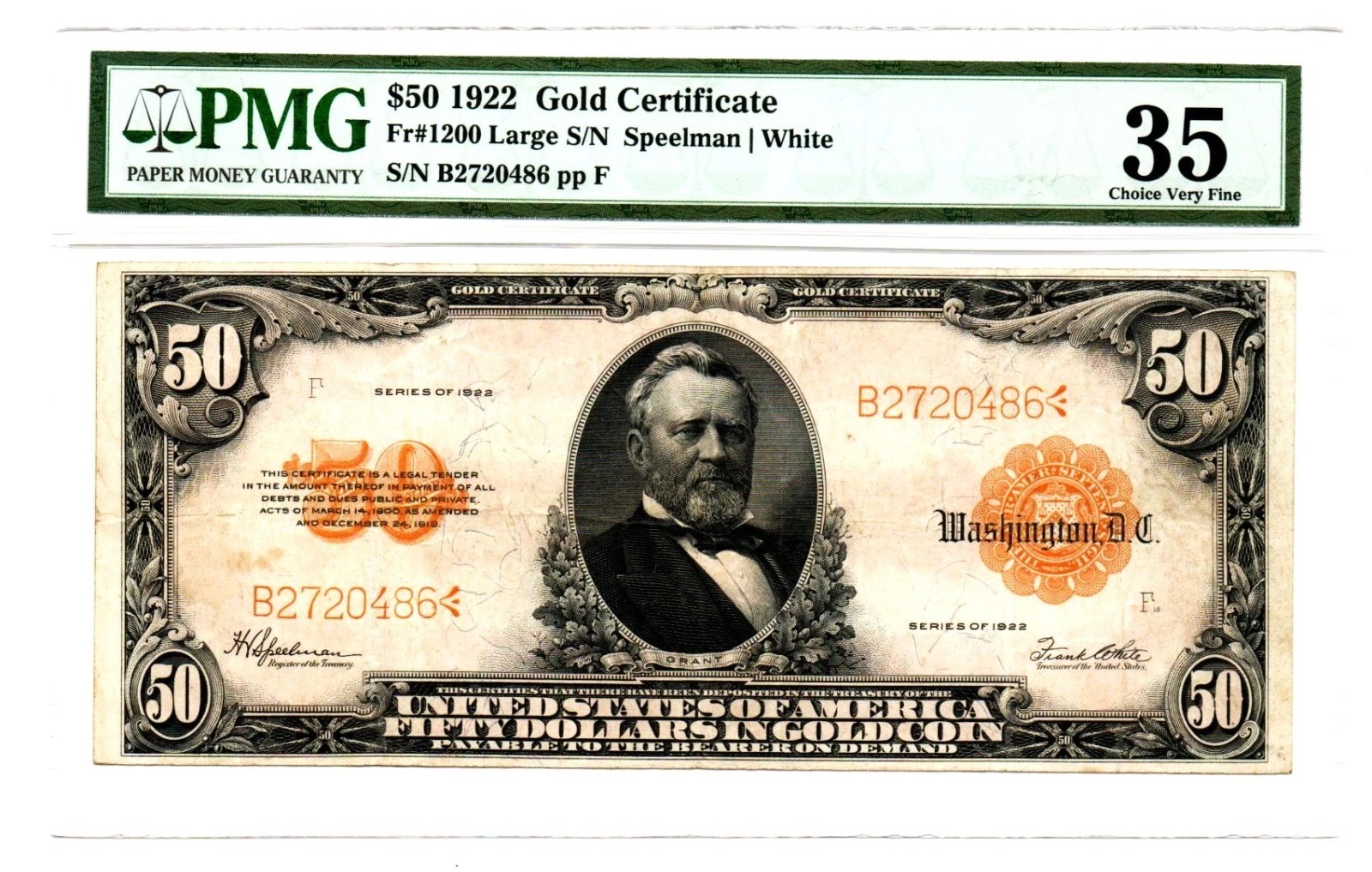
There is a moment that every serious currency collector understands instinctively, the first time you hold a large-size note up to good light and realize that what you are looking at is not merely old paper money, but a small masterpiece of engraving, design, and governmental authority. The Series 1923 $50 Gold Certificate delivers that feeling in abundance. Featuring a commanding portrait of Ulysses S. Grant at center, printed on paper measuring roughly 7.375 by 3.125 inches, and bearing the unmistakable golden-yellow Treasury seal of the Gold Certificate series, this note occupies a singular place in American numismatic history. It was issued in what turned out to be the final year of large-format production, making every surviving example a document of closure as much as commerce.
A Brief History of Gold Certificates in American Commerce
Gold Certificates were first authorized by Congress in 1863, though early issues circulated primarily among banks and financial institutions rather than the general public. By the late nineteenth century, however, Gold Certificates had entered everyday commerce, serving as a paper representation of gold coin deposited with the United States Treasury. Holders were theoretically entitled to redeem their notes for gold on demand, which gave the currency a tangible credibility that other paper instruments of the era sometimes lacked.
The large-size Gold Certificate series went through several distinct design generations, progressing from the ornate, allegorical designs of the 1870s and 1880s through the cleaner, portrait-centered compositions of the early twentieth century. By the time the Series 1922 notes were authorized, the format had been standardized into the familiar large-size design that collectors now associate with the pre-1929 era. The $50 denomination within this series carried Grant’s portrait, a fitting choice given that the 18th President had presided over some of the most turbulent monetary debates in the nation’s history.
The Design: Grant in Gold
The obverse of the Series 1922 $50 Gold Certificate is dominated by a precisely engraved bust of Ulysses S. Grant positioned at the center of the note. The engraving work, executed by the Bureau of Engraving and Printing, captures Grant in the dignified manner typical of late large-size portraiture, with fine cross-hatching giving depth to his characteristic beard and coat. To the left and right of the portrait, ornate lathe-work borders frame the design, while the denomination “FIFTY DOLLARS” appears prominently in the upper portion of the note.
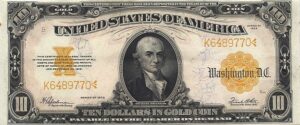
The golden-yellow Treasury seal appears to the right of center on the obverse, immediately identifying the note’s class as a Gold Certificate. This seal color distinguishes Gold Certificates from the red seals of Legal Tender Notes, the blue seals of Silver Certificates, and the green seals of Federal Reserve Notes that would eventually dominate American currency. The serial numbers on the Series 1922 $50 are printed in gold ink as well, lending a visual consistency to the note’s golden theme. The reverse carries an elaborate green geometric lathe-work design centered on the large “50” denomination counter.
When examining a Series 1922 $50 Gold Certificate, inspect the serial number ink carefully under magnification. Genuine examples display gold-colored serials that have a slightly metallic luster distinct from the yellow-orange hue sometimes seen on cleaned or washed notes. Faded or brownish serials may indicate environmental damage that will affect the grade significantly.
Signatures and the Speelman-White Combination
The Series 1922 $50 Gold Certificate bears the signatures of Register of the Treasury Houston B. Speelman and Treasurer of the United States Frank White. This Speelman-White pairing is the only signature combination known on this note, meaning that unlike some large-size issues where two or three different signature pairs create distinct collecting varieties, the Fr. 1200 presents a relatively unified collecting target in terms of signatures. Speelman served as Register from 1921 to 1927, and White served as Treasurer from 1921 to 1928, so their tenures overlapped precisely during the period when these notes were printed and released.
It is worth noting that while the series date on the note reads 1922, the notes were actually placed into circulation beginning in 1923, which is why numismatic literature and collector discussion often reference the note in the context of 1923 large-size production. This slight discrepancy between series date and actual issuance year was commonplace in the large-size era, as the series date reflected when the design was formally approved rather than when printing or distribution began.
Do not confuse the series date of 1922 with a printing date. The Bureau of Engraving and Printing did not print dates that corresponded to actual production years on large-size notes. Always cross-reference the Friedberg number (Fr. 1200 for this issue) when researching auction records to ensure you are comparing the correct note.
The 1929 Size Reduction and Why 1923 Matters
To fully appreciate the Series 1923 $50 Gold Certificate, one must understand what came next. In July 1929, the United States Treasury and the Bureau of Engraving and Printing completed the transition to small-size currency, reducing all note dimensions to approximately 6.125 by 2.625 inches. The rationale was largely economic and practical: smaller notes required less paper, less ink, smaller printing plates, and smaller wallets. The public adapted quickly, but in doing so effectively rendered every large-size note a collector’s item from the moment small-size currency entered circulation.
The Series 1922 Gold Certificates were among the last large-size notes produced before this transition. When production of small-size notes began in earnest, large-size Gold Certificates continued to circulate alongside their successors for a time, but their days were numbered. President Franklin Roosevelt’s Executive Order 6102 of April 1933 prohibited private ownership of gold coin and gold certificates, requiring citizens to surrender their notes to Federal Reserve Banks. This order devastated the surviving population of all Gold Certificate series, including the 1922 $50, as notes were turned in and destroyed rather than saved.
Rarity and Survival Rates
The combination of normal large-denomination attrition and the 1933 mandatory surrender makes the Series 1922 $50 Gold Certificate legitimately scarce in all grades. High-denomination notes circulated among merchants, banks, and businesses rather than individual consumers, which in theory might suggest better preservation rates than lower denominations. In practice, however, $50 Gold Certificates were handled heavily in commercial settings and rarely hoarded by ordinary citizens who might have tucked a $1 Silver Certificate away as a novelty. Ownership of gold certificates in the post-1933 environment was also illegal for American citizens until the Gold Reserve Act restrictions were finally lifted in 1964, which meant that notes held privately after 1933 represented genuine legal risk to their owners.
Today, certified examples in grades below Very Fine are not uncommon at major auction houses, but Extremely Fine and better examples command significant premiums. Uncirculated examples are genuinely rare, and notes graded PCGS or PMG at 64 or above appear at auction infrequently enough that when they do, they generate serious competitive bidding from advanced collectors.
If budget constraints are a factor, consider targeting a PMG or PCGS graded example in the Fine-20 to Very Fine-30 range. At these grades, the design details, golden seal color, and portrait quality are fully visible and aesthetically pleasing, while the price remains considerably more accessible than Extremely Fine or better examples. A problem-free VF-20 example represents exceptional value for what is, historically speaking, a major rarity.
Collecting Context: Where the Fr. 1200 Fits in a Gold Certificate Collection
Collectors assembling a type set of large-size Gold Certificates will encounter the $50 denomination as one of the more challenging entries. The series spans denominations from $10 through $10,000 in the large-size format, and the $50 sits in an interesting middle zone: more accessible than the $100, $500, or $1,000 denominations, but considerably scarcer than the $10 or $20 issues that had larger original print runs and broader circulation among the general public. For collectors focused specifically on the Series 1922 Gold Certificate run, completing the full denomination set represents a formidable but achievable long-term goal.
Within the context of all large-size $50 notes, the 1922 Gold Certificate competes for collector attention against the $50 Legal Tender Notes of the 1880s and 1890s, the $50 National Bank Notes, and the $50 Federal Reserve Notes of the Series 1914 and 1918 issues. Each of these has its own appeal, but the Gold Certificate possesses a visual drama, anchored by its golden seal and gold serial numbers, that many collectors find uniquely compelling.
| Friedberg No. | Series / Type | Estimated Survivors | Rarity |
|---|---|---|---|
| Fr. 1200 | 1922 $50 Gold Certificate, Speelman-White | 300-500 known | Rare |
| Fr. 1200 (CU) | 1922 $50 Gold Cert., Uncirculated (65+) | Fewer than 20 known | Key Date |
| Fr. 1197 | 1913 $50 Gold Certificate, Parker-Burke | 150-250 known | Rare |
| Fr. 1198 | 1913 $50 Gold Certificate, Teehee-Burke | 200-300 known | Rare |
| Fr. 1199 | 1922 $50 Gold Certificate, Speelman-White (earlier plates) | 400-600 known | Scarce |
| Fr. 158 | 1880 $50 Legal Tender, Scofield-Gilfillan | Fewer than 50 known | Key Date |
| Fr. 1072 | 1914 $50 Federal Reserve Note, Red Seal | 500-800 known | Scarce |
| Fr. 1085 | 1914 $50 Federal Reserve Note, Blue Seal, Boston | 1,000+ known | Common |
Authentication and Grading Considerations
Because high-grade examples of the Fr. 1200 command four- and sometimes five-figure prices, authentication through a major third-party grading service such as PMG (Paper Money Guaranty) or PCGS Currency is strongly recommended before any significant purchase. Both services encapsulate the note in a tamper-evident holder and assign a numerical grade on the 70-point Sheldon-derived scale. For Gold Certificates specifically, graders pay close attention to paper quality, the vibrancy of the golden Treasury seal, the integrity of the gold serial number ink, and the presence or absence of folds, tears, and edge wear.
Collectors should also be aware of the note’s sensitivity to light and humidity. The gold-colored ink used for the serial numbers and seal can oxidize or fade with prolonged exposure to ultraviolet light or high moisture environments. Properly stored examples, ideally in archival-quality mylar sleeves within a climate-controlled space, retain their visual appeal far better than notes that have been displayed in frames or stored in non-archival albums.
When purchasing a raw (ungraded) example of the Series 1922 $50 Gold Certificate, budget an additional $50 to $80 for third-party certification before adding it to your collection. A certified note provides not only authentication assurance but also a standardized grade that makes future resale or insurance valuation straightforward. The certification cost is almost always recovered in the note’s enhanced marketability.
Conclusion: A Note Worth Pursuing
The Series 1923 $50 Gold Certificate, catalogued as Fr. 1200, is many things simultaneously: a portrait of one of America’s most consequential generals and presidents, a functioning commercial instrument from an era when paper currency was directly tied to physical gold, a masterwork of engraver’s craft executed at the Bureau of Engraving and Printing, and a survivor of the 1933 government recall that eliminated the vast majority of its original issue. For collectors who appreciate the intersection of artistry, history, and genuine scarcity, it represents a compelling acquisition target at virtually any grade level. The large-size era ended in 1929, but the notes it produced continue to tell their stories to anyone patient enough to hold one up to the light.