📷 Image source: banknote.ws (World Banknote Gallery). Images are selected by AI to represent the article topic and may not depict the exact note(s) described.
A New Era for American Paper Money
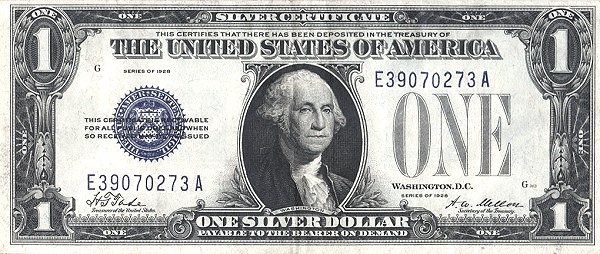
When the United States transitioned from large-size to small-size currency in 1928, the redesigned notes represented a dramatic shift in American monetary aesthetics and practicality. Among the first small-size issues, the Series 1928 $1 Silver Certificate holds a special place in numismatic history. Featuring a portrait of George Washington on the obverse and a simple eagle reverse, these notes were the first dollar-denomination Silver Certificates produced in the familiar wallet-sized format we know today. Yet beneath their seemingly uniform appearance lies a surprisingly complex world of varieties, mule notes, and printing nuances that have fascinated collectors for decades.
Understanding the Series Designations
The Series 1928 $1 Silver Certificate was produced across six distinct series designations: 1928, 1928A, 1928B, 1928C, 1928D, and 1928E. Each new letter suffix signaled a change in the signature combination appearing on the note, specifically the pairing of the Register of the Treasury and the Treasurer of the United States. These signature pairs are among the most critical factors in determining a note’s rarity and collector value.
The base 1928 series carried the signatures of H.T. Tate as Register and Walter O. Woods as Treasurer. Moving through the alphabet, 1928A brought E.E. Jones and Walter O. Woods, while 1928B paired E.E. Jones with H.T. Tate in reverse roles. The 1928C notes feature W.O. Woods and F. LaRoe, 1928D carries W.A. Julian and Henry Morgenthau, and the 1928E series, produced in the smallest quantities of the run, features signatures of W.A. Julian and Henry Morgenthau as well, though with plate changes that distinguish them from 1928D. Collectors assembling a complete set of signature varieties will quickly discover that certain combinations are far easier to locate in circulated grades than in uncirculated condition.
When buying any Series 1928 $1 Silver Certificate, always confirm the signature combination matches the series letter on the note. Misidentified notes appear regularly in dealer inventories, particularly when 1928B and 1928C notes are grouped together due to similar serial number ranges. A quick reference to the Standard Catalog of United States Paper Money will save you from overpaying for a common variety marketed as scarce.
What Are Mule Notes and Why Do They Matter?
Among all the varieties within the 1928 $1 Silver Certificate family, mule notes are the ones that generate the most excitement, and the most confusion, among collectors. A mule note is produced when mismatched plate types are used to print a single note: specifically, when one face plate (with its characteristic micro-size plate number) is paired with a back plate (with a macro-size, or larger, plate number), or vice versa. The terminology is borrowed from the hybrid animal, reflecting the combination of two different things that do not quite belong together.
In practical terms, you identify a mule note by examining the plate check numbers printed in the lower right corner of both the face and back of the note. On early small-size notes, the BEP used small, fine-print check numbers. When the Bureau transitioned to larger, bolder plate numbers on the back plates starting around 1938, some printers inadvertently combined old face plates with new back plates, or new face plates with old back plates, creating mule combinations. On the Series 1928 $1 Silver Certificate specifically, mule notes exist within the 1928D and 1928E series, where the back plates had already transitioned to the larger numeral style while certain face plates still carried the older micro numbers.
The distinction matters enormously to collectors because mule notes from the 1928 series exist in far smaller quantities than their non-mule counterparts, and graded mule notes in VF or better condition can command premiums of two to five times the standard catalog value. The 1928E mule in particular is considered one of the genuinely scarce notes in the entire small-size Silver Certificate series.
To check for a mule note, use a 5x or 10x loupe and compare the physical size of the plate check numbers on the face versus the back of the note. A noticeable difference in font size between the two sides is your indicator. On certified notes slabbed by PCGS Currency or PMG, mule status is typically noted on the label, but always verify this yourself when purchasing raw notes at shows or auctions.
Wide Margins vs. Narrow Margins: A Printing Detail That Counts
Another layer of complexity involves the physical printing margins of the notes themselves. Early BEP sheets printed for the 1928 series were trimmed with slightly wider margins around the printed area, producing what collectors call wide-margin notes. As printing efficiencies improved and the Bureau refined its cutting tolerances, later print runs were trimmed more tightly, resulting in narrow-margin notes where the border design sits noticeably closer to the edge of the paper.
This distinction is most significant among notes in higher circulated or uncirculated grades. A wide-margin example of a 1928 or 1928A $1 Silver Certificate presents a more visually appealing note with greater perceived eye appeal, and serious type collectors often pay a modest premium for well-centered, wide-margin examples. Conversely, narrow-margin notes that are off-center to one side may appear almost boarderless on the narrow edge, which can suppress value in high-grade examples even if the note is otherwise attractive.
Wide-margin notes are more common in the earlier series designations (1928 and 1928A), while the later 1928C through 1928E notes were predominantly printed with narrower margins as production standards evolved. This does not make narrow-margin notes inferior by default, but collectors building registry sets or seeking premium type notes do take margin width into account when evaluating otherwise equivalent specimens.
Grading Considerations for the 1928 $1 Silver Certificate
The 1928 series Silver Certificates circulated heavily through the Great Depression era, and well-worn examples are plentiful across most series designations. Truly uncirculated examples of the base 1928 and 1928A series are not particularly scarce, but gem uncirculated notes with strong margins and original paper brightness represent the top tier of the market. The 1928C and 1928E are the genuinely difficult series to locate in grades above Very Fine, and gem 65 EPQ or higher examples of these series realized strong prices at major auctions throughout the 2010s and 2020s.
Star notes, indicated by a star symbol replacing the suffix letter in the serial number, exist for all six series designations and are universally scarcer than their regular counterparts. The 1928E star note in particular is considered a condition rarity, with very few examples known in grades above Fine. Even a heavily circulated 1928E star with solid paper and intact corners is a note worth celebrating in any collection.
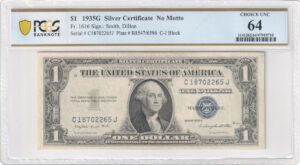
When grading raw Series 1928 $1 Silver Certificates for potential submission to PMG or PCGS Currency, pay close attention to the blue Treasury seal. These seals on early small-size notes were printed with inks that can rub, fade, or acquire a grayish cast over time. A note with a bright, vivid blue seal and crisp serial numbers will almost always grade higher than an otherwise similar note with a faded or smeared seal impression.
Building a Complete Type Set
For collectors who want to assemble a complete run of Series 1928 $1 Silver Certificate varieties, the challenge is not just finding examples of every series letter, but also accounting for mule and non-mule varieties within the later series, and making decisions about star notes. A conservative complete set including one example of each series designation (1928 through 1928E) in VF condition is attainable on a reasonable budget. Expanding that set to include star notes, mule varieties, and wide-margin versus narrow-margin representatives dramatically increases both the difficulty and the reward of the pursuit.
Major auction houses including Heritage Auctions, Stack’s Bowers, and Lyn Knight Currency Auctions have offered notable examples of the 1928 series over the years. Keeping a want list and monitoring Heritage’s Currency Signature Sales each January and August is a reliable strategy for tracking down elusive varieties in certified grades.
| Series | Variety | Approx. Print Run | Rarity |
|---|---|---|---|
| 1928 | Regular Issue | 638,296,908 | Common |
| 1928 Star | Star Note | 3,168,000 | Scarce |
| 1928A | Regular Issue | 454,552,908 | Common |
| 1928A Star | Star Note | 2,736,000 | Scarce |
| 1928B | Regular Issue | 674,597,808 | Common |
| 1928C | Regular Issue | 5,364,348 | Rare |
| 1928D | Mule Variety | Subset of 1928D run | Rare |
| 1928E | Regular Issue | 3,519,324 | Rare |
| 1928E | Mule Variety | Subset of 1928E run | Key Date |
| 1928E Star | Star Note | Fewer than 200,000 est. | Key Date |
Final Thoughts: Depth in a Familiar Note
The Series 1928 $1 Silver Certificate is one of those issues that rewards careful study disproportionately. On the surface, these notes look nearly identical to the untrained eye. Dig deeper, however, and you encounter a collecting universe filled with meaningful signature combinations, the genuine thrill of hunting mule varieties, the subtle aesthetic satisfaction of wide-margin examples, and the quiet prestige of completing a star note run that most collectors never finish. That combination of accessibility at the entry level and genuine depth at the advanced level is exactly what makes the 1928 series one of the most beloved families in small-size currency collecting.
Whether you pick up a circulated 1928B for a few dollars at a coin show or spend years chasing a gem 1928E mule star, every note in this series has a story woven into the broader history of American monetary policy, the Great Depression, and the early days of the standardized small-size format that still defines our paper money today.