There is a moment in every collector’s journey when a note that looks perfectly ordinary reveals something unexpected under magnification. For thousands of Federal Reserve Note enthusiasts, that moment has come while examining a Series 1950 or 1950A bill and noticing that the face plate and back plate numbers simply do not match the conventional series expectations. Welcome to the world of 1950/1950A transitional mule notes, one of the most technically nuanced collecting areas in mid-century American paper money.
What Is a Mule Note?
The term “mule” in numismatics is borrowed from the coin world, where it describes a piece struck from two dies that were never officially intended to be paired together. On paper money, a mule note results when a face plate from one series or plate-number style is combined with a back plate from a different series or plate-number style during the printing process. The Bureau of Engraving and Printing did not retire plates the instant a new series was authorized; plates remained in use until they were worn, damaged, or condemned, meaning that for a brief but productive period, old and new plates ran side by side on the same presses.
For the 1950 to 1950A transition specifically, the critical mechanical change at the BEP was the shift in face plate check numbering. Under Series 1950, face plates carried small, low-number check digits in a micro-size format. When the Priest/Humphrey signature combination was adopted for Series 1950A in late 1953 and into 1954, the BEP began phasing in a revised plate-numbering protocol. Notes printed during the overlap carry tell-tale mismatches that trained eyes can spot with a 5x loupe in under a minute.
The Mechanical Background: Plate Numbers and Check Letters
Every Federal Reserve Note printed during this era bears two critical identification points: a face plate number (printed in the lower right of the face) and a back plate number (printed in the lower right of the back). On Series 1950 notes, face plate numbers for most denominations ran in a low series consistent with the production cycle that began when these notes first entered printing in 1950 under the Treasurer John W. Snyder Treasury regime. The back plates used during the same period were numbered in a complementary low sequence.
The changeover did not happen simultaneously for all denominations or all twelve Federal Reserve districts. The BEP produced different denominations on separate press schedules, and individual district orders were filled as needed rather than on a unified national timetable. This staggered production is precisely why mule notes are not uniformly distributed across all twelve districts or all five affected denominations. A Richmond $20 mule may be relatively available while an equivalent Minneapolis $50 mule is a genuinely rare find.
When examining a potential 1950/1950A mule, always check BOTH the face plate number in the lower right of the obverse AND the back plate number in the lower right of the reverse under at least 5x magnification. The mule condition is confirmed only when one number belongs to the old series protocol and the other to the new. Checking just one side leads to misidentification.
Identifying the Transitional Combinations
The practical question for collectors is: how do you tell a mule from a regular note without a reference book in hand at a currency show? The answer lies in understanding the plate number ranges that define each series production run.
For Series 1950 Federal Reserve Notes, face plate numbers on $20 notes, for example, generally ran from plate 1 through approximately plate 453 before the transition began influencing production in meaningful volume. Back plates for the same denomination ran in a corresponding low range. When Series 1950A production ramped up, new face plates entered service carrying numbers in a distinctly higher range while back plates from the older 1950 inventory were still being consumed. The resulting note carries a high-series face plate number combined with a low-series back plate number, or occasionally the reverse pairing. Both directions of mismatch are catalogued, though one direction tends to be significantly scarcer than the other for a given denomination and district.
The Friedberg catalog, specifically the Friedberg “Paper Money of the United States” reference in its various editions, lists these mule varieties under the standard FRN listings for 1950 and 1950A. Collectors should cross-reference with the Chuck O’Donnell specialized census data and the Greensheet market publications, which have tracked population reports on certified mule examples since the major grading services began attributing them consistently in the early 2000s.
Denomination-by-Denomination Breakdown
The $5 Federal Reserve Note Mules
Series 1950 $5 notes (Friedberg 1961-1966A range) were produced in relatively high volume across all twelve districts, meaning mule examples, while collectible, surface with some regularity in circulated grades. The Clark/Snyder to Priest/Humphrey transition on $5 notes produced mules primarily in the Boston, New York, and Chicago districts, which received the largest individual print orders. A VF example of a common-district $5 mule might retail in the $65 to $125 range, while a Fine-grade Dallas or Minneapolis mule of the same pairing can reach $200 to $350 in current market conditions.
The $10 Federal Reserve Note Mules
The $10 denomination mules from this transitional period occupy a middle ground in terms of availability. New York and Chicago examples in circulated grades are genuinely findable at major currency shows, while Kansas City and Minneapolis examples in the same transitional pairing are legitimately scarce. A PMG 64 EPQ certified $10 1950/1950A mule from the Minneapolis district sold at auction in 2022 for just over $980, a figure that illustrates the premium that district scarcity adds on top of the base mule attribution.
The $20 Federal Reserve Note Mules
The $20 denomination is where most collectors first encounter transitional mules, simply because $20 notes circulated in the highest volume and thus survived into modern collections in the greatest numbers. The 1950 to 1950A mule combinations on $20 notes are documented across all twelve Federal Reserve districts, making a complete district set an achievable if ambitious collecting goal. A complete 12-district set of circulated $20 mules from this transition is considered a major accomplishment, with set completion premiums pushing total values well above the sum of individual note prices.
Building a district set of 1950/1950A mule $20 notes is a rewarding long-term project. Focus first on the scarcer districts: Minneapolis (F-Minneapolis), Kansas City, and Dallas. These will take the longest to find at fair prices and should not be passed up when encountered, even in lower circulated grades like VG or Fine.
The $50 and $100 Federal Reserve Note Mules
Higher denomination mules from this transitional period are considerably scarcer simply because print runs for $50 and $100 notes were a fraction of those for $5 through $20 notes. A $50 Series 1950/1950A mule is considered a genuinely rare note in any grade above Fine, and $100 mules from scarce districts in Choice Uncirculated condition are significant finds. PCGS Currency and PMG have both certified $100 transitional mules, though the population in premium grades remains very thin, with some district/denomination combinations having fewer than five certified examples in grades of 63 or better across both services combined.
Star Note Mules: The Rarest of the Rare
Within the mule category, star note mules occupy the absolute pinnacle of scarcity. Star notes, used by the BEP as replacements for defective notes, were printed in much smaller quantities than regular serial number notes. When a star note happens to be a transitional mule, the two scarcity factors multiply. Star note mule combinations from the 1950/1950A series in districts with smaller Federal Reserve note orders, such as Minneapolis or San Francisco for certain denominations, represent some of the most elusive pieces in the entire FRN collecting field. A certified Minneapolis $20 star note mule from this transition would command a significant auction premium, with comparable pieces having realized $1,500 to $3,000 in recent years depending on grade.
When purchasing a 1950/1950A mule note that is not already certified, consider submitting it to PMG or PCGS Currency specifically requesting the mule attribution. Both services have designated mule notation, and an attributed, certified mule note typically sells for a 30 to 60 percent premium over an equivalent unattributed example in comparable grade. The certification cost is almost always recovered on resale.
Authentication and Common Pitfalls
Not every plate number mismatch constitutes a recognized mule variety. Collectors occasionally confuse notes that have been studied and found to fall within acceptable BEP production tolerances with genuine mule combinations. The key is working from documented plate number ranges published in specialized references. The Whitman “Standard Guide to Small-Size U.S. Paper Money” by Dean Oakes and John Schwartz, and the more specialized work by Brian Bansner and the Society of Paper Money Collectors research publications, provide the authoritative plate number boundaries for distinguishing genuine mules from notes with merely sequential plate numbers that happen to span a production changeover.
Trimmed or altered notes also occasionally mislead newer collectors. A note that has been trimmed to remove pressing evidence on the margins can sometimes conceal a plate number entirely or push it into a position that suggests misalignment. Always examine mule candidates under good raking light in addition to direct magnification, and never pay mule premiums for unattributed, uncertified examples unless you are genuinely expert at plate number identification.
| Series / Denomination | District / Variety | Est. Known / Certified | Rarity |
|---|---|---|---|
| 1950/1950A $20 | New York (B) | 200+ circulated examples | Common |
| 1950/1950A $20 | Chicago (G) | 150+ circulated examples | Common |
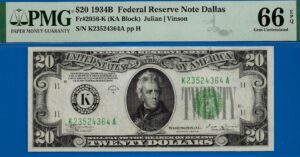
| 1950/1950A $20 | Dallas (K) | 40-70 documented examples | Scarce |
| 1950/1950A $20 | Minneapolis (I) | 25-45 documented examples | Rare |
| 1950/1950A $50 | Any district, CU grade | Fewer than 30 certified CU | Rare |
| 1950/1950A $100 | Boston (A) or Richmond (E) | Fewer than 15 certified total | Rare |
| 1950/1950A $20 Star | Minneapolis (I*) | Fewer than 8 confirmed | Key Date |
| 1950/1950A $50 Star | Any district | Fewer than 12 confirmed total | Key Date |
| 1950/1950A $10 | Kansas City (J) | 30-50 documented examples | Scarce |
| 1950/1950A $5 | Boston (A) or Chicago (G) | 75-120 documented examples | Common |
Where to Find Transitional Mules Today
The primary hunting grounds for 1950/1950A mule notes in 2024 are the major currency auction houses: Stack’s Bowers, Heritage Auctions, and Lyn Knight Currency Auctions. Heritage in particular maintains a robust archive of realized prices for certified mule FRNs that serves as an invaluable free pricing resource. The Memphis International Paper Money Show and the Chicago Paper Money Expo are the premier in-person venues where dealers who specialize in mid-century FRNs bring their best material.
Online, the PCGS and PMG certification lookup tools allow collectors to research the population of certified mules by series, denomination, and district before bidding. Checking population reports before committing to a purchase price is essential, because pop report numbers for certain district/denomination mule combinations have shifted meaningfully as estates have been dispersed and old dealer stocks entered the certification pipeline over the past decade.
Conclusion: A Collecting Specialty with Genuine Depth
The transitional mule notes created during the Series 1950 to 1950A changeover represent one of those collecting specialties that rewards patience, research, and a willingness to look closely at notes that most people walk right past. There is real satisfaction in pulling a Minneapolis $20 mule out of a dealer’s $50 box because you took the time to learn what to look for. Whether you are building a complete 12-district set of $20 mules, hunting for a certified star note mule to anchor a display, or simply want to understand the mechanical history behind the notes in your collection, the 1950/1950A transitional series is rich territory. The BEP’s practical habit of running old plates alongside new ones for economic reasons created, entirely by accident, some of the most interesting variety collecting in the entire Federal Reserve Note series.