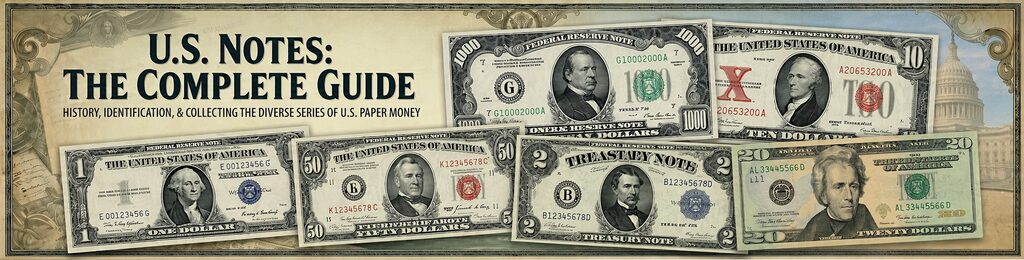
📷 Image source: U.S. Currency Education Program (uscurrency.gov). Images are selected by AI to represent the article topic and may not depict the exact note(s) described.
Walk into almost any currency dealer’s stock and you will find Series 1934 and 1934A $20 Federal Reserve Notes without much trouble. The 1934C and 1934D issues are similarly accessible. But ask for a Series 1934B $20 from certain Federal Reserve districts, and the conversation tends to go quiet. The 1934B $20 occupies a peculiar niche in mid-century American currency: broadly recognized by date collectors yet genuinely elusive in multiple districts, misunderstood by generalists, and consistently undervalued by anyone who has not studied its print history. For collectors who enjoy the hunt, few twentieth-century small-size notes offer the same combination of historical intrigue and real scarcity.
A Brief History of the 1934 Series $20
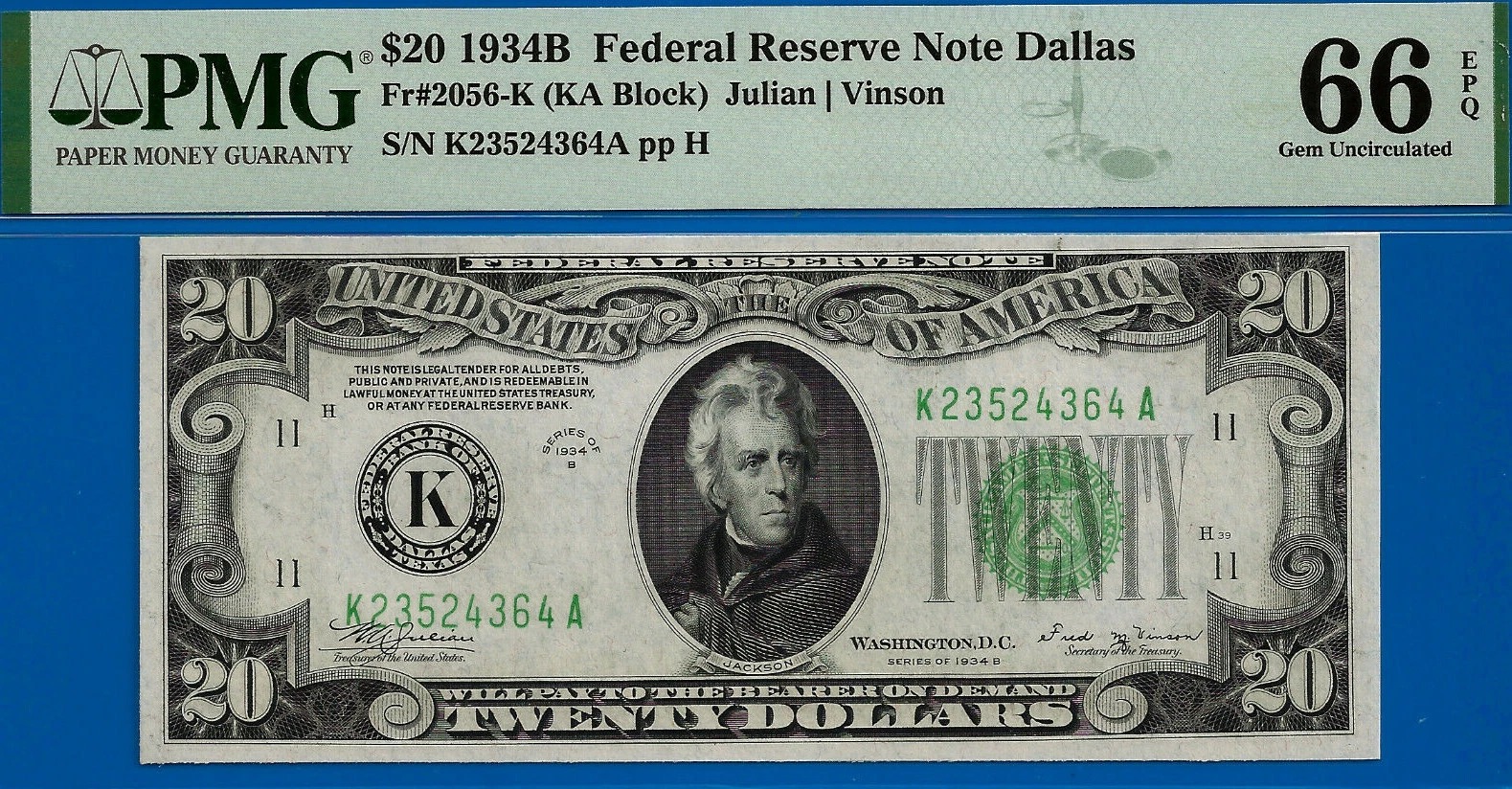
The small-size $20 Federal Reserve Note design introduced in 1928 remained structurally unchanged through the entire 1934 series run, which encompassed four suffix designations: 1934, 1934A, 1934B, and 1934C, plus a 1934D issue. Each suffix reflects a change in the signature combination appearing on the face of the note. The 1934B designation specifically pairs the signature of Treasurer William Alexander Julian with that of Secretary of the Treasury Fred M. Vinson. Vinson served as Treasury Secretary from July 23, 1945, until June 23, 1946, a tenure of less than one year. That abbreviated time in office is the first and most important clue to understanding why 1934B notes are scarcer across the board than their 1934A or 1934C counterparts.
When a new Treasury Secretary took office, the Bureau of Engraving and Printing did not immediately halt all existing print orders. There was always some overlap and transition period. But because Vinson moved on relatively quickly to become Chief Justice of the United States Supreme Court, the window during which 1934B plates were active was genuinely narrow. Total production across all twelve Federal Reserve districts was substantially lower than for adjacent series. The aggregate effect was uneven: some high-demand districts printed enough notes to supply circulation needs, while smaller or less commercially active districts printed only modest quantities, and a few produced numbers so small that survivors in any collectible grade are legitimately rare today.
Understanding the Twelve Districts
The Federal Reserve System divides the country into twelve districts, each identified by a letter (A through L) and a corresponding number (1 through 12). On a $20 Federal Reserve Note, the district is identified by the large letter printed inside the Federal Reserve seal on the left side of the note’s face, as well as repeated numerals in the four corners. Boston is District A (1), New York is B (2), Philadelphia is C (3), Cleveland is D (4), Richmond is E (5), Atlanta is F (6), Chicago is G (7), St. Louis is H (8), Minneapolis is I (9), Kansas City is J (10), Dallas is K (11), and San Francisco is L (12).
For the 1934B $20, not all twelve districts received print orders of comparable magnitude. New York and Chicago, serving the nation’s two largest commercial banking centers, always received the heaviest allocations. San Francisco and Cleveland also saw substantial production tied to wartime and postwar economic activity. But Minneapolis, Richmond, and Atlanta received comparatively thin allocations for the 1934B date, and the numbers bear this out dramatically when you cross-reference BEP production records against surviving census data from major grading services.
When examining a 1934B $20, verify the district by checking both the letter inside the Federal Reserve seal and the repeated numerals in the corners. Altered or misattributed notes do occasionally surface at auction, particularly for high-value scarce districts. A quick cross-check takes seconds and can prevent a costly mistake.
The Minneapolis Problem
Minneapolis (District I, number 9) is the single most discussed rarity in the 1934B $20 series. Production figures researched from BEP records and compiled by currency scholars including Don Kelly and the late Peter Huntoon place the Minneapolis 1934B $20 print run at approximately 1,044,000 notes across regular series production. While that number sounds substantial in isolation, it pales against contemporary New York production that exceeded 50,000,000 notes for the same series designation. Factor in roughly seven decades of circulation wear, loss, and destruction, and the surviving census of Minneapolis 1934B $20 notes in grades Fine or better is remarkably thin.
PCGS Currency and PMG combined population reports as of recent years show fewer than 200 graded examples of the Minneapolis 1934B $20 in all grades combined, with specimens grading VF30 or better numbering in the dozens rather than the hundreds. A Gem example, graded 65 EPQ or better, is effectively a once-in-a-decade find at major auction. When one does appear, prices routinely reach into the mid-four-figures even in moderate circulated grades.
Richmond and Atlanta: The Overlooked Scarce Districts
Minneapolis earns most of the collector attention, but Richmond (District E, number 5) and Atlanta (District F, number 6) 1934B $20 notes present their own substantial challenges. Both districts served economies that were still rebuilding in the mid-1940s, and neither required the massive note allotments that the northeastern and midwestern financial centers demanded. Richmond 1934B $20 production is estimated at approximately 1,440,000 notes, and Atlanta at roughly 1,296,000. These are not print-on-demand rarities in the manner of certain star note issues, but when placed in the context of attrition over eight decades, the effective scarcity is real and documented.
Do not overlook Atlanta and Richmond 1934B $20 notes simply because they lack the name recognition of Minneapolis. Both are significantly tougher to locate in grades above Very Fine than most price guides reflect. The gap between catalog value and actual sale prices for high-grade Richmond and Atlanta examples has been widening steadily since 2015.
Star Notes: Scarcity Compounded
Star notes, those replacement notes printed by the BEP to substitute for defective sheets pulled during production, add another layer of complexity to the 1934B $20 story. For any district where regular-series production was already low, star note production was proportionally even lower. Minneapolis 1934B $20 star notes are considered by most specialists to be among the ten or fifteen rarest regularly issued small-size Federal Reserve Note varieties in the entire twentieth-century series. Confirmed examples can be counted on two hands. Richmond and Atlanta star notes for the 1934B $20 are similarly extreme, with population reports from the major grading services showing single-digit certified examples for some districts.
Even for more common districts like New York and Chicago, 1934B $20 star notes require serious effort to locate in collectible grades. The star note is identified by a five-pointed star preceding the serial number on the face of the note, replacing the standard suffix letter. On a circulated example, this star can sometimes appear faded or partially obscured, so strong lighting and magnification are essential when examining any potential star note purchase.
Grading Considerations for the 1934B $20
The 1934B $20 was a working note circulated during the immediate postwar period, a time when cash transactions remained the norm for most Americans. Heavy use was the rule rather than the exception. As a practical matter, this means the grade distribution for surviving examples skews heavily toward the lower end: VG through Fine accounts for the majority of graded specimens across all districts. Very Fine examples command meaningful premiums. Extremely Fine and About Uncirculated notes are genuinely scarce for most districts, and true Uncirculated examples, whether graded 63 or higher by PMG or PCGS Currency, are legitimately rare for all but New York and Chicago.
Paper quality matters enormously for this series. Look for notes with original paper surfaces, no evidence of pressing or cleaning, and strong ink impression on both the portrait and the reverse vignette of the White House. The green Treasury seal and green serial numbers should appear crisp and well-defined. Notes with pinholes, edge tears, or corner folds that have been pressed flat are unfortunately common in the marketplace and should be priced accordingly.
Third-party grading by PMG or PCGS Currency is especially important for scarce-district 1934B $20 notes. For a Minneapolis or Richmond example priced above $300, the cost of certification is trivially small relative to the confidence it provides in authenticity, originality, and accurate grade. Unholdered examples at shows or online auction deserve careful scrutiny.
Building a District Set
One of the most rewarding ways to collect the 1934B $20 series is to pursue a complete twelve-district set in a consistent grade. A mid-grade set targeting Very Fine 20 to Very Fine 30 is achievable with patience, though it may take five to ten years of active searching to locate acceptable Minneapolis, Richmond, and Atlanta examples at reasonable prices. Collectors targeting Extremely Fine or better should plan on a longer timeline and a substantially larger budget for those three districts in particular.
For collectors new to district set building, beginning with the more accessible issues including New York, Chicago, and San Francisco allows the collection to take shape quickly while the hunt continues for the key-date districts. Display in a custom currency album with individual pockets labeled by district letter creates a visually compelling presentation and makes the gaps in a set immediately apparent, which serves as useful motivation for continued searching.
| District | Federal Reserve Bank | Est. Print Run | Rarity |
|---|---|---|---|
| A (1) Boston | Boston | 3,600,000 | Scarce |
| B (2) New York | New York | 52,800,000 | Common |
| C (3) Philadelphia | Philadelphia | 4,320,000 | Scarce |
| D (4) Cleveland | Cleveland | 6,480,000 | Common |
| E (5) Richmond | Richmond | 1,440,000 | Rare |
| F (6) Atlanta | Atlanta | 1,296,000 | Rare |
| G (7) Chicago | Chicago | 38,880,000 | Common |
| H (8) St. Louis | St. Louis | 2,880,000 | Scarce |
| I (9) Minneapolis | Minneapolis | 1,044,000 | Key Date |
| J (10) Kansas City | Kansas City | 2,520,000 | Scarce |
| K (11) Dallas | Dallas | 1,800,000 | Rare |
| L (12) San Francisco | San Francisco | 14,400,000 | Common |
Pricing Trends and Market Outlook
The 1934B $20 series has seen steady appreciation for key districts over the past fifteen years, outpacing the broader small-size Federal Reserve Note market in several categories. Minneapolis examples in Very Fine grades that sold for $400 to $600 in 2008 have routinely crossed $1,200 to $1,800 at major auction houses including Heritage Auctions and Stack’s Bowers in recent sales cycles. Atlanta and Richmond in the same grade tier have moved from the $150 to $250 range into $400 to $700 territory for clean, original examples. Dallas, often overlooked in older price guides, has followed a similar trajectory.
The market for high-grade 1934B $20 notes from scarce districts remains thin by definition, meaning that a single strong auction result can meaningfully reset the price expectations for a given district. Collectors who find themselves holding a certified Extremely Fine or better Minneapolis, Richmond, or Atlanta example should be aware that dealer buy prices have not always kept pace with auction realization prices, and taking a scarce note directly to auction typically yields better results than a dealer offer.
Check Heritage Auctions’ currency archive for historical sale results before buying or selling any 1934B $20 note from a scarce district. The auction archives going back to 2003 provide a detailed price history that is far more reliable than static catalog values for establishing current fair market prices.
Conclusion: A Series Worth Serious Attention
The Series 1934B $20 Federal Reserve Note rewards the collector who takes time to understand its production history. On the surface it looks like just another mid-century green seal note, and for New York and Chicago issues that impression is essentially correct. But for Minneapolis, Atlanta, Richmond, and Dallas, the 1934B $20 is a genuinely challenging collectible whose scarcity is rooted in the brief tenure of Fred Vinson as Treasury Secretary and the uneven allocation of print orders across Federal Reserve districts during the final year of World War Two and its immediate aftermath. Whether you are building a type set, a district set, or simply tracking down a specific note that has eluded you for years, the 1934B $20 is a series that offers the real satisfaction of a difficult search and a meaningful find.