
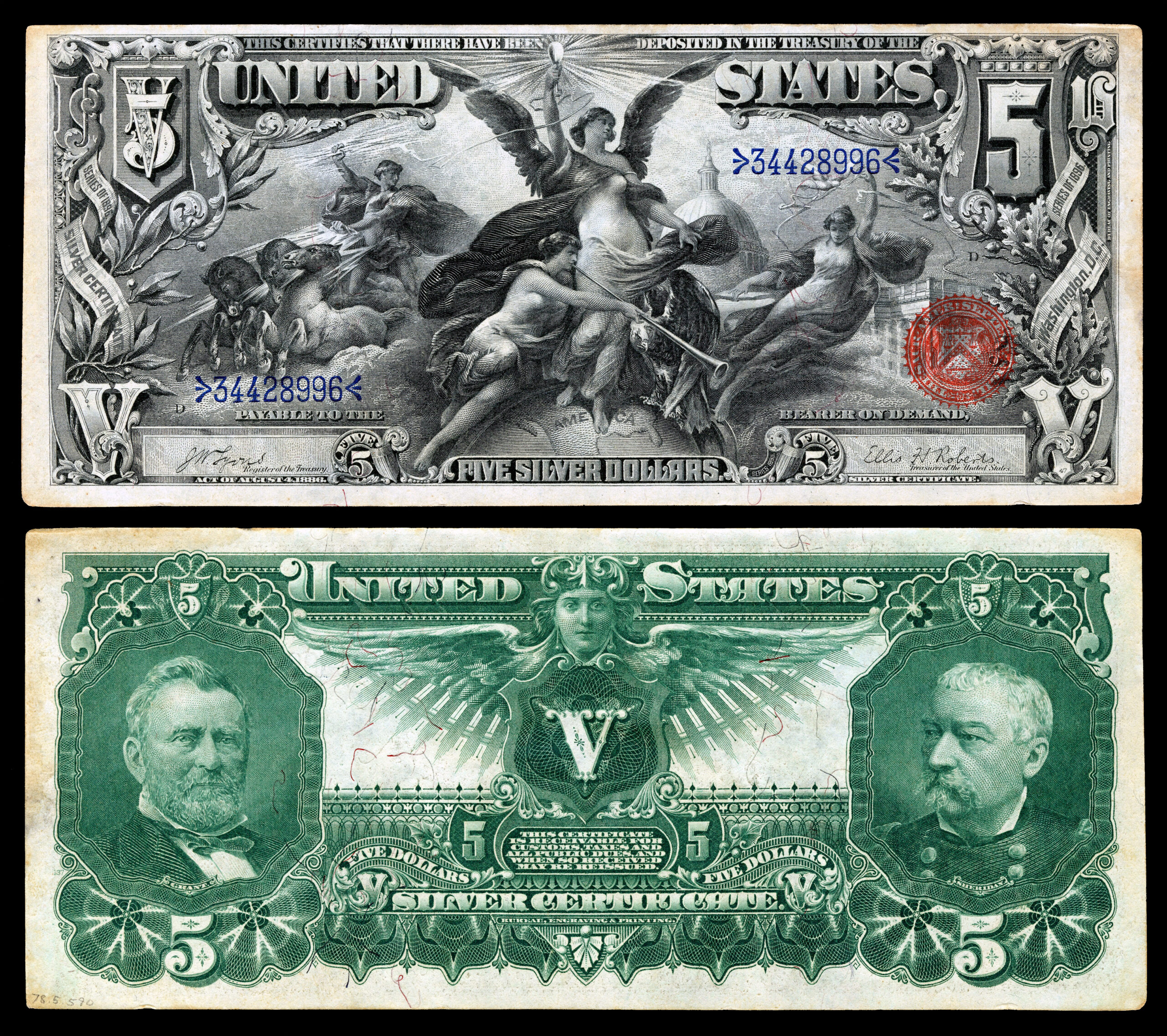
📷 Image source: National Numismatic Collection, National Museum of American History (via Wikimedia Commons). Images are selected by AI to represent the article topic and may not depict the exact note(s) described.
Walk into any major currency auction and the $10 Educational Silver Certificate of 1896 will command the room. Its allegorical vignette of Commerce and History flanking an elaborate architectural frame, the whole design earning it the collector nickname “Tombstone” for the monument-like central panel, represents the apex of American banknote artistry. But the Educational series was short-lived, politically controversial, and expensive to produce. By 1899, the Treasury had moved on. What replaced it, and why, is a story that touches on aesthetics, economics, public morality debates, and the quiet machinery of Treasury Department decision-making that shaped American paper money for the next three decades.
The Educational Series: Brilliant but Embattled
The three denominations of the Educational series, the $1 featuring History instructing Youth, the $2 depicting Science presenting Steam and Electricity, and the $10 showing Commerce and History flanking that grand architectural centerpiece, were issued beginning in 1896 under the authority of Treasury Secretary John G. Carlisle. The Bureau of Engraving and Printing under Director Claude Johnson spared no expense. Fine-line steel engraving, elaborate lathe-work borders, and full-color allegorical figures made these notes genuine works of art.
The problem was precisely that artistry. The reverse of the $1 Educational note depicted the busts of Grant and Sheridan in a manner that some critics found stiff, but the real controversy centered on the female figures on all three denominations. Moralist groups and a handful of newspaper editorialists objected to what they characterized as immodestly draped or undraped female allegorical figures on circulating currency. The criticism seems almost quaint today, but in the political climate of the late 1890s it carried real weight. Treasury officials received letters, and Congressional members took note.
Beyond the aesthetics controversy, there were genuine practical objections. The intricate designs were difficult and expensive to engrave. Printing plates wore more quickly than simpler designs. The fine detail also made the notes harder for the average merchant or bank teller to authenticate quickly in poor lighting. The Educational notes were, in a word, impractical for mass circulation currency, however beautiful they were.
When examining an Educational $10 Silver Certificate, check the signature combination carefully. The only pairing issued was Tillman-Morgan (Treasurer-Register), meaning any note with a different signature combination is either a counterfeit or has been altered. The note also carries a distinctive red Treasury seal at lower right, distinguishing it immediately from its blue-seal successors.
Series 1899 and the Silver Certificate Redesign
The Treasury Department’s response was a thorough overhaul of the Silver Certificate series beginning in 1899. Rather than commissioning new allegorical artwork in the Educational vein, designers and Treasury officials returned to portraiture, the safer, more traditional, and frankly more economical approach that had dominated American currency before the Educational experiment.
For the $1 denomination, the Series 1899 Silver Certificate introduced the beloved Black Eagle design, featuring a large spread eagle over the U.S. Capitol with small portraits of Abraham Lincoln and Ulysses S. Grant in the upper corners. This note, printed in enormous quantities through multiple signature combinations well into the early twentieth century, became one of the most widely circulated Silver Certificates ever issued. Its simplicity was a direct philosophical rebuke to the Educational series complexity.
The $2 Silver Certificate of 1899 brought a portrait of George Washington in a straightforward oval vignette, again a retreat to safe patriotic iconography. The $5 of the same era featured a running Indian Chief design, which, while visually striking, relied on portraiture and documentary imagery rather than allegory.
The $10 Question: Why 1908, Not 1899?
Here is where the story becomes particularly interesting for collectors focused on the $10 denomination. While the $1 and $2 Educational notes were replaced by new Series 1899 designs, the $10 Educational note did not receive its designated replacement until the Series 1908. This roughly decade-long gap is not an accident or an oversight. It reflects the economics and logistics of currency production during this period.
The Bureau of Engraving and Printing continued printing the Series 1896 $10 Educational note into the early 1900s under multiple signature combinations. The note was issued under Tillman-Morgan, Bruce-Roberts, and Lyons-Roberts signature pairings, with the Lyons-Roberts combination being the last and, for collectors, among the most available in circulated grades. The Bureau simply continued printing an existing design as long as the plates were serviceable and demand for the notes could be met, regardless of the aesthetic controversy that had prompted the design changes at the $1 and $2 levels.
The three signature combinations on the $10 Educational Silver Certificate represent meaningfully different levels of rarity. The Tillman-Morgan notes are genuinely scarce in any grade above Fine-12. Bruce-Roberts examples appear at auction somewhat more frequently. Lyons-Roberts notes are the most common of the three, though “common” is a relative term for any $10 Educational note, which commands substantial premiums even in lower circulated grades.
The Series 1908 $10 Silver Certificate: The Tombstone’s True Replacement
When the redesigned $10 Silver Certificate finally appeared as Series 1908, the contrast with its predecessor could not have been more deliberate. The new design centered on a large portrait of Michael Hillegas, the first Treasurer of the United States, placed prominently in the center of the note in the classic oval vignette format. Gone were the allegories, the architectural frames, the elaborate neoclassical figures. In their place was a straightforward, dignified portrait note with clean geometric lathe-work borders.
The Treasury seal on the 1908 issue appeared in blue rather than the red seal of the Educational note, a visual distinction that makes attribution in the field straightforward even at a glance. The serial numbers on Series 1908 notes also appeared in blue ink, consistent with the seal color. This blue-seal $10 Silver Certificate carried the signatures of Vernon-Treat and Vernon-McClung across its production run, with a relatively brief additional printing under Napier-McClung.
The Hillegas portrait itself was something of an obscure choice for the general public, but it reflected a Treasury Department preference in this era for featuring actual monetary officials rather than purely symbolic or allegorical figures. Hillegas served as Treasurer from 1777 to 1789, giving the note a patriotic Revolutionary-era connection without any of the controversy that allegorical female figures had attracted.
Print runs for the Series 1908 $10 Silver Certificate were substantial for the era. The Vernon-Treat pairing, which represents the first and most widely printed signature combination, accounts for the majority of surviving examples. Vernon-McClung notes are somewhat scarcer, and Napier-McClung examples, produced in much smaller numbers, are legitimately difficult to locate in grades above Very Fine-30.
Series 1908 $10 Silver Certificates occasionally surface with mismatched serial number ink tones, a condition resulting from plate wear and ink density variations at the Bureau of Engraving and Printing. These are not errors in the collectible sense but rather production characteristics. When grading these notes, examine the serial numbers under magnification for clarity, as fading or smearing can affect technical grade and therefore market value significantly.
Contextualizing the Design Philosophy Shift
The replacement of the Educational series designs with the sober portraiture of the 1899 and 1908 Silver Certificates was part of a broader pattern in American currency history. The late nineteenth century had seen genuine ambition in banknote design, with the 1869 Rainbow Notes (Legal Tender issues) and the Educational series representing the high-water mark of artistic aspiration. The early twentieth century represented a consolidation and standardization period.
This was not entirely a retreat. The Bureau of Engraving and Printing continued producing exquisitely engraved notes, and the quality of the steel engraving on Series 1908 and contemporaneous issues remains impressive by any standard. But the guiding principle shifted from art-as-currency to currency-as-functional-document. The Federal Reserve Act of 1913 accelerated this trend, eventually producing the standardized portrait-centered designs that, with modifications, persist on American currency to this day.
For collectors, this philosophical turning point makes the late 1890s and early 1900s an especially rich period to study. The Educational notes represent the last great flourishing of allegorical design on American paper money, while the Series 1899 and 1908 replacements show the Treasury Department recalibrating toward the modern era.
| Series / Date | Signature Combination | Estimated Surviving Examples | Rarity |
|---|---|---|---|
| 1896 $10 Educational | Tillman-Morgan | Fewer than 200 known in all grades | Key Date |
| 1896 $10 Educational | Bruce-Roberts | Estimated 300-400 survivors | Rare |
| 1896 $10 Educational | Lyons-Roberts | Estimated 500-700 survivors | Scarce |
| 1908 $10 Silver Cert. | Vernon-Treat | Several thousand known | Scarce |
| 1908 $10 Silver Cert. | Vernon-McClung | 1,500-2,500 estimated survivors | Scarce |
| 1908 $10 Silver Cert. | Napier-McClung | Fewer than 600 known across grades | Rare |
| 1899 $1 Black Eagle | Various (multiple combinations) | Hundreds of thousands surviving | Common |
| 1899 $2 Silver Cert. | Tillman-Roberts | Estimated 2,000-4,000 survivors | Scarce |
Building a Collection Around the Transition
Serious collectors who want to document this pivotal design transition have a clear but challenging goal: assemble an example of the Educational $10 alongside the Series 1908 replacement. This is an ambitious collecting objective given the cost of the 1896 note, but it is achievable at the circulated grade level. A Fine-12 or Very Fine-20 Educational $10 in the Lyons-Roberts signature combination, while still a four-figure acquisition, is obtainable through major currency auctions several times per year. Pairing it with a Very Fine or Extremely Fine Series 1908 Vernon-Treat example creates a compelling exhibit-ready narrative of American currency design philosophy.
For collectors working with tighter budgets, the Silver Certificate transition story can be told very effectively using the $1 denominations. A circulated 1896 Educational $1 alongside an 1899 Black Eagle $1 makes the design philosophy contrast just as clear, at a fraction of the cost. The educational value of having both notes side by side, the allegorical complexity of the former against the sturdy simplicity of the latter, is considerable.
When purchasing any Educational series Silver Certificate, insist on notes certified by PCGS Currency or PMG. The market for cleaned, pressed, or repaired Educational notes is unfortunately active, and even experienced collectors can miss subtle restoration work without third-party grading. A genuine Fine-15 is almost always preferable to an apparent Extremely Fine-40 that has been pressed or washed, both in terms of integrity and long-term value stability.
Conclusion: The Tombstone’s Legacy
The Educational $10 Silver Certificate did not simply end. It transitioned, reluctantly and over a longer timeline than its $1 and $2 siblings, into the Series 1908 Hillegas note that represented everything the Educational series was not: practical, uncontroversial, economical to produce, and designed for a public that needed to identify its currency in seconds rather than admire it for minutes. The shift from the Tombstone design to the Hillegas portrait captures in miniature the larger story of American currency entering the modern era.
For numismatists, both ends of this transition are worth collecting. The Educational notes remain among the most breathtaking objects in American paper money history. The Series 1908 replacements, quieter and more austere, carry their own historical weight as the notes that answered the question the Treasury was asking after 1896: what should American currency look like going forward? The answer they gave shaped the next century of American paper money design.