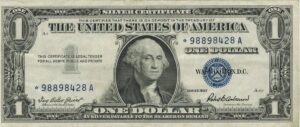
Walk into almost any currency show and ask a dealer for a Series 1934B $5 Federal Reserve Note in high grade from the Chicago or Minneapolis district, and watch the conversation get interesting fast. The 1934B five-dollar note occupies a peculiar place in American numismatic history: it was printed in relatively modest quantities, interrupted by wartime production priorities, and distributed unevenly across the twelve Federal Reserve districts in ways that created dramatic rarity gaps from one bank to the next. For collectors willing to go beyond the obvious common pieces, the 1934B $5 is a deeply rewarding series to pursue.
Understanding the 1934 Series Progression
Before diving into the 1934B specifically, it helps to understand how the Bureau of Engraving and Printing (BEP) used series designations. The base “Series 1934” designation was assigned when a new design was introduced. Each time the Treasury Secretary or Treasurer of the United States changed, the series received a suffix letter: 1934A, 1934B, 1934C, and so on. The design of the note itself remained virtually identical throughout, which means the only physical distinctions are the suffix letter printed on the face of the note and the signature combination.
The Series 1934B $5 Federal Reserve Note bears the signatures of W.A. Julian as Treasurer and Fred M. Vinson as Secretary of the Treasury. Vinson served as Treasury Secretary from July 23, 1945, until June 23, 1946, before President Truman elevated him to Chief Justice of the United States Supreme Court. That relatively brief window of service is part of why 1934B notes across all denominations tend to be scarcer than their 1934A or 1934C counterparts.
The Lincoln Portrait and Design Details
The Series 1934B $5 features the familiar portrait of Abraham Lincoln centered on the face, with the Lincoln Memorial vignette on the reverse. The green Federal Reserve seal appears to the left of Lincoln, with the district letter and number identifying which of the twelve Federal Reserve Banks issued the note. The black Treasury seal appears to the right. Serial numbers are printed in green ink. The back design is printed in a distinctive green that collectors sometimes call “Federal Reserve green” to distinguish it from the olive or yellow-green shades seen on some wartime emergency issues.
When examining a Series 1934B $5, check the district letter in the black seal on the left side of the note. This letter, running A through L, corresponds to the twelve Federal Reserve Banks from Boston (A) to San Francisco (L). Knowing which district you are looking at is the first step toward understanding relative rarity, since some districts received only a single print run of 1934B notes while others received several.
Print Runs and District-by-District Rarity
The core fascination with the 1934B $5 lies in how dramatically print quantities varied by district. The BEP printed notes for each Federal Reserve Bank based on currency orders submitted by those banks, meaning that a rapidly growing commercial district like New York or Chicago might order far more notes than a smaller district like Minneapolis or Richmond. For the 1934B series, the total production across all twelve districts came to approximately 183 million notes, but that figure is deeply misleading if taken as a simple average across districts.
The Federal Reserve Bank of New York (District B) received the lion’s share, with deliveries totaling roughly 64.4 million notes, making New York 1934B fives by far the most common in the series. At the opposite extreme, the Minneapolis district (District I) received only around 1.4 million notes. Kansas City (District J) and Richmond (District E) also came in with very limited deliveries, each below 5 million notes. These figures come from BEP production records and have been compiled and refined by researchers including the work documented in Friedberg’s “Paper Money of the United States” and the more granular district-level data published in the Standard Catalog of United States Paper Money by Cuhaj and Michael.
Star Notes: A Whole Separate Challenge
Every district also received a corresponding star note production run for the 1934B $5, and star notes from the lower-production districts are genuinely difficult to find in any grade. Star notes, identified by the asterisk replacing the first letter of the serial number prefix, were produced as replacement notes to substitute for sheets damaged or destroyed during production. For a district that only ordered 1.4 million regular notes, the corresponding star note production might be only 64,000 to 128,000 pieces, placing them firmly in key-date territory.
For star note collectors pursuing the 1934B $5 series, the Minneapolis (I*), Kansas City (J*), and Richmond (E*) star notes are the most elusive. Even in grades of Very Fine 25 to Extremely Fine 40, these can command multiples of catalog value when they surface at auction. Always verify star note authenticity by cross-referencing the serial number block with documented ranges in the Friedberg reference.
Grading Considerations for the 1934B $5
Like most circulated Federal Reserve Notes from the mid-1940s, the typical 1934B $5 encountered in dealer stocks today falls in the Fine 12 to Extremely Fine 40 range. Notes that circulated through the postwar consumer economy absorbed wear quickly, particularly at the corners and along the central fold. A note grading Very Fine 30 will typically show a single horizontal fold and light handling, with paper that retains reasonable crispness away from the fold lines.
Uncirculated examples (MS-63 and above in PCGS or PMG grading nomenclature) are scarce for most districts and genuinely rare for the low-production banks. PMG (Paper Money Guaranty) and PCGS Currency are the two leading third-party grading services, and submitting a potential high-grade 1934B to either service is strongly recommended before making a significant purchase, particularly for the rarer districts. Population reports from both services show that certified MS-64 and MS-65 examples of Minneapolis, Richmond, and Kansas City 1934B $5 notes are extremely thin, sometimes with only single-digit populations known.
Approximate Current Market Values
Market values for the 1934B $5 vary enormously by district and grade. For the common New York note in circulated grades like VF-30, retail values typically run in the $15 to $30 range, placing it within reach of virtually any collector. The same grade from Minneapolis or Kansas City might realistically trade for $150 to $400 depending on eye appeal and centering. Uncirculated New York examples in PMG 64 EPQ can be found for $75 to $125. A Minneapolis or Richmond example in PMG 64 EPQ, if it could be located, would likely bring $500 or more at auction, with truly gem examples potentially exceeding $1,000 in competitive bidding.
The most recent major auction data (as tracked through Heritage Auctions, Stack’s Bowers, and Lyn Knight Currency Auctions) confirms that low-district 1934B fives in high grades rarely appear more than once or twice per year on the national auction circuit, reinforcing their genuine numismatic scarcity rather than simply catalog rarity.
Building a complete district set of Series 1934B $5 Federal Reserve Notes is a rewarding long-term project. Start by acquiring the common districts (New York, Chicago, San Francisco) in mid-grade to anchor the set, then be patient and selective when scarcer districts appear. Set registries at PCGS and PMG allow you to track your collection against other known certified examples, which can be both motivating and educational.
How to Authenticate and Detect Problems
Because lower-production 1934B $5 notes command premium prices, collectors should be aware of two main concerns: cleaned or pressed notes, and altered series letters. Cleaning a circulated note with solvents or pressing folds with heat can artificially improve apparent grade, and these treatments are detectable under ultraviolet light or by a trained eye examining paper surface texture. More concerning for the rarity-focused collector is the possibility of a note from a common district having its district identifier altered to simulate a scarcer issue. Examine the district letter in both the face seal and the serial number prefix carefully, ensuring consistency of ink color and printing impression with the surrounding text. Third-party certification by PMG or PCGS remains the best protection against these issues.
| District / Bank | Fr. Number | Approx. Print Run | Rarity |
|---|---|---|---|
| A – Boston | Fr. 1957-A | 7,200,000 | Scarce |
| B – New York | Fr. 1957-B | 64,400,000 | Common |
| C – Philadelphia | Fr. 1957-C | 10,800,000 | Common |
| D – Cleveland | Fr. 1957-D | 14,400,000 | Common |
| E – Richmond | Fr. 1957-E | 4,200,000 | Rare |
| F – Atlanta | Fr. 1957-F | 12,600,000 | Common |
| G – Chicago | Fr. 1957-G | 32,400,000 | Common |
| H – St. Louis | Fr. 1957-H | 9,600,000 | Scarce |
| I – Minneapolis | Fr. 1957-I | 1,440,000 | Key Date |
| J – Kansas City | Fr. 1957-J | 3,600,000 | Rare |
| K – Dallas | Fr. 1957-K | 7,800,000 | Scarce |
| L – San Francisco | Fr. 1957-L | 14,400,000 | Common |
Placing the 1934B in a Broader Collection Context
For collectors building a type set of twentieth-century Federal Reserve Notes, a single circulated 1934B $5 from New York satisfies the type requirement at modest cost. But for the specialist pursuing a complete date-and-district collection of small-size $5 Federal Reserve Notes, the 1934B series represents one of the toughest hurdles in the entire run from 1928 to the present. Only the Series 1934 (base series, no suffix) rivals it for combined district scarcity, particularly in the lower-production banks.
The 1934B $5 also holds interest for thematic collectors focused on the Julian-Vinson signature combination. Vinson’s tenure was short enough that his signature appears on a relatively narrow band of note types, and collectors who pursue complete signature sets find the 1934B fives among the more challenging pieces to complete across all twelve districts.
Where to Find These Notes Today
Dealers specializing in small-size currency are the most reliable source for 1934B $5 notes, particularly for scarcer districts. The major currency shows, including the Florida United Numismatists (FUN) show in January, the Whitman Coin and Collectibles Expos, and the American Numismatic Association (ANA) World’s Fair of Money, regularly attract dealers with broad inventories of Federal Reserve type notes. Online auction platforms including Heritage Auctions and Stack’s Bowers run dedicated paper money sales several times per year where district rarities surface.
When searching for scarcer district examples of the 1934B $5, do not overlook raw (uncertified) notes in dealer lots or estate collections. Many high-grade examples have never been submitted to a grading service. If the paper quality, color, and centering look right on a raw note from a trusted dealer, submitting it yourself can both authenticate the piece and potentially reveal a higher grade than you expected, adding meaningful value to your collection.
Conclusion: A Series Worth the Hunt
The Series 1934B $5 Federal Reserve Note rewards the collector who takes the time to understand it. On the surface, it looks like any other mid-century green-seal five: Lincoln on the face, the Memorial on the back, a straightforward design that has served American commerce for decades. But beneath that familiar appearance lies a fascinating distribution story shaped by postwar economic geography, a narrow Treasury Secretary tenure, and BEP printing logistics that created genuine rarity differences of ten-to-one or more between the most common and least common districts.
Whether you are a new collector adding your first date-and-district type piece or a veteran building the definitive certified set of postwar small-size fives, the 1934B is a series that deserves serious attention. The Minneapolis key date alone makes it one of the most satisfying pieces to finally acquire. Start with what you can find, be patient with the rarities, and enjoy the research along the way.