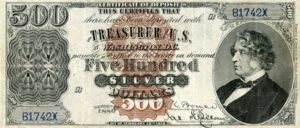
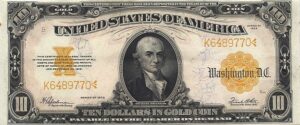
Walk into any serious currency auction today and you will find bidders growing noticeably more attentive whenever a crisp Series 1966 or 1966-A $100 United States Note crosses the block. That heightened interest is entirely justified. This red-seal hundred-dollar bill occupies a unique position in American numismatic history: it is the last Legal Tender Note, sometimes called a United States Note, ever produced for general public use at a denomination above $5. When the Treasury stopped issuing these notes, a monetary tradition that stretched back to the Civil War-era Demand Notes of 1861 came to a quiet, almost unannounced close. For collectors, that finality translates directly into lasting desirability.
A Brief History of United States Notes
To fully appreciate what the Series 1966 $100 represents, it helps to understand the long lineage it closes out. United States Notes were first authorized by the Legal Tender Act of February 25, 1862, and the earliest examples, the famous “greenbacks,” helped finance the Union war effort when specie payments were suspended. These notes bore no interest and were backed solely by the faith and credit of the federal government, a radical concept at the time.
Over the following century, United States Notes were issued in denominations ranging from $1 to $10,000, though many high denominations were retired long before the 1960s. A key statutory requirement distinguished them from Federal Reserve Notes: by law, the Treasury was required to maintain a fixed amount of United States Notes in circulation, originally set at $300 million and later adjusted. That legal minimum kept United States Notes technically alive even as Federal Reserve Notes became the dominant circulating currency of the 20th century.
By the early 1960s, United States Notes survived only in the $2 and $5 denominations for everyday commerce. The $100 denomination had last been issued as a United States Note in Series 1966, and its printing was driven largely by that statutory minimum obligation rather than any great practical need for an alternative hundred-dollar bill.
Why 1966? The Political and Economic Context
The Kennedy and Johnson administrations oversaw considerable restructuring of American currency. Executive Order 11110, signed by President Kennedy on June 4, 1963, famously delegated certain silver certificate authorities to the Treasury, and the mid-1960s saw the elimination of silver certificates from general circulation entirely by 1968. Against this backdrop, Treasury officials were quietly reassessing the continued necessity of United States Notes.
The Series 1966 $100 United States Note was printed between 1966 and 1968 under the signatures of Treasurer Kathryn O’Hay Granahan and Secretary of the Treasury Henry H. Fowler. This Granahan-Fowler signature combination is one of the most recognizable on mid-1960s federal currency. The Series 1966-A notes, printed slightly later, carried the signatures of Treasurer Dorothy Andrews Kabis and Secretary Joseph W. Barr, though Barr’s tenure as Secretary lasted only 30 days in late 1968 into January 1969, making the Barr-signed notes on other series extremely collectible. On the 1966-A United States Notes, however, it is the Kabis-Barr combination that appears.
When examining a Series 1966 $100 United States Note, confirm the signature combination carefully. The Series 1966 notes bear Granahan-Fowler signatures, while Series 1966-A notes carry Kabis-Barr signatures. Misidentified examples show up at smaller auction houses and on dealer tables with some regularity, sometimes affecting the price asked.
Design and Physical Characteristics
The Series 1966 $100 United States Note uses the same basic portrait of Benjamin Franklin that had appeared on $100 bills since the 1920s series. The obverse features Franklin centered on a finely engraved portrait, with “The United States of America” across the top and “One Hundred Dollars” along the bottom. The most visually striking feature distinguishing it from a contemporary $100 Federal Reserve Note is the bold red Treasury seal at right and the matching red serial numbers, a color combination that immediately identifies it as a Legal Tender Note.
The reverse retains the familiar Independence Hall design that has graced the $100 bill for decades. Because the note was printed at the Bureau of Engraving and Printing in Washington, D.C., during the intaglio printing era, the tactile quality of well-preserved examples is exceptional. You can feel the ink standing in relief from the paper surface on any Extremely Fine or better example, a hallmark of BEP craftsmanship.
Serial numbers on the Series 1966 notes run with a single letter prefix and a single letter suffix, with no Federal Reserve district letter since United States Notes were not district-specific. The serial number block runs from A00000001A through approximately A01800000A across both series, though the split between the two series falls roughly at the A00760000A range.
Low serial numbers on United States Notes carry a significant premium. A Series 1966 $100 with a serial number below A00001000A can command two to three times the price of a mid-range serial in equivalent grade. Numbers below A00000100A are genuinely rare and belong in advanced reference collections.
Print Runs and Rarity by Series
The Bureau of Engraving and Printing delivered Series 1966 $100 United States Notes in a total quantity of approximately 768,000 notes, while the Series 1966-A followed with a somewhat larger delivery of approximately 1,000,000 to 1,200,000 notes, bringing the combined production to roughly 1.8 million pieces across both series. Compare this to contemporaneous $100 Federal Reserve Note productions running into the hundreds of millions, and the inherent scarcity of these Legal Tender Notes becomes immediately apparent.
Survival rates complicate the picture further. These notes circulated in a period before widespread currency collecting at the public level, and many were spent without a second thought. A significant portion of lower-grade circulated examples have been absorbed into collector sets, but high-grade Gem Uncirculated (MS-65 or PMG 65 EPQ equivalent) specimens are genuinely difficult to locate. Population reports from PCGS Currency and PMG confirm that certified examples in 65 or better represent a small fraction of the total population submitted for grading.
Star Notes: The Key to the Series
Like all BEP-printed currency of the era, the Series 1966 and 1966-A $100 United States Notes include star note replacements, printed when standard notes were damaged during production. These star notes, identifiable by the star symbol replacing the suffix letter in the serial number, are among the most coveted varieties in all of post-World War II U.S. paper money.
Series 1966 star notes had a print run of approximately 128,000 notes. Series 1966-A star notes are even scarcer, with an estimated production of only 512,000, though some researchers place the figure slightly lower. In Gem Uncirculated condition, a Series 1966 star note can realize $5,000 to $10,000 or more at major auction, while even a Very Fine example typically sells well above $1,000. The 1966-A star notes in high grade are similarly priced, and any certified example above PMG 63 or PCGS 63 represents a meaningful numismatic acquisition.
Always insist on third-party grading certification (PMG or PCGS Currency) when purchasing star notes from the Series 1966 or 1966-A $100 issues. The premium values involved make these notes targets for cleaning, pressing, and even outright counterfeiting of the star designation itself on otherwise ordinary serial number notes. Certified holders also make auction resale significantly easier.
Condition and Value Ranges for Collectors
The Series 1966 $100 United States Note exists across a broad quality spectrum in today’s market. Circulated examples in Good to Very Good condition (G-4 to VG-8) typically trade in the $150 to $250 range, making them accessible entry points for newer collectors who want a piece of this history without a major outlay. Fine to Very Fine examples (F-12 to VF-35) step up to approximately $300 to $600 depending on eye appeal and centering.
Extremely Fine (EF-40 to EF-45) examples with minimal folds and strong paper quality bring $600 to $900, while About Uncirculated notes (AU-50 to AU-58) approach $1,000 to $1,500. Certified Gem Uncirculated examples graded PMG 65 EPQ or PCGS 65 PPQ move into the $2,000 to $4,500 range, with exceptional specimens and favorable auction situations pushing beyond that ceiling.
The Series 1966-A regular (non-star) issues trade at a modest discount to the 1966 series across most grades, reflecting the slightly higher print run. However, in superb gem grades (67 or better with full original paper quality designations), either series commands serious collector attention and prices well into four figures.
| Series | Variety | Est. Print Run | Rarity |
|---|---|---|---|
| 1966 | Regular Issue (Granahan-Fowler) | 768,000 | Scarce |
| 1966 | Star Note (*) | 128,000 | Key Date |
| 1966 | Regular, Gem Unc. (PMG/PCGS 65+) | Small fraction of 768,000 | Rare |
| 1966 | Low Serial (below A00001000A) | Est. under 1,000 | Rare |
| 1966-A | Regular Issue (Kabis-Barr) | ~1,000,000-1,200,000 | Scarce |
| 1966-A | Star Note (*) | Est. 512,000 | Rare |
| 1966-A | Regular, Gem Unc. (PMG/PCGS 65+) | Small fraction of run | Rare |
| 1966-A | Low Serial (below A00000100A) | Extremely limited | Key Date |
The End of an Era: Legal Tender Notes After 1966
In 1971, the Treasury Department formally announced that it would no longer issue United States Notes in denominations above $2. The $5 United States Note (Series 1963) had already been the last of that denomination produced, and the $2 bill limped along as a United States Note through Series 1963-A before being redesigned as a Federal Reserve Note for the Bicentennial Series of 1976. By that point, the $100 Legal Tender Note had already passed from living memory for many Americans.
The statutory requirement to maintain $300 million in United States Notes in circulation technically remained on the books, satisfied by the relatively small quantities of $2 and $5 United States Notes still floating through the banking system. The Series 1966 $100, therefore, represents the highest-denomination Legal Tender Note that a collector can realistically obtain from the modern era, adding another layer of significance to an already historically rich issue.
Building a complete type set of 20th-century $100 bills is a rewarding long-term project, and the Series 1966 United States Note is an essential inclusion. Pair it with a Series 1928 Gold Certificate $100 (Fr. 2405), a Series 1934 Federal Reserve Note, a Series 1950 Federal Reserve Note, and a Series 1963-A Federal Reserve Note to showcase the full evolution of the modern hundred-dollar bill across note types and seal colors.
Collecting Strategy and Where to Find Quality Examples
The best sources for high-quality Series 1966 and 1966-A $100 United States Notes remain the major auction houses, including Heritage Auctions, Stack’s Bowers, and Lyn Knight (now part of the broader auction landscape). Heritage’s Currency Signature auctions and the major FUN and ANA convention sales regularly feature certified examples across grades, and the archived realized prices provide an invaluable benchmark for any serious buyer.
Fixed-price dealer lists from established SPMC (Society of Paper Money Collectors) members and dealers who specialize in large-size and small-size Legal Tender Notes are another reliable avenue. The SPMC itself publishes the journal Paper Money, which frequently features marketplace data and dealer advertisements relevant to United States Note collectors.
When evaluating an uncertified example in hand, examine the note under good lighting for evidence of cleaning (an unnatural sheen or disturbed surface fibers), pressing (artificially sharp folds that have been ironed flat), or tape repairs at the margins or center fold. On a note with collector premiums reaching into the thousands of dollars, the cost of professional grading is always justified before purchase or before offering the note for resale.
Conclusion: A Note Worth Knowing
The Series 1966 $100 United States Note is not merely old currency. It is the closing chapter of a monetary institution that helped preserve the Union, financed westward expansion, and persisted through the Federal Reserve era purely by the inertia of federal statute. Its red seal is not decoration but a declaration of a different monetary philosophy, one in which the government itself, not a banking system, stood as the direct guarantor of the paper in your pocket.
For collectors, that history is available at a range of price points, from well-circulated examples accessible to beginners, to gem-quality star notes that challenge even the most advanced holdings. Whether you acquire one as a single cornerstone piece or build toward a comprehensive Legal Tender Note type set, the Series 1966 $100 belongs in any serious collection that aspires to tell the full story of American paper money.