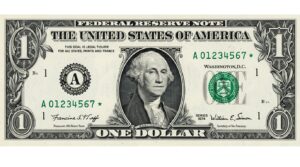
📷 Image source: banknote.ws (World Banknote Gallery). Images are selected by AI to represent the article topic and may not depict the exact note(s) described.
Picture a US Army paymaster in Casablanca, Tunisia, or Algiers in 1942, handing soldiers their wages in dollar bills unlike any seen before or since. The familiar blue Treasury seal that Americans knew from standard Silver Certificates had been replaced with a bold yellow one, and the serial numbers were printed in the same vivid yellow-gold ink. These were not counterfeit notes or some foreign imitation. They were genuine United States currency, deliberately altered to serve a critical wartime security function: if the Nazis captured large quantities of these bills, the Treasury could instantly invalidate them by announcement, protecting the Allied war effort from a potential financial catastrophe. That ingenious solution produced what collectors today know as the North Africa Yellow Seal Silver Certificates, among the most historically significant and visually striking notes in all of American numismatics.
The Strategic Logic Behind the Yellow Seal
When the United States entered World War II following the attack on Pearl Harbor in December 1941, military planners faced a logistical and financial puzzle. American forces being deployed to the North African theater, beginning with Operation Torch in November 1942, needed to be paid in US dollars. However, military strategists and Treasury officials worried about what would happen if large stockpiles of standard US currency fell into enemy hands. Normal greenbacks could circulate anywhere in the world, and captured funds could finance enemy operations or destabilize Allied economies.
The solution was elegant in its simplicity. The Bureau of Engraving and Printing (BEP) modified existing Series 1935A $1 Silver Certificate plates by overprinting the Treasury seal and serial numbers in bright yellow ink rather than the standard blue used on domestic Silver Certificates. This color change served as a visual identifier that distinguished military-issue notes from domestic circulation currency. Critically, Treasury officials announced that if these notes were captured by Axis forces, the United States government reserved the right to demonetize the entire series at once, rendering captured stocks worthless overnight.
This was not merely theoretical. The concept had genuine strategic value, and similar thinking simultaneously produced the Hawaii overprint notes issued after Pearl Harbor, which used brown seals and “HAWAII” overprints front and back for the same defensive purpose in the Pacific theater.
When examining a North Africa Yellow Seal note, look at the serial numbers under good light. Genuine examples show serial numbers printed in the same yellow-gold ink as the Treasury seal, not black or blue ink. Altered standard 1935A notes occasionally appear on the market with chemically or digitally modified seals. Always purchase these notes with third-party grading certification from PCGS Currency or PMG to confirm authenticity.
Physical Characteristics and Identification
The North Africa Yellow Seal notes share their basic design with the standard Series 1935A $1 Silver Certificates, featuring a portrait of George Washington on the face and the eagle reverse design that would remain on the $1 bill through subsequent series. The key distinguishing features are straightforward once you know what to look for.
The Treasury seal on the right side of the face is printed in yellow-gold ink rather than the blue ink found on standard 1935A notes. The serial numbers, which appear twice on the face of the note (upper right and lower left), are also printed in yellow-gold ink. The signature combination is that of W.A. Julian as Treasurer of the United States and Henry Morgenthau Jr. as Secretary of the Treasury, the same pairing found on standard Series 1935A notes. The blue “SILVER CERTIFICATE” obligation text and the blue “ONE DOLLAR IN SILVER” wording on the face remain in standard blue, as does the fine-line security printing throughout the note.
Serial number ranges for the North Africa issue run from approximately Z00000001A through Z74364000A for the regular issue, though collectors should note that not all Z-block serial numbers represent North Africa notes. The Z prefix and yellow overprinting together confirm the wartime issue. Total print run figures are estimated at approximately 26,916,000 notes, a relatively modest quantity compared to the hundreds of millions of standard 1935A notes produced.
The Hawaii Connection: A Sister Issue
The North Africa Yellow Seal notes are frequently discussed alongside the Hawaii overprint Silver Certificates and Federal Reserve Notes of the same era, and understanding both issues helps collectors appreciate the broader wartime currency program. The Hawaii notes, produced following Executive Order 9112 in January 1942, were issued in $1 Silver Certificates (Series 1935A, Fr. 2300) as well as $5, $10, and $20 Federal Reserve Notes, all carrying brown Treasury seals and bold “HAWAII” overprints.
While the Hawaii notes were intended to protect against a potential Japanese occupation of the Hawaiian Islands, the North Africa Yellow Seal notes served troops in the Mediterranean theater. Both programs reflect the same wartime security philosophy, and many collectors pursue both series as a thematic set representing America’s wartime monetary ingenuity.
Building a companion set of the North Africa Yellow Seal alongside the Series 1935A Hawaii overprint ($1, Fr. 2300) and the $1 Hawaii Federal Reserve Note creates a compelling wartime emergency currency display. All three notes share the Julian-Morgenthau signature combination, making them a cohesive matched set. A circulated trio in Very Fine condition can often be assembled for under $600 total, representing exceptional historical value per dollar spent.
Condition, Grading, and Market Values
Like all collectible currency, North Africa Yellow Seal notes command dramatically different prices depending on grade. The notes did circulate, many of them heavily, in the difficult conditions of a wartime military environment. Sweat, humidity, rough handling, and the general chaos of a combat theater environment meant that high-grade survivors are genuinely scarce. Most examples that reach today’s market grade in the Very Fine (VF20 to VF35) range, showing light folds and some wear but retaining good overall detail.
In circulated grades such as Fine (F12), expect to pay approximately $25 to $45 for a honest, problem-free example. Very Fine examples (VF20 to VF35) typically trade in the $60 to $110 range. Extremely Fine (EF40 to EF45) notes, showing only minor handling and retaining most of their original crispness, can reach $150 to $250. Choice Uncirculated examples graded CU63 or better by PMG or PCGS Currency command $300 to $600, while the finest known gems graded 66 EPQ or 67 EPQ have brought over $1,000 at major auction. Star note replacements (those with a star suffix replacing a damaged note during printing) are significantly rarer and carry strong premiums at all grade levels, typically commanding two to three times the value of regular-issue notes in comparable condition.
Detecting Problems and Altered Notes
Because North Africa Yellow Seal notes carry a premium over standard blue-seal 1935A notes, altered examples do occasionally surface. Unscrupulous sellers have attempted to chemically alter or overprint blue seals to mimic the yellow color. The most reliable protection is third-party authentication. Under ultraviolet light, genuine yellow ink on these notes fluoresces differently than the blue ink used on standard notes. The paper itself should show appropriate aging consistent with an 80-plus-year-old note. Any note with a seal that appears artificially bright, uneven, or slightly out of register with the surrounding design warrants careful scrutiny.
Additionally, collectors should examine the serial number ink carefully. On genuine North Africa notes, both the seal and the serial numbers were overprinted simultaneously in the same yellow ink batch. If the serial numbers appear in blue or black while the seal appears yellow, the note has almost certainly been altered and is worth only face value at best.
Standard Series 1935A blue-seal Silver Certificates are among the most affordable collectible US notes, often available in circulated grades for under $5 each. Keeping a few blue-seal examples alongside your North Africa note makes for an excellent side-by-side educational display, instantly showing visitors the dramatic visual difference that made the yellow seal so effective as a security measure.
Provenance and Military History
One of the great appeals of these notes for many collectors is the human history they carry. Soldiers received these notes as pay during some of the most intense fighting of World War II, including the campaigns in Tunisia (November 1942 to May 1943), the invasion of Sicily in July 1943, and the subsequent campaign up the Italian peninsula. A note in well-worn condition might genuinely have passed through the hands of a GI at Anzio or Kasserine Pass, bought a Coca-Cola at a base canteen in Oran, or paid for a meal in liberated Naples.
Some collectors actively seek out notes with period envelopes, wartime letters, or military payment records that establish provenance. While such documentation is extremely rare, it adds an irreplaceable dimension to any example. Even without documentation, these notes carry the weight of history in a way that few collectible items can match.
| Series / Type | Variety | Est. Print Run | Rarity |
|---|---|---|---|
| 1935A Yellow Seal (Fr. 2306) | Regular Issue | 26,916,000 | Scarce |
| 1935A Yellow Seal Star Note | Z-block Star Replacement | Est. under 1,000,000 | Rare |
| 1935A Yellow Seal CU65 EPQ or better | Gem Uncirculated Survivors | Very few graded | Key Date |
| 1935A Hawaii $1 (Fr. 2300) | Regular Issue | 35,052,000 | Scarce |
| 1935A Hawaii $1 Star Note | Star Replacement | Est. under 204,000 | Rare |
| 1934A Hawaii $5 FRN (Fr. 2302) | Brown Seal Hawaii Overprint | 9,416,000 | Scarce |
| 1934 Hawaii $10 FRN (Fr. 2303) | Brown Seal Hawaii Overprint | 10,424,000 | Scarce |
| 1934A Hawaii $20 FRN (Fr. 2304) | Brown Seal Hawaii Overprint | 11,246,000 | Rare |
Where to Find North Africa Yellow Seal Notes Today
These notes appear regularly at major US currency shows, through established currency dealers, and on Heritage Auctions, Stack’s Bowers, and similar major platforms. The Professional Currency Dealers Association (PCDA) membership roster is an excellent starting point for finding reputable specialists. Online marketplaces like eBay also list these notes frequently, but the authentication concerns discussed above make buying raw (uncertified) examples risky for newer collectors. For anyone spending more than $50 on an example, PMG or PCGS Currency encapsulation is strongly recommended.
For new collectors on a budget, a Fine to Very Fine circulated North Africa Yellow Seal note represents perhaps the single best combination of historical significance, visual drama, and affordability in all of US paper money collecting. At $30 to $80 for a solid circulated example, you acquire a genuine piece of World War II history that is legally collectible, widely available, and endlessly fascinating to show to non-collectors who have never heard this story before.
Conclusion: A Cornerstone of Any Wartime Collection
The Series 1935A North Africa Yellow Seal Silver Certificate stands as a remarkable intersection of monetary policy, military strategy, and printing ingenuity. In designing a note that could be instantly demonetized if captured, Treasury officials and BEP craftsmen created something far more enduring: a tangible artifact of American resolve during the most consequential conflict in modern history. Whether you are assembling a comprehensive wartime emergency currency set, building a themed Silver Certificate collection, or simply looking for one extraordinary note that tells an important story, the North Africa Yellow Seal deserves a place of honor in your collection. Few pieces of paper money carry this much history in so accessible a package.