📷 Image source: Wikimedia Commons. Images are selected by AI to represent the article topic and may not depict the exact note(s) described.
Walk into almost any antique mall or coin show in America and you will find them: crisp blue-seal dollar bills tucked into plastic sleeves, often priced between two and five dollars, sometimes less. The Series 1957 $1 Silver Certificate is everywhere, and that ubiquity fools many collectors into dismissing it entirely. That would be a mistake. Beneath the surface of this seemingly mundane note lies a fascinating story of monetary transition, a web of sub-series distinctions, and a set of star note varieties that can command serious premiums from advanced collectors. This is the note that closed the chapter on large-scale silver certificate production in the United States, and it deserves a far more careful look than it usually gets.
A Brief History of the Silver Certificate
Silver certificates were authorized by the Bland-Allison Act of 1878 and subsequently refined by the Sherman Silver Purchase Act of 1890. For nearly a century, they served as a practical paper surrogate for silver coin, with each note technically representing a specific quantity of silver dollars held in Treasury vaults. By the mid-twentieth century, however, rising silver prices were making the certificates increasingly impractical. The government could not afford to keep printing money that obligated it to hold an appreciating commodity as backing.
President John F. Kennedy signed Executive Order 11110 in June 1963, which among other measures began the process of retiring silver certificates. But before that final curtain fell, the Bureau of Engraving and Printing had already produced billions of Series 1957 notes across three distinct sub-series. These were the last $1 silver certificates ever printed in quantity, and their production bridged the Eisenhower and Kennedy administrations.
The Three Sub-Series: 1957, 1957-A, and 1957-B
The Series 1957 $1 Silver Certificate was produced in three separate sub-series, each distinguished by a different combination of Treasury and Comptroller signatures printed on the face of the note. Understanding these pairings is the foundation of collecting this series intelligently.
Series 1957
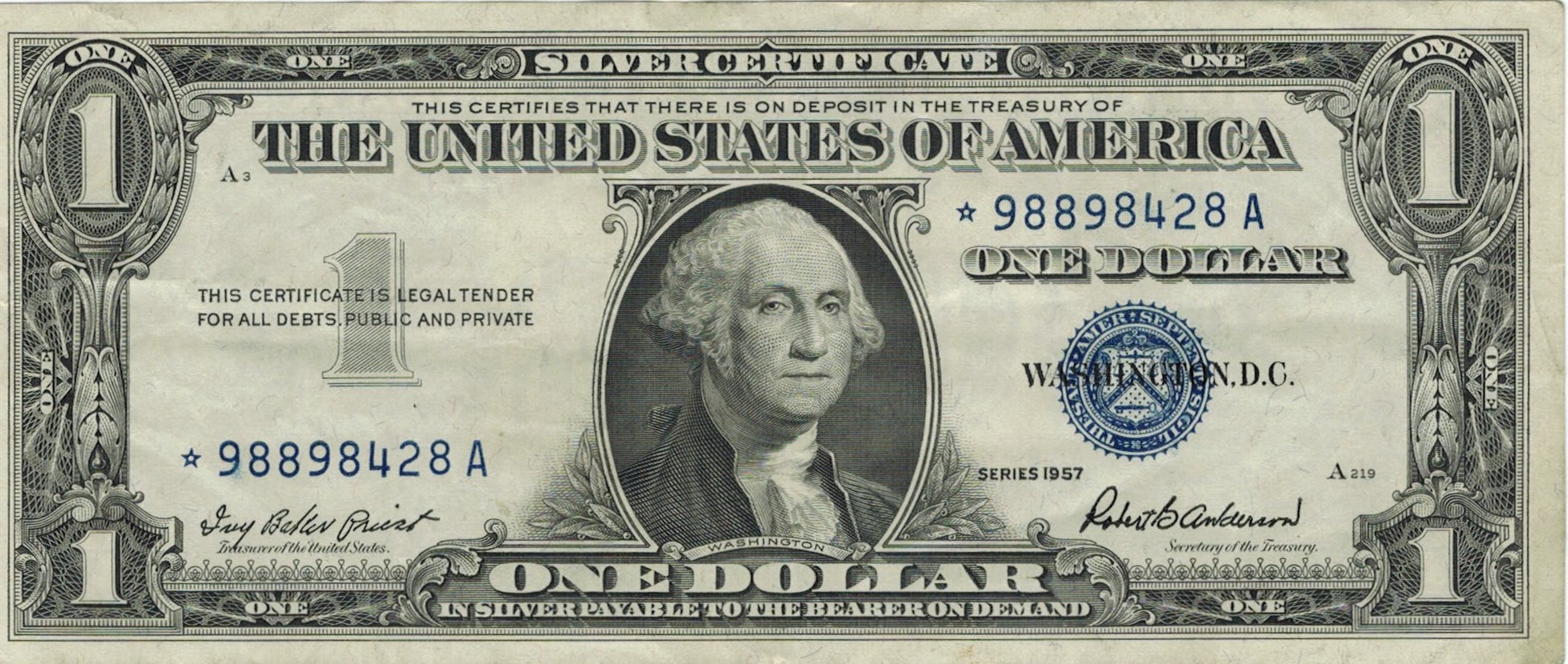
The original 1957 series bears the signatures of Ivy Baker Priest as Treasurer of the United States and Robert B. Anderson as Secretary of the Treasury. Priest served from 1953 to 1961, and Anderson from 1957 to 1961, which brackets the production window precisely within the Eisenhower administration. The print run for the 1957 base series alone exceeded 1.6 billion notes, making it one of the largest single runs of any small-size note type in American history. In circulated grades, these are genuinely common. In gem uncirculated condition (MS-65 or PMG 65 EPQ and above), well-centered examples with bright paper are more competitive than most newcomers expect.
Series 1957-A
The 1957-A sub-series introduced new signatures: Elizabeth Rudel Smith as Treasurer and C. Douglas Dillon as Secretary of the Treasury. Smith and Dillon served in the Kennedy administration beginning in 1961, so the switch to a new sub-series designation reflects precisely that change in appointees. The 1957-A had a somewhat smaller print run than the base series, roughly 1 billion notes, but it remains quite common in all grades below gem uncirculated. The shift in Treasury leadership gives this sub-series a subtle historical poignancy: it was printed during the very administration that would begin dismantling the silver certificate system.
Series 1957-B
The final sub-series, 1957-B, carries the signatures of Kathryn O’Hay Granahan as Treasurer and C. Douglas Dillon continuing as Secretary of the Treasury. Granahan replaced Smith in 1962, triggering the new sub-series designation. The 1957-B had the smallest print run of the three sub-series, approximately 400 million notes, though that figure still represents an enormous quantity by most standards. This sub-series is the most sought-after of the three in high grade, and its star notes are particularly prized.
When examining Series 1957 notes, always check the signature combination first to confirm which sub-series you have. Notes are sometimes mis-attributed by sellers who only glance at the series date printed on the face. The Priest-Anderson, Smith-Dillon, and Granahan-Dillon pairings each correspond to a distinct sub-series with meaningfully different scarcity profiles, especially in star note form.
Design and Physical Characteristics
All three sub-series share the same basic design that was introduced with the small-size $1 silver certificate in 1928. The obverse features a portrait of George Washington at center, surrounded by fine-line lathe work. The most visually distinctive feature is the bold blue Treasury seal to the right of the portrait and the matching blue serial numbers, both of which immediately identify the note as a silver certificate rather than a Federal Reserve Note (which carries a green seal) or a United States Note (which carries a red seal).
The reverse features the iconic back design first used in 1935, commonly called the “funnel back” or “plain back” design. Unlike the elaborate pyramid-and-eye reverse introduced on the 1935 series, the 1957 series back design is clean and straightforward. The paper itself is the distinctive rag-cotton blend used by the BEP, and surviving high-grade examples often display a crispness and whiteness that stands up well against the passage of time when stored properly.
Serial numbers on 1957 series notes run from A00000001A through the end of the alphabet cycle, with block letter combinations that experienced collectors use to cross-reference print quantities against BEP production records. The prefix and suffix letters change as each printing plate block is completed, and tracking these block letters is one way to pin down approximate production dates within a given sub-series.
Centering is the single most important grading factor for Series 1957 $1 Silver Certificates in gem uncirculated grades. The BEP’s cutting tolerances in the late 1950s and early 1960s were less precise than modern standards, so gem-centered examples (with equal margins on all four sides) are significantly scarcer than the raw print run numbers suggest. Always prioritize centering when selecting high-grade examples for registry sets.
Star Notes: The Real Prize
Star notes are replacement notes printed by the Bureau of Engraving and Printing to substitute for notes that are damaged or destroyed during the production process. They are identified by a star symbol (asterisk) appearing at the beginning or end of the serial number, depending on the era. For Series 1957 $1 Silver Certificates, the star appears at the end of the serial number prefix position.
Star notes for all three 1957 sub-series were produced, but in quantities far smaller than the regular issue runs. The total star note production for the base 1957 series was approximately 72 million notes, which sounds large but represents only about 4.5 percent of the regular issue run. For the 1957-A sub-series, star note production is estimated at roughly 28 million. The 1957-B star notes are the rarest of all, with production figures estimated at approximately 8 to 10 million notes, depending on the production block.
Within the star note population, condition is everything. Because these notes circulated at face value for years before most people understood their premium status, finding a 1957-B star note in true gem uncirculated condition is a genuine challenge. PMG and PCGS Currency both report relatively small populations of 1957-B stars graded 65 EPQ or higher, making them legitimate key pieces in a complete silver certificate type set.
One important nuance: not all star note blocks for the 1957 series are equally scarce. Some individual printing blocks had significantly shorter runs than the overall star note totals suggest. Collectors building a comprehensive set sometimes target specific star note blocks as well as the broader sub-series categories. BEP production records, cross-referenced with serial number databases maintained by organizations like the Society of Paper Money Collectors (SPMC), are indispensable tools for this level of research.
Third-party grading from PMG or PCGS Currency is strongly recommended before purchasing any Series 1957 star note priced above $50. Cleaned, pressed, or artificially brightened notes are not uncommon in this series because silver certificates were widely circulated and many survivors show wear. A legitimate gem example should display original paper surfaces, full embossing from the intaglio printing, and no evidence of washing or pressing under UV light.
Condition Rarities and the High-Grade Market
One of the most interesting paradoxes in collecting the Series 1957 $1 Silver Certificate is the inverse relationship between the enormous print runs and the relative scarcity of truly high-grade survivors. When these notes were issued, most Americans had no reason to preserve them. They spent freely through the late 1950s and 1960s. Some notes were redeemed for silver coin before the June 1968 deadline. Others simply wore out in wallets and cash registers.
The notes that survived in gem condition often did so by accident: tucked into books, stored in boxes of old paperwork, or set aside by a prescient collector who recognized them as historically interesting. Original packs of 100 notes, still banded as they left the Federal Reserve, occasionally surface at major currency auctions and represent the highest-quality examples available. These “original pack” or “gem pack” notes typically grade 65 to 67 EPQ and command substantial premiums over individually graded examples at the same grade level.
For the 1957-B sub-series in particular, gem uncirculated examples with strong eye appeal and full original paper quality are genuinely difficult to source. The smaller print run, combined with the later issue date (when silver certificates were already beginning to lose their novelty), means fewer high-quality survivors exist relative to the 1957 base series.
| Series / Sub-Series | Note Type | Est. Print Run | Rarity |
|---|---|---|---|
| 1957 (Priest-Anderson) | Regular Issue | ~1.6 billion | Common |
| 1957 (Priest-Anderson) | Star Note | ~72 million | Scarce |
| 1957-A (Smith-Dillon) | Regular Issue | ~1.0 billion | Common |
| 1957-A (Smith-Dillon) | Star Note | ~28 million | Scarce |
| 1957-B (Granahan-Dillon) | Regular Issue | ~400 million | Common |
| 1957-B (Granahan-Dillon) | Star Note | ~8-10 million | Rare |
| 1957 Any Sub-Series | Regular Issue, Gem (65 EPQ+) | Small survivor pop. | Scarce |
| 1957-B | Star Note, Gem (65 EPQ+) | Very small survivor pop. | Key Date |
Building a Set: Strategies for Collectors at Every Level
For collectors just entering the silver certificate space, the Series 1957 $1 offers an accessible entry point with real numismatic depth. A basic three-note type set covering one example of each sub-series can be assembled in very fine (VF-20 to VF-35) condition for well under $30 total, making it an ideal introductory project. Moving up to choice uncirculated (CU-63 to CU-64) examples raises the budget modestly but opens up a genuinely different visual experience: the blue seals are vivid, the paper is bright, and the note gives a tangible sense of what these looked like fresh from the BEP.
Intermediate collectors often expand the set to include a star note for each sub-series, which is where the challenge and cost begin to escalate meaningfully. A circulated 1957 base-series star note in VF condition might bring $10 to $20 at retail. A 1957-A star in the same grade runs somewhat higher. A 1957-B star in any circulated grade can command $40 to $100 depending on condition and the market, and gem examples have sold at major auctions for multiples of that figure.
Advanced collectors building registry-quality sets focus almost exclusively on third-party graded examples at the 65 EPQ level and above, often targeting specific serial number blocks within each sub-series. Some collectors also pursue fancy serial numbers within the 1957 series: solid numbers, radars, ladders, and low serial numbers all carry premiums beyond the base value of the note type itself.
The End of an Era
When the last Series 1957-B $1 Silver Certificates rolled off the BEP presses in the early 1960s, it marked the close of a monetary tradition stretching back to the Grant administration. The silver certificates were not replaced by something structurally equivalent. The $1 Federal Reserve Note that succeeded them carried no commodity backing whatsoever, representing a fundamental philosophical shift in American monetary policy. For collectors, that transition gives the Series 1957 notes a historical weight that transcends their modest face value.
These notes were the last time ordinary Americans carried paper money that was, at least in theory, directly exchangeable for a tangible asset held in Treasury vaults. By June 1968, even that technical right had been extinguished. What remains today is not just a common blue-seal dollar bill but a document of monetary history, available to any collector willing to look past the familiar face and read the story printed between the lines.