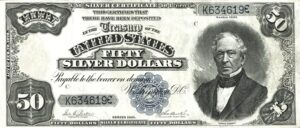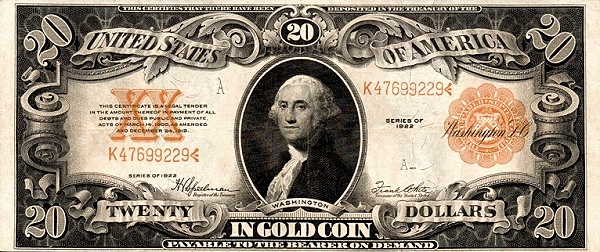
📷 Image source: banknote.ws (World Banknote Gallery). Images are selected by AI to represent the article topic and may not depict the exact note(s) described.
A Window into History: The $5 Porthole Gold Certificate
Pick up a Series 1922 $5 Gold Certificate in any grade above Fine and you’ll understand immediately why collectors have pursued it for generations. The face of the note is dominated by a striking circular portrait of Abraham Lincoln, framed within an ornate lathe-work border that resembles, with remarkable precision, the porthole of a nineteenth-century ocean liner. It is this design element, officially unintentional but visually unforgettable, that earned the note its enduring nickname: the Porthole note. No other piece of small-size or large-size American currency quite replicates the effect, and that singularity has made the 1922 $5 Gold Certificate a cornerstone of serious collections for well over a century.
Design and Printing: What Makes the Porthole Distinctive
The Series 1922 $5 Gold Certificate is a large-size note, measuring approximately 7.375 by 3.125 inches, the standard large-size format used by the Bureau of Engraving and Printing before the currency redesign of 1928 introduced the smaller notes we carry today. The obverse features Lincoln’s portrait centered within that distinctive circular frame, surrounded by elaborate geometric lathe-work. The background is a rich golden-yellow, consistent with the Gold Certificate class, which was issued under the authority of the Gold Standard Act and was technically redeemable in gold coin at any Federal Reserve Bank or Treasury facility.
The reverse of the note is printed in a deep black ink and carries the denomination prominently at center, with “GOLD CERTIFICATE” boldly stated at top. The Treasury seal, printed on the obverse in a vivid orange-gold color, appears to the right of Lincoln’s portrait. This particular shade is often described by collectors as a “bright pumpkin” tone, distinctly different from the yellow-gold seals seen on some earlier Gold Certificate issues and a useful diagnostic point when authenticating the note.
The Friedberg catalog, the standard reference work for U.S. paper money authored originally by Robert Friedberg and now maintained in updated editions, assigns this note the number Fr. 1144. There is only one signature combination known for this series: Register of the Treasury John Burke and Treasurer of the United States Frank White, abbreviated in collector shorthand as Speelman-White. Wait, a correction is important here: the signatures on Fr. 1144 are actually those of Harley V. Speelman as Register and Frank White as Treasurer, the same pairing found on many notes of the early 1920s. This is the sole signature variety for the series, which simplifies the collecting picture considerably compared to notes with multiple signature combinations.
When examining a Series 1922 $5 Gold Certificate, check the color of the Treasury seal under natural light rather than fluorescent lighting. Authentic seals display a vivid orange-gold tone that photographs poorly but is unmistakable in hand. Faded or brownish seals often indicate significant environmental exposure and usually correspond to lower grades on certified holders.
Print Runs and Survival Rates
Precise Bureau of Engraving and Printing records for large-size Gold Certificates are not always complete in the public domain, but numismatic research and auction census data allow reasonable estimates. The Series 1922 $5 Gold Certificate was printed in substantial quantities during its production window, with serial numbers documented into the tens of millions. However, the survival rate tells a very different story. When President Franklin D. Roosevelt issued Executive Order 6102 on April 5, 1933, Americans were required to surrender gold coins, gold bullion, and gold certificates to the Federal Reserve. Gold Certificates were effectively demonetized for private citizens, and the vast majority were returned to the Treasury and destroyed.
The result is that despite a once-large circulation population, genuinely high-grade examples of the 1922 $5 Gold Certificate are scarce today. Population reports from PCGS Currency and PMG (Paper Money Guaranty) reflect this reality. As of recent census data, fewer than 150 examples have been graded at PMG 40 (Extremely Fine) or above across both major grading services combined, a figure that underscores just how dramatically the 1933 redemption campaign, combined with ordinary circulation wear, reduced the high-grade population.
Notes that survived tend to fall into two categories: those that were tucked away and forgotten before the 1933 order took effect, and a small number that were technically exempt as collector items but whose owners could document that status. The latter group is vanishingly small and largely academic. Most surviving high-grade examples owe their condition to simple good fortune rather than deliberate preservation.
Serial number position matters on the 1922 $5 Gold Certificate. Low serial numbers (below 1000) and serial numbers ending in repeated digits attract premium bids at auction. Star notes, indicated by a star symbol replacing the suffix letter, are not known for this series, so do not pay a star premium for any example offered as such without extraordinary documentation.
Grading Nuances: Why Every Point Counts
For most collector-grade currency, the difference between a VF-25 and a VF-30 is meaningful but not financially dramatic. With the 1922 $5 Gold Certificate, every grading increment represents a significant jump in both rarity and value. Here is why:
The note’s design is its own enemy when it comes to preservation. The intricate lathe-work surrounding Lincoln’s portrait is extraordinarily sensitive to handling. Even light folds create visible breaks in the geometric pattern that trained graders immediately spot. The golden background toning, so attractive in high grades, shows soiling and fingerprints with particular cruelty. And the large format means the corners, notoriously the first casualties of circulation, are more exposed than on smaller notes.
A Very Fine example (grading 25 to 35 on the 70-point scale used by PMG and PCGS Currency) will show several vertical and horizontal folds, some minor soiling, and possibly light edge wear. These are still beautiful and displayable notes, and they represent the grade most collectors realistically target. An Extremely Fine example (40 to 45) will show only two or three folds with no significant soiling, and the golden toning will remain bright. Notes graded Choice Extremely Fine (45) or above are genuinely exceptional pieces, and anything reaching AU (About Uncirculated, 50 to 58) or Uncirculated is a major discovery-grade rarity.
The highest certified example known as of recent auction records is a PMG 64 Choice Uncirculated note that sold at a major Stack’s Bowers auction for well into five figures, demonstrating the ceiling that truly gem examples command. For context, a circulated Fine-12 example of the same note can be purchased for a few hundred dollars, making this a series accessible at entry level but with significant upside for the grade-conscious collector.
Authentication Concerns and Altered Notes
Because high-grade 1922 $5 Gold Certificates command strong premiums, the series has attracted its share of alterations and outright counterfeits over the decades. The most common form of manipulation is the artificial brightening of the Treasury seal, sometimes accomplished with chemical agents that temporarily restore color but ultimately damage the paper fibers. A second concern is pressed notes: circulated examples that have been professionally flattened to simulate higher grades. Third-party grading from PMG or PCGS Currency provides meaningful protection against these issues, and for any example priced above $500, certification is strongly advisable.
Paper quality is a useful diagnostic. Genuine 1922 $5 Gold Certificates were printed on a distinctive rag-content paper with visible red and blue silk fibers embedded throughout. These fibers should appear randomly distributed and slightly three-dimensional. Photocopied or digitally reproduced fakes, though relatively crude, do circulate in the lower collector tiers, and the fiber test quickly distinguishes genuine notes from paper reproductions.
Before purchasing any ungraded 1922 $5 Gold Certificate above Fine condition, examine the paper surface under a loupe at 5x to 10x magnification. Genuine notes will show crisp, original engraved ink with a slight tactile relief you can feel with a fingertip. Pressed notes often display flattened ink and a slightly glazed paper surface where the fibers have been compressed. This simple check takes thirty seconds and can save hundreds of dollars.
The Gold Certificate Class in Context
To fully appreciate the 1922 $5, it helps to understand where it sits within the broader Gold Certificate family. Gold Certificates were first authorized by Congress in 1863 and evolved through multiple design generations before the 1928 small-size redesign. The large-size $5 Gold Certificates include several series predating 1922, including the Series 1905 “Technicolor” note (Fr. 587) with its dramatic red and blue color scheme, widely considered one of the most beautiful pieces of American paper money ever printed. The 1922 $5 represents the final large-size iteration of the denomination in Gold Certificate form, making it both a capstone issue and, for many collectors, the most attainable entry point into the series given its relatively higher print run compared to earlier dates.
The small-size $10 Gold Certificate (Series 1928, Fr. 2400) is sometimes confused with the large-size $5 by beginning collectors because of superficial similarities in seal color and class designation. They are entirely distinct issues, and the 1922 $5 predates the small-size era by several years. Understanding this timeline is fundamental to building a coherent collection.
| Grade (PMG/PCGS Scale) | Grade Description | Approx. Certified Population | Rarity |
|---|---|---|---|
| VG-8 to F-12 | Very Good to Fine | 400+ examples | Common |
| VF-20 to VF-25 | Very Fine | 200 to 300 examples | Common |
| VF-30 to VF-35 | Choice Very Fine | 100 to 150 examples | Scarce |
| EF-40 to EF-45 | Extremely Fine | 60 to 90 examples | Scarce |
| AU-50 to AU-58 | About Uncirculated | 20 to 35 examples | Rare |
| CU-60 to CU-63 | Uncirculated | 8 to 12 examples | Rare |
| CU-64 and above | Choice to Gem Uncirculated | 3 to 5 examples | Key Date |
Market Values and Where to Find Them
Auction records provide the most reliable value benchmarks for the 1922 $5 Gold Certificate. In the VG to Fine range, examples regularly appear on eBay and at general numismatic shows for $200 to $400, making entry into the series genuinely accessible. Moving up the grade ladder, a solid VF-30 in a PMG or PCGS Currency holder typically brings $600 to $900 at major auction houses including Heritage Auctions, Stack’s Bowers, and Lyn Knight Currency Auctions. Extremely Fine examples have realized $1,500 to $3,000 depending on eye appeal and originality. Above AU-50, the market becomes thin and individual sales are often event-driven, with strong bidder interest capable of pushing prices well above guide values.
The Standard Catalog of United States Paper Money (published by Krause Publications and updated periodically) provides printed retail values, though auction realizations often diverge from catalog prices in both directions depending on market conditions. The Friedberg Price Guide, incorporated into the latest editions of the Friedberg reference, is another useful benchmark. Neither should be treated as absolute gospel; condition rarity at the top of the grade spectrum means that genuine gem examples essentially have no fixed market price until the hammer falls.
Building a Strategy Around the Porthole Note
For collectors approaching the 1922 $5 Gold Certificate for the first time, a practical strategy is to begin with a certified example in the VF-20 to VF-30 range. This gives you an authentic, displayable, and historically significant piece at a reasonable entry price while you develop the eye to evaluate finer examples. As you become more comfortable with the series, you can trade up, selling your lower-grade piece and applying the proceeds toward a better specimen.
Specialists in Gold Certificates often recommend pairing the 1922 $5 with the Series 1928 small-size $10 Gold Certificate (Fr. 2400) and the $20 Gold Certificate (Fr. 2402) to create a cross-era comparison set that illustrates the dramatic shift in American currency design during the late 1920s. Such thematic sets can be assembled over time without enormous capital outlay and tell a coherent story about American monetary history during the gold standard era.
Why the Porthole Note Endures
Ultimately, the enduring appeal of the Series 1922 $5 Gold Certificate rests on three pillars: exceptional beauty, genuine historical significance, and honest scarcity at high grades. It represents the final expression of large-size Gold Certificate design for the $5 denomination, connects tangibly to the era of the gold standard that defined American monetary policy for generations, and survives in gem condition in only the rarest of circumstances. Whether you are a beginning collector drawn in by the Porthole design or a seasoned specialist hunting a certified AU example for a registry set, this note rewards the attention you bring to it. That combination of accessibility at the entry level and genuine challenge at the top of the grade scale is precisely what makes it one of the most satisfying pursuits in the entire field of American paper money collecting.