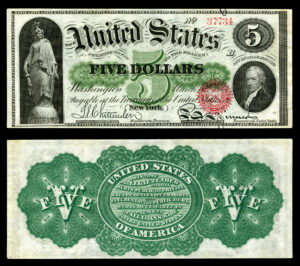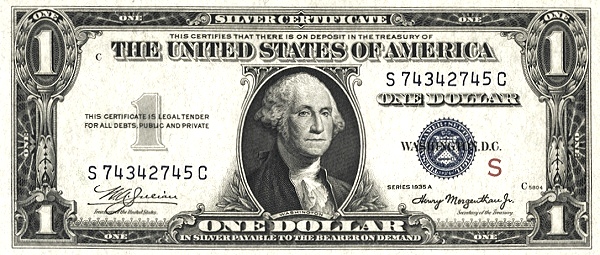
📷 Image source: banknote.ws (World Banknote Gallery). Images are selected by AI to represent the article topic and may not depict the exact note(s) described.
Pick up a well-preserved National Bank Note from the 1870s or a pristine Legal Tender from the 1880s and hold it under a loupe. The portrait staring back at you, whether it is Abraham Lincoln, Alexander Hamilton, or the allegorical figure of a Roman goddess, was not printed so much as it was cut into existence. A master engraver working at the Bureau of Engraving and Printing spent weeks, sometimes months, pushing a hardened steel graver across a soft steel die, coaxing a likeness from nothing but disciplined hand pressure and decades of training. Thomas F. Morris was the defining figure in that tradition for the last quarter of the 19th century, and understanding his work, along with that of his closest colleagues, transforms the way a collector reads American paper money.
The Bureau Before the Bureau: Currency Printing in the Civil War Era
To understand Thomas Morris, you need to understand the chaotic environment in which he learned his trade. Before the BEP consolidated its operations in the 1870s, the Treasury Department contracted currency printing to private firms, most notably the American Bank Note Company and the National Bank Note Company. These firms maintained their own corps of portrait engravers, and the United States government was largely dependent on their goodwill and capacity. The Demand Notes of 1861 and the first Legal Tender Notes of 1862 (the original “Greenbacks”) were produced under this contracted arrangement.
Congress grew increasingly uncomfortable with private control over the nation’s currency production. Starting in 1862, the Treasury began building its own in-house printing capacity in the basement of the Treasury Building. Morris entered this operation in 1866, when he was hired as a journeyman portrait engraver. The timing placed him at the center of a generational transfer of expertise. Senior engravers who had learned the intaglio tradition in the private firms were slowly being absorbed into a government operation that was still figuring out its own identity.
Thomas F. Morris: Career, Style, and Signature Work
Morris rose quickly through the BEP hierarchy because he possessed an unusually refined ability to capture facial texture and the illusion of three-dimensional depth within the extreme constraints of intaglio line work. Portrait engraving for currency is not the same discipline as portrait engraving for artistic prints. The engraver must anticipate how the image will transfer under thousands of pounds of press pressure, how the ink will sit in the recessed lines, and how the portrait will read at a small scale while still conveying authority and recognizability. Morris internalized these constraints and built them into his cutting technique.
His most celebrated work appears on the Series 1869 Legal Tender Notes, commonly called the “Rainbow Notes” by collectors for their vivid multicolor designs. The $1 denomination (Friedberg catalog number Fr. 18) carries a Morris-engraved portrait of Columbus that sits in the left vignette, while the $2 (Fr. 42) features a particularly fine rendering of Jefferson. The Lincoln portrait on the $1 Rainbow Note is widely regarded as one of the finest Lincoln engravings ever placed on circulating American currency. Morris returned to the Lincoln subject multiple times throughout his career, each iteration refining the brow structure and the characteristic asymmetry of Lincoln’s face.
When examining Series 1869 Rainbow Notes, use a 5x loupe to study the portrait engraving in the cheek and forehead areas. Morris characteristically used fine parallel cross-hatching that creates subtle tonal gradations invisible to the naked eye. Notes where this detail survives sharply command a significant premium over examples where wear or cleaning has softened the lines.
By the 1870s, Morris was the BEP’s acknowledged master portraitist. His work appears across the Silver Certificates of 1878 and 1880, the Gold Certificates of the same era, and the complex vignette work on National Bank Notes printed during the Series 1875 period. The $5 Silver Certificate of 1886 (Fr. 263-267, the “Morgan Dollar Back” series) features a particularly strong Morris portrait of Ulysses S. Grant on the face. In Very Fine condition, these notes currently trade in the range of $400 to $900 depending on the specific signature combination, with the Rosecrans-Hyatt pairing (Fr. 263) commanding the highest premiums among advanced collectors.
The Workshop Around Morris: Fellow Engravers and the Division of Labor
Portrait engraving was only one component of a finished currency note. The BEP organized its engravers by specialty, and Morris worked alongside colleagues who handled lettering, geometric lathe work, and scenic vignettes. Understanding these colleagues helps collectors attribute specific design elements to specific hands.
Charles Burt
Charles Burt had established his reputation before the BEP’s formal consolidation, having worked for the American Bank Note Company in the 1850s. His portraits carry a slightly softer, more painterly quality than Morris’s work, with rounder tonal transitions in the shadow areas. Burt is responsible for the Hamilton portrait on the Original Series $2 National Bank Notes and several of the female allegorical figures that populate Legal Tender backs from the 1860s. He retired from the BEP in 1891, and his later BEP work shows a refinement that comes from decades of accumulated expertise.
Lorenzo Hatch
Hatch specialized in scenic and allegorical vignettes rather than pure portraiture, but his work frequently appears alongside Morris portraits on the same note face. His most recognized contribution is the elaborate lathework-adjacent vignette work on the backs of the Series 1875 and 1882 National Bank Notes. Collectors who study Brown Back Nationals from the 1882 series (Fr. 466-478 for $5 denominations) are looking at a note where Hatch’s contributions to the reverse design are just as historically significant as Morris’s portrait work on the face.
George F. C. Smillie
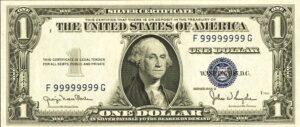
G.F.C. Smillie joined the BEP in 1894 and represents the transitional generation that would carry portrait engraving into the 20th century. His work has a crisper, more photomechanically influenced quality reflecting the changing reference materials available to engravers by the 1890s. Early photographs began supplementing painted portraits as engraving references during this period, and Smillie’s technique shows the influence. His engraving of Martha Washington on the $1 Silver Certificate of 1886 and 1891 (Fr. 215-221) is a benchmark of the late 19th century BEP style and remains one of the most admired portraits in American currency history.
The Martha Washington Silver Certificates (Fr. 215-221) are among the most approachable high-quality 19th century notes for new collectors. The 1891 series in particular has enough surviving examples that Fine to Very Fine specimens can still be acquired for $200 to $500 in many dealer inventories. Focus on examples with original paper quality and avoid any with pinholes near the portrait vignette, since restoration in that area is difficult to detect under casual examination.
How Engraver Attribution Affects Collector Value
The numismatic market has historically undervalued engraver attribution compared to what the art print market would assign to comparable work. This creates genuine opportunity for collectors willing to do the research. A Series 1880 $100 Legal Tender (Fr. 168-172) featuring a Morris-engraved portrait of Abraham Lincoln in the central vignette is a historically significant object beyond its face value and basic rarity. The specific engraver’s identity is documented in BEP records and in Gene Hessler’s comprehensive reference work “The Engraver’s Line,” published in 1993, which remains the essential text for this area of study.
Hessler cataloged hundreds of BEP engravers and cross-referenced their work to specific notes, making it possible for the first time to build a collection organized around engraver attribution rather than purely around denomination or series. This approach tends to produce more narratively coherent collections and often surfaces notes that are underpriced relative to their historical significance.
Morris’s career at the BEP effectively ended around 1898 due to health issues. The transition to photomechanical transfer processes in the early 20th century would soon make hand-engraved portrait dies less central to the production process, though master engravers continued to produce the original dies by hand well into the 20th century. The notes produced between roughly 1869 and 1900 represent the apex of hand-engraved portraiture on American circulating currency.
Gene Hessler’s “The Engraver’s Line” (BNR Press, 1993) is out of print but copies surface regularly on eBay and at major currency shows for between $45 and $100. It is worth every cent for any collector focused on 19th century US currency. Hessler’s “U.S. Essay, Proof and Specimen Notes” is a companion volume that covers the same engravers’ experimental and presentation work and is equally essential.
Reading a Morris Portrait: A Practical Field Guide
How do you identify Morris’s hand without access to archival documentation? Several stylistic signatures are consistent enough across his confirmed work to serve as working indicators. First, examine the hairline above the forehead on male portraits. Morris consistently used a tight, nearly vertical line pattern in this region that creates a sculptural separation between the hair mass and the skin. Second, look at the collar and neck junction on three-quarter view portraits. Morris built depth in this area using a distinctive graduating line weight that thickens toward the shadow side more aggressively than contemporaries like Burt. Third, the eyes in Morris portraits tend toward a slightly downward gaze that conveys gravity and authority, a deliberate choice that reinforces the institutional weight that currency portraiture was supposed to project.
These are not absolute identifiers, and attribution should always be cross-referenced against Hessler’s documented assignments. But as a first pass when examining a 19th century note in hand, these visual cues will point you in a useful direction.
| Series / Fr. Number | Denomination and Type | Engraver Attribution | Rarity |
|---|---|---|---|
| 1869 / Fr. 18 | $1 Legal Tender “Rainbow” | Morris (Lincoln portrait) | Scarce |
| 1869 / Fr. 42 | $2 Legal Tender “Rainbow” | Morris (Jefferson portrait) | Scarce |
| 1869 / Fr. 122 | $10 Legal Tender “Rainbow” | Morris / Burt (Webster) | Rare |
| 1869 / Fr. 196 | $50 Legal Tender “Rainbow” | Morris (Hamilton portrait) | Key Date |
| 1886 / Fr. 215 | $1 Silver Certificate (Martha Washington) | G.F.C. Smillie | Scarce |
| 1886 / Fr. 263 | $5 Silver Certificate (Grant, Morgan back) | Morris (Grant portrait) | Rare |
| 1878 / Fr. 345b | $10 Silver Certificate (Hendricks) | Charles Burt | Key Date |
| 1880 / Fr. 168 | $100 Legal Tender (Lincoln) | Morris (Lincoln portrait) | Rare |
| 1882 / Fr. 466 | $5 National Bank Note Brown Back | Morris / Hatch | Common |
| 1891 / Fr. 221 | $1 Silver Certificate (Martha Washington) | G.F.C. Smillie | Common |
Building a Collection Around These Engravers
A thematically unified collection built around the Morris-era BEP portrait engravers is achievable at multiple budget levels. An entry-level approach might focus on the Series 1891 Silver Certificates in the $1 to $5 denominations, where Smillie’s portraiture can be studied in relatively affordable examples. A mid-range collection could center on the Series 1880 Legal Tenders, which carry some of the strongest Morris portrait work in denominations where surviving populations are manageable. An advanced collection targeting the Rainbow Notes of 1869 represents a serious financial commitment, but these are among the most visually spectacular and historically important notes in all of American currency collecting.
In every case, condition is paramount. The reason for building this collection is to appreciate the engraver’s craft, and that craft is only visible in notes that retain sharp, original surface detail. A Very Fine Morris portrait will show you things an About Good example simply cannot. Budget for quality rather than quantity, and consider third-party grading from PCGS Currency or PMG for any significant acquisition, both to confirm authenticity and to document condition for insurance and resale purposes.
National Currency Foundation and major auction houses including Heritage Auctions, Stack’s Bowers, and Lyn Knight Currency Auctions maintain searchable archives of past auction results. Before purchasing any 19th century note with a Morris or Smillie portrait attribution, spend 15 minutes searching comparable examples in these archives. Realized prices over the past three years will give you a far more accurate market baseline than any printed price guide, which can lag real market conditions by 18 months or more.
The Legacy Carved in Steel
Thomas F. Morris retired from the BEP around 1898 having spent more than three decades cutting portraits into steel dies that would be handled by millions of Americans who never knew his name. His Lincoln, his Hamilton, his Grant, and his Jefferson circulated in wallets and cash drawers from New England to the Pacific territories, quietly doing the cultural work of connecting the new industrial republic to its founding figures and its preserving heroes. The fact that those portraits were not photographic reproductions but interpretive acts of a skilled craftsman’s hand gives them a warmth and intentionality that modern currency, produced through photomechanical and digital processes, simply cannot replicate.
For collectors, the 19th century BEP portrait tradition represents one of the most richly documented and yet persistently underexplored areas in American numismatics. The research tools exist. The notes are acquirable. The visual rewards are immediate and genuine. There is no better entry point into this world than picking up a Rainbow Note, a Martha Washington Silver Certificate, or an 1880s Legal Tender, holding it to a strong light, and learning to read what Thomas Morris and his colleagues left behind.