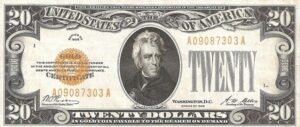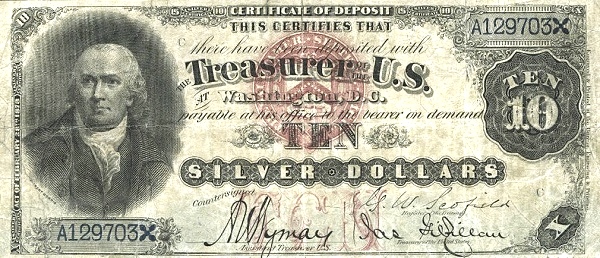
📷 Image source: banknote.ws (World Banknote Gallery). Images are selected by AI to represent the article topic and may not depict the exact note(s) described.
Few pieces of American paper money carry the historical weight of the Series 1878 $1 Silver Certificate. Born from a political fight over silver coinage, authorized by the Bland-Allison Act of February 28, 1878, and printed within months of that legislation’s passage, this note represents the opening chapter of an entirely new class of United States currency. Silver certificates would go on to be issued for nearly a century, right up to 1964, but everything that followed traces its lineage back to this single, remarkable note. If you have ever held one, you already know there is something different about it. If you have not, this guide will explain exactly why collectors pursue it with such determination.
The Political Origin of Silver Certificates
To understand why the Series 1878 $1 Silver Certificate exists, you have to understand the monetary chaos of the post-Civil War era. The Coinage Act of 1873, derided by silver advocates as the “Crime of 1873,” had effectively demonetized silver by removing the standard silver dollar from the list of authorized coins. Western mining interests and agrarian debtors howled in protest for years. Their answer came in the form of the Bland-Allison Act, which required the Treasury to purchase between two and four million dollars worth of silver bullion each month and coin it into standard silver dollars.
The problem was immediate and practical: Morgan silver dollars are heavy. Carrying them in commerce was inconvenient, and the Treasury vaults quickly filled with coins that the public did not want to use in daily transactions. The silver certificate was the elegant solution. These notes were receipts, redeemable on demand in silver dollar coins deposited in the Treasury. The public could use lightweight paper in trade while the silver sat safely in government vaults. The first notes were prepared rapidly, and the Bureau of Engraving and Printing delivered Series 1878 silver certificates into circulation before the year was out.
Design and Physical Characteristics
The Series 1878 $1 Silver Certificate is a large-size note, measuring approximately 7.375 inches by 3.125 inches, considerably larger than modern currency. The face of the note features a portrait of Martha Washington at the left, the only time a woman has been depicted on a circulating U.S. currency note of this denomination. That distinction alone makes it historically significant beyond its silver certificate status.
The obligation printed on the face is direct and unambiguous: “This certifies that there have been deposited in the Treasury of the United States One Silver Dollar payable to the bearer on demand.” This language distinguishes it clearly from United States Notes and National Bank Notes of the same era.
The Treasury seal on the 1878 issue is printed in red ink and takes a large, ornate, scalloped circular form. The back of the note is printed in black ink rather than the green used on United States Notes, a feature that initially caused some public confusion. The back design is relatively plain compared to later issues, dominated by large numeral denomination indicators and the inscription “Silver Certificate.”
When examining a Series 1878 $1 Silver Certificate, check the back printing color first. The black-ink reverse is one of the quickest authenticity indicators that distinguishes it from later silver certificate series, which shifted to green backs. A greenish back on an alleged 1878 note is an immediate red flag worth investigating further.
Signature Combinations: The Key to Variety Collecting
The Series 1878 $1 Silver Certificate was produced under two different Treasury official pairings, and these signature combinations are the primary way collectors distinguish between the major varieties. The Register of the Treasury signed on the left, and the Treasurer of the United States signed on the right. For the 1878 series specifically, the combinations are:
- Allison / Gilfillan: John Allison (Register) and James Gilfillan (Treasurer). This is the more common pairing and covers Friedberg numbers Fr. 215 through portions of the series.
- Scofield / Gilfillan: Lyman Scofield (Register) and James Gilfillan (Treasurer). Scofield replaced Allison partway through the series, creating a distinct and scarcer variety.
Beyond signature combinations, the 1878 series also presents collectors with a significant design variety related to how the obligation was printed on the note. Early printings featured the payable clause on the face in a distinctive typeset format. Later notes within the series show subtle differences in the positioning and style of the engraved text. These are cataloged in the Standard Catalog of United States Paper Money and in the Friedberg reference as distinct varieties carrying separate catalog numbers.
Signature combinations on large-size silver certificates are identified by examining the printed signatures below the portrait. Use a loupe or magnifier to confirm legibility, especially on well-circulated examples where ink wear on signatures can make attribution difficult. A misattributed note can mean a significant difference in catalog value, so take the time to confirm before purchasing.
Serial Numbers and the Countersigning Varieties
One of the most striking features of certain Series 1878 $1 Silver Certificates is the presence of a handwritten or stamped countersignature. Early in the series, Assistant Treasurers at specific Sub-Treasury offices were required to individually countersign each note before it was released into circulation. This practice, borrowed from earlier large-denomination government securities, was intended as an additional security measure.
Countersigned examples are documented from the Sub-Treasury offices in New York and Washington, D.C. The New York countersigned notes bear the signature of the Assistant Treasurer at that location, most commonly Thomas C. Acton. Washington countersigned notes are considerably scarcer. These countersigned examples represent their own distinct sub-varieties and carry substantial premiums in the collector market. A countersigned example in Fine condition can easily command several times the price of an unsigned note in the same grade.
Serial numbers on the 1878 issue are printed in red ink and appear in two locations on the face of the note. The numbering began at 1 and ran sequentially. No complete census of surviving serial numbers exists, but PCGS and PMG population reports give collectors a reasonable picture of the surviving universe of these notes.
The 1880 Series Successor and Why the 1878 Stands Apart
The Series 1878 $1 Silver Certificate was relatively short-lived as a production type. By 1880, the Treasury updated the silver certificate design, producing the Series 1880 notes which introduced blue serial numbers and additional design refinements. The 1880 series is itself a rich collecting area, but it is the 1878 issue that holds the “first of class” distinction that drives so much collector demand.
The combination of historical importance, the Martha Washington portrait, the black back printing, the red seal, and the countersigning varieties makes the 1878 issue more complex and more rewarding to collect than a simple date might suggest. Completing a full type set of the 1878 varieties is a genuine challenge that can occupy a serious collector for years.
For new collectors approaching large-size silver certificates for the first time, start with a Fine or Very Fine example of the common Allison-Gilfillan signature combination (Fr. 215). This gives you a genuine, circulated piece of monetary history at a relatively accessible price point, typically in the $300 to $600 range depending on grade, without committing to the premium pricing of rarer varieties before you have developed your eye for the series.
Grading Considerations for the 1878 Issue
Grading large-size silver certificates from 1878 requires attention to factors that do not apply to modern currency. Paper quality is paramount. These notes were printed on a distinctive fiber paper that, after more than 140 years, shows aging in predictable ways. Collectors and graders look for the following:
- Folds and creases: Even a single center fold drops a note from Uncirculated to Extremely Fine territory. Multiple folds on a note that is otherwise bright can still yield a Very Fine grade.
- Margins: Large-size notes are graded partly on the evenness and width of their margins. Early BEP production had some inconsistency in cutting, and narrow margins or shifted cuts affect grades.
- Ink originality: The red seal and red serial numbers on the 1878 issue are susceptible to fading. A bright red seal on a circulated note is highly desirable. Washed-out or pinkish seals suggest either heavy circulation or exposure to moisture and light.
- Paper originality: Do not mistake pressed or cleaned notes for high-grade originals. Both PCGS Currency and PMG routinely note cleaning or pressing on these early notes, which significantly impacts market value even when the note receives a numeric grade.
The PMG population report as of recent census data shows very few Series 1878 $1 Silver Certificates grading above Very Fine 30, and Uncirculated examples of any variety are genuinely rare. Most survivors grade between Very Good 10 and Fine 15, reflecting the heavy use these notes saw in everyday commerce.
| Friedberg No. | Signature Combination / Variety | Estimated Survivors | Rarity |
|---|---|---|---|
| Fr. 215 | Allison / Gilfillan, no countersign | 300-500 known | Scarce |
| Fr. 216 | Allison / Gilfillan, countersigned Acton (New York) | 50-80 known | Rare |
| Fr. 217 | Allison / Gilfillan, countersigned Washington | Fewer than 20 known | Key Date |
| Fr. 218 | Scofield / Gilfillan, no countersign | 100-200 known | Scarce |
| Fr. 219 | Scofield / Gilfillan, countersigned Acton (New York) | 30-50 known | Rare |
| Fr. 220 | Scofield / Gilfillan, countersigned Washington | Fewer than 10 known | Key Date |
| Fr. 221 | Allison / Gilfillan, back design variant | 75-125 known | Rare |
| Fr. 221c | Allison / Gilfillan, back design variant, countersigned | Fewer than 5 confirmed | Key Date |
Market Values and Auction Records
The Series 1878 $1 Silver Certificate trades across a wide range depending on variety and grade. For the most common variety, Fr. 215, a note in Good 6 condition might sell for $150 to $250 at a major currency auction. The same variety in Very Fine 25 has realized $500 to $900 in recent Heritage Auctions sales. An Extremely Fine example of Fr. 215 crosses into the four-figure range routinely.
The countersigned varieties command dramatically higher prices. A Fine-grade Fr. 216 (Acton countersign) sold at a Heritage Auctions currency sale for approximately $4,800 in a recent offering. The Washington countersigned varieties (Fr. 217 and Fr. 220) are rare enough that pricing is almost entirely auction-dependent, with major examples reaching $15,000 to $30,000 or more when they do surface.
The rarest sub-varieties, Fr. 221c in particular, are so seldom offered publicly that established price guides acknowledge the difficulty of providing reliable retail value estimates. When a note with fewer than five confirmed examples comes to auction, the result is often a new record for the type.
Always buy large-size silver certificates in holders from PCGS Currency or PMG rather than raw if you are spending more than a few hundred dollars. The authentication and grading services have specifically flagged altered and restored examples of the 1878 issue in their census databases. A third-party holder gives you both authentication confidence and a documented grade that supports resale value.
Building a Collection Around the 1878 Issue
There are several strategies collectors take when approaching the 1878 $1 Silver Certificate. The most straightforward is acquiring a single representative example of the series as part of a broader large-size type set. For that purpose, a circulated Fr. 215 in Very Good or Fine condition is entirely appropriate and achievable on a modest budget.
More ambitious collectors work toward a complete variety set, acquiring one example of each Friedberg number. This is a multi-year, multi-thousand dollar undertaking even for the more common varieties, and the Washington countersigned notes may require decades of patient watching at major auctions. The most dedicated specialists build serial number studies, tracking known examples to understand the production sequence and the actual number of notes that survived from each signature period.
The 1878 issue also pairs naturally with a Series 1880 $1 Silver Certificate collection, allowing a collector to show the evolution of the silver certificate type from its experimental first issue through its refined successor. Displayed together, these notes tell a complete story of an important era in American monetary policy.
Conclusion: Why the 1878 Issue Still Matters
The Series 1878 $1 Silver Certificate is not simply an old note. It is the starting point of a currency type that served American commerce for nearly ninety years, a physical document of the Bland-Allison Act’s compromise between gold standard advocates and silver interests, and the only circulating American note to have featured Martha Washington’s portrait. Its combination of genuine rarity, fascinating varieties, historical significance, and the aesthetic appeal of large-size currency design makes it one of the most rewarding areas of American paper money collecting. Whether you are chasing your first example or hunting the final variety to complete a set, the 1878 $1 Silver Certificate rewards the effort in a way that few other notes can match.