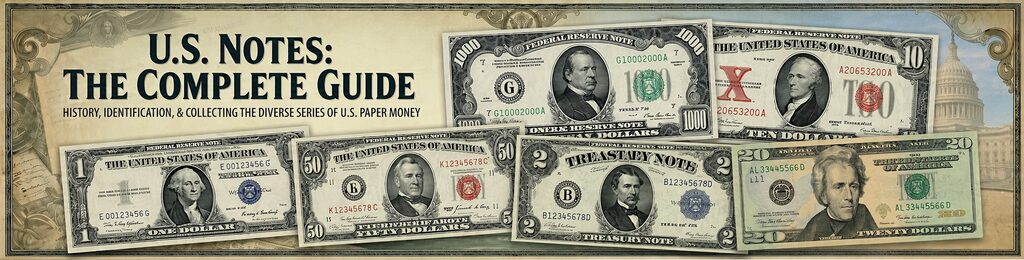
US Notes

Federal Reserve Notes Series 1928 $5 through $100: Collecting the First Small-Size Issue Denomination by Denomination

The Series 1928 Federal Reserve Notes represent one of the most historically significant transitions in American currency, marking the shift from large-size to the compact format still used today. This denomination-by-denomination breakdown reveals which notes are common finds and which are genuine rarities that command serious premiums in today’s market.

Read More →
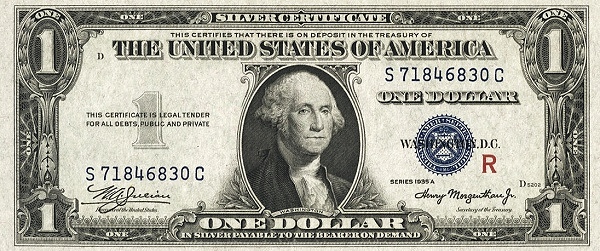
Series 1934 $1 Silver Certificate: The Dark Green vs. Light Green Seal Mystery Explained

The Series 1934 $1 Silver Certificate comes in two distinct seal color varieties that have puzzled collectors for decades. Learn how to tell them apart, why they exist, and which one is worth hunting for in today’s market.

Read More →

The Seal of the Treasury Department on US Currency: How Its Design Changed from 1862 to the Present

Few elements of American paper money carry more historical weight than the Treasury seal, yet most collectors overlook its evolution across 160 years of currency design. This deep dive traces every major change to the seal’s appearance, color, and placement, giving you the tools to date, attribute, and value notes more precisely.

Read More →

The Series 1934C $5 Federal Reserve Note: Why Certain Federal Reserve Districts Produced Dramatically Fewer Examples

The Series 1934C $5 Federal Reserve Note is one of the most district-dependent collecting puzzles in mid-century US currency, with print runs varying by factors of ten or more across the twelve Federal Reserve Banks. Understanding which districts are genuinely scarce, which signature combinations to watch for, and how Treasury seal colors factor into value can transform a casual acquisition into a sharp collecting strategy.

Read More →

Federal Reserve Notes Series 1950D $5: The Scarcest Suffix Letter of the Postwar Five-Dollar Issue

Among the postwar Federal Reserve Note five-dollar series, the 1950D stands apart as the most elusive suffix letter issued, with critically low print runs at several Federal Reserve Districts. Understanding exactly why this series is scarce, which districts to prioritize, and how to authenticate genuine examples can transform your collecting strategy for mid-century small-size currency.

Read More →

Federal Reserve Note Series 1928 $20 Redeemable in Gold Clause: The Variety That Disappeared After 1933

The Series 1928 $20 Federal Reserve Note carries one of the most historically charged phrases ever printed on American paper money: ‘Redeemable in Gold on Demand at the United States Treasury.’ Understanding why that clause vanished after 1933, and how it affects rarity and value today, is essential knowledge for any serious collector of small-size currency.

Read More →

Series 1963A $1 Federal Reserve Note Chicago District Star Notes: Why District G Replacement Notes Are Significantly Scarcer Than Reported

The Series 1963A $1 Federal Reserve Note from the Chicago District harbors one of the most underappreciated scarcities in postwar small-size currency collecting. This deep-dive examines verified print run data, surviving population estimates, and the market dynamics that keep G* notes flying under the radar for all but the most informed collectors.

Read More →

Signature Varieties on Series 1928 Federal Reserve Notes: Tate-Mellon Through Woods-Mills

The Series 1928 Federal Reserve Notes span four distinct signature combinations, each telling a story of Treasury leadership during one of America’s most turbulent economic decades. Understanding these varieties, their print runs, and their relative scarcity can mean the difference between paying fair market value and uncovering a genuine sleeper note in a dealer’s stock.

Read More →

Series 1934D $20 Federal Reserve Note: The Last Pre-Security-Redesign Twenty and Its Dramatic District Population Differences

The Series 1934D $20 Federal Reserve Note holds a unique position in American currency history as the final twenty-dollar bill printed before the landmark 1950 redesign introduced updated security and aesthetic features. Understanding the striking population differences across Federal Reserve districts, signature combinations, and condition scarcities makes this an essential study for any serious collector of mid-century American paper money.

Read More →

Series 1934 $10 Federal Reserve Note Mule Varieties: Large Plate Number vs. Small Plate Number Issues Explained

The Series 1934 $10 Federal Reserve Note produced one of the most fascinating transitional varieties in twentieth-century U.S. currency: the mule. Understanding how large and small plate numbers created these hybrid notes can sharpen your eye at currency shows and potentially reveal hidden treasures in your collection.

Read More →