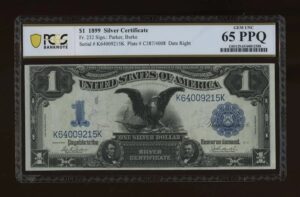
Picture two notes side by side on your grading table: a crisp 1899 $5 Silver Certificate, its ornate engraving anchored by the famous ‘Running Antelope’ portrait of Chief Oncpapa, and a 1963-A $5 Federal Reserve Note fresh from a Federal Reserve Bank bag. Both look pristine at first glance. But apply the same grading rubric to both, and you will almost certainly misprice one of them, probably both. The physical properties, paper chemistry, printing technology, and circulation history of large-size notes (issued through 1928) and small-size notes (1928 to present) are different enough that seasoned graders at PCGS Currency, PMG, and legacy services like CGAS developed distinct evaluation frameworks for each era. Understanding why those frameworks diverge is one of the most practical skills a currency collector can develop.
The Physical Foundation: Paper, Ink, and Printing Methods
Before you can grade a note intelligently, you need to understand what it is made of. Large-size notes were printed on a heavier, more absorbent rag paper that was produced under less standardized conditions than modern currency stock. The Bureau of Engraving and Printing used intaglio printing for the primary designs starting in earnest in the 1870s, but sheet sizes, plate configurations, and paper batches varied considerably across decades. That variation shows up in grading because a note that ‘looks’ MS-63 might have originated from a soft paper lot that absorbed ink unevenly, producing toning or color inconsistencies that have nothing to do with handling.
Small-size notes, introduced with the Series of 1928 following the Pittman Act mandate for currency standardization, were printed on a tighter, more uniform cotton-linen blend. The BEP tightened its manufacturing controls substantially throughout the 1930s and again after World War II. By the time the Series of 1963 notes entered circulation, production tolerances were tight enough that a genuine Gem Uncirculated example is expected to be nearly perfect in every measurable way. That expectation does not apply to a 1902 $10 National Bank Note from a small-town bank in rural Nebraska, where the original print quality may have left subtle embossing inconsistencies that are entirely original to manufacture.
Why Large-Size Notes Receive More Grading Latitude
The single most important concept for collectors transitioning from small-size to large-size notes is manufacturing tolerance. Third-party grading services explicitly account for the fact that large-size notes were produced with less mechanical precision. A note graded PMG 64 Choice Uncirculated from the Series of 1886 Silver Certificate issues (Friedberg numbers Fr. 217 through Fr. 225 for the $1 denomination) may display slightly uneven margins, minor ink smears at the border, or a faintly off-center impression, none of which would be tolerated at that grade level for a modern Federal Reserve Note.
Centering standards illustrate this beautifully. For small-size notes graded Gem Uncirculated 65 or higher by PMG or PCGS Currency, the margins must be reasonably even on all four sides, with the design well-centered within the note. For large-size notes at the same numerical grade, graders understand that sheets were hand-fed and guillotined under conditions that routinely produced off-center cuts. A large-size note with margins that measure 3mm on the left and 8mm on the right is not automatically penalized at the same severity a small-size note with similar margins would be.
When examining a large-size note, always check the margins with a millimeter ruler before assuming centering is poor. Many notes that appear dramatically off-center to the naked eye still qualify for high Uncirculated grades once you understand era-appropriate tolerances. Off-center cuts were inherent to the production process, not evidence of damage or mishandling.
Paper Quality and the Originality Premium
Both grading services and experienced collectors pay an enormous premium for original paper surfaces on large-size notes. ‘Original paper’ means the surface has never been cleaned, pressed, washed, or chemically treated. Because large-size notes circulated during eras when cleaning and pressing currency was actually common practice among collectors and merchants alike, finding a genuinely original example can be more challenging than finding one that grades highly on surface preservation alone.
PMG and PCGS Currency both assign ‘EPQ’ (Exceptional Paper Quality) and ‘PPQ’ (Premium Paper Quality) designations respectively to notes that demonstrate original surfaces. For large-size notes, earning an EPQ or PPQ qualifier is considered especially significant because it confirms the note has not been doctored to improve its apparent grade. A 1901 $10 Legal Tender Note (Fr. 121 through Fr. 122, featuring the iconic Bison design) graded PMG 64 EPQ will typically sell for 30 to 50 percent more than the same note graded 64 without the qualifier.
For small-size notes, the EPQ qualifier still matters, but the baseline expectation of originality is higher because fewer small-size notes were subjected to the pressing and cleaning practices common in earlier eras. A 1934-A $500 Federal Reserve Note graded PCGS 64 PPQ is impressive, but the qualifier carries somewhat less relative premium than it does for a comparable large-size note.
To test for pressing or cleaning on an unslabbed large-size note, hold it at an oblique angle under a single light source and look for a smooth, almost plastic-like sheen. Genuine original paper has a slightly matte, slightly fibrous surface appearance. A pressed note loses the natural paper ‘tooth’ and takes on a flat, almost laminated look that becomes obvious with practice.
Folds, Creases, and the Circulation Story
On the numerical grading scale, both eras share the same framework from 1 through 70, and the basic meaning of each grade band is consistent: Very Fine (VF, grades 20 to 35) notes show significant handling but retain most of their original detail; Extremely Fine (EF, grades 40 to 45) notes show light folds and sharp detail; About Uncirculated (AU, grades 50 to 58) notes retain most of their paper crispness with only trace handling. But how graders evaluate folds differs significantly between eras.
Large-size notes were folded into quarters as a matter of course during everyday commerce, producing the classic ‘wallet fold’ pattern of two intersecting center creases. A large-size note in Fine-12 with four-way folder creases but full, legible detail in all design elements is considered a respectable circulated example. The same four-way fold on a 1969-C $100 Federal Reserve Note would land it firmly in the Very Good range, perhaps VG-8 to F-12 at best, because the small-size format concentrates fold stress differently and the higher production standards mean graders expect more resistance to crease severity.
Corner folds and edge folds are weighted differently too. On a large-size note, a single corner fold that does not penetrate more than 4 to 5mm into the design is often consistent with an EF-40 grade. On a small-size note, the same fold might push the grade down to AU-50 or even lower if it creates a visible break in the paper fiber visible under magnification.
Color and Eye Appeal: Subjectivity Within a Framework
Both PMG and PCGS Currency incorporate an eye appeal assessment that is deliberately subjective but guided by era-specific expectations. For large-size notes, rich, saturated color in the Treasury seal, serial numbers, and ornamental elements is a mark of quality. The red and blue fiber strands embedded in pre-1928 paper should be visible but not indicate excessive wetness or pressing. The distinctive red seal of the 1880 series Legal Tender issues or the brown seal of certain 1882 National Bank Notes should display vivid, original color rather than a faded or oxidized tone.
For small-size notes, collectors track seal color evolution carefully as a grading and authentication reference. The light green seal appeared on certain 1928 Federal Reserve Notes, transitioning to the darker green that persisted through most of the mid-century series. The distinctive blue seals and serial numbers on 1935 and 1957 Silver Certificates, the red seals on United States Notes through 1966, and the yellow-gold seals on 1934 Gold Certificates all must display authentic, original color at premium grades. Fading on a 1934-A $100 Gold Certificate (Fr. 2405) yellow seal is penalized significantly because the seal color is both a design feature and an authentication point.
UV light examination is standard practice for both eras but reveals different things. On large-size notes, UV helps detect washing (cleaned paper fluoresces differently than original stock). On small-size notes, UV examination after 1990 is essential for detecting counterfeit security threads and verifying that fluorescent fibers are present in correct quantity and placement.
Serial Numbers, Signatures, and Variety-Specific Grading Considerations
Both grading eras require examiners to verify that serial numbers, Treasury seal, and plate letters are correctly matched to the series claimed on the note. For large-size notes, this is sometimes complicated by the fact that multiple signature combinations existed within a single Friedberg number, and some signature pairings are dramatically rarer than others. The 1891 $1 Silver Certificate (Fr. 222 through Fr. 225) exists with Rosecrans-Nebeker, Tillman-Morgan, and Bruce-Roberts signatures. The Bruce-Roberts combination is considerably scarcer, and a note with that signature combination warrants a premium even at lower circulated grades.
For small-size notes, signature combinations are equally important but the documentation is more precise because BEP records from the 1928 onward period are more complete. The 1928-B $1 Legal Tender Note with Woods-Mellon signatures (Fr. 1500) is a genuinely common type, but the 1928-E $1 Legal Tender (Fr. 1503) with Julian-Morgenthau signatures saw a print run of only 1,348,000 notes, making high-grade examples legitimately rare and grade-sensitive in ways that common signature combinations are not.
Star Notes Across Both Eras
Replacement notes, designated by a star symbol in the serial number (or a ‘star’ or ‘X’ prefix on some large-size examples), exist across both eras but carry different baseline rarity expectations. Large-size star notes were not systematically issued until relatively late in the era; the BEP did not adopt the star replacement system consistently until around 1910, meaning pre-1910 ‘replacement’ notes are extremely rare and often identified only by specialized research rather than a visible star symbol.
For small-size notes, the star replacement system has been consistent since 1928, but print runs vary enormously. A 1995 $1 Federal Reserve Note star from the Atlanta district (F*) with a print run of only 128,000 is a legitimate key-date rarity in any grade, while a 1981 $1 star from the New York district with a print run exceeding 6 million pieces is common even in Gem Uncirculated grades.
| Series / Date | Type or Variety | Est. Print Run or Survivors | Rarity |
|---|---|---|---|
| 1880 $1 Legal Tender (Fr. 31) | Scofield-Gilfillan Signatures | Est. fewer than 50 VF or better | Key Date |
| 1896 $5 Silver Certificate (Fr. 270) | Educational Series, Tillman-Morgan | Est. 100 to 150 in circulated grades | Rare |
| 1901 $10 Legal Tender (Fr. 121) | Bison Note, VF or better survivors | Several hundred known | Scarce |
| 1928-E $1 Legal Tender (Fr. 1503) | Julian-Morgenthau, Small Size | 1,348,000 printed | Scarce |
| 1934-A $500 FRN (Fr. 2202) | All Federal Reserve Districts | Fewer than 1,000 known across districts | Rare |
| 1934 $100 Gold Certificate (Fr. 2405) | Yellow Seal, Julian-Morgenthau | Est. 200 to 300 in any grade | Rare |
| 1995 $1 FRN Star (Atlanta, F*) | Star Replacement, Small Size | 128,000 printed | Key Date |
| 1981 $1 FRN Star (New York, B*) | Star Replacement, Small Size | Over 6,000,000 printed | Common |
| 1963-A $5 FRN (Fr. 1975-L) | San Francisco District, Gem CU | High print volume, common in all grades | Common |
| 1886 $1 Silver Certificate (Fr. 219) | Rosecrans-Jordan, Large Size | Fewer than 30 AU or Unc. known | Key Date |
Practical Grading Workflow: Applying Era-Specific Standards
Whether you are grading for your own collection or evaluating a purchase at a show or auction, a consistent workflow helps you apply the right standards to each era. Start by identifying the note type and era definitively. Large-size or small-size? Then consult the appropriate Friedberg catalog number to understand what signature combinations and varieties exist for that specific type. This matters because a seemingly common note might actually be a scarce variety based on signatures alone.
Next, assess paper quality before anything else. Hold the note carefully by its edges and examine the surface under a single directional light. For large-size notes, look for originality, that slightly fibrous, dimensional paper surface that has never been pressed flat. For small-size notes, look for full paper crispness with no evidence of moisture, folding fatigue, or artificial stiffening. Then move to centering, using era-appropriate expectations. Then assess folds and creases systematically, counting and characterizing each one. Finally, examine color, detail sharpness, and serial number clarity before arriving at a grade.
Before submitting notes to PMG or PCGS Currency for grading, research recent auction results for the same Friedberg number at various grades using Heritage Auctions’ free archive. This tells you whether the grade bump from, say, 63 to 64 EPQ represents a meaningful value increase for your specific note, helping you decide whether the submission fee is justified.
Conclusion: Two Eras, One Informed Collector
The gap between grading a 1914 $20 Federal Reserve Note and a 1950-B $20 Federal Reserve Note is wider than the 36 years between them might suggest. The paper is different, the printing is different, the manufacturing tolerances are different, and the surviving population profiles are different. Applying small-size standards to large-size notes will lead you to undervalue genuine rarities. Applying large-size latitude to small-size notes will lead you to overpay for notes with real problems masked by their relative age and surface charm.
The collectors who do best in both markets are those who invest time in understanding what each era’s notes were made of and how they were made. Study original BEP production records through the Smithsonian’s National Numismatic Collection resources. Read the grading guides published by PMG and PCGS Currency, which include era-specific commentary. Handle as many authenticated, third-party graded examples as you can at shows and through dealer inventory. Over time, your eye will develop the calibration to move seamlessly between eras, which opens up the full, magnificent breadth of American paper money history as a collecting field.