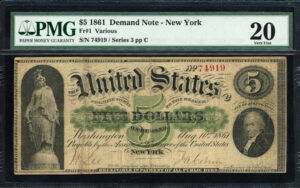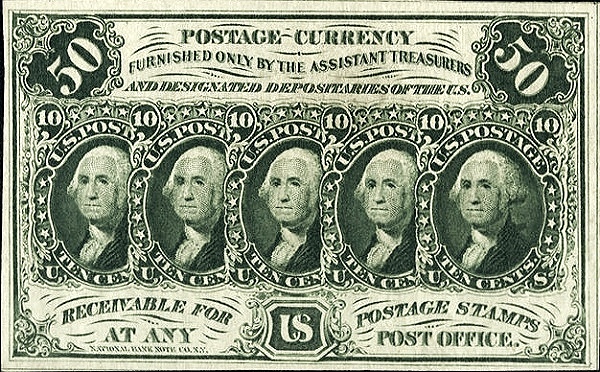
📷 Image source: banknote.ws (World Banknote Gallery). Images are selected by AI to represent the article topic and may not depict the exact note(s) described.
Pick up a Five Cent Third Issue fractional note, the Spencer Clark portrait variety (Fr. 1238), and hold it up to the light. In roughly two seconds, an experienced numismatist will have formed a preliminary grade in their head, based almost entirely on three things: where the design sits on the paper, how much white space surrounds it, and whether the fiber paper shows any of that distinctive ribbed embossing the Treasury Department applied as an anti-counterfeiting measure. These tiny notes, issued between 1862 and 1876 across five distinct issues, compress every grading challenge of large-size currency into a space smaller than a playing card. Understanding how centering, margins, and embossing interact is the difference between paying fair market value and overpaying by 300 percent.
A Brief Context: Why Fractional Currency Exists at All
When the Civil War erupted in 1861, citizens hoarded every piece of hard money they could find. Gold and silver coins vanished from circulation almost immediately. Postage stamps briefly served as small change, but they stuck together, deteriorated in pockets, and were impossible to count quickly at store counters. Congress authorized Postage Currency in August 1862, essentially printing reproductions of then-current stamp designs on small paper notes. These evolved through five formal issues until the Specie Resumption Act of 1875 allowed the Treasury to finally retire fractional paper in favor of coinage, with redemption ending in 1876.
The five issues span a remarkable range of designs, paper types, and printing techniques, which is precisely why grading them demands a different eye than grading a Silver Certificate or a Federal Reserve Note. The printing presses, the paper stock, and the finishing methods changed considerably across those fourteen years, and each shift creates distinct grading criteria.
The First Issue: Postage Currency and Its Perforated Nightmare
First Issue notes (August 1862 to May 1863) were printed by the American Bank Note Company and National Bank Note Company on plain, unperforated or perforated paper. The perforated varieties, including the 5-cent Jefferson (Fr. 1228) and the 25-cent Washington (Fr. 1279), present an immediate grading challenge that has no real parallel elsewhere in American currency: perforation completeness and evenness.
A perforated First Issue note with full, even perforations on all four sides trades at a meaningful premium over an imperf example in the same technical grade. But beyond the perforations, the fundamental margin question applies. These notes were sheet-fed and cut by hand or with guillotine shears, so margins vary wildly. A well-centered First Issue 50-cent note with Abraham Lincoln’s portrait (Fr. 1310 through Fr. 1312 depending on the back printing) and even margins of at least 1.5mm on all sides is genuinely scarce. Most survivors show dramatically uneven cuts, with one side nearly touching the design and the opposite side showing generous white space.
When examining First Issue perforated notes, count the individual perf teeth on each side and check whether any are pulled or missing. A note described as “perforated” with two or more missing teeth on a single edge will grade lower than the overall paper quality might suggest, and many dealers price these as if the perfs were complete. Always examine under magnification before purchasing raw examples.
Centering: The Single Biggest Value Driver
Across all five issues, centering is the primary grade separator for notes in the Very Fine through Gem range. The Friedberg catalog and the major grading services are in agreement on this point, even if the specific tolerances differ slightly between PMG and PCGS Currency in their holder population reports.
What does proper centering mean for fractional notes specifically? Because the designs are so small, even a 1mm shift in any direction is visually obvious and measurable as a percentage of the total note width. A Third Issue 10-cent note (Fr. 1251 to Fr. 1261, depending on variety) measures roughly 67mm wide. A 2mm shift to the left therefore represents nearly a 3 percent lateral displacement, far more dramatic to the eye than the same 2mm shift would appear on a large-size note measuring 189mm wide.
Grading services use the following general framework for centering on fractionals, though collectors should understand these are guidelines rather than rigid rules:
- Gem Uncirculated (65 to 67): Margins even and generous on all four sides, with no side measuring less than approximately 1.5 to 2mm. Design perfectly centered within tolerances of roughly 10 percent top-to-bottom and side-to-side.
- Choice Uncirculated (63 to 64): Margins still present on all sides, minor centering shifts acceptable, no design elements cut into.
- Extremely Fine (40 to 45): Light circulation folds permitted, centering may be noticeably off-center but no design cutting.
- Very Fine (20 to 35): Moderate folds, centering shifts more forgivable at this grade range, but a sharply cut or touching margin still negatively impacts the grade.
The practical implication for collectors is significant. A Second Issue 10-cent note (Fr. 1244 to Fr. 1247) grading PMG 64 Choice Uncirculated with well-centered margins might realize $300 to $500 at auction. The identical variety in PMG 64 with a dramatically shifted cut that nearly touches the design on one side might bring $150 to $200, even though the paper quality and circulation wear are identical. Centering is not a secondary consideration; it is the grade itself at the top end of the scale.
When building a type set of fractional currency, prioritize centering over raw grade number, especially for Third and Fourth Issue notes where the print runs were larger and well-centered examples are more attainable. A PMG 63 with four even margins will display more beautifully in a frame or album page than a PMG 65 with one pinched edge, and the 63 will often cost significantly less.
Margins: Reading the Cut
Margins on fractional currency tell a story about how the sheet was handled after printing. The Treasury Department contracted printing to multiple firms and eventually brought production fully in-house at the Bureau of Engraving and Printing (established 1862, consolidated operations by 1877). The quality of the cutting operation varied considerably by year and contract period.
Fourth Issue notes (1869 to 1875) were printed on paper containing a distinctive pink fiber and, in some varieties, blue fibers embedded in the stock. The cutting on Fourth Issue notes tends to be more consistent than First or Second Issue material, but centering problems are still common. The 15-cent note of the Fourth Issue (Fr. 1267 and Fr. 1268, featuring Columbia) is particularly notorious among specialists for dramatic top-to-bottom centering shifts. Finding a 15-cent Fourth Issue with even top and bottom margins is a genuine prize.
Fifth Issue notes (1874 to 1876), printed by the Bureau on thinner, more uniform paper, generally show better centering than earlier issues, but the short print run means fewer survivors and proportionally fewer gem examples survive with pristine margins. The 10-cent Crawford (Fr. 1265) and 25-cent Walker (Fr. 1309) are the two most collected Fifth Issue varieties, and gem examples of either with full margins trade at substantial premiums.
Embossing: The Overlooked Grading Factor
Beginning with the Second Issue (1863 to 1867), the Treasury added an oval bronze-colored surcharge to the back of most notes, applied under pressure to create a slight relief impression visible on the face of the note when held to raking light. This embossing, sometimes called the Treasury seal impression or the bronze protective overprint, served as an anti-counterfeiting device. It is also one of the most overlooked grading factors among new collectors and one of the most carefully scrutinized by specialists.
Full, sharp embossing on a Second Issue note indicates the note was printed correctly and has not been pressed, cleaned, or artificially flattened. A flat embossing or a partially faded bronze surcharge raises immediate questions. Has the note been ironed? Has it been soaked or chemically treated? Grading services will note “apparent” problems or assign a net grade when embossing is suspiciously flat relative to the paper’s overall condition.
For Third Issue notes, which include the largest variety count in the fractional series (over 30 distinct Friedberg numbers across six denominations), the embossing standard is similarly important. Third Issue 50-cent notes with Spinner portraits (Fr. 1324 to Fr. 1342) come with multiple paper varieties including pink paper and fiber paper, and the embossing reads differently on each. Pink paper examples tend to show slightly softer embossing impressions, while fiber paper examples with full embossing can be quite dramatic. Collectors grading raw Third Issue 50-cent notes should hold them under a single directional light source at a shallow angle to evaluate embossing depth accurately.
Never evaluate embossing under overhead fluorescent lighting. Hold the note parallel to a single desk lamp or window light source and tilt it slowly. Full embossing will cast a tiny shadow on the face of the note as you move it. Flat embossing shows no shadow variation at any angle. This simple test will immediately reveal whether a note has been pressed, which is one of the most common forms of problematic restoration in fractional currency.
Paper Quality, Folds, and the Special Problem of Splits
Fractional notes circulated intensively. They were folded, stuffed into pockets, and used until they literally disintegrated, which is exactly why uncirculated examples are scarce and command the premiums they do. The most common circulation folds on fractionals are corner folds, center horizontal folds from folding the note in half, and vertical center folds. Each reduces the grade incrementally.
A specific and serious problem unique to fractional currency is the split note. Because many issues were printed on a single thickness of relatively fragile paper (unlike the more durable cotton-linen stock of later large-size currency), notes that saw heavy use frequently split along fold lines, sometimes separating into two or three pieces. Split notes that have been rejoined, even cleanly, are problem notes and grade accordingly. Grading services label these as “repaired splits” or simply “repaired.” A Fifth Issue 25-cent note with a repaired center split might grade PMG 15 Net, while a comparable example with only moderate folds but no splits might grade a straight Very Fine 25.
| Fr. Number / Type | Denomination and Issue | Notes in Grade 64+ (Est.) | Rarity |
|---|---|---|---|
| Fr. 1310 (perforated) | 50-cent, First Issue, Lincoln | Fewer than 20 known gem | Key Date |
| Fr. 1238 | 5-cent, Third Issue, Clark portrait | Approx. 30 to 50 gem graded | Rare |
| Fr. 1267 | 15-cent, Fourth Issue, Columbia | Fewer than 40 gem graded | Rare |
| Fr. 1309 | 25-cent, Fifth Issue, Walker | Approx. 60 to 80 gem graded | Scarce |
| Fr. 1265 | 10-cent, Fifth Issue, Crawford | Approx. 50 to 70 gem graded | Scarce |
| Fr. 1244 | 10-cent, Second Issue, Washington | Approx. 100 to 150 gem graded | Scarce |
| Fr. 1279 (perforated) | 25-cent, First Issue, Washington | Fewer than 25 gem graded | Key Date |
| Fr. 1324 | 50-cent, Third Issue, Spinner, pink paper | Approx. 80 to 120 gem graded | Scarce |
| Fr. 1251 | 10-cent, Third Issue, Meredith | Approx. 150 to 200 gem graded | Common |
| Fr. 1228 (imperf) | 5-cent, First Issue, Jefferson | Approx. 75 to 100 gem graded | Scarce |
Practical Grading: How to Evaluate a Raw Fractional Note Before Submitting
For collectors who encounter raw fractional currency at shows, estate sales, or online auctions, a systematic approach to evaluation will prevent costly mistakes. Start with a loupe or magnifier at 5x to 10x and work through the following checklist in order.
First, assess paper integrity. Look for splits, repaired tears, missing corners, or pinholes. Any of these conditions creates a problem note that will receive a net grade or a details designation from major grading services. A pinholes designation alone can drop realized value by 40 to 60 percent in gem range material.
Second, assess folds and circulation wear. Count the distinct crease lines. A single light vertical fold is a Very Fine note at best. Multiple intersecting folds push toward Fine or Very Good. Cotton fibers lifting along fold lines indicate heavy use.
Third, measure margins visually with a ruler or margin guide. Many experienced collectors carry a small transparent ruler to currency shows specifically for this purpose. Note which sides are short and whether any design elements are cut or shaved.
Fourth, evaluate embossing using the raking light technique described above. Any flat areas on a Second through Fifth Issue note warrant skepticism.
Fifth, check for artificial enhancements. Cleaned notes often show an unnatural brightness or a slightly stiff feel. Pressed notes feel flatter than their folds would suggest and show suppressed fiber texture. Chemically treated notes sometimes show faint tide lines near edges where a cleaning solution dried unevenly.
The Market Today: What Good Grading Knowledge Is Worth
Fractional currency has seen sustained collector interest over the past decade, with major auction houses regularly featuring significant collections. A PMG 65 Gem Uncirculated Third Issue 25-cent note with Fessenden portrait (Fr. 1300 to Fr. 1302 range) in Choice to Gem condition has sold for $800 to $1,200 in recent Heritage and Stack’s Bowers auctions. The same variety graded PMG 25 Very Fine sells for $30 to $60. That gap exists almost entirely because of centering, margin quality, and embossing completeness.
The collectors who understand these grading factors at a granular level are the ones who find undervalued examples in mixed lots, correctly identify problem notes before purchasing, and build collections that hold and appreciate in value. Fractional currency rewards patience and close observation more than perhaps any other series in American numismatics. The notes are small, but the knowledge required to grade them expertly is anything but.
Submit fractional currency to PCGS Currency or PMG in the dedicated small-size or fractional holder options, and always photograph your raw notes before submission using raking light to document embossing depth. If a graded note comes back with a lower grade than anticipated, you can compare your photographs to the holder grade and request a review with documented evidence. Both services have review processes, and for valuable varieties, the difference between a 63 and a 65 holder can justify the submission fee many times over.