Flip through any major currency auction catalog and you will notice something interesting: the gap between a PMG Choice Fine 15 and a Very Fine 20 is often just one or two folds, yet the price difference on a desirable large-size note can be staggering. A 1901 $10 Legal Tender “Bison” note in CF 15 might realize $1,800 at auction, while the same note in VF 20 can push past $2,600. For collectors working with serious series like the 1880 Silver Certificates, the 1902 National Bank Notes, or the legendary 1896 “Educational” series, that grade boundary is not academic. It is real money.
Why Large-Size Notes Make This Comparison Essential
Large-size United States currency, issued from 1861 through the final transitional series of 1922 to 1923, measures approximately 7.375 by 3.125 inches. Because these notes are bigger, every fold, crease, and area of wear is proportionally more visible than on the small-size notes that replaced them after 1928. The paper itself, a distinctive rag-content stock supplied primarily by Crane and Company, also responds differently to circulation than modern currency paper. Fibers separate more visibly at fold intersections, and the engraved vignettes, many of them masterworks by the Bureau of Engraving and Printing’s finest craftsmen, show wear in the fine lines of portraiture and ornamental scrollwork long before the overall note looks obviously circulated to the naked eye.
This is precisely why the CF 15 to VF 20 range is such contested territory for large-size collectors. The notes look superficially similar in hand, especially under poor lighting, but PMG’s trained graders are evaluating multiple overlapping criteria simultaneously. Let us break each grade down in specific, actionable terms.
Defining Choice Fine 15: What PMG Is Actually Seeing
PMG’s official grading standards define the Fine range (F 12 through CF 15) as notes that have seen “considerable circulation” but retain their basic design elements clearly. Choice Fine 15 sits at the upper boundary of this range and represents a note that has circulated meaningfully but has not yet crossed into the sharper, more preserved world of Very Fine.
Fold Count and Fold Character
A typical CF 15 large-size note will exhibit somewhere between eight and twelve distinct folds. Crucially, many of these folds will be what graders call “heavy” or “hard” folds, meaning the paper fibers have been stressed to the point where the crease is flat and lacks any three-dimensional lift. Run your fingernail along a CF 15 fold and it will feel like a groove in the paper rather than a soft bend. On a note like a Series 1899 $1 Silver Certificate (Fr. 226 through Fr. 229), the iconic Black Eagle vignette will still display the bird’s feather detail clearly, but the central fold crossing the eagle’s body will show white fiber separation under a 10x loupe.
Surface Wear and Texture
In CF 15, the paper surface has lost what numismatists call its “crispness” almost entirely. The note will feel limp or soft when held at the corners and allowed to drape. Printed surfaces, particularly in the dark ink areas of the treasury seal and serial numbers, may show light rubbing. On a 1907 $5 Woodchopper Legal Tender note (Fr. 91), the green Treasury seal, printed over the face design, will still be fully legible and reasonably bold, but close inspection will reveal micro-abrasion in the highest relief areas of the printed ink.
When evaluating a CF 15 candidate, hold the note at a 45-degree angle under a single directional light source. Hard folds will cast small shadows, and you can count them accurately this way. More than ten hard folds on a large-size note almost certainly keeps it in the Fine range regardless of how bright the colors appear.
Color and Ink Retention in CF 15
One characteristic that surprises newer collectors: a CF 15 note can actually display quite vibrant colors. The green Treasury seal on Legal Tender notes, the blue or red serial numbers on Silver Certificates and Gold Certificates, and the complex back designs can all retain strong color even at this grade. Color is not the primary driver of the Fine versus Very Fine distinction. Fold structure and surface integrity are the controlling factors.
Defining Very Fine 20: The Threshold of Desirability
PMG’s Very Fine range runs from VF 20 through VF 35. VF 20 is the entry point, and for large-size notes, it represents a meaningful qualitative leap from CF 15. Notes in VF 20 are described as having “light to moderate circulation,” and that phrasing translates into several specific physical characteristics.
Fold Count and Fold Character in VF 20
A VF 20 large-size note typically shows five to eight folds, and critically, at least some of those folds will be what graders classify as “soft” rather than hard. A soft fold means the paper has been bent but the fibers have not fully separated. Under a loupe, a soft fold on a large-size note shows the paper surface slightly disturbed but continuous, without the bright white fiber exposure of a hard fold. The note will still have some stiffness when held at the corners, a quality called “body” in numismatic terminology, though it will not approach the sharp snap of an Extremely Fine or better example.
Surface Preservation in VF 20
This is where VF 20 most visibly separates from CF 15. In Very Fine 20, the high-relief areas of the engraved portraits and vignettes retain more of their original detail. On a 1914 $10 Federal Reserve Note (Fr. 910 through Fr. 955, depending on district and signature combination), Andrew Jackson’s portrait in VF 20 will show clear definition in the hair above his temples and in the fine lines of his coat lapels. The same note in CF 15 will show those areas worn smooth or nearly smooth, the engraved lines having been flattened by handling.
Focus your loupe examination on the portrait’s hair and the fine scrollwork surrounding the central vignette. These areas lose detail first in circulation. If the hair lines above the ear are still individually distinguishable, you are likely looking at VF 20 or better. If they have merged into a solid tone, Fine grades are more appropriate.
The Corners: A Critical Differentiator
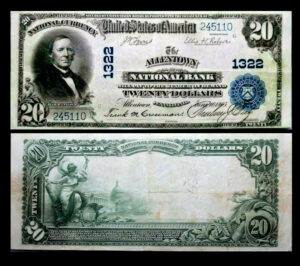
Corner wear is one of the most reliable diagnostic points between CF 15 and VF 20 on large-size notes. In CF 15, all four corners will typically show rounding, with the extreme tips of the corners having lost their paper point and worn to a blunt curve. In VF 20, the corners may still show some rounding or fraying, but at least two corners will retain a recognizable point, even if slightly blunted. On a 1902 Date Back National Bank Note in CF 15, flipping the note over and examining the back corners under light will almost always reveal moderate to heavy rounding on all four corners. The same note in VF 20 will show sharper corners, with only light wear at the tips.
Series-Specific Examples: Where the Grade Difference Matters Most
1896 Educational Series Silver Certificates
Few large-size series are more grade-sensitive than the 1896 Educational Series. The $1 (Fr. 224), $2 (Fr. 247), and $5 (Fr. 270) notes feature allegorical scenes designed by Edwin H. Blashfield and Will H. Low, engraved by bureau craftsmen including Charles Schlecht and G.F.C. Smillie. The density of fine engraved line work in these designs means that a half-grade of wear translates into dramatically different visual quality. A CF 15 $1 Educational note will show the central figure of History presenting a scroll to a young student with the facial features and drapery lines noticeably flattened. In VF 20, those same elements retain a three-dimensional quality that makes the note genuinely beautiful. Current retail for a Fr. 224 in CF 15 runs approximately $425 to $550, while VF 20 examples regularly bring $700 to $900, a premium that reflects exactly the visual difference described here.
1901 $10 Legal Tender (Bison Note)
The Fr. 122 through Fr. 122e Bison notes are among the most popular large-size notes in the American collector market. The central vignette of a American bison, flanked by portraits of Meriwether Lewis and William Clark, is engraved with extraordinary detail in the animal’s fur and musculature. In CF 15, the texture of the bison’s coat has been worn to a largely uniform tone with only traces of the original line differentiation. In VF 20, the individual engraved lines suggesting fur texture remain distinct across most of the vignette, creating a dramatically more dynamic visual impression. The signature combination also matters here: the Lyons-Roberts (Fr. 122) and Lyons-Treat (Fr. 122a) are the most common, while the Vernon-McClung (Fr. 122c) and Napier-McClung (Fr. 122e) combinations carry significant premiums in all grades.
For the 1901 Bison note specifically, examine the fur texture along the bison’s shoulder hump under magnification. This area experiences the heaviest wear in circulation because it sits at the center of the note where folding stress concentrates. VF 20 examples will show clear fur line differentiation here. CF 15 examples will not.
1880 $100 Legal Tender Notes
At the premium end of the large-size market, the 1880 $100 Legal Tender notes (Fr. 168 through Fr. 171) feature a large central portrait of Abraham Lincoln engraved by Charles Burt. In CF 15, a Fr. 168 (Scofield-Gilfillan signatures, large brown seal) might catalog around $3,500 in circulated grades. In VF 20, comparable examples have brought $6,000 to $8,500 at major auction houses including Heritage and Stack’s Bowers. The engraved portrait detail in Lincoln’s beard and the fine hatching of his coat are the primary visual differentiators between these two grades on this specific type.
The PMG Grading Process: How These Calls Are Made
PMG employs a multi-grader review process for significant notes. Initial examination is conducted under consistent controlled lighting, typically a combination of overhead fluorescent and directed halogen or LED sources. Graders use calibrated 10x loupes and, for particularly valuable or borderline notes, digital microscopy. The grading form tracks fold count, surface quality, margins, eye appeal, and any noted problems such as pinholes, tears, edge nicks, stains, or writing.
For the CF 15 to VF 20 boundary specifically, PMG graders weight fold character heavily. A note with seven folds, all of which are hard and show white fiber exposure, may grade CF 15 despite the relatively low fold count. Conversely, a note with nine folds, most of which are soft, combined with strong surface preservation and sharp corner points, can legitimately reach VF 20. This nuance is why two notes that look nearly identical in a photograph can come back with different grades, and why experienced collectors always prefer to examine notes in hand before purchasing.
When buying raw (ungraded) large-size notes at shows or from dealers, bring a small LED penlight in addition to your loupe. Raking light, held at a very low angle to the note’s surface, will reveal hard fold lines, counting them accurately as shadows even when the note looks deceptively clean under overhead lighting.
| Series / Friedberg No. | Type and Denomination | Approx. Known in VF+ | Grade Sensitivity |
|---|---|---|---|
| 1896 Fr. 224 | $1 Educational Silver Certificate | 1,200 estimated | High |
| 1896 Fr. 247 | $2 Educational Silver Certificate | 600 estimated | High |
| 1896 Fr. 270 | $5 Educational Silver Certificate | 250 estimated | Very High |
| 1901 Fr. 122 | $10 Bison Legal Tender | 3,500 estimated | Moderate |
| 1901 Fr. 122e | $10 Bison (Napier-McClung) | 180 estimated | Very High |
| 1880 Fr. 168 | $100 Legal Tender (Lincoln) | 90 estimated | Very High |
| 1914 Fr. 910 | $10 FRN Boston (Red Seal) | 220 estimated | High |
| 1907 Fr. 91 | $5 Woodchopper Legal Tender | 4,800 estimated | Low |
| 1899 Fr. 226 | $1 Black Eagle Silver Certificate | 8,500 estimated | Low |
| 1882 Fr. 1204 | $20 Gold Certificate (Garfield) | 140 estimated | High |
Practical Buying Strategy: Working the CF 15 to VF 20 Boundary
For collectors on a budget, CF 15 notes offer excellent value in common large-size series where the price gap to VF 20 is large but the visual difference is manageable. A 1899 Black Eagle $1 Silver Certificate (Fr. 226 through Fr. 229) in CF 15 typically retails for $75 to $120, while VF 20 examples run $175 to $250. If budget constraints apply, CF 15 is a perfectly respectable grade for a type collection entry. However, for condition-sensitive series like the Educationals, the 1882 Gold Certificates, or the 1869 Rainbow Legal Tenders, the difference in visual quality between CF 15 and VF 20 is dramatic enough that stretching the budget for the higher grade is almost always the right collecting decision.
One underappreciated strategy is targeting PMG VF 20 notes with the EPQ (Exceptional Paper Quality) designation. PMG awards EPQ to notes that are free of any artificial alterations, cleaning, or restoration, and that display paper quality original to their grade. A VF 20 EPQ large-size note will show honest, clean circulation wear without the pressed, washed, or chemically treated appearance that disqualifies many otherwise attractive examples. In competitive series, VF 20 EPQ notes consistently outperform non-EPQ VF 20 examples at auction by 15 to 30 percent, and they are significantly more liquid in the secondary market.
Conclusion: Grade Knowledge Is Buying Power
The distance between PMG Choice Fine 15 and Very Fine 20 is measured in millimeters of paper bend and microns of engraved ink relief, but it translates directly into hundreds or thousands of dollars depending on the series. Understanding that the distinction rests primarily on fold character rather than fold count, on surface detail preservation in the engraved vignette rather than color brightness, and on corner condition as a reliable secondary indicator gives collectors a genuine analytical edge whether they are examining a raw note at a coin show or evaluating a slabbed example in an online auction. Large-size United States currency represents some of the finest engraving and design work ever produced by the Bureau of Engraving and Printing. Learning to read the grades that preserve versus obscure that artistry is one of the most rewarding skills a currency collector can develop.