📷 Image source: Wikimedia Commons. Images are selected by AI to represent the article topic and may not depict the exact note(s) described.
Pick up any pre-1929 Federal Reserve Note, Silver Certificate, or United States Note and you will immediately notice something that feels almost extravagant by modern standards: the sheer physical size of the thing. At 7.375 inches by 3.125 inches, large-size notes dwarfed their successors. They bore elaborate, individually designed vignettes, sprawling ornate borders, and a visual vocabulary that owed more to Victorian engraving tradition than to industrial efficiency. Then, on July 10, 1929, a new generation of currency measuring just 6.14 inches by 2.61 inches entered circulation, and nothing about American paper money would ever be the same.
The Problem With Big Money
The story of the 1929 reduction does not begin in 1929. It begins in the years immediately following World War I, when the United States government was wrestling with the staggering cost of producing, distributing, and replacing paper currency at a national scale. The BEP was printing billions of notes annually, and the expense of paper, ink, labor, and press time was enormous. Every note was essentially a custom printing job: different denominations carried different vignettes, different border treatments, and different engraving styles depending on the issuing authority, whether that was the Federal Reserve, the Treasury, or one of the twelve Federal Reserve Banks.
A 1920 Treasury Department study estimated that the government could realize substantial savings if it standardized currency production. The existing system required the BEP to maintain dozens of separate plate designs and printing sequences. Federal Reserve Notes alone came in versions for twelve different districts, each with its own seal, letter designation, and numbering system. Add Gold Certificates, Silver Certificates, United States Notes, Federal Reserve Bank Notes, and Treasury Notes to the mix, and you had a production nightmare of overlapping designs and incompatible plate configurations.
Beyond production costs, there was the matter of counterfeiting. Paradoxically, the elaborate engraving on large-size notes was meant to deter counterfeiters, but the sheer variety of designs also made it harder for the public to spot a fake. A standardized smaller note with consistent design elements, positioned portraits, and uniform color schemes would make anomalies far easier to detect.
The Political and Economic Road to Standardization
Secretary of the Treasury Andrew Mellon championed the reduction program through the mid-1920s. Mellon, who served from 1921 to 1932, was famously focused on fiscal efficiency, and the currency production budget was a natural target. Working with BEP Director Alvin Hall and a team of design consultants, the Treasury convened a formal committee in 1925 to determine exactly how small the new notes could be while still accommodating all required security features, legal text, and portrait engravings.
The committee’s findings, delivered in 1926, proposed the 6.14 x 2.61 inch format. This was not an arbitrary dimension. It was the smallest size that could comfortably contain a central portrait vignette of meaningful resolution, flanking numerals, seal impressions, serial numbers, and all legally mandated inscriptions. The format was also chosen to fit the emerging standard of machine-counting and mechanical cash-handling equipment being adopted by banks across the country.
When attributing early small-size notes from the Series 1928 transition period, pay close attention to the serial number prefix and suffix letters. Federal Reserve Notes from this first small-size series use a single letter prefix corresponding to the issuing district (A for Boston, B for New York, and so on) followed by a seven-digit number and a single letter suffix. Misidentification between Series 1928 and 1928A is common among newer collectors and can significantly affect value.
Design Standardization: The Birth of Familiar Faces
One of the most lasting consequences of the 1929 program was the standardization of portrait assignments. Before 1929, portrait choices on US currency were varied and sometimes changed with new series. The 1926 design committee established fixed rules: the obverse of each denomination would carry a specific portrait of a statesman or president, and the reverse would carry a specific architectural or symbolic vignette. These assignments, locked in for the Series 1928 notes, have remained largely unchanged ever since.
Washington went to the dollar, Jefferson to the two-dollar note, Lincoln to the five, Hamilton to the ten, Jackson to the twenty, Grant to the fifty, and Franklin to the hundred. The larger denominations, then still in regular circulation, received McKinley on the five hundred, Cleveland on the thousand, Madison on the five thousand, and Chase on the ten thousand. These pairings were not entirely new, but their codification into a permanent standard was a direct result of the 1929 program.
The reverses told a similarly standardized story. The Lincoln Memorial appeared on the five-dollar note, the Treasury Building on the ten, the White House on the twenty, the Capitol on the fifty, and Independence Hall on the hundred. This architectural vocabulary reinforced the note’s identity as a government instrument rather than a regional or institutional one.
Production Logistics: Retraining an Entire Bureau
Implementing the change was a massive logistical undertaking. The BEP had to design, engrave, and proof hundreds of new plates for each denomination across each currency type. New printing presses capable of handling the smaller format had to be calibrated or, in some cases, ordered. Staff who had spent careers working with large-format intaglio printing had to adapt their techniques to tighter tolerances.
The paper supply chain also required adjustment. The BEP’s longtime supplier, Crane and Company of Dalton, Massachusetts, had to retool its currency paper production to accommodate the new dimensions. The distinctive red and blue security fibers embedded in the paper were retained, but the paper’s weight-per-sheet specification changed to reflect the smaller format and the BEP’s new practice of printing 12-subject sheets rather than the earlier 4-subject and 8-subject configurations used for large-size notes.
Original BEP press sheets from the earliest small-size printings are extraordinarily rare in collector hands. If you ever encounter a claimed 1928-series uncut sheet, verify provenance meticulously. Legitimate examples sometimes surface from Federal Reserve Bank archives or estate collections of former BEP employees, but reproductions and fantasy sheets are also known to exist in the marketplace.
The Public Reaction: Skepticism and Gradual Acceptance
Not everyone greeted the new currency warmly. American wallets of the 1920s were designed for the larger format, and many older citizens found the small notes flimsy or easy to lose. Newspaper editorials at the time mocked the new bills as looking like “stage money” or “toy currency.” Some banks reported initial customer complaints that the new notes were hard to distinguish by touch from receipts or other paper slips in a coat pocket.
The Federal Reserve System addressed these concerns by conducting a robust public information campaign throughout the spring and summer of 1929. Banks displayed sample notes. Treasury officials gave radio addresses explaining the cost savings and security improvements. Within a year of the July 10 changeover, complaints had essentially subsided as the public adjusted.
One practical accommodation that helped acceptance was the government’s commitment to honoring large-size notes at full face value indefinitely. Unlike some currency transitions in other countries that imposed deadlines or exchange fees, the US approach was gradual and penalty-free. Large-size notes were legal tender alongside small-size notes for decades, and many circulated well into the 1940s and even 1950s in rural areas. Today, of course, large-size notes remain legal tender, though you would never spend one given their considerable collector premium.
The Black Eagle and the Transition Types
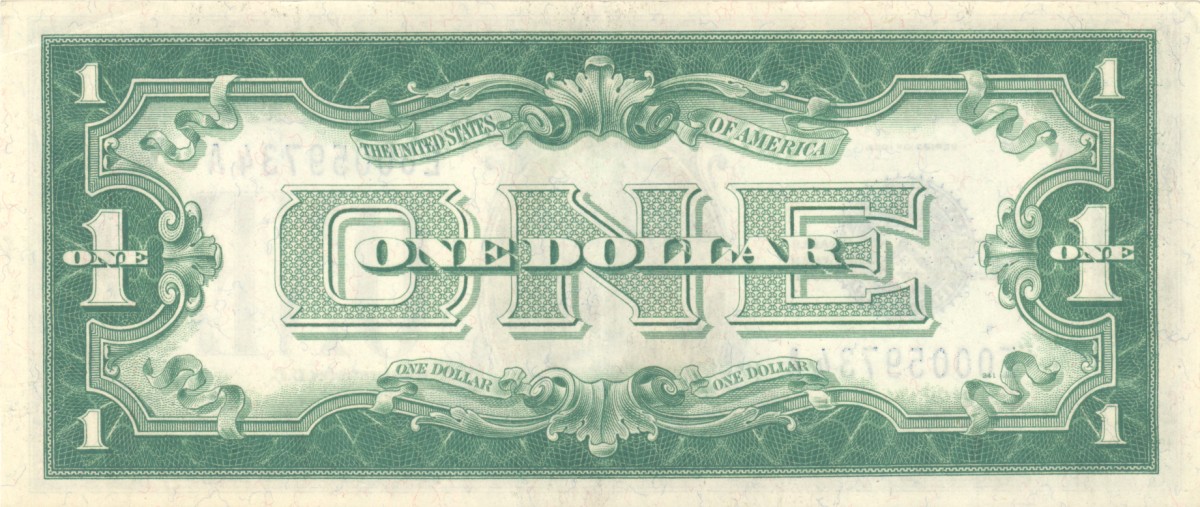
Among small-size collectors, the Series 1928 Silver Certificates hold a special fascination precisely because they document the transition so visibly. The Series 1928 one-dollar Silver Certificate, for instance, carries the distinctive gray treasury seal and is signed by Walter O. Woods (Treasurer) and Andrew W. Mellon (Secretary of the Treasury), the very officials who oversaw the size reduction. The “Black Eagle” note, so called for the prominent eagle vignette on its reverse, was issued only in Series 1928 and 1928A, making it a tangible artifact of the changeover era.
Similarly, the Series 1928 Federal Reserve Notes represent the first standardized small-size FRNs, and their signature combination of Woods-Mellon is found across all twelve Federal Reserve districts. Condition is paramount for these early small-size notes. Because they entered circulation in 1929, right as the Great Depression was beginning, many survivors were heavily used before being retired. Uncirculated examples command significant premiums, and star notes from this series are genuinely scarce across most districts.
For Series 1928 Federal Reserve Notes, the Minneapolis (I) and Dallas (K) districts generally saw smaller print runs than New York (B) or Chicago (G). When building a type set by district, budget more generously for Minneapolis and Dallas examples in grades above Very Fine, as they appear far less frequently at auction than their New York counterparts.
Lasting Impact on Currency Security
One argument that historians sometimes overlook is the long-term security dividend of standardization. Before 1929, a counterfeiter targeting, say, a Federal Reserve Bank Note from Kansas City had a relatively limited circulation area in which the forgery needed to pass scrutiny. After standardization, every dollar bill in the country looked essentially the same, meaning any merchant or teller anywhere in the nation could spot a deviation from the standard design. This nationwide familiarity with a single design template proved to be a genuine deterrent, particularly for crude counterfeits.
The standardization also made future security upgrades far more cost-effective. When the BEP eventually introduced microprinting, color-shifting ink, and security threads in the 1990s and 2000s, those upgrades could be engineered once and applied uniformly across all notes of a given denomination. The modular design philosophy established in 1929, with its fixed portrait positions, fixed reverse vignettes, and fixed placement of serial numbers and seals, created a template that has absorbed dozens of security enhancements over ninety-plus years without requiring fundamental redesigns.
| Series / Type | Variety or District | Approx. Print Run | Rarity |
|---|---|---|---|
| 1928 Silver Certificate $1 (Black Eagle) | Standard Issue | 638,296,908 | Common |
| 1928 Silver Certificate $1 (Black Eagle) | Star Note | Approx. 5,800,000 | Scarce |
| 1928 FRN $5 Woods-Mellon | Minneapolis (I) | Approx. 1,680,000 | Rare |
| 1928 FRN $5 Woods-Mellon | Dallas (K) | Approx. 2,280,000 | Rare |
| 1928 FRN $20 Woods-Mellon | Minneapolis (I) Star | Fewer than 24,000 | Key Date |
| 1928 United States Note $2 | Standard Issue | Approx. 55,889,424 | Common |
| 1928 Gold Certificate $20 | Standard Issue | Approx. 66,204,000 | Scarce |
| 1928 Gold Certificate $100 | Standard Issue | Approx. 3,240,000 | Rare |
| 1928 FRN $100 Woods-Mellon | San Francisco (L) Star | Fewer than 12,000 | Key Date |
Collecting the Transition Era
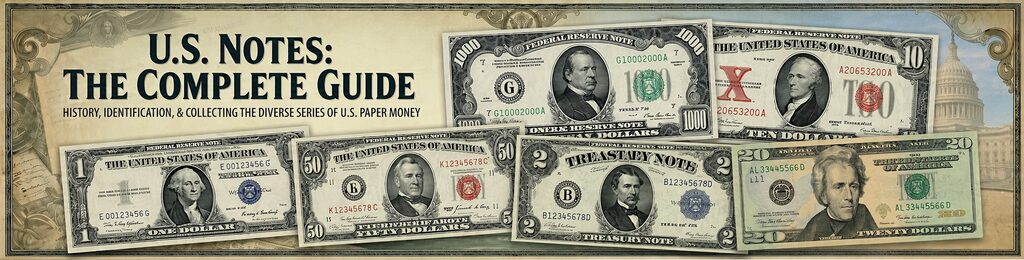
For the collector, the 1929 transition offers one of the most compelling narratives in all of US paper money. You can assemble a comparison set pairing a large-size note with its small-size Series 1928 counterpart for each major denomination, creating a vivid visual record of the change. A large-size 1914 Federal Reserve Note alongside a 1928 FRN of the same denomination makes an arresting display that tells the story without a word of explanation.
Grading considerations for Series 1928 notes deserve special mention. Because these notes entered circulation in 1929 and many remained in use through the Depression years, true uncirculated examples are genuinely rare for the lower denominations. PMG and PCGS Currency both maintain strong populations for these early small-size notes, and their census data shows that the average circulated grade for Series 1928 one-dollar Federal Reserve Bank Notes and Silver Certificates hovers around Very Fine 25 to Extremely Fine 40. Anything grading 64 or above is a premium example worthy of serious collector attention.
When examining early small-size notes for genuine uncirculated status, look specifically at the corners and the center fold line. Series 1928 notes stored in bank bundles for decades often show a single light center fold from being banded. A note with four sharp corners but a faint center fold should be graded About Uncirculated, not Uncirculated, regardless of its apparent freshness. Third-party grading services are well worth the fee for any Series 1928 note you are considering for more than face value.
Conclusion: A Transformation That Shaped a Century
The BEP’s 1929 currency reduction program was, at its core, an act of industrial rationalization. Treasury officials wanted to cut costs, simplify production, and improve the government’s ability to maintain consistent anti-counterfeiting standards. They achieved all of those goals. What they probably did not fully anticipate was that the standardized small-size format would prove so durable that it would survive, with only incremental modifications, for nearly a century and counting.
The notes issued on July 10, 1929, established a visual grammar for American currency that three generations of Americans have absorbed as part of their earliest financial experiences. The face of Washington on the dollar, Hamilton on the ten, Lincoln on the five: these associations are so deeply embedded in American commercial culture that they feel timeless. But they are not timeless. They are the product of a specific committee decision made in the mid-1920s by practical men trying to save the government money.
For collectors, that specificity is precisely the point. The Series 1928 notes are not just old currency; they are the founding documents of the modern American monetary aesthetic. Owning a crisp, well-graded example from the first year of small-size issue is owning a piece of the moment when America’s paper money became, in a very real sense, recognizably modern.