Before the Rails: Banking on the Frontier
In the years immediately following the National Currency Act of 1863 and its successor the National Bank Act of 1864, the American West was essentially a banking desert. San Francisco harbored a handful of state-chartered institutions riding the tail end of the Gold Rush, but between the Sierra Nevada and the Missouri River, organized banking was scattered and unreliable. Miners, merchants, and ranchers depended on Wells Fargo express offices, private assay houses, and — in many cases — nothing at all. The Comptroller of the Currency’s annual reports from the mid-1860s show fewer than thirty nationally chartered banks in the entire region west of Omaha. That number was about to change dramatically.
The Golden Spike and the Paper Cascade
When Leland Stanford tapped that ceremonial spike into the laurelwood tie at Promontory Summit, Utah Territory, on May 10, 1869, the telegraph instantly transmitted the news to the entire country. What followed over the next decade was a cascade of economic development that historians have long documented in terms of cattle, grain, and timber, but have paid less attention to in terms of paper money. Every new town platted along the Union Pacific and Central Pacific main lines, and later along the feeder lines of the Atchison, Topeka and Santa Fe, the Southern Pacific, and the Northern Pacific, was a potential home for a nationally chartered bank.
The mechanics were straightforward but consequential for currency production. Under the National Bank Act, any group of five or more investors who could assemble the required minimum capital (as low as $50,000 in towns under 6,000 population after the 1874 revisions) could apply to the Comptroller of the Currency for a charter. Once approved, they purchased U.S. government bonds, deposited them with the Treasury, and received printed National Bank Notes amounting to 90 percent of the bond value. Those notes carried the issuing bank’s name, charter number, and state or territory imprinted directly on the face, making each issue a unique artifact of its community.
Railroad towns created exactly the population thresholds and mercantile activity that made bank formation viable. Cheyenne, Wyoming Territory, was a raw tent city in mid-1867; by 1869 it had a federally chartered national bank, the First National Bank of Cheyenne (Charter 1800), issuing Original Series notes. Ogden, Utah Territory, incorporated as a city the same year the rails met, and the First National Bank of Ogden (Charter 2597) followed by 1882. The pattern repeated itself from Reno to Tucson.
When researching Western nationals, always cross-reference the bank’s charter number against the year the railroad arrived in that town. A charter issued within five years of rail service almost always signals a railroad-boom bank, and these tend to have shorter lifespans, lower capital bases, and smaller total note outputs, all factors that drive scarcity and collector value upward.
The Notes Themselves: Design, Seals, and Series
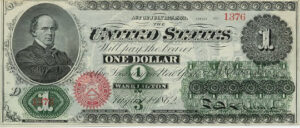
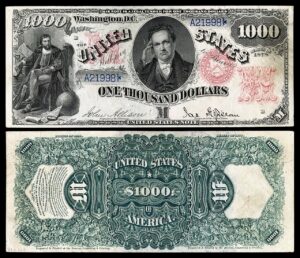
For collectors, the physical notes issued by these newly chartered Western banks fall into several distinct series, each with its own design characteristics and relative scarcity profile. The earliest examples are Original Series notes, produced from 1863 through approximately 1875, printed by the American Bank Note Company and the Continental Bank Note Company under contract to the Bureau of Engraving and Printing. These large-format notes (approximately 7.375 by 3.125 inches) carry an orange Treasury seal and the signatures of Register of the Treasury and Treasurer of the United States in hand-signed or countersigned form on the earliest sheets.
The Series of 1875 followed with a revised Treasury seal in red and the replacement of countersignatures by engraved facsimile signatures. Both Original Series and 1875 notes from Western charter banks are among the most aggressively pursued items in the entire national currency series. The reason is simple arithmetic: a bank chartered in 1871 in a town of 2,000 people, issuing only $50,000 in capital notes against $55,000 in bonds, would have produced a very limited quantity of sheets. When that bank failed or was liquidated during the contraction of the 1870s or early 1880s, its unredeemed notes passed into collector hands in tiny quantities. Many Western Original Series notes are unique or exist in populations of fewer than five known examples.
The Series of 1882 introduced the Brown Back design, recognized by its distinctive brown Treasury seal and the elaborate green geometric lathe work on the reverse. Brown Backs from railroad-era Western banks represent a middle tier: slightly more available than Original Series issues but still genuinely scarce for low-charter-capital institutions in small towns. The 1882 Date Back and Value Back variants (produced into the 1900s) represent the tail end of the large-note era and are generally more accessible, though any note from a small-town Western bank commands a premium.
Territorial Issues: The Crown Jewels
No discussion of railroad-era Western currency is complete without addressing territorial nationals, notes issued by banks chartered before the issuing state achieved statehood. These are among the most coveted items in all of American paper money collecting. The designation “Territory” or “Ter.” appears either in the bank’s printed title on the note or as part of the geographic imprint, and this word transforms an already scarce item into a genuinely rare one.
Wyoming Territory banks are particularly prized. The First National Bank of Cheyenne operated under Charter 1800 as a territorial issuer until Wyoming achieved statehood on July 10, 1890. Notes bearing the “Wyoming Territory” or “W.T.” imprint are known in very small numbers. A comparable situation exists for notes from Dakota Territory (which split into North and South Dakota on November 2, 1889), Montana Territory (statehood November 8, 1889), Idaho Territory (statehood July 3, 1890), and Washington Territory (statehood November 11, 1889). The admission of six states in 1889 and 1890, all of them served by recently completed rail lines, created a natural terminus for territorial-designation notes.
Territorial national bank notes are authenticated and cataloged exhaustively in Don Kelly’s “National Bank Notes: A Guide with Prices” and the Standard Catalog of United States Paper Money. Before purchasing any territorial note, request a full population report from PCGS Currency or PMG, and verify that the territorial designation is part of the original printing, not a later alteration. Altered state notes with fraudulent territorial designations do exist in the marketplace.
Charter Numbers as a Collecting Framework
Serious collectors of Western nationals often organize their pursuit around charter number ranges that correspond to the railroad boom periods. Charters issued in the range of roughly 1700 to 2200 (approximately 1866 to 1874) capture the first wave of post-golden-spike Western bank formations. Charters from 2200 to 3500 (roughly 1874 to 1882) reflect the secondary expansion as feeder railroads pushed into Nevada mining country, Colorado mountain towns, and the agricultural plains of Kansas and Nebraska. Charters above 4000 through approximately 6000 capture the Northern Pacific and Atchison, Topeka and Santa Fe boom of the early to mid-1880s.
Each range has its own signature combination on the notes. Collectors should know that the Allison-Spinner pairing (John Allison as Register, Francis Spinner as Treasurer) appears on Original Series notes through 1875. Allison-New (Treasurer John C. New) bridges 1875 to 1876, followed by Allison-Wyman and then the prolific Allison-Gilfillan combination which covers much of the late 1870s. For the 1882 Brown Back era, the Bruce-Gilfillan, Bruce-Wyman, Rosecrans-Jordan, and Rosecrans-Hyatt combinations are most commonly encountered on Western railroad-era notes.
Nevada: A Special Case Study
Nevada presents a particularly instructive case for railroad-era national bank collecting. The state had been admitted to the Union in 1864, partly to provide Lincoln with electoral votes, but its banking infrastructure remained thin. The transcontinental railroad’s route through Nevada via the Central Pacific line accelerated chartering activity, and the Comstock Lode silver boom of the late 1870s provided capital. The First National Bank of Nevada in Carson City (Charter 3578, chartered 1886) and the First National Bank of Winnemucca (Charter 3575) are among the key Nevada issues that collectors pursue. Original Series and 1875 Series notes from Nevada carry a strong premium, often trading at multiples of 10 to 20 times equivalent notes from Midwestern states in comparable grades.
Nevada is notable for another reason: several Nevada national banks failed rapidly, some within five to seven years of chartering, which means their note populations are extraordinarily thin. The Nevada Bank of San Francisco, while technically a California institution, financed several Nevada mining operations and its notes circulated widely in the region during the early 1880s, making Nevada-associated currency an interconnected collecting specialty.
Condition is brutally important for railroad-era Western nationals. Notes from boom towns circulated hard in rough commercial environments: mining supply stores, railroad payroll offices, and cattle auctions. Finding an Original Series note from a small Wyoming or Nevada bank in Very Fine (VF 30) or better is a genuine event. Most survivors grade Fine (F 12) or below. Even problem-free examples in Fine can represent strong value relative to similar Eastern issues in uncirculated condition.
Prices and the Modern Market
The modern auction market for railroad-era Western nationals has been buoyant. Heritage Auctions, Stack’s Bowers, and Lyn Knight Currency Auctions have all produced landmark results in this category over the past decade. A PMG Fine 15 example of a First National Bank of Cheyenne Original Series $1 note (Charter 1800) realized over $18,000 in a 2019 Heritage sale. An Original Series $5 from the First National Bank of Laramie City, Wyoming Territory (Charter 2518), graded PMG Very Good 10, achieved approximately $14,500 in the same period. For comparison, an Original Series $5 from a common Ohio or Illinois bank in the same grade might realize $800 to $1,500.
The premium for territorial designation over state designation on the same charter can be enormous. A Montana Territory note versus a Montana state note from the same bank, all else equal, can carry a price differential of 300 to 500 percent. This makes accurate attribution absolutely critical and also makes the category a target for sophisticated alterations.
| Bank and Charter | Series / Denomination | Est. Notes Known | Rarity |
|---|---|---|---|
| First NB of Cheyenne, WY Ter. (Ch. 1800) | Original Series $1 | 4 to 6 | Key Date |
| First NB of Laramie City, WY Ter. (Ch. 2518) | Original Series $5 | 5 to 8 | Key Date |
| First NB of Helena, MT Ter. (Ch. 2106) | Series 1875 $10 | 8 to 12 | Rare |
| First NB of Winnemucca, NV (Ch. 3575) | Series 1882 Brown Back $5 | 10 to 15 | Rare |
| First NB of Bismarck, DA Ter. (Ch. 2434) | Original Series $5 | 6 to 9 | Key Date |
| First NB of Ogden, UT Ter. (Ch. 2597) | Series 1882 Brown Back $10 | 15 to 22 | Rare |
| First NB of Tucson, AZ Ter. (Ch. 2639) | Series 1882 Brown Back $5 | 20 to 30 | Scarce |
| First NB of Reno, NV (Ch. 2478) | Series 1875 $5 | 12 to 18 | Rare |
| First NB of Cheyenne, WY (Ch. 1800) | Series 1882 Brown Back $10 | 25 to 35 | Scarce |
| First NB of Denver, CO (Ch. 1016) | Series 1875 $5 | 30 to 50 | Scarce |
Building a Railroad-Era Western Nationals Collection
For collectors entering this specialty, a tiered approach makes sense. Begin by acquiring Series 1882 Brown Back or Date Back notes from larger Western railroad cities: Denver, Salt Lake City, Sacramento, Portland, or Seattle. These are scarce but not impossibly rare, and examples in Fine to Very Fine condition can be acquired for $500 to $3,000 depending on the specific bank and denomination. This builds familiarity with the design vocabulary, authentication markers, and the feel of legitimate Western nationals.
The intermediate tier involves pursuing Series 1875 notes from the same cities and then extending to smaller towns along the main rail corridors. The SPMC (Society of Paper Money Collectors) maintains an extensive library of national bank data, and the “Territorial and National Bank Note Reference” by Louis Van Belkum remains an invaluable resource for establishing which banks existed in which towns and what series they issued.
The advanced pursuit, naturally, involves Original Series notes and true territorial issues. At this level, professional third-party grading from PMG or PCGS Currency is not optional; it is essential. Provenance documentation, ideally tracing a note back to a known collection or early auction appearance, adds both confidence and value. The late John Hickman’s collection, dispersed through multiple Lyn Knight and Heritage sales in the 1990s and 2000s, produced many landmark Western national results and serves as a benchmark for condition and price comparisons.
Conclusion: Collecting the Infrastructure of Manifest Destiny
The transcontinental railroad was the greatest infrastructure project of nineteenth-century America, and its economic ripple effects reached far beyond iron rails and wooden trestles. In the towns that sprouted along every surveyed right-of-way, the locally chartered national bank was as essential an institution as the depot itself. The notes those banks issued, printed under the authority of the federal government and bearing the proud names of communities that sometimes vanished as quickly as they appeared, are among the most historically resonant artifacts that currency collectors can pursue. They are simultaneously local history documents, federal financial instruments, and works of engraver’s art produced during a golden age of American banknote design. The steel rails are still there, in many cases. The paper money is far more fragile, and far more rare.