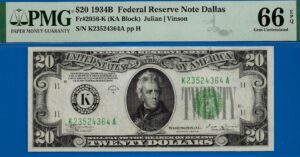
Picture this: you are flipping through a stack of older Federal Reserve Notes and you spot something strange on a Series 1950-B $20. The green intaglio ink on the back vignette has a faint, almost frosty shimmer in certain light, and tiny raised flecks seem to catch the beam of your loupe like miniature crystals. Your pulse quickens. Is it a misprint? A rare experimental ink? A previously uncatalogued variety worth a premium? Almost certainly, it is none of those things. What you are looking at is ink crystallization, a post-printing surface defect that has puzzled collectors for decades and continues to generate spirited discussion on currency forums and at grading tables. This guide cuts through the confusion with a thorough look at the chemistry behind the phenomenon, how to identify it correctly, and what it means for your collection.
What Is Intaglio Printing and Why Does It Matter?
To understand ink crystallization, you first need a firm grasp of intaglio printing, the technique the Bureau of Engraving and Printing (BEP) has used for U.S. currency since the first Demand Notes of 1861. In intaglio, ink is pressed into finely engraved recesses in a steel plate. The paper is then forced under enormous pressure, sometimes exceeding 20 tons per square inch on older presses, directly into those recesses. The ink transfers in raised ridges you can literally feel with your fingertip on a crisp original note. That characteristic tactile quality is one of the most important authenticity markers in U.S. paper money.
The BEP historically used oil-resin based inks formulated to achieve three goals: deep color saturation, adhesion to the cotton-linen substrate, and rapid enough drying to allow stacking and processing. From roughly the 1920s through the 1970s, linseed oil was a primary vehicle in both the black and green intaglio inks. Linseed-based inks cure through oxidative polymerization, a chemical process in which the oil absorbs oxygen from the air and forms a cross-linked polymer film. Under ideal conditions, this produces a smooth, durable, slightly glossy surface. Under the wrong conditions, it can go badly wrong.
The Chemistry of Crystallization
Ink crystallization, sometimes called ink bronzing or chalking depending on its visual character, occurs when the oxidative curing process proceeds unevenly or too rapidly. Several variables can trigger it. Excessive heat during drying, low ambient humidity, exposure to ultraviolet light, or the presence of metallic driers in the ink formula at higher-than-optimal concentrations can all cause the resin binders to precipitate out of solution before they fully integrate. The result is a lattice of micro-crystalline or amorphous resin particles sitting on or just above the ink film surface rather than within it.
Under a 10x loupe, crystallized ink appears as a granular or frosted texture, sometimes with a faint iridescent sheen, over areas that should be smooth raised ink ridges. In severe cases visible under raking light or even at an oblique viewing angle, the affected areas may look almost powdery, as though a fine dust has settled on the note. In mild cases, only a specialist with a quality loupe will notice anything unusual at all. Critically, the crystallization occurs after the note has left the press, during storage or early circulation, which is why it is classified as a post-printing defect rather than a manufacturing error.
Always examine suspected crystallization under two different light sources: direct overhead illumination to check color and density, then raking light held nearly parallel to the note surface. True crystallization will show a distinctly different texture under raking light, while most printing variations will not change character between the two viewing angles.
Which Notes Are Most Susceptible?
Ink crystallization appears across a wide range of series, but certain eras and denominations show it far more frequently than others. The highest incidence occurs on notes from the Series 1928 through 1950-D Federal Reserve Notes, particularly $5, $10, and $20 denominations printed during and immediately after World War II. Wartime production pressures led to faster press speeds, higher drying temperatures, and occasional substitution of ink components due to supply chain restrictions. The Series 1934, 1934-A, and 1934-C $10 Federal Reserve Notes (Friedberg numbers Fr. 2004 through Fr. 2006) are especially well-documented candidates, and collectors examining these notes in high grades should routinely check for crystallization before bidding or buying.
Large-size notes from 1917 through 1923 Legal Tender Notes and Federal Reserve Bank Notes are less commonly affected because their older ink formulations used different resin systems, though chalking, a related but distinct phenomenon, does appear on some Series 1917 $1 Legal Tender Notes (Fr. 36 and Fr. 37). The transition era of the late 1920s into the early 1930s, coinciding with the shift from large-size to small-size notes and the reformulation of BEP inks, seems to have introduced the conditions most hospitable to crystallization.
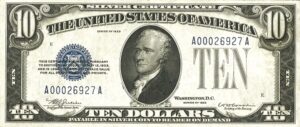
Silver Certificates of the Series 1934 and 1935 families, particularly the $1 Silver Certificates (Fr. 1606 through Fr. 1616), are another collecting area where crystallization regularly appears. Because so many of these notes were stored in bank vaults or Treasury holdings for extended periods under suboptimal humidity control, the conditions for crystallization were frequently met.
When purchasing raw Series 1934 or 1935-series notes at shows or online, specifically request that the seller photograph the back of the note under raking light. The back green intaglio on these issues is the most common location for crystallization and is often invisible in standard scan images used in auction listings.
Crystallization vs. Actual Printing Errors: How to Tell Them Apart
The confusion between ink crystallization and genuine printing errors is understandable, but the two phenomena have reliably different characteristics once you know what to look for.
A genuine ink-related printing error, such as an ink void, a smear, or an over-ink, occurs during the printing process and is locked into the note at the moment the paper leaves the press. The error will be consistent and fixed. The boundaries of the affected area will be sharp and definitive under magnification. The paper substrate in an ink void will be perfectly smooth because the error reflects a lack of ink, not a textural change in existing ink. Conversely, a smear will show a directional flow pattern in the ink consistent with mechanical movement during printing.
Ink crystallization has none of these characteristics. Its boundaries are diffuse and irregular, consistent with a chemical process spreading through a cured ink film rather than a mechanical event at a specific moment. The raised intaglio ridges beneath the crystallization are intact and correctly formed. The crystalline texture sits on top of or within the ink film, not replacing it. Under a loupe at 10x or higher, you can often see that the engraved design details beneath the crystallized surface are perfectly crisp, which would not be the case with most true printing errors that alter the ink deposit pattern.
Another useful test involves oblique transmitted light, holding the note up to a strong light source and viewing it from the side. Crystallization will typically show no significant change in the paper fiber pattern beneath the affected area, confirming the paper itself is undamaged. A printing error involving the substrate, such as a paper foldover or a pre-fold impression, will show a clear structural anomaly in transmitted light.
How the Major Grading Services Handle Crystallization
The two dominant third-party grading services for currency, PCGS Currency and PMG (Paper Money Guaranty), both treat ink crystallization as a post-printing environmental or storage defect, and both will note it on the certification label when it is present to a degree that affects eye appeal or structural integrity.
PMG uses the designation “Ink Crystallization” as a grading qualifier on notes where the defect is moderate to severe. A note that might otherwise merit an EPQ (Exceptional Paper Quality) designation will lose that designation if crystallization is present, regardless of whether the paper itself is bright and original. In terms of numerical grade, mild crystallization on a note with otherwise Gem Uncirculated characteristics might result in a PMG 63 or 64 rather than a 65 or 66. Severe crystallization on a note with good paper quality might push it down into the Choice Fine or Very Fine range purely on the basis of surface integrity. PCGS Currency applies similar standards, using their own terminology and notation system.
It is worth emphasizing that neither service considers crystallization a manufacturing variety that adds premium value. Unlike a misprint, a mule note, or a star replacement note, crystallization is purely a negative condition factor from a grading standpoint.
If you acquire a raw note with mild crystallization that is otherwise high-grade, submitting it to PMG or PCGS Currency is still worthwhile. A PMG 63 or 64 with a crystallization notation on a key-date note like a Series 1934-C $500 Federal Reserve Note is still a significantly more valuable and liquid asset than the same note held raw. The certification protects you and the buyer on resale.
The Specific Case of $500 and $1,000 Notes
High-denomination Federal Reserve Notes of the Series 1934 and 1934-A families present a particularly interesting case study in crystallization. These notes, which include the $500 (Fr. 2200 and Fr. 2201) and $1,000 (Fr. 2210 and Fr. 2211) denominations printed through the Boston, New York, Chicago, and other Federal Reserve districts, were issued in relatively limited quantities and saw most of their use in interbank transfers and large commercial transactions. Many were never circulated by the public at all. Instead, they sat in Federal Reserve vaults for years before being retired.
Vault storage, particularly in older facilities without modern climate control, created exactly the conditions that favor crystallization: moderate to low humidity, temperature fluctuations, and long exposure periods. As a result, a disproportionate share of surviving high-denomination notes from these series show at least mild crystallization on the back vignette. Collectors targeting $500 and $1,000 notes should budget for careful examination or professional grading as part of any acquisition.
| Series / Fr. Number | Denomination and Type | Approx. Print Run | Crystallization Frequency |
|---|---|---|---|
| 1934 / Fr. 2004 | $10 FRN (all districts) | ~400 million | Common |
| 1934-A / Fr. 2005 | $10 FRN (all districts) | ~600 million | Common |
| 1934 / Fr. 1703 | $5 Silver Certificate | ~175 million | Scarce |
| 1934-C / Fr. 2006 | $10 FRN (all districts) | ~280 million | Scarce |
| 1950-B / Fr. 2013 | $20 FRN (all districts) | ~590 million | Common |
| 1934 / Fr. 2200 | $500 FRN (Boston, NY, Chicago) | ~640,000 | Scarce |
| 1934-A / Fr. 2201 | $500 FRN (all issuing districts) | ~1.1 million | Scarce |
| 1934 / Fr. 2210 | $1,000 FRN (NY, Chicago, SF) | ~44,000 | Rare |
| 1935-A / Fr. 1607 | $1 Silver Certificate | ~3.8 billion | Common |
| 1928-B / Fr. 1862 | $1 Legal Tender (rare series) | ~55,000 | Key Date |
Storage, Prevention, and What Not to Do
Ink crystallization cannot be reversed once it occurs. This is perhaps the most important practical point for collectors. Any attempt to clean, rub, or treat a crystallized surface will cause further damage. Solvents will attack the ink binder and spread the crystallization or strip the ink entirely. Gentle polishing with a cloth, a technique that absolutely should never be applied to paper money under any circumstances, will physically dislodge the crystalline material and leave bare ink or exposed paper behind. There is no conservation treatment currently available to a private collector that will safely address the problem.
What you can do is prevent crystallization in notes you currently hold. The BEP’s own archival standards and those recommended by the American Numismatic Association and the Society of Paper Money Collectors all point to the same conditions: stable relative humidity between 45 and 55 percent, stable temperatures between 65 and 70 degrees Fahrenheit, minimal UV light exposure, and inert archival-quality holders. Mylar D (polyester) currency sleeves and archival binders provide excellent protection. Avoid PVC-based holders, which off-gas plasticizers that can interact with ink binders. Keep high-value notes away from exterior walls where temperature gradients are greatest, and never store currency in attics or basements where humidity fluctuates seasonally.
Building a Collection Strategy Around Crystallization
Savvy collectors can actually use their knowledge of ink crystallization as a buying advantage. Because many general collectors and even some dealers conflate crystallization with cleaning or other more damaging treatments, notes with mild crystallization sometimes trade at discounts steeper than their actual condition warrants. A Series 1934-A $10 Federal Reserve Note in the Boston district (Fr. 2005-A) with a PMG 64 grade and a noted mild crystallization qualifier is still a very collectible note in a solid grade, and it may sell at 20 to 30 percent below a comparable example without the notation. For type collectors building sets by series rather than chasing condition rarities, this represents genuine value.
Conversely, collectors focused on registry-set quality should approach crystallization-affected notes with caution. In the competitive world of high-grade certified currency, condition is everything, and a note with any crystallization notation will never achieve the highest numerical grades or the EPQ/PPQ designations that drive the strongest prices in that segment of the market.
Conclusion: Knowledge Is the Collector’s Best Tool
Ink crystallization sits at an intersection of chemistry, history, and numismatic condition assessment that rewards careful study. It is not a printing error, not a variety, and not evidence of counterfeiting or tampering. It is a natural aging phenomenon rooted in the specific ink chemistry the BEP used across several decades of U.S. currency production, and it affects some of the most historically significant notes in the American paper money canon. Understanding it thoroughly, knowing which series are most susceptible, how to identify it under magnification, how the grading services treat it, and how to factor it into buying and selling decisions, is the kind of deep, practical knowledge that separates confident collectors from those who are perpetually uncertain about what they are holding. Bring your loupe, adjust your light source, and look closely. What you find might surprise you.