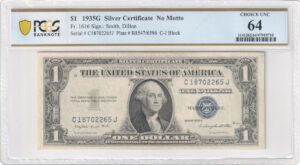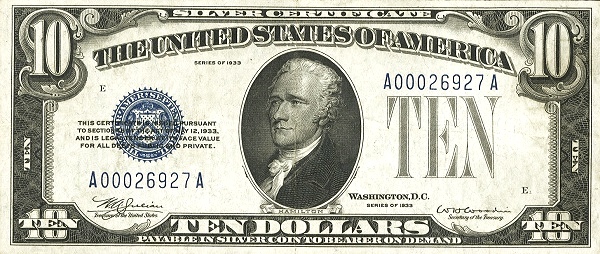
📷 Image source: banknote.ws (World Banknote Gallery). Images are selected by AI to represent the article topic and may not depict the exact note(s) described.
A Tiny Change with Lasting Consequences
Pick up two Series 1935D $1 Silver Certificates side by side and most people would swear they’re identical. Same blue seal, same George Washington portrait, same ornate back design centered on the numeral ONE. But flip them over and look closely at the reverse, specifically at the width of the border framing the back design, and you’ll see something that separates the two notes as decisively as any signature change or overprint color: the Wide Back and the Narrow Back. This distinction, born of a quiet mid-run modification to the intaglio printing plates at the Bureau of Engraving and Printing, turned what was already a high-mintage workhorse note into a two-variety collector pursuit that rewards patience and a good loupe.
Background: The 1935 Series and Its Many Iterations
The Series 1935 $1 Silver Certificate is a sprawling family. Running from the original 1935 issue through the 1935A, 1935B, 1935C, 1935D, 1935E, 1935F, 1935G, and 1935H, these notes spanned roughly two and a half decades of continuous production. Each new letter suffix typically reflected a change in the Secretary of the Treasury or Treasurer of the United States, whose facsimile signatures appeared on the face of the note. The 1935D specifically carries the signatures of Ivy Baker Priest as Treasurer and George Humphrey as Secretary of the Treasury, a pairing that was in place from 1953 through 1957.
The back design itself had been relatively stable since the Series 1928 introduced the small-size format. The dominant ONE numeral flanked by ornate scrollwork had become iconic, but the exact geometry of the back plate, particularly the outer border margins, was subject to refinement over time. The BEP periodically updated plate layouts to improve print quality, reduce ink spread, and accommodate wear patterns on high-volume runs. It was one such refinement, introduced partway through the 1935D production run, that created the Wide Back and Narrow Back varieties.
What Exactly Is the Difference?
The terminology is straightforward once you know what to look for. On the Wide Back variety, the outer border of the back design has a noticeably broader margin between the outermost decorative line and the edge of the printed design field. Measured precisely, the back design on Wide Back notes spans approximately 67.8 mm in width across the printed area. On the Narrow Back variety, this border is tighter and the overall design appears slightly more compact, measuring closer to 66.5 mm. The difference is roughly 1.3 mm, which sounds trivially small but is clearly visible once you train your eye.
The practical way to spot the difference is to look at the back of the note and observe how much white space exists between the outermost scrollwork border and the perimeter of the printed image. On the Wide Back, that space is generous and almost seems to breathe. On the Narrow Back, the design crowds closer to the edges and the border lines appear thicker relative to the surrounding paper. A 5x loupe or even a decent smartphone macro lens makes the comparison easy.
When examining 1935D notes in dealer stocks or at currency shows, bring a small flexible ruler or a printed reference card with the 67.8 mm and 66.5 mm measurements. Even in circulated grades where edge wear is present, measuring the design width from the inner margin lines (which stay clean) will reliably identify the variety.
When Did the Change Happen?
The Bureau of Engraving and Printing did not publicize plate revisions as collectible events, so pinpointing the exact serial number at which Wide Back plates gave way to Narrow Back plates requires cross-referencing serial number blocks with known examples. Research by currency specialists, including work documented in the Friedberg catalog and by collectors writing in the Bank Note Reporter and Paper Money journal of the Society of Paper Money Collectors (SPMC), has established that the transition occurred somewhere within the high-volume production of the 1935D run, generally estimated to have happened around 1954 to 1955 as new plate orders were filled.
The Wide Back notes were produced on earlier plates and appear predominantly in lower serial number ranges, while Narrow Back notes dominate the later blocks. However, because old and new plates could theoretically be used concurrently at different printing presses, there is some overlap zone where both varieties can appear in adjacent serial ranges. This makes the 1935D an interesting note to examine even in large accumulations, since you cannot assume variety purely from serial number without physically checking the back.
Star Notes: The Rarity Multiplier
Star notes, the replacement notes printed to substitute for defective sheets, add another dimension to the Wide Back versus Narrow Back equation. Star notes for the 1935D are identified by a star symbol preceding the serial number. Both Wide Back and Narrow Back star notes exist, but their relative scarcities differ substantially. The Wide Back star notes from this series are considerably scarcer than their regular-issue counterparts, with known populations suggesting they are genuinely rare in grades above Very Fine. Narrow Back star notes, while not common in strict numismatic terms, are far more available.
For the advanced collector assembling a type set or a complete 1935 series set, owning a Wide Back star note in a certified holder graded Fine or better represents a real accomplishment. PCGS Currency and PMG both attribute the variety on their holder labels, which has helped establish market recognition and price transparency.
If you are searching raw star notes for the Wide Back variety, focus on notes with lower serial number prefixes in the 1935D star note blocks. Stars in the A block and early B block ranges statistically lean toward Wide Back attribution, though every note should be physically measured before purchase.
Grading Considerations Unique to This Variety
The 1935D was produced in enormous quantities and circulated heavily throughout the mid-1950s. Finding either variety in gem uncirculated condition requires some patience, but it is far from impossible given the sheer volume printed. What complicates matters is that the BEP’s intaglio printing of this era occasionally produced back-to-face misalignment and ink smearing that can obscure the border details needed to attribute Wide versus Narrow. For grading purposes, third-party certification services will typically designate the variety only when the borders are clearly legible.
Circulated examples in the Very Fine to Extremely Fine range are the bread-and-butter collector grade for this note. Wide Back regulars in VF-30 can be found for modest premiums over Narrow Back examples, generally in the range of $8 to $20 depending on the note’s eye appeal. In Gem CU-65 holders, Wide Back examples command more meaningful premiums, often fetching $60 to $100 or more at auction, compared to $25 to $45 for a comparable Narrow Back. These figures shift with market cycles, so treating recent auction records as your pricing baseline is always wise.
Friedberg Numbers and Catalog Attribution
The standard reference for collectors of US paper money, Robert Friedberg’s Paper Money of the United States, lists the 1935D Silver Certificate varieties as Friedberg number 1614 for the Wide Back and Friedberg 1615 for the Narrow Back in editions that explicitly separate the two. Earlier editions of the Friedberg catalog did not always make this distinction clearly, which contributed to the variety being underappreciated by generalist collectors for many years. The Whitman Encyclopedia of U.S. Paper Money by Jeff Garrett and Ron Guth similarly breaks out these varieties and provides population and value context that is useful for contemporary collectors.
For those using the Schwartz-Parrett Standard Guide to Small-Size U.S. Paper Money, the Wide and Narrow designations are discussed with additional serial number range data that goes beyond what Friedberg provides. Owning at least two of these major references is genuinely worthwhile if you plan to specialize in the 1935 series.
When buying certified examples of 1935D notes, verify that the label explicitly states “Wide Back” or “Narrow Back” rather than simply listing “Series 1935D.” An unattributed certified note may be worth sending for a variety notation to PCGS Currency or PMG, especially if it grades VF or higher, since proper attribution can meaningfully affect resale value.
Why This Variety Matters in the Broader Context of 1935 Silver Certificates
The Wide versus Narrow Back distinction on the 1935D is not the only back-design variety in the 1935 Silver Certificate family. The Series 1935A produced during World War II includes the famous “R” and “S” experimental note varieties printed on different paper stocks as part of a wartime paper-supply trial, and those command significant premiums in their own right. But the 1935D Wide/Narrow split is particularly instructive because it demonstrates how routine manufacturing improvements at the BEP, changes made purely for production efficiency and not for any policy or security reason, can create enduring numismatic varieties without any contemporary announcement or fanfare.
This is precisely the kind of variety that rewards collectors who look carefully at notes that most people dismiss as common. The 1935D is not a glamorous rarity. It is not a low-mintage key date. It is, in face value and general appearance, an utterly ordinary dollar bill. But beneath that ordinariness lies a story of plate geometry, production sequencing, and the quiet evolution of the BEP’s craft, and that story is exactly what makes paper money collecting endlessly engaging.
| Series / Variety | Type | Approx. Print Run | Rarity |
|---|---|---|---|
| 1935D Wide Back | Regular Issue | Est. 600+ million | Common |
| 1935D Narrow Back | Regular Issue | Est. 600+ million | Common |
| 1935D Wide Back Star | Star / Replacement | Est. 2.4 million | Scarce |
| 1935D Narrow Back Star | Star / Replacement | Est. 5.8 million | Scarce |
| 1935D Wide Back (CU-65 or better) | Regular, Gem Unc. | Small surviving pop. | Scarce |
| 1935D Wide Back Star (VF or better) | Star, Circulated | Very limited survivors | Rare |
| 1935D Wide Back Star (CU-63 or better) | Star, Uncirculated | Extremely few known | Key Date |
| 1935D Narrow Back Star (CU-65) | Star, Gem Unc. | Scarce, not impossible | Scarce |
Building a Complete 1935D Set
For collectors interested in building a meaningful specialized holding around the 1935D, the logical goal is a four-note set: Wide Back regular issue, Narrow Back regular issue, Wide Back star, and Narrow Back star. All four in certified holders graded at least Extremely Fine-40 represent a genuinely satisfying and display-worthy achievement. A budget-conscious collector can assemble the two regular-issue notes quite easily for under $50 total in circulated grades, and can add the Narrow Back star for another $50 to $80. The Wide Back star is the challenge piece; expect to budget $150 or more for a presentable example, and considerably more if you insist on gem quality.
Completing this four-note set places the collector in excellent company. The 1935D with its Wide/Narrow distinction is a favorite among small-size Silver Certificate specialists, and a complete certified set is the kind of holding that photographs beautifully for exhibits at paper money shows.
Heritage Auctions, Stack’s Bowers, and Lyn Knight Currency Auctions all maintain searchable archives of past sales. Running searches for “1935D Wide Back star” in these archives gives you real transaction data going back a decade or more, which is far more reliable for current valuation than any fixed price guide.
Conclusion: Common Notes, Uncommon Knowledge
The Series 1935D $1 Silver Certificate will never be the most expensive note in a collection. It will not anchor a blue-chip numismatic portfolio the way a high-grade 1890 Grand Watermelon Treasury Note does. But the Wide Back versus Narrow Back variety is a reminder that numismatic knowledge, not just rarity or age, creates value in this hobby. A collector who can pick up a Wide Back star note from a dealer’s bargain box because it has not been properly attributed, and who knows exactly what they are holding, has done something that no amount of spending can replicate. That kind of expertise, built note by note and variety by variety, is what separates a true currency collector from someone who simply owns old paper.
Study the backs. Measure the borders. Know your varieties. The 1935D rewards exactly that kind of attention.