A Quiet Experiment That Left a Loud Legacy
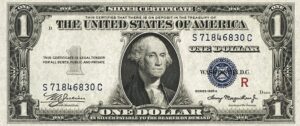
In the late 1940s and early 1950s, the Bureau of Engraving and Printing (BEP) faced a persistent challenge: the standard cotton-linen paper used for Federal Reserve Notes and Silver Certificates wore out faster than Treasury officials would have liked. Heavy circulation, particularly in retail and vending machine environments, was reducing the average lifespan of a $1 note considerably. The solution, the BEP hoped, could be found in an experimental paper blend incorporating a higher proportion of synthetic fibers. The result was a small but historically significant print run of Series 1935E $1 Silver Certificates printed on this trial stock, notes that numismatists now call the “Experimental” or “Special Paper” variety.
Historical Context: Why the BEP Needed a Better Paper
World War II had strained Federal paper currency production enormously. The BEP printed billions of notes between 1942 and 1945, including the distinctive Hawaii overprint and the North Africa yellow-seal emergency issues. When peacetime production normalized, the BEP turned its attention to internal quality improvements. Paper currency durability was a growing concern as the American economy boomed, vending machines proliferated, and cash transactions increased dramatically in volume.
Around 1948 through 1952, the BEP contracted with paper suppliers to test alternative fiber compositions. The experimental stock used in the 1935E trial is generally described as containing a higher percentage of synthetic or non-cotton fibers compared to the standard 75% cotton, 25% linen blend that has been the backbone of U.S. currency paper since the late 19th century. The goal was a note that would resist tearing and soiling longer, potentially reducing production and replacement costs over millions of notes in circulation.
When handling a suspected 1935E Experimental note, compare its feel directly against a known standard 1935E example. The experimental paper often has a slightly stiffer, less “crisp cotton” texture in well-preserved specimens, and under UV light the experimental stock may fluoresce differently than the standard issue due to its altered fiber composition.
How the Experimental Notes Were Distributed for Testing
The BEP did not simply print experimental notes and vault them. To gather meaningful real-world durability data, the agency intentionally released the experimental 1935E $1 Silver Certificates into general circulation alongside standard notes. This was a controlled release: experimental notes were assigned specific serial number blocks so the BEP could track how many returned to Federal Reserve Banks for redemption, and in what condition, over a defined study period.
The experimental notes are identifiable by serial numbers falling within designated ranges using the prefix letter “S”, specifically associated with the experimental distribution program. Standard 1935E notes used a broad range of letter prefixes in conventional sequence. When the BEP or the Federal Reserve recovered circulated notes bearing the study serial blocks, they were evaluated for wear characteristics compared to control notes printed on standard paper from the same period.
The total experimental print run is documented at approximately 1,184,000 notes, a strikingly small figure relative to the hundreds of millions of standard 1935E notes produced. This limited quantity, combined with the fact that many were redeemed during the study period and destroyed, means that surviving examples, particularly in higher grades, are genuinely scarce in today’s marketplace.
Identifying the 1935E Experimental Variety: Key Diagnostic Points
Because the experimental notes were circulated notes and not officially publicized at the time, many have passed through collections unrecognized. Here is how to approach identification systematically.
1. Serial Number Block Verification
The most reliable primary identifier is the serial number. Experimental 1935E notes fall within the S-A block range, with serials beginning with the prefix “S” followed by a numeric sequence and the suffix “A”. Specifically, the documented experimental serial range runs from S00000001A through approximately S01184000A, though researchers including Friedberg catalog editor Arthur Friedberg and independent researchers have noted that the exact upper boundary has been a subject of ongoing study as census populations are updated.
2. Paper Texture and Characteristics
Experienced handlers describe the experimental paper as subtly different in hand feel. In circulated grades (Fine through Extremely Fine), the experimental stock may show different wear patterns: edges tend to fray in a slightly different manner, and the paper does not develop the same soft “limp” quality that heavily circulated standard notes exhibit. In uncirculated grades, the crispness is sometimes described as more “board-like” compared to the supple snap of a standard BEP cotton-linen sheet.
3. UV Fluorescence Testing
Under a standard long-wave ultraviolet lamp (365nm), authentic U.S. currency paper has a characteristic dull, non-fluorescent response due to the absence of optical brightening agents in the cotton-linen stock. Some researchers report that the experimental 1935E paper shows a slightly different UV response, though this test alone is not definitive and should be used in conjunction with serial number verification rather than as a standalone diagnostic.
Never rely solely on paper feel or UV response to attribute an experimental 1935E note. Always cross-reference the serial number against the documented S-A block range first. Misattributed notes sold as “experimentals” do appear at auction, and confirmed serial number documentation should accompany any significant purchase.
4. Plate and Print Quality
The experimental notes were printed using the same intaglio printing plates as standard 1935E notes, signed by Ivy Baker Priest (Treasurer) and H. H. Humphrey (Secretary of the Treasury). The engraving quality, blue Treasury seal placement, and back design are identical to standard issues. Do not attempt to distinguish experimental notes based on ink depth or plate wear characteristics, as these vary naturally across all production runs and are not reliable discriminators.
The Priest-Humphrey Signature Combination in Context
The Series 1935E notes occupy an interesting transitional moment in Silver Certificate history. Signed by Ivy Baker Priest as Treasurer (serving from January 28, 1953) and Secretary of the Treasury George Humphrey (serving from January 21, 1953 to July 29, 1957), these notes were produced primarily between 1953 and 1957. The 1935E was one of the higher-print-run 1935-series issues, with total standard production exceeding 5 billion notes across all Federal Reserve districts, making the experimental subset’s approximately 1.18 million notes a genuinely tiny fraction of overall output.
Collectors who specialize in Silver Certificate signature varieties will find the 1935E experimental an essential component of a complete type set. The Priest-Humphrey pairing appears on the 1935E, 1935F (with motto added later), and 1957 series, but only the 1935E carries the experimental paper designation, giving it unique cross-appeal to both signature variety collectors and paper trial specialists.
Grading Considerations for Experimental Notes
Because these notes were released into general circulation, truly uncirculated examples (graded MS-63 or above by PCGS Currency or PMG) are rare discoveries. The bulk of surviving experimental 1935E notes grade in the Very Fine (VF-25 to VF-35) to Extremely Fine (EF-40 to EF-45) range, reflecting their normal passage through commerce before being saved by an observant collector or returned to a bank and pulled from the stream.
PMG-graded examples in EF-45 have realized between $175 and $325 at major currency auctions in recent years, depending on centering and note freshness. Uncirculated examples graded PMG 63 or PCGS 63 have sold in the $600 to $900 range at Heritage Auctions and Stack’s Bowers currency sales. A PMG 65 EPQ (Exceptional Paper Quality) example, when it surfaces, can command well over $1,200 given the rarity of the paper designation and the grade combination. In lower circulated grades (Fine 12 to Very Fine 20), raw examples change hands between collectors for $40 to $90, though attribution is always the buyer’s responsibility when purchasing unholdered notes.
If you acquire a raw (unholdered) 1935E Experimental note at a reasonable price, consider submitting it to PMG or PCGS Currency for grading and attribution. The holder’s label will specifically note the experimental paper variety, which dramatically improves resale value and provides definitive documentation for future buyers. Submission fees are a worthwhile investment for any note in EF or better condition.
Where the Experimental Program Led: The Broader Legacy
Despite the careful testing, the BEP ultimately did not adopt the experimental fiber blend for general currency production. Post-study analysis reportedly showed that while the alternative paper performed adequately, it did not demonstrate sufficient improvement over the standard cotton-linen stock to justify the cost and complexity of switching suppliers and production processes. The standard 75/25 cotton-linen formula, produced under strict BEP contract by Crane and Company of Dalton, Massachusetts (which has supplied U.S. currency paper since 1879), continued without modification.
The experimental 1935E notes thus stand as a road not taken: physical evidence of the BEP’s ongoing commitment to improving the nation’s paper money even when that improvement ultimately led back to the existing standard. For collectors, this makes them artifacts not just of printing history but of institutional decision-making, the physical remnants of a quiet government research program that most Americans who handled these notes never knew existed.
| Series / Variety | Signature Combination | Approx. Print Run | Rarity |
|---|---|---|---|
| 1935E Standard | Priest – Humphrey | 5,134,056,000+ | Common |
| 1935E Experimental (Fr. 1613) | Priest – Humphrey | 1,184,000 | Rare |
| 1935E Experimental, Unc. (PMG 63+) | Priest – Humphrey | Subset of above | Key Date |
| 1935A | Julian – Morgenthau | 3,656,000,000+ | Common |
| 1935A R Experimental | Julian – Morgenthau | 1,184,000 | Rare |
| 1935A S Experimental | Julian – Morgenthau | 1,184,000 | Rare |
| 1935D Wide I | Clark – Snyder | Est. scarce subset | Scarce |
| 1935F (With Motto) | Priest – Anderson | 1,173,360,000 | Common |
| 1957 Star Note | Priest – Anderson | Varies by run | Scarce |
Building a Focused Collection Around the 1935E Experimental
For collectors who want to pursue a thematic specialty, the 1935E experimental fits naturally into several collecting frameworks. A “Silver Certificate paper trials” collection could pair the 1935E experimental with the earlier and equally celebrated 1935A R and 1935A S experimental notes, which were the first major BEP paper trials on $1 Silver Certificates, conducted around 1942 with a similarly controlled print run of approximately 1,184,000 each. Together, these three experimental varieties document the BEP’s decades-long interest in improving note durability.
Alternatively, a complete 1935-series type set spanning the 1935 through 1935H issues makes a compelling display, with the experimental 1935E as the centerpiece rarity. Pair each note in a consistent grade range (say, all EF-40 to AU-55) for a visually coherent album page that tells the full story of this long-running Silver Certificate design.
When purchasing a 1935E Experimental note from a dealer or auction, always request or verify the Friedberg catalog number (Fr. 1613 for the standard experimental attribution). Cross-reference the serial number with published census data from PCGS CoinFacts or PMG’s online population report to understand how many graded examples exist at or above the grade you are considering. This data directly informs fair market value.
Final Thoughts: A Small Note With an Outsized Story
The Series 1935E $1 Silver Certificate experimental variety is precisely the kind of note that rewards careful collectors. It does not announce itself with a flashy overprint or a dramatic rarity caused by an obvious printing error. Instead, it carries its story in its paper, in the specific serial number block that marks it as one of roughly 1.18 million notes sent out as quiet test subjects for a government durability study. Most of the Americans who spent these notes in 1953 or 1954 had no idea they were handling a piece of monetary research history.
That invisibility is part of what makes finding and correctly attributing one so satisfying. Whether you are a Silver Certificate specialist, a paper money generalist looking for an accessible rarity, or a new collector drawn in by the detective work of numismatic identification, the 1935E experimental is a worthy acquisition. At current market prices, particularly in circulated grades, it remains one of the more attainable genuine rarities in 20th century U.S. paper money, and its collector base has only grown as awareness of these fascinating trial notes has increased in recent decades.