There is a moment every experienced currency collector knows well. You are holding two notes side by side, both in slabs, both graded by a top-tier service. One reads 65 EPQ. The other reads 64. On paper, the 65 wins. But you keep coming back to the 64, drawn by something almost tactile even through the plastic: a crispness, a dimensionality, a sense that the note has not been touched since it left the Bureau of Engraving and Printing. The 65, by contrast, lies flat and glassy, its surface just a little too uniform. You have encountered the single most important tension in modern currency grading, the question of originality.
What Is Embossing and Where Does It Come From?
To understand why originality matters so profoundly, you need to understand how United States currency is printed. Since the first Demand Notes of 1861, the primary design elements on American paper money have been produced through intaglio printing, a process in which engraved steel plates are pressed under enormous pressure against dampened paper. The ink sits in recessed lines on the plate, and when the paper is forced against it, the fibers are literally pulled into those lines. The result is ink that stands slightly above the paper surface, creating a three-dimensional relief that you can feel with your fingertips.
Run your thumb across a fresh Federal Reserve Note, across the portrait of Franklin on a $100, or the word “WASHINGTON” on a $1, and you will feel that subtle ridge. That tactile quality is original embossing. On an uncirculated note that has never been pressed, cleaned, or manipulated, those ridges remain sharp and distinct. They are the fingerprint of the intaglio process, and they are largely irreversible once lost.
How Pressing Destroys Originality
Pressing a banknote, applying heat and pressure to flatten folds or simulate crispness, is one of the most common forms of note alteration encountered in the hobby. The practice ranges from crude home-ironing attempts on circulated notes all the way to sophisticated humidity-and-pressure treatments that can genuinely obscure light folds. The problem is that every form of pressing crushes the embossing. The three-dimensional ink ridges are flattened back into the paper. The note may read technically uncirculated under magnification, its paper fibers showing no definitive breaks, but the life has been pressed right out of it.
A skilled grader at PMG or PCGS Currency examines embossing as a primary indicator of originality. A Gem Uncirculated 65 with destroyed embossing is a note that has been altered in some fashion, even if that alteration improved its cosmetic appearance. The EPQ qualifier that PMG applies, standing for Exceptional Paper Quality, is specifically designed to flag notes that retain original paper surfaces, original embossing, and show no evidence of pressing, cleaning, or artificial enhancement.
When examining a raw note under a raking light held at a low angle to the surface, original embossing will cast tiny shadows across the ink ridges. A pressed note will appear uniformly flat, with little to no shadow variation across the printed areas. This simple test takes about ten seconds and can save you significant money.
The Grading Scale and Where Originality Fits
The standard international currency grading scale runs from Poor-1 through Gem Uncirculated-70, with the key uncirculated grades running from About Uncirculated-55 through the Gem Uncirculated range of 65 to 67 and the superb grades of 68 through 70. A note graded 64 by PMG sits just below Gem, assigned a Choice Uncirculated designation. It may carry a minor counting smudge, the faintest evidence of handling at a corner, or simply a microscopic imperfection in the paper that prevents the full Gem designation.
Now consider a note graded 65 without the EPQ qualifier. PMG’s own guidelines indicate that a 65 without EPQ may have paper that has been washed, pressed, or otherwise treated. The numerical grade reflects the note’s eye appeal and the absence of folds, but the missing qualifier is a red flag. In major series, particularly large-size type notes, National Bank Notes, and pre-Federal Reserve issues, the difference between 64 EPQ and 65 (no qualifier) is not merely academic. It has direct marketplace consequences.
Real-World Marketplace Evidence
Consider the 1899 $5 Silver Certificate, the iconic “Indian Chief” note. In PMG 64 EPQ, an exceptional example with strong color, original embossing, and vivid blue Treasury seal has sold at major auction for $2,500 to $4,000 depending on the Lyons-Roberts or Parker-Burke signature combination. A comparable note in PMG 65 without the EPQ qualifier, where a grader has noted paper treatment, often brings $300 to $600 less despite the higher numerical grade. Sophisticated bidders at Heritage, Stack’s Bowers, and Lyn Knight auctions have learned to read slab labels carefully.
The same dynamic appears in Federal Reserve Note collecting. A 1928 $100 Federal Reserve Note from the San Francisco district in PMG 63 EPQ, a scarce issue in any grade, will consistently outperform a pressed 65 from the same district because the advanced collector knows that original paper cannot be recreated. You can press a note up from 63 to 65 in cosmetic terms, but you cannot press embossing back into existence once it is gone.
When buying notes graded 65 or higher without an EPQ or PPQ qualifier, always request high-resolution scans showing the note under raking or oblique lighting. If the seller cannot or will not provide these images, treat the absence of the qualifier seriously before bidding.
Large-Size Notes: Where the Stakes Are Highest
The originality question matters in every series, but it reaches its highest stakes in large-size currency issued between 1861 and 1928. These notes, printed on thicker, rag-content paper with particularly deep intaglio impressions, were stored in drawers, bank vaults, and private hoards for decades. Many emerged with light folds that a pressing treatment could obscure. The large-size Legal Tender Notes, Silver Certificates, Gold Certificates, and National Bank Notes of this era were never intended for long-term survival, and original gem examples are genuinely rare.
A 1901 $10 Legal Tender Note, the celebrated “Bison” note with its Lyons-Treat or Vernon-Treat signatures, exists in original gem condition in tiny numbers. Heritage Auctions has recorded only a handful of PMG 66 EPQ and finer examples across all auction appearances. When you encounter a Bison note graded 65 without EPQ at a price that seems almost reasonable, the qualifier’s absence should prompt immediate skepticism. Original embossing on the bison’s fur details and the portrait of Lewis and Clark is not merely decorative on this issue. It is the proof of authenticity that no artificial process can fully replicate.
PCGS Currency’s PPQ Designation
PCGS Currency uses the designation PPQ, standing for Premium Paper Quality, in a functionally parallel way to PMG’s EPQ. A note in PCGS 64 PPQ has passed review confirming original paper surfaces, no chemical treatments, and intact embossing. The two services’ qualifiers are not perfectly interchangeable in collector perception, with PMG’s EPQ carrying slightly broader market recognition as of 2024, but both perform the same essential service: separating original survivors from cosmetically improved pieces.
Collectors who work across both slabbing services should be aware that PMG grades on a net basis, meaning the numerical grade already incorporates any problems, while PCGS Currency can assign a grade with a “Details” notation calling out a specific issue. A PCGS 64 PPQ and a PMG 64 EPQ are broadly comparable, but always read the full label before drawing conclusions about a note’s history.
When building a type set of large-size notes, prioritize EPQ or PPQ designations even if it means acquiring lower numerical grades. A set of 63 EPQ and 64 EPQ examples will hold value better over time and attract stronger bids at resale than a set of 65 and 66 notes without originality qualifiers.
Small-Size Notes and the Modern Collector
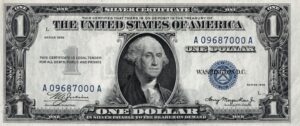
While the originality debate is most dramatic in large-size issues, it applies equally to small-size notes from 1928 onward. The 1928 and 1928-A $500 and $1,000 Federal Reserve Notes are obvious examples: notes in these denominations that emerge from old collections in original VF or EF condition are more historically honest than pressed UNC examples, and advanced collectors know it. Even among common small-size notes, a 1935-A $1 Silver Certificate in PMG 66 EPQ, with its vivid blue seal and sharp intaglio portrait of Washington, is simply a more satisfying object than a 67 that glows too uniformly under fluorescent light.
Star notes in any small-size series also benefit enormously from originality designations. A 1995 $1 Federal Reserve Note star from the Atlanta district with a print run of 128,000 notes is already a significant rarity. Finding one in PMG 65 EPQ rather than a pressed 66 essentially confirms that you are looking at an unaltered survivor, and the premium that commands in the market is fully justified.
| Series / Issue | Denomination or Variety | Known in EPQ/PPQ Gem | Rarity |
|---|---|---|---|
| 1901 Legal Tender | $10 Bison Note (all signatures) | Fewer than 12 in PMG 66 EPQ or finer | Key Date |
| 1899 Silver Certificate | $5 Indian Chief (Lyons-Roberts) | Approximately 20-30 in PMG 64 EPQ+ | Rare |
| 1922 Gold Certificate | $1,000 (large-size, all districts) | Fewer than 8 in any EPQ grade | Key Date |
| 1928 Federal Reserve Note | $100 San Francisco (L-A) | Under 25 in PMG 63 EPQ or finer | Rare |
| 1935-A Silver Certificate | $1 Hawaii Emergency (S prefix) | Several hundred in PMG 64 EPQ | Scarce |
| 1995 Federal Reserve Note Star | $1 Atlanta (F*) 128,000 run | Under 50 confirmed in PMG 65 EPQ+ | Key Date |
| 1929 National Bank Notes | $50 Type 1 (small charter banks) | Very few in PPQ or EPQ above 63 | Rare |
| 1934 Federal Reserve Note | $500 (all districts, small-size) | Scattered examples in EPQ 63-65 | Scarce |
| 1928 Legal Tender | $2 Red Seal (common date) | Hundreds in PMG 66 EPQ | Common |
Practical Advice for Buying Raw Notes
Many collectors first encounter the originality question when purchasing raw, unslabbed notes at coin shows, estate sales, or from dealer stocks. The inability to feel a raw note through a slab makes the examination both easier and more consequential. Hold the note under a strong directional light source angled at approximately 15 to 20 degrees to the paper surface. Original embossing will create visible micro-shadows across the portrait, numerals, and fine line work. A pressed note will appear flat and shadowless across those same areas.
Next, examine the paper under magnification at 5x to 10x. Original uncirculated paper shows intact surface fibers with a slight nap or texture. Pressed paper often shows crushed or matted fibers, sometimes with a faint sheen where heat has been applied. Chemical washing leaves behind a slightly translucent quality in areas where surface sizing has been removed, most visible when backlighting the note.
Before submitting a raw note for grading, photograph it under raking light and compare the embossing to certified examples in the same series listed in recent PMG or Heritage auction archives. If your note’s portrait relief looks flatter than comparable certified examples, consider whether pressing may have occurred before you invest in grading fees.
The Long View: Originality as a Store of Value
The currency market’s gradual embrace of the EPQ and PPQ designations since the early 2000s has not eliminated pressed notes from circulation in the hobby, but it has created a reliable two-tier market. Original notes in any grade trade at premiums that compound over time, while pressed or cleaned examples tend to plateau or decline relative to the broader market as collectors become more educated.
The logic is straightforward. A pressed note started its life at a lower grade and was artificially elevated. Its ceiling has already been reached. An original note in a lower grade still has room to appreciate as its survival rarity becomes better understood. The 1901 Bison note in PMG 64 EPQ that your grandfather acquired from a bank teller in 1955 and stored flat in a drawer has traveled through time with its integrity intact. That integrity, represented by those sharp intaglio ridges under raking light, is not just aesthetically pleasing. It is the numismatic equivalent of provenance, and like all genuine provenance, it cannot be manufactured.
When you next hold two slabs side by side and feel the pull toward the lower-graded note with the EPQ qualifier, trust that instinct. The numbers on a slab label are a starting point, not an ending point. Originality is the destination.