Pick up almost any piece of American paper money printed before 1929 and you are holding a small engraved museum piece. The vignettes, scrollwork, and allegorical figures that filled those large-format notes required the finest intaglio craftsmen the Bureau of Engraving and Printing could employ. And hovering over much of that work, wings spread, talons gripping arrows and olive branches, was the bald eagle. From the first federally issued paper currency of 1861 through the security-laden Federal Reserve Notes circulating today, the eagle has never truly left American currency. But the way it appears, what it communicates, and what collectors should look for has changed dramatically across a century and a half of monetary evolution.
The 1861 Demand Notes: The Eagle Takes Flight on Federal Paper
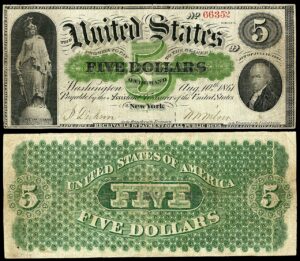
Before the Civil War, the federal government did not issue paper money directly to the public. That changed with brutal urgency in the summer of 1861. The Act of July 17, 1861 authorized $60 million in Demand Notes, the first federally issued paper currency in American history. These notes, bearing denominations of $5, $10, and $20, were printed by the American Bank Note Company and the National Bank Note Company before the Bureau of Engraving and Printing assumed control of federal currency production.
The $5 Demand Note (Friedberg 1, catalog value in Fine at approximately $1,800 to $2,400 depending on the payable-at city) featured a spread eagle at the center of the note’s face, perched above a shield with a ribboned banner. This was not decorative filler. In 1861, the eagle was a deliberate assertion of national sovereignty at a moment when that sovereignty was being tested on battlefields across the South. The engravers at American Bank Note Company understood their assignment. The eagle is large, confident, and surrounded by elaborate lathe work that makes counterfeiting difficult.
The five payable-at cities, Boston, New York, Philadelphia, St. Louis, and Cincinnati, create variety among Demand Notes that collectors prize today. Notes payable at Cincinnati are the rarest, with surviving examples in any grade commanding premiums well above catalog. The eagle appears identically across all city varieties, making the payable-at designation, rather than the design element, the key rarity driver for this series.
When examining Demand Notes, pay close attention to the “For the” vs. “Will pay to” signature inscription below the eagle. Notes signed “For the” Register and “For the” Treasurer are earlier printings and generally more valuable. The distinction reflects a mid-run change in the printed obligation wording, and both varieties carry different catalog numbers in Friedberg.
Legal Tender Notes and the Eagle’s Golden Era, 1862 to 1880
The Legal Tender Notes, often called United States Notes, that followed the Demand Notes between 1862 and 1923 represent the high-water mark of eagle imagery on American currency. Engravers working for the Treasury had artistic latitude that modern currency designers can only envy. The large format, roughly 7.375 by 3.125 inches for most issues, gave them canvas to work with.
The 1869 Series of Legal Tender Notes deserves special attention. Called the “Rainbow Notes” by collectors for their vivid color combinations, these notes deployed the eagle with particular drama. The $1 (Fr. 18) shows a small eagle to the right of the Columbus vignette, but it is the higher denominations that truly showcase the motif. The $10 Rainbow Note (Fr. 96) positions a large spread eagle above the denomination numeral on the back, rendered in a warm orange-red ink that has aged beautifully on well-preserved survivors. A Fine example catalogs around $650 to $800, while a PMG 64 example sold at Heritage in 2021 for $3,840.
The Series 1880 Legal Tender Notes introduced what collectors call the “eagle back” design on several denominations. The $5 (Fr. 67 through Fr. 72, depending on signature combination) places a large spread eagle at the center of the reverse, wings fully extended, surrounded by intricate geometric lathe work in a deep green ink. This reverse design was used continuously through the 1907 series on $5 Legal Tender Notes, making it one of the longest-running eagle back designs in American currency history.
Silver Certificates and the Eagle on the Reverse
Silver Certificates, authorized by the Bland-Allison Act of 1878 and issued through 1957, give collectors a different perspective on eagle deployment. Rather than centering the eagle on the face, the Bureau of Engraving and Printing frequently placed large-scale eagle vignettes on the reverse of higher denomination Silver Certificates, where the green ink of the back printing particularly suited the motif.
The 1886 $5 Silver Certificate (Fr. 259 through Fr. 265) is arguably the most beloved eagle reverse in all of American currency collecting. The back features a massive spread eagle, wings outstretched to nearly fill the entire reverse field, rendered with extraordinary detail. Individual feathers are distinguishable under magnification. A shield rests on the eagle’s breast, and the execution showcases the absolute peak of 19th century intaglio engraving. This note is sometimes called the “Morgan Back” by collectors, a reference to the similarity in period to Morgan silver dollars, though the eagle on this note predates common usage of that nickname. In EF-40, examples catalog at $425 to $600; in PMG 65 EPQ, Heritage realized $3,360 for a particularly well-struck example in their 2019 Currency Signature Sale.
The 1886 $5 Silver Certificate eagle reverse shows significant variation in strike quality. Notes printed early in a production run display crisper feather detail than late-run impressions where the intaglio plates had worn. When comparing two examples in the same technical grade, prefer the note with sharper eagle feather definition, especially on the wingtips and tail feathers. This detail distinction can affect resale value even when both notes carry identical PMG or PCGS Currency grades.
National Bank Notes: The Eagle as a Standard
The National Bank Note series, spanning 1863 through 1935, standardized the eagle in a different way. Rather than featuring it as a unique artistic centerpiece, National Bank Notes incorporated a standardized eagle vignette into the charter plate design that appeared across thousands of issuing banks. The “First Charter” period notes (1863 to 1882) used the most dramatic eagle imagery, with large spread eagles appearing on the reverses of $1, $2, and $5 denominations. The $1 First Charter (Fr. 380 through Fr. 386) reverse features a spread eagle above a landing scene evoking American westward expansion. Because National Bank Notes required the bank’s name, city, and charter number to be incorporated into each printing, the eagle vignette serves as a constant across otherwise highly variable notes. Collectors of National Bank Notes often approach eagle imagery as a secondary consideration after the issuing bank’s geographic desirability, rarity of the issuing institution, and condition.
By the “Third Charter” period (1902 to 1929), the eagle had been somewhat reduced in prominence on National Bank Notes, replaced by portraits of political figures as the primary face design. The back designs used during the Third Charter period, particularly the “Blue Seal” date-back and plain-back varieties, retain eagle elements in the border work but no longer feature the dramatic full-spread eagle centerpieces of earlier charter periods.
The Small-Size Transition of 1929: The Eagle Goes to the Seal
The currency reform that took effect on July 10, 1929 was one of the most sweeping visual changes in American monetary history. Notes shrank from approximately 7.375 by 3.125 inches to the 6.14 by 2.61-inch format still used today, a reduction of roughly 30 percent in surface area. The elaborate vignettes, allegorical figures, and large eagle centerpieces that had defined American paper money for seven decades were abandoned in favor of standardized portrait designs that could be reproduced consistently in the new smaller format.
This is often described as the moment the eagle “left” American paper money, but that characterization misses something important. The eagle did not disappear; it migrated. On small-size Federal Reserve Notes and United States Notes, the eagle became part of the seal system rather than an independent vignette. The Treasury seal, which appears to the right of the portrait on most small-size notes, incorporates a scale of justice, a key, and a chevron of thirteen stars, but the overarching visual authority of the seal system on the note’s reverse became the Great Seal of the United States, which of course features the bald eagle prominently.
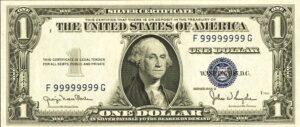
The Series 1928 $1 Silver Certificate (Fr. 1600) introduced a design that would be refined but not fundamentally altered for decades. The reverse of the $1 note at this time did not yet feature the Great Seal eagle; that came later. The familiar Great Seal eagle on the reverse of the $1 Federal Reserve Note was introduced with the Series 1935A Silver Certificate, following President Roosevelt’s 1935 executive order incorporating both sides of the Great Seal into the $1 note’s reverse design. This is the eagle most Americans have held in their hands more than any other: the spread-winged eagle from the obverse of the Great Seal, shield on its breast, arrows in the left talon, olive branch in the right, and the motto “E Pluribus Unum” on the ribbon in its beak.
The 1935A $1 Silver Certificate exists in two distinct reverse varieties related to the motto placement on the Great Seal eagle. The more common variety has the familiar layout, while notes with the “R” (Rural) and “S” (Urban) experimental stamps in red are highly sought. However, for eagle-focused collectors, examining the die used to engrave the seal reveals subtle differences in feather count and beak angle between printings from different die generations, a detail documented in specialized literature but rarely graded by the certification services.
The High-Denomination Eagle Notes: $500 to $10,000
Before their discontinuation in 1969 (with the last printings occurring in the Series 1934 and 1934A), the high-denomination Federal Reserve Notes carried eagle imagery that was restrained but present. The $500 FRN (Fr. 2200 through Fr. 2204, Series 1928 through 1934A) features the portrait of William McKinley, but the reverse incorporates the numeral “500” surrounded by decorative work that includes eagle-derived scroll elements in the border engraving. These notes today carry catalog values ranging from $2,500 in VF to over $15,000 in CU, with any note bearing a star serial commanding substantial premiums. Only twelve Federal Reserve Banks issued $500 notes across all series combined, and some district-series combinations are genuinely rare with fewer than 100 known examples.
Modern Security Eagles: The Motif Becomes a Feature
The currency redesigns of the 1990s and 2000s brought the eagle back as an explicit design element, this time serving the dual purpose of patriotic symbolism and anti-counterfeiting technology. The Series 1996 $100 Federal Reserve Note introduced a watermark eagle to the right of Benjamin Franklin’s portrait, visible when held to light. This was not a printed eagle but a three-dimensional image formed in the paper itself during the papermaking process at Crane and Company’s mill in Dalton, Massachusetts.
The Series 2004 $20 Federal Reserve Note took eagle imagery further with the introduction of color-shifting ink on the numeral “20” in the lower right corner of the face. When tilted, this numeral shifts from copper to green, but the design surrounding it incorporates a small eagle as part of the updated Federal Reserve seal, now printed in black with the eagle-bearing seal made more prominent than in earlier small-size issues. The background printing on the face of the Series 2004 and later $20 notes also incorporates a large, pale blue eagle printed as a background security element behind the portrait of Andrew Jackson.
The most dramatic modern eagle deployment came with the Series 2006 $10 Federal Reserve Note. The redesigned reverse features a large image of the Treasury Building in Washington, but the face incorporates a large, stylized torch-and-eagle design in the background printing to the left of Alexander Hamilton’s portrait. Printed in subtle peach and yellow inks, this eagle is easy to overlook in daily transactions but is a deliberate design choice by the Bureau of Engraving and Printing’s design team, who have stated in BEP publications that the eagle was retained as a unifying patriotic element across the redesigned note series.
| Series / Date | Denomination and Type | Approx. Known or Print Run | Rarity |
|---|---|---|---|
| 1861 Demand Note | $5, Payable at Cincinnati (Fr. 1) | Fewer than 30 known | Key Date |
| 1861 Demand Note | $5, Payable at New York (Fr. 1) | Approx. 100 to 150 known | Rare |
| 1869 Legal Tender | $10 Rainbow Note (Fr. 96) | Survivors moderate, Fine examples scarce | Scarce |
| 1886 Silver Certificate | $5 Eagle Back (Fr. 259) | Moderate survivors, CU examples rare | Scarce |
| 1880 Legal Tender | $5 Eagle Back (Fr. 67 through Fr. 72) | Multiple sig. combos, varies by FR number | Scarce |
| 1863 to 1875 NBN | $1 First Charter Eagle Back (Fr. 380) | Varies by bank; some banks one known | Key Date |
| 1935A Silver Certificate | $1 “R” and “S” Experimentals (Fr. 1609, 1610) | 1,184,000 R; 1,184,000 S | Scarce |
| 1934A FRN | $500, All Districts | Under 500 surviving per district | Rare |
| 1996 FRN | $100 with Watermark Eagle | High production; circulated examples common | Common |
| 2004 FRN | $20 with Color-Shift Eagle Seal | Billions printed; star notes moderately scarce | Common |
Building an Eagle-Themed Collection: A Practical Approach
Assembling a type set of eagle-motif American paper money is one of the more intellectually satisfying ways to approach currency collecting. Because the motif spans every major currency type, from Demand Notes through modern FRNs, a complete thematic collection also functions as a comprehensive survey of American monetary history. A realistic approach for most collectors is to identify three or four signature pieces from the large-size era, where the eagle imagery is most dramatic, and then build outward from there.
For the large-size anchor piece, the 1886 $5 Silver Certificate eagle back (Fr. 259 through 265) in VF to EF condition represents exceptional value for the visual impact delivered. Budget collectors can approach a complete small-size eagle type set, including the 1935A $1 with Great Seal eagle reverse, a Third Charter National Bank Note with eagle border elements, and modern redesigned FRNs showing the security eagle features, for well under $500 total outlay.
Intermediate collectors should consider targeting specific signature combinations on the Legal Tender eagle back $5 notes. The Fr. 72 (Napier-McClung signatures, Series 1907) is considerably scarcer than the more common Speelman-White signature combinations and yet rarely commands a disproportionate premium at auction, creating genuine value opportunities for attentive buyers.
Advanced collectors building toward comprehensive coverage should consult the Friedberg catalog alongside the Standard Catalog of United States Paper Money (Krause Publications) for cross-referencing. The PCGS Currency and PMG population reports are invaluable for determining true rarity in specific grades. For Demand Notes specifically, the specialized census maintained by the Society of Paper Money Collectors provides survival data unavailable elsewhere.
The Eagle as Living History
What makes the bald eagle’s journey across 160 years of American paper money so compelling is that it is never merely decorative. In 1861, it was a sovereignty statement on notes meant to finance a war for national survival. In the 1880s, it was an artistic achievement on notes that doubled as evidence of American engraving supremacy. In 1935, it was a carefully considered political act by a president who wanted both sides of the Great Seal displayed on the most common denomination in American circulation. And today, it serves as both a patriotic signal and a security feature that sophisticated scanning technologies are designed to detect and verify.
Every time you examine an old note and find that spread-winged figure, sharp talons gripping the symbols of war and peace, you are seeing a continuous conversation across generations of American engravers, Treasury officials, and currency designers. The bird has changed, sometimes subtle and watermarked, sometimes enormous and central, but it has never truly left. For collectors who understand what to look for, the eagle on American paper money is never just a picture. It is a primary source.