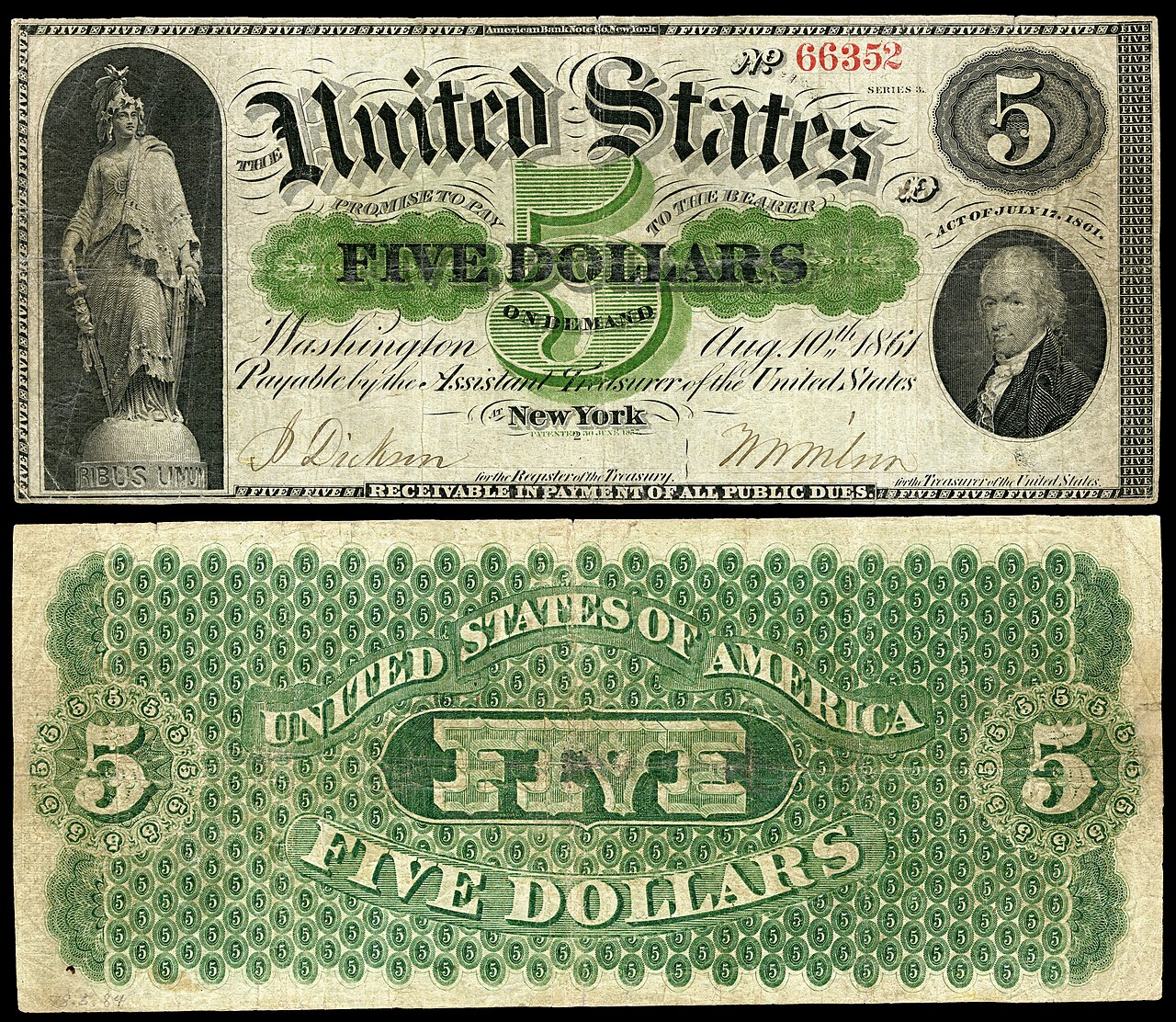
📷 Image source: National Numismatic Collection, National Museum of American History (via Wikimedia Commons). Images are selected by AI to represent the article topic and may not depict the exact note(s) described.
Pick up any piece of American paper money, study it closely under a loupe, and you will find yourself in conversation with centuries of national mythology. The designers who created United States currency were not simply illustrators filling blank space. They were communicators, selecting symbols with deliberate precision to project ideas of sovereignty, unity, and republican virtue. Eagles screech from vignettes. Shields stand guard over serial numbers. Flags wave, subtly or boldly, from corner devices and border ornaments. Learning to read these symbols transforms every note from a transaction slip into a primary historical document.
The Architecture of American Symbolism
Before diving into specific series and denominations, it helps to understand where these symbols came from. The bald eagle was officially adopted as the national emblem on June 20, 1782, when Congress approved the Great Seal of the United States. The seal’s obverse depicts a bald eagle clutching an olive branch in its right talon and a bundle of thirteen arrows in its left, with a shield of thirteen alternating red and white stripes across its breast. Above the eagle’s head, a constellation of thirteen stars bursts from a cloud. This image, with remarkably little modification, has appeared on American banknotes ever since.
The shield, drawn from European heraldic tradition but reinterpreted in an American republican context, carries specific meaning. The red and white stripes represent the original thirteen states. The solid blue chief, or horizontal bar at the top, represents Congress binding the states together. Currency engravers understood this symbolism and deployed the shield not merely as decoration but as a statement of federal authority, particularly important in the turbulent decades following the Civil War when that authority was being actively contested and reconstructed.
Demand Notes and Legal Tender Notes: The Patriotic Foundation (1861-1880s)
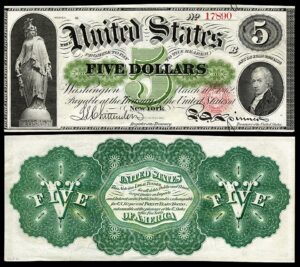
When the federal government issued its first modern paper currency in August 1861, the Demand Notes, the eagle appeared almost immediately. The $5 Demand Note carried a large eagle vignette at its center, a deliberate assertion of federal power at the very moment the Union was fracturing. These notes, sometimes called “greenbacks” due to their distinctive green reverse printing, established a visual grammar that would persist for generations.
The Legal Tender Notes that followed from 1862 onward became increasingly ornate in their patriotic display. The Series of 1869, often called the “Rainbow Notes” by collectors due to their vivid multicolored printing, represent perhaps the most ambitious exercise in patriotic currency design in American history. The $1 note of 1869 features a Columbus sighting land vignette on the left and a large eagle with a shield on the right face. The $2 note, sometimes called the “Lazy Two” for the recumbent numeral on its face, carries a dramatic eagle vignette above the Treasury building. The $10 note of this series shows Daniel Webster on the left and an allegory of civilization on the right, flanked by intricate lathe-work borders incorporating shield motifs.
When examining 1869 Legal Tender Notes, use a 5x loupe to inspect the fine-line lathe-work borders along the note edges. Authentic notes will show unbroken, razor-sharp geometric patterns, while reproductions typically show slight blurring or ink bleeding at the micro-detail level. This is also where shield ornaments appear in miniature form.
National Bank Notes: Eagles in Regional Service
National Bank Notes, issued from 1863 through 1935, gave patriotic imagery a fascinating regional dimension. The Original Series and Series of 1875 notes used a standardized set of vignettes across all issuing banks, but the eagle appeared prominently on most denominations. The $1 Original Series note carries the “Concordia” vignette on the left and an eagle with shield on the right end. The $2 note of the same series features Sir Walter Raleigh on the left face and a bald eagle vignette at the right.
The Series 1882 Brown Back and Date Back notes introduced variations on the eagle theme, with the reverse of many denominations showcasing elaborate eagle vignettes surrounded by the state charter number of the issuing bank. The Series 1902 Plain Back notes, issued through 1929, carried portrait vignettes on the face but retained eagle and shield motifs in the border lathe-work. Collectors of National Bank Notes often find that comparing eagle vignettes across different banks and states reveals subtle engraving differences that were introduced over the decades as printing plates were reworked.
National Bank Notes from territorial banks, particularly those issued before statehood from territories like Oklahoma, New Mexico, and Hawaii, command significant premiums. Patriotic imagery on these notes carries extra historical weight since the notes were circulating precisely when these territories were pressing for admission to the Union. A Series 1902 Red Seal from a Guthrie, Oklahoma Territory bank can bring ten times the value of an identical note from an established state bank.
Silver Certificates and the Flag Motif
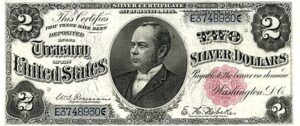
Silver Certificates, issued from 1878 through 1957, introduced more varied patriotic imagery. The Series 1886 $1 Silver Certificate, known to collectors as the “Martha Washington” note, is the only US currency to ever feature a woman on the face of a circulating note. However, the reverse of this note carries a bold, striking design centered on the numeral “1” surrounded by ornamental borders incorporating small flag-like devices at the corners.
The Silver Certificate series reached its patriotic apex with the large-size Educational Notes of 1896. These three denominations, the $1, $2, and $5, carry allegorical reverse designs of extraordinary beauty. The $1 note’s face shows “History Instructing Youth,” with the Washington Monument and Capitol visible in the background beneath an eagle with spread wings. The $2 note carries “Science Presenting Steam and Electricity to Commerce and Manufacture,” and the $5 shows “Electricity as the Dominant Force in the World.” The reverses of all three feature portrait vignettes framed by intricate borders incorporating eagle heads and shield elements. These notes represent the absolute pinnacle of engraver’s art applied to patriotic currency design, and in grades of Very Fine or better, they are among the most visually spectacular collectibles in American numismatics.
Gold Certificates: Restrained Elegance
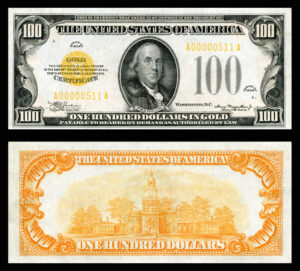
Gold Certificates, which circulated from 1865 through 1933 before being recalled under Executive Order 6102, took a more restrained approach to patriotic imagery. The large-size Gold Certificates of the 1882 and 1905 series are notable for their golden-orange reverses, a color scheme that itself communicated the note’s gold backing without resort to elaborate symbolic imagery. However, eagle vignettes and shield motifs still appeared in the fine engraving work of these notes. The Series 1882 $20 Gold Certificate features Garfield on the face and a substantial eagle vignette on the reverse. The famous Series 1905 $20 Gold Certificate, nicknamed the “Technicolor Note” by collectors for its vivid red, gold, and black color scheme, carries an eagle with spread wings on its reverse that remains one of the most dramatic single vignettes in American currency history.
Gold Certificates are legal to own and collect, despite the 1933 recall order, because the recall was for monetary purposes rather than as a prohibition on collection. However, always purchase Gold Certificates from reputable dealers or auction houses with documented provenance. The Series 1928 small-size Gold Certificates, particularly the $10 and $20 denominations in uncirculated condition, remain undervalued relative to their historical significance and are worth serious consideration for a type collection.
Federal Reserve Notes: Modern Patriotism
When the Federal Reserve System began issuing notes following the Federal Reserve Act of 1913, the design vocabulary inherited all the patriotic symbolism established over the previous half-century but expressed it in increasingly standardized form. The large-size Federal Reserve Notes of 1914 and 1918 carried elaborate vignettes. The $5 Series 1918 Federal Reserve Note features Columbus sighting land on the left and the Mayflower on the right of its reverse, a pairing of discovery and settlement that articulates a specific narrative of American origins. The $10 note of the same series carries a panoramic reverse showing a reaping scene and factory, patriotism expressed through industry rather than heraldry.
The small-size notes introduced in 1928 compressed these designs but retained essential symbolic elements. The Great Seal, with its eagle and shield, appeared on the $1 Federal Reserve Note beginning with the Series 1963 redesign that standardized the modern “In God We Trust” reverse. The obverse of the $1 note features the face of the Great Seal to the right of Washington’s portrait and the reverse of the Great Seal, including the Eye of Providence above the unfinished pyramid, to the left. Together these two seal images constitute the most concentrated display of official American symbolism on any circulating note.
The redesigned high-denomination notes introduced from 1996 through 2013 incorporated new patriotic elements as security features. The Series 2004A $50 Federal Reserve Note introduced a waving American flag printed in color-shifting ink on the right side of Andrew Jackson’s portrait. The fifty stars of the flag background are printed in microprinting too fine to reproduce on contemporary scanners and copiers. The Series 2006 $100 Federal Reserve Note redesign, fully implemented with the Series 2009A notes entering circulation in 2013, incorporated a Liberty Bell printed in color-shifting copper-to-green ink within an inkwell, a bell that rings for freedom, alongside a quill pen, symbolizing the Declaration of Independence.
Star Notes and Patriotic Varieties Worth Watching
For collectors focused on patriotic imagery, certain star note and variety combinations carry special numismatic interest. Star notes, replacement notes identified by the star suffix or prefix on their serial numbers, occasionally appear in print runs associated with patriotic commemorative issues. The Series 1976 $2 Federal Reserve Notes, released on April 13, 1976, as part of the national bicentennial celebration, carry a reproduction of John Trumbull’s “Declaration of Independence” painting on their reverse. First-day issues postmarked at the issuing Federal Reserve Bank carry a significant premium. Star notes from this series in uncirculated condition are genuinely scarce.
| Series / Date | Type and Denomination | Approx. Print Run | Rarity |
|---|---|---|---|
| 1861 | Demand Note, $5 (Eagle Vignette) | ~3,000,000 (surviving: hundreds) | Key Date |
| 1869 | Legal Tender “Rainbow” $1 | Est. several million (survivors in VF+ rare) | Rare |
| 1896 | Silver Certificate $1 Educational | Est. 20,000,000 (high grade survivors scarce) | Scarce |
| 1896 | Silver Certificate $5 Educational | Est. 3,500,000 (VF+ survivors rare) | Rare |
| 1905 | Gold Certificate $20 “Technicolor” | Est. 1,000,000 | Rare |
| 1918 | Federal Reserve $5 (Columbus Reverse) | Various by district | Scarce |
| 1976 | $2 FRN Bicentennial, Star Note | Under 500,000 combined star notes | Scarce |
| 1976 | $2 FRN First Day Issue, Postmarked | Est. 1,000,000 postmarked (high grade rare) | Scarce |
| 2004A | $50 FRN Flag Color-Shift, Low Serial | First print runs | Common |
| 1882 | National Bank Note Brown Back, Eagle Reverse, Territorial Bank | Varies by charter (many under 5,000) | Key Date |
Reading Patriotic Symbols as a Collector
Developing the ability to analyze patriotic symbolism on currency requires building a reference library and a practiced eye. The standard reference for large-size notes, the Friedberg catalog, provides vignette descriptions that allow collectors to identify specific patriotic imagery by type and location. For small-size notes, the Standard Catalog of United States Paper Money, published by Krause, provides comparable detail. Supplementing these with specialized references such as Hessler’s “Engraver’s Line” or the Whitman Encyclopedia of U.S. Paper Money will deepen understanding of how specific vignettes evolved across series and denominations.
When handling notes for study, always use cotton gloves and support the note fully. Never fold a note to examine reverse imagery. A strong raking light source held at a low angle to the note surface will reveal the depth and detail of intaglio engraving in a way that flat overhead lighting cannot. The finest eagle vignettes, particularly those on large-size Legal Tender Notes and Educational Series Silver Certificates, reward this kind of careful examination with detail invisible under casual inspection: individual feathers, the precise set of the talons, the direction of the eagle’s gaze, all carry symbolic meaning that the original engravers built in intentionally.
Building a thematic collection around patriotic symbolism is an excellent entry strategy for collectors with limited budgets. A representative set of eagle vignette types can be assembled from circulated examples of Legal Tender Notes, Silver Certificates, and early Federal Reserve Notes for a few hundred dollars total. Focus on note types where the patriotic imagery is the central design element rather than a minor border detail, and prioritize mid-grade examples, Very Fine to Extremely Fine, where the vignette detail remains sharp and legible.
Conclusion: Symbols That Earned Circulation
The patriotic symbols on American currency were never purely decorative. In 1861, the eagle on a Demand Note asserted federal monetary authority at a moment of existential national crisis. In 1896, the allegorical figures on the Educational Notes argued for an expansive, confident vision of American civilization at the height of the Gilded Age. In 2004, the color-shifting flag on the redesigned $50 note served simultaneously as security device and national statement in the post-September 11 environment. Each iteration of the eagle, the shield, and the flag reflects the moment in which it was designed, the anxieties and aspirations of the Americans who made the decisions about what should appear on their money.
For collectors, this means that assembling a collection organized around patriotic imagery is really assembling a parallel history of the American republic, one told not in words but in fine engraving, deliberate color, and symbolic form. The notes are worth studying not despite their familiar imagery but because of it. Look closely enough, and the eagle still has something to say.