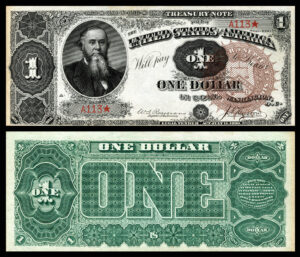
Pick up a well-preserved example of the 1875 Series $50 United States Note and you are holding something that transcends currency. The face of the note is dominated by a bold red Treasury seal and an intricate vignette of Alexander Hamilton, but it is the reverse that stops even seasoned collectors cold. Two ships rendered in crisp intaglio engraving occupy the green-tinted back: the USS Constitution under full sail at the right, and a sidewheel steamship widely identified as the SS Sirius at the left. Together they frame a denomination that circulated in the post-Civil War era when Ulysses S. Grant was in the White House and the Bureau of Engraving and Printing was still perfecting its craft. For numismatists, this note represents the intersection of monetary history, naval heritage, and 19th-century engraving artistry at its most ambitious.
A Brief History of the $50 United States Note
The Legal Tender Act of February 25, 1862 authorized the federal government to issue paper money directly, without the backing of specie. These notes, popularly called “Greenbacks,” carried the full faith and credit of the United States and were declared legal tender for all public and private debts. The fifty-dollar denomination was included from the earliest printings, though the designs evolved substantially over the following two decades.
The 1869 Series, often called the “Rainbow Notes” for their vivid polychrome printing, introduced the ship imagery on the $50 reverse for the first time. The design was carried forward through the 1874, 1875, 1878, and 1880 series with modifications primarily in the signature combinations and serial number styles rather than in the core vignettes. The 1875 Series specifically reflects the transitional Treasury of the mid-Grant era, signed by Treasurer F.E. Spinner and Register of the Treasury John Allison in its most common variety.
The Ships: Identity and Historical Significance
USS Constitution: Old Ironsides on Paper
The sailing frigate depicted on the right side of the reverse is unmistakably the USS Constitution, launched in Boston on October 21, 1797. She is one of six original frigates authorized by the Naval Act of 1794 and remains the world’s oldest commissioned naval vessel still afloat. Her nickname “Old Ironsides” was earned during the War of 1812, when British cannonballs were said to bounce off her exceptionally thick live-oak hull during engagements including the defeat of HMS Guerriere on August 19, 1812.
Placing Constitution on the nation’s currency was a deliberate act of patriotic symbolism. In the decade following the Civil War, the federal government was actively rebuilding national identity and confidence in its paper money, which had suffered credibility problems during the war. Nothing communicated permanence and martial strength more effectively than the image of the ship Oliver Wendell Holmes had immortalized in his 1830 poem “Old Ironsides.” The BEP engravers rendered her under full sail, all three masts carrying pressed canvas, a portrait of American power at sea.
The Sidewheel Steamer: The Sirius Connection
The steamship on the left of the reverse is the subject of more numismatic debate. Most catalog references and collector tradition identify her as the SS Sirius, the 703-ton sidewheel steamer that completed the first transatlantic crossing entirely under steam power, arriving in New York Harbor on April 23, 1838, just hours before Isambard Kingdom Brunel’s far larger Great Western. The Sirius departed Cork, Ireland on April 4, 1838, and her 18-day crossing represented a technological watershed that signaled the end of the age of sail in commercial shipping.
The pairing is conceptually elegant: a sailing warship representing American naval glory and an early steamship representing technological progress and transatlantic ambition. Some researchers have suggested the steamer may be a more generic composite image rather than a strict portrait of the Sirius, a common practice among 19th-century currency engravers who sometimes adapted stock maritime vignettes. However, the historical consensus among paper money specialists including those who have contributed to the Friedberg catalog supports the Sirius identification, and the symbolic logic of the pairing strongly argues in favor of deliberate selection.
When examining the ship vignettes on a circulated example, use a 5x loupe to check the rigging lines on the Constitution image. On well-struck, lightly circulated examples (VF or better) individual rope lines are clearly distinguishable. Heavy wear blurs these into a gray mass, making VF the practical threshold for appreciating the engraving’s full artistic detail.
Design Details: Reading the Engraving
The reverse of the 1875 $50 Legal Tender note was printed in green ink using the intaglio process, in which engraved steel plates transfer ink under enormous pressure, creating the slight tactile relief that distinguishes genuine currency from counterfeits. The central field between the two ships carries the large denomination numeral “50” flanked by ornate lathe-work designs, the product of geometric ruling machines that could produce mathematically precise spirograph-like patterns impossible to replicate with period printing technology.
The face of the note presents Alexander Hamilton in an oval portrait at the center, a particularly apt choice given Hamilton’s role as the first Secretary of the Treasury and architect of the American financial system. The serial numbers on 1875 Series notes appear in red, matching the Treasury seal at right. The series designation and obligation text, which reads “The United States will pay to the bearer Fifty Dollars” in various forms across the series years, anchors the note’s legal function amid its artistic ambition.
Signature combinations are critical to identifying specific varieties. The 1875 Series appears with the Allison-New pairing (John Allison as Register, William A. Richardson as Secretary is found on earlier issues; by 1875 the pairing shifts to Allison and Treasurer John C. New). Collectors should cross-reference their example carefully against the Friedberg numbering system, as signature combinations directly determine catalog value and rarity.
The signature combination is the single fastest way to narrow your Friedberg number on large-size Legal Tender notes. On $50 Legal Tender notes of this era, always read the Register’s signature (left) and Treasurer’s signature (right) before opening any price guide. The difference between an Allison-Spinner and an Allison-New example can represent thousands of dollars in catalog value at the same grade.
The 1869 Rainbow Note: The First Appearance
Before the 1875 Series, the ship design debuted on the 1869 $50 United States Note, Fr. 151. This issue is one of the most visually spectacular notes in all of American numismatics. The face incorporated large expanses of color, including a vivid red-orange tint over the portrait area, giving the series its “Rainbow” nickname. The 1869 $50 is exceedingly rare in any grade; PMG and PCGS population reports show fewer than two dozen examples graded across all condition levels, making it one of the genuine key dates in large-size Legal Tender collecting.
The 1874 Series (Fr. 152) followed with a slightly modified face design but retained the same reverse. By 1875, the BEP had refined its printing registration and the notes of this series tend to show crisper color alignment than some earlier examples, though the fundamental artistic program remained unchanged throughout.
Survival and Condition Census
Large-size $50 Legal Tender notes of all series are genuinely scarce in circulated grades and rare in uncirculated condition. The fifty-dollar denomination saw significant circulation in commercial and banking transactions during the 1870s and 1880s, and unlike small-denomination notes that wore out quickly in daily pocket use, $50 notes often passed through counting houses and bank vaults where they accumulated folds, ink stamps, and handling marks rather than the uniform wear of street circulation.
A raw VF example of the 1875 Series is a legitimate find at a major currency auction. Choice AU examples surface perhaps once or twice a year across major auction houses including Stack’s Bowers, Heritage Auctions, and Lyn Knight. Gem Uncirculated examples (PMG 65 or better) are condition rarities for virtually every signature variety and command substantial premiums above catalog value.
Third-party grading is strongly recommended before purchasing any large-size $50 Legal Tender note above the VG grade level. Both PMG (Paper Money Guaranty) and PCGS Currency authenticate and grade these notes, and their population reports, available free on each grading service’s website, give you real-time data on how many examples of each Friedberg number exist in each grade. This research takes ten minutes and can prevent costly overpayment.
The Broader Context: Ships on American Currency
Naval imagery was a recurring theme in 19th-century American banknote design. The American Bank Note Company and Continental Bank Note Company, which competed fiercely for government and state bank printing contracts, maintained extensive archives of maritime vignettes. Ships communicated commerce, exploration, and military strength simultaneously, all values a young republic was eager to project through its financial instruments.
Other notable ship appearances in American currency history include the USS Monitor on certain National Bank Notes, Columbus’s fleet on commemorative-adjacent issues, and the eagle-and-ship combinations common on pre-Civil War state bank notes. But the Constitution and Sirius pairing on the Legal Tender $50 is unique in deliberately yoking the heroic sailing past to the steam-powered future, a metaphor entirely appropriate for a nation rebuilding itself after its most devastating war.
| Friedberg No. | Series / Signatures | Estimated Survivors | Rarity |
|---|---|---|---|
| Fr. 151 | 1869 (Allison-Spinner) | Fewer than 25 known | Key Date |
| Fr. 152 | 1874 (Allison-Spinner) | Approx. 30-40 known | Key Date |
| Fr. 153 | 1875 (Allison-New) | 75-100 estimated | Rare |
| Fr. 154 | 1875 (Allison-Wyman) | 50-70 estimated | Rare |
| Fr. 155 | 1875 (Allison-Gilfillan) | 40-60 estimated | Rare |
| Fr. 156 | 1878 (Allison-Gilfillan) | 60-80 estimated | Rare |
| Fr. 157 | 1880 (Bruce-Gilfillan) | 100-150 estimated | Scarce |
| Fr. 158 | 1880 (Bruce-Wyman) | 80-110 estimated | Scarce |
| Fr. 159 | 1880 (Rosecrans-Jordan) | Fewer than 50 known | Rare |
| Fr. 167 | 1880 (Tillman-Morgan) | 150-200 estimated | Scarce |
What to Pay: Market Values in Context
The large-size $50 Legal Tender market is thinly traded but surprisingly active when strong examples surface. At major 2023 and 2024 auction events, VG examples of the 1875 Series (Fr. 153-155) realized between $1,800 and $3,500 depending on eye appeal and centering. VF examples pushed into the $4,500 to $8,000 range. A single PMG Very Fine 30 example of Fr. 153 hammered at just over $6,000 at a 2023 Stack’s Bowers sale, illustrating that even mid-grade examples of these notes represent significant numismatic investments.
The 1869 Rainbow Note in any collectible grade is a six-figure proposition. A Fine 15 example graded by PMG sold for $108,000 at Heritage Auctions in 2022, confirming its status as one of the premier keys in the entire field of large-size paper money.
Eye appeal matters enormously on large-size Legal Tender notes, often more than the technical grade. A well-centered VF with bright original color and no rust or foxing will outperform a higher-graded example with stains, tears, or serious misregistration. Always request high-resolution images of both face and reverse before bidding online, and specifically look at the centering margins and the condition of the serial numbers, which on these notes can show ink smearing or plate wear that the overall grade may not fully capture.
Building a Collection Around the Ship Notes
For collectors drawn to the maritime imagery of these $50 Legal Tender notes, several collection strategies present themselves. A date-and-signature-variety set across Fr. 151 through Fr. 167 represents a lifetime pursuit and an extraordinary achievement; fewer than a handful of collectors have ever completed it. A more accessible approach focuses on the 1875 and 1880 series, acquiring one or two examples in the VF to AU range to represent the type, then pursuing condition upgrades as budget permits.
Another compelling angle involves pairing the $50 Legal Tender with other currency issues featuring naval imagery: National Bank Notes with ship vignettes from the same era, or Federal Reserve Notes depicting naval themes from later periods. Such a thematic collection tells a coherent story about how the United States used its financial instruments to construct and project national identity.
Whatever approach you choose, the 1875 $50 United States Note rewards close attention. The next time you hold one, remember that the engravers who cut those steel plates were working in a tradition that connected commerce to culture, turning fifty dollars of legal tender into a compact monument to American naval achievement. The Constitution still floats in Boston Harbor. The Sirius crossed an ocean on steam and courage alone. Their images, pressed into green ink on large paper more than a century and a half ago, endure in the hands of collectors who understand that currency is never merely money.