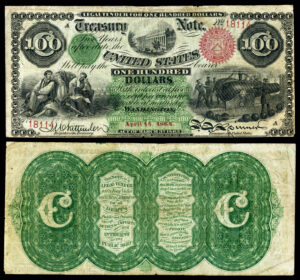
Crack open a well-worn album of pre-Civil War American banknotes and you will encounter something extraordinary: a level of artistic sophistication that puts modern currency to shame. Intricate allegorical vignettes, portrait medallions of impossible precision, and lathe-work geometric borders that seem to shimmer under magnification. None of that was produced by a government agency. It came from a handful of fiercely competitive private engraving firms, and chief among them stood the American Bank Note Company, an organization whose story is inseparable from the birth of American federal paper money.
Before the Government Printed Its Own Money
It is easy to forget that the United States government had no dedicated currency printing operation for most of the nineteenth century. The prevailing political philosophy held that running a printing plant was a commercial function, not a governmental one. State-chartered banks issued their own notes, railroad companies printed scrip, and municipalities floated their own paper obligations. All of them relied on private security printers to produce notes that were difficult to counterfeit.
The landscape of these printers was crowded and contentious. By the 1850s, seven major firms dominated the eastern seaboard market: Rawdon, Wright, Hatch and Edson; Danforth, Wright and Company; Jocelyn, Draper, Welsh and Company; Wellstood, Hanks, Hay and Whiting; Bald, Cousland and Company; Toppan, Carpenter and Company; and Buttre and Cousland. Each maintained a stable of master engravers, proprietary pantograph machines for scaling artwork, and closely guarded vaults of steel dies representing decades of accumulated intellectual property. Their vignettes of Lady Liberty, soaring eagles, and pastoral harvest scenes appeared on thousands of different notes across dozens of states.
The competition, while creatively productive, was financially exhausting. Bidding wars for large state bank contracts drove margins to the bone, and the rise of photographically aided counterfeiting in the late 1850s demanded expensive investment in new security technologies. The logical solution was consolidation.
The Formation of the American Bank Note Company, 1858
On January 1, 1858, the seven rival firms merged to create the American Bank Note Company, headquartered in New York City. The new entity was capitalized at one million dollars, an enormous sum for the era, and immediately became the dominant force in North American security printing. Its client list read like a who’s who of commercial ambition: railroads, insurance companies, foreign governments, and virtually every bank that wanted notes worth accepting at par.
The merger pooled an extraordinary collection of engraved steel dies. Historians estimate the combined vignette library numbered in the thousands of individual images, each cut by hand into hardened steel by craftsmen who had spent years learning the trade. These dies were the firm’s most valuable assets, and many of the portrait vignettes produced during this era, including several used on early federal notes, had been in the companies’ inventories for a decade or more before the Civil War erupted and changed everything.
When examining early Legal Tender Notes from the 1862 Series, look for the fine-line geometric lathe work in the border designs. This “engine turning” was produced on specialized rose-engine lathes owned by the American Bank Note Company, and its complexity is one reason these early notes are so difficult to replicate even today. The crisp, almost three-dimensional quality of this work degrades noticeably in later BEP-produced notes from the 1870s, giving collectors a reliable visual benchmark for distinguishing the two production eras.
The Civil War Crisis and the Birth of Federal Currency
When Confederate forces fired on Fort Sumter in April 1861, the federal government faced an immediate liquidity catastrophe. Gold and silver coins vanished from circulation as citizens hoarded hard money, and the existing state bank note system was wholly inadequate to fund a modern industrial war. Congress scrambled to authorize paper currency at the federal level for the first time since the Continental Congress era.
The Demand Notes authorized by Congress in July and August of 1861 were the first obligations of the United States government to circulate as currency in the modern sense. Treasury Secretary Salmon P. Chase needed them produced immediately, and the government had no printing infrastructure whatsoever. The obvious solution was to contract with the American Bank Note Company and its New York competitor, the National Bank Note Company.
The first Demand Notes, issued in denominations of $5, $10, and $20, were printed using a divided-plate process: the ABNC handled certain printing passes while the National Bank Note Company handled others. Overprinting with the distinctive green Treasury seal, which gave these notes their popular nickname “greenbacks,” was done at the Treasury Department building in Washington using hand stamps. The results were inconsistent, leading to serial number and overprint placement varieties that now command significant premiums among collectors.
The Series 1862 Legal Tender Notes that followed represented the first truly standardized federal paper money. The ABNC-produced $1 Legal Tender, featuring a portrait of Salmon Chase himself (a bit of self-promotion Chase later regretted), showcased the firm’s engraving at its finest. The $5 note featured a vignette of “The Pioneer” that had originated in the ABNC’s predecessor firms’ inventories. The $10 carried an eagle and shield design of remarkable intricacy. All bore the ABNC imprint on the face of the note, a practice that continued through the early federal series.
The National Bank Note Company: A Worthy Rival
The American Bank Note Company did not have the federal contract entirely to itself. The National Bank Note Company, formed in 1859 and never part of the 1858 merger, competed aggressively for Treasury business throughout the 1860s. The rivalry between the two firms produced some genuinely creative tension: when the Treasury Department wanted new designs for the Series 1869 “Rainbow” Legal Tender Notes, both companies submitted competing proposals, and the final notes incorporated engraving work from both firms.
The “Rainbow” series, so called because of the vibrant colors used in different denomination overprints, represented arguably the artistic high-water mark of privately produced federal currency. The $1 note featured a portrait of George Washington flanked by elaborate allegorical vignettes. The $2 carried Thomas Jefferson’s portrait with the vignette “Capitol at Washington” rendered in extraordinary detail. The $5 displayed Andrew Jackson’s likeness above a scene of pioneer settlers. Collectors today recognize the 1869 series as among the most beautiful notes ever produced for American circulation.
The 1869 Series Legal Tender Notes are distinguished from later BEP-produced versions of the same denominations by their vivid color contrasts and the presence of fine cross-hatching in the portrait backgrounds. Later BEP-printed notes from the 1874 and 1875 series used simpler geometric backgrounds. If you are grading an 1869 note for purchase, pay particular attention to the portrait shading: worn examples often lose the fine lines in the subject’s hair and collar first, dropping grades quickly from Fine to Very Good.
The Transition: Congressional Pressure and the 1877 Consolidation
The Bureau of Engraving and Printing had technically existed since August 29, 1862, when a small note-signing and sealing operation was established in the Treasury building basement. But for its first decade and a half, the BEP handled only the finishing work on notes that private firms had already printed. The actual engraving and plate printing remained with the ABNC, the National Bank Note Company, and smaller contractors.
Congressional scrutiny of the private printing contracts intensified through the early 1870s. Critics argued that the government was paying premium prices for work it could do itself, that the private firms held dangerous monopoly power over federal currency production, and that keeping printing plates in private hands posed a security risk. A series of hearings produced mounting pressure on the Treasury to bring currency production fully in-house.
The transition was gradual. The BEP began acquiring plate-printing equipment and training its own engravers throughout the mid-1870s. By 1877, it had sufficient capacity to handle all federal currency printing internally, and the contracts with the ABNC and National Bank Note Company were allowed to lapse. The last ABNC-printed federal notes were delivered that year, ending a relationship that had produced the entire foundation of American federal paper money.
The impact on the notes themselves was immediately visible. Early BEP-produced issues from the late 1870s and 1880s, while technically competent, lacked the artistic ambition of their privately produced predecessors. The bureau was staffed initially with journeymen engravers rather than the master craftsmen who had spent careers at the private firms. The intricate vignette work that characterized ABNC production gradually gave way to simpler, more standardized designs that were easier to reproduce consistently at scale.
What the ABNC Left Behind: Legacy in the Notes
Many of the portrait vignettes and design elements introduced by the ABNC remained in federal currency use long after the company lost its government contracts. The engraved portrait of Abraham Lincoln that debuted on ABNC-printed notes continued in use through multiple series. More remarkably, some of the lathe-work border patterns developed for early Legal Tender Notes influenced BEP design standards well into the twentieth century.
The American Bank Note Company itself continued operating as a premier security printer for foreign governments and corporations until filing for Chapter 11 bankruptcy protection in 1990. Its remarkable archive of engraved dies, numbering in the tens of thousands of images, was eventually acquired by various collectors and institutions. Some of those dies have appeared at auction in recent decades, offering numismatists a direct physical connection to the origins of American paper money.
| Series / Issue | Denomination / Variety | Approx. Surviving Examples | Rarity |
|---|---|---|---|
| 1861 Demand Note | $5, New York, “For the” handwritten | Fewer than 30 known in all grades | Key Date |
| 1861 Demand Note | $10, Philadelphia | Approximately 50-75 known | Rare |
| 1861 Demand Note | $20, Boston | Fewer than 20 known in any grade | Key Date |
| 1862 Legal Tender | $1, First Obligation reverse | Several hundred known | Scarce |
| 1862 Legal Tender | $2, First Obligation reverse | Fewer than 150 known in Fine or better | Rare |
| 1863 Legal Tender | $100, Eagle reverse (ABNC imprint) | Fewer than 40 known | Rare |
| 1869 Legal Tender | $1 “Rainbow,” bright color | Thousands known, Fine or better scarcer | Common |
| 1869 Legal Tender | $50, Washington/red tint | Under 100 known in circulated grades | Rare |
| 1869 Legal Tender | $500, Lincoln portrait | Extremely few, most in institutional collections | Key Date |
| 1875 Legal Tender | $5, Transitional BEP/ABNC printing | Hundreds known, distinguishing variety scarce | Scarce |
When authenticating early Legal Tender Notes from the 1862 and 1863 series, a loupe at 5x to 10x magnification will reveal whether the plate printing shows the characteristic ink squeeze of intaglio printing from an engraved steel plate. Genuine ABNC-produced notes will show slightly raised ink on the portrait areas where heavy ink deposits were pushed into the paper fiber during printing. Photomechanical counterfeits and later reproductions lack this tactile dimensionality entirely, and even high-quality color photocopies will show a flat, uniform ink layer with no surface relief.
Collecting ABNC-Era Currency Today
For collectors willing to commit the research time, ABNC-printed federal notes represent one of the most rewarding specialties in American numismatics. The field rewards knowledge: understanding which serial number ranges correspond to which printing contracts, recognizing the subtle differences between First Obligation and Second Obligation reverses on 1862 Legal Tender Notes, and identifying the presence or absence of the ABNC imprint on later issues where it was sometimes removed from plates.
The grading standards applied to these early notes by PCGS Currency and PMG acknowledge their age and production context. Paper that has survived 160 years in circulated condition with original surfaces and no restoration often grades higher than a superficially similar note with professional cleaning or pressed folds. The Friedberg reference numbers, drawn from Robert Friedberg’s foundational catalog “Paper Money of the United States,” remain the standard identifier system, and any serious collector of this material should have a current edition at hand.
Market values for Demand Notes and early Legal Tender Notes have appreciated significantly over the past two decades as the supply of problem-free examples dwindles and collector demand from the large-size note specialist community grows. A Fine-graded 1861 Demand Note in any denomination represents a genuine rarity with historical significance that few other collectibles can match. These are not merely antiques. They are the direct ancestors of every dollar bill in circulation today, produced by craftsmen who understood that the credibility of a new nation’s currency depended on art as much as law.
The Broader Significance
The story of the American Bank Note Company and its role in federal currency production is ultimately a story about trust. In 1861, a government desperate for circulating medium turned to the most trusted private security printers in the country, because it had no choice and because the public reputation of those firms was the surest guarantee of public confidence in the new notes. The ABNC delivered that confidence through craft: through engraving so fine and printing so precise that counterfeiting was genuinely difficult and the notes commanded acceptance at face value from the Atlantic to the Mississippi.
When the Bureau of Engraving and Printing finally took over that responsibility in 1877, it inherited not just the technical processes but the standard of excellence the private firms had established. The BEP spent decades trying to match the artistic quality of its private predecessors, and scholars who have compared the two eras honestly acknowledge that the ABNC’s finest work was never quite surpassed in terms of pure engraving artistry. That legacy lives in the notes themselves, waiting for collectors patient enough to look closely.