📷 Image source: banknote.ws (World Banknote Gallery). Images are selected by AI to represent the article topic and may not depict the exact note(s) described.
Pick up a Civil War-era fractional currency note today and you are holding one of the most historically charged pieces of paper money ever produced by the United States government. These small notes, ranging from three cents to fifty cents in face value, were born out of a genuine monetary crisis: by mid-1862, hoarding had driven every silver coin, copper cent, and even postage stamp out of everyday circulation. The Treasury Department’s solution was elegant in its urgency. Between 1862 and 1876, five distinct issues of fractional currency were printed, and woven throughout their designs was a rich vocabulary of allegorical and military iconography that consciously linked the act of making change with the Union’s cause on the battlefield. Nowhere is this more vivid than in the use of Victory figures, military emblems, and martial symbolism that graced these tiny but ambitious notes.
The Monetary Crisis That Forced Artistic Choices
To understand why these notes carry such deliberate iconography, you first have to understand the desperation that produced them. When the Civil War broke out in April 1861, public panic triggered an immediate run on banks. Gold and silver coin disappeared almost overnight. By December 1861, specie payments had effectively suspended. By the summer of 1862, even copper cents had vanished from commerce. Merchants resorted to issuing their own private scrip, using postage stamps as change, and printing small paper tokens. The chaos was both economic and reputational. The federal government could not afford to appear helpless.
Congress authorized the use of postage stamps as currency in July 1862, but stamps deteriorated quickly and proved impractical. The Act of March 3, 1863, formally established what would be called Postage Currency initially, and then Fractional Currency, to be issued by the Treasury. The political moment demanded that these new notes project confidence, authority, and above all, nationalist sentiment. The choice of iconography was therefore not incidental. It was a deliberate propaganda exercise conducted in denominations no larger than half a dollar.
The First and Second Issues: Stamps and Simple Frames
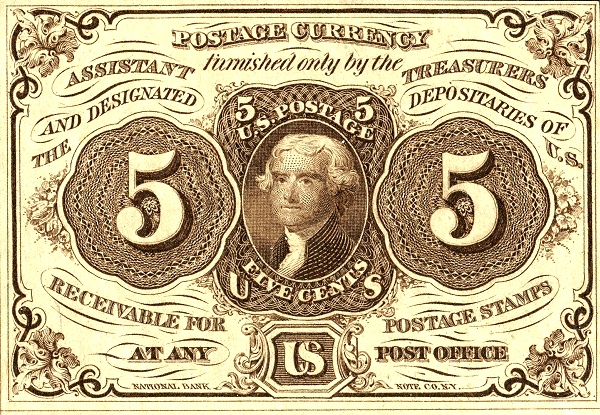
The First Issue, authorized in 1862 and commonly called Postage Currency, reproduced the actual designs of the five-cent and ten-cent postage stamps of the era on fractional notes. The five-cent note (Friedberg 1228 to 1231) featured Jefferson, and the ten-cent note carried Washington. Military iconography was absent from these earliest issues, but the choice to use presidential portraiture established the notes as instruments of national, not merely commercial, authority.
The Second Issue, produced from 1863 through 1867, introduced a more sophisticated design language. A bronze-colored oval surcharge was applied over the face of many notes to discourage counterfeiting by photography, a genuinely new threat at the time. The five-cent note of the Second Issue (Friedberg 1232 to 1236) continued to feature Washington, while the twenty-five-cent note (Friedberg 1283 to 1286) carried a bust of Washington within a design framework that used scalloped borders and geometric lathe-work associated with security printing of the period. The patriotic framing was becoming more pronounced, though explicit martial imagery was still restrained.
First Issue Postage Currency notes with perforated edges command a significant premium over straight-edge examples. The perforations were designed to mimic actual postage stamps and were quickly abandoned as impractical. A well-centered, perforated First Issue five-cent note in Fine condition can sell for two to three times the price of its straight-edge counterpart. Always examine the corners carefully under magnification before purchasing.
The Third Issue: Victory Arrives in Force
It is the Third Issue, produced between 1864 and 1869, where military iconography reaches its fullest and most artistically sophisticated expression on fractional currency. The notes of this series were designed under the supervision of Spencer M. Clark, the first superintendent of the National Currency Bureau, and they reflect both the intensity of the ongoing war and the increasing confidence of the Union government in its own eventual triumph.
The fifty-cent notes of the Third Issue are the most compelling examples for the student of military iconography. Several varieties (Friedberg 1331 to 1342) feature Spinner, the Treasury Secretary, but it is the design varieties carrying allegorical figures that demand the most attention. The so-called “Spinner” and “Justice” types placed classical female figures in the tradition of Republican iconography. These figures drew directly from the European tradition of representing abstract virtues as robed women: Justice with scales, Liberty with a cap on a pole, and most relevantly, Victory with laurel wreath and sometimes a palm frond.
The twenty-five-cent Third Issue note (Friedberg 1294 to 1308) features a bust of Washington flanked by design elements including an eagle with spread wings, a motif that appears repeatedly across the Third Issue and which functions as a direct emblem of military power and national sovereignty. The eagle on these notes is not the benign, perch-sitting bird of some contemporary commercial imagery. It is rendered with talons forward, wings fully extended, in a posture that contemporary viewers would have associated with martial aggression and national dominance.
Third Issue fifty-cent notes exist in red back, green back, and a rare fiber paper variety. The fiber paper versions (Friedberg 1376 to 1379) were printed on paper containing embedded red and blue silk fibers as an anti-counterfeiting measure. These fiber paper varieties are significantly scarcer than their plain-paper counterparts and are frequently misidentified. Hold the note up to a raking light source and look for the telltale colored threads running through the paper substrate itself.
Allegorical Victory: Reading the Symbolism
The allegorical figure of Victory in the Western artistic tradition descends from the Greek Nike and the Roman Victoria. She appears winged or wingless depending on context, carrying laurel crowns (associated with military triumph since antiquity), palm fronds (symbols of peace achieved through victory), and occasionally a shield or sword. On fractional currency, these classical references were filtered through the visual language of mid-nineteenth-century American engraving, which was itself deeply influenced by European academic traditions.
Engravers working for the National Currency Bureau, including the highly skilled craftsmen trained in the American Bank Note Company tradition, would have been intimately familiar with these conventions. The women on Third Issue fifty-cent notes are depicted in a manner consistent with contemporary book illustrations, commemorative medals, and public sculpture representing Union triumph. The laurel wreath motif appears in the design borders of multiple Third Issue denominations, and its repetition was not decorative filler. It was a consistent visual argument: the government paying you in these notes is winning the war.
The color choices reinforced this message. The Treasury seal on Third Issue notes appears in red, a color associated with urgency and authority. The intricate geometric lathe-work on the backs of these notes, printed in green, created a visual richness that asserted the technological and financial sophistication of the issuing government. These were not the crude scrip of a regime in crisis. They were, by the visual rhetoric of their design, the currency of a confident republic.
The Fourth and Fifth Issues: Mars Yields to Commerce
By the time the Fourth Issue began production in 1869, the war had been over for four years, and the iconographic urgency of the Third Issue gave way to a more conventionally commercial aesthetic. The Fourth Issue (1869 to 1875) featured Lincoln on the ten-cent note (Friedberg 1257 to 1261), Washington on the fifteen-cent note (the only fifteen-cent denomination in American currency history, Friedberg 1267 to 1271), and a Stanton portrait on the fifty-cent note. The allegorical Victory figures receded, replaced by presidential portraiture and more restrained border designs.
The Fifth Issue, printed between 1874 and 1876, was essentially a transitional issue produced as fractional currency wound toward its eventual redemption. The Resumption Act of January 14, 1875, committed the government to restoring specie payments by January 1, 1879, and fractional currency was officially retired from circulation as the coins it had replaced gradually returned. The Fifth Issue ten-cent note (Friedberg 1264 to 1266) and twenty-five-cent note (Friedberg 1308 to 1310) are comparatively plain by Third Issue standards, their design language reflecting peacetime administrative priorities rather than wartime propaganda imperatives.
Fractional currency shields, produced in 1866 as specimen displays for bank cashiers to use in detecting counterfeits, are among the most visually spectacular items in the entire series. These large cardboard mounts carry genuine fractional note specimens in both face and back configurations. A complete shield in presentable condition can run into the thousands of dollars, but individual specimen notes detached from shields appear regularly at auction and offer a more accessible entry point to this segment of the series.
Condition and Grade Considerations Specific to Fractional Notes
Grading fractional currency presents challenges distinct from grading large-size notes. The small format means that even minor folds are proportionally more significant. The Third Issue notes in particular were often poorly centered at the time of printing, and originality of margins is a critical consideration. Many fractional notes were trimmed by contemporary users to create neat, even edges, a practice that drastically reduces numismatic value today. The Paper Money Guaranty (PMG) and Professional Coin Grading Service (PCGS Currency) both grade fractional notes, and certification is strongly recommended for any example above Fine-15.
Foxing, the brown spots caused by mold or chemical interaction with the paper, is extremely common on fractional notes that spent decades in desk drawers, tobacco tins, and household jars. Light foxing in the margins is generally tolerable in circulated grades but should be disclosed and will affect value. Pressed or ironed notes, a known problem in the series, can appear to grade higher than their actual wear warrants, and experienced dealers can usually identify the telltale loss of paper fiber texture that pressing produces.
| Issue / Friedberg No. | Denomination and Variety | Estimated Surviving Examples | Rarity |
|---|---|---|---|
| First Issue, Fr. 1228 | 5-cent, perforated edges, straight face | 1,500 to 2,500 VF or better | Scarce |
| Second Issue, Fr. 1284 | 25-cent, surcharge variety, bronze oval | 3,000 to 5,000 | Common |
| Third Issue, Fr. 1337 | 50-cent, Spinner, fiber paper, red back | Under 500 in VF or better | Rare |
| Third Issue, Fr. 1342 | 50-cent, Justice, fiber paper, green back | Under 300 known in any grade | Key Date |
| Third Issue, Fr. 1294 | 25-cent, Washington, red back | 4,000 to 7,000 | Common |
| Third Issue, Fr. 1303 | 25-cent, Washington, fiber paper, red back | 800 to 1,200 | Scarce |
| Fourth Issue, Fr. 1268 | 15-cent, Columbia, large red seal | 5,000 to 8,000 | Common |
| Fourth Issue, Fr. 1271 | 15-cent, Columbia, large brown seal | 1,000 to 2,000 | Scarce |
| Fifth Issue, Fr. 1265 | 10-cent, Meredith, green seal | 6,000 to 9,000 | Common |
| Fractional Shield, 1866 | Complete specimen display card | Under 200 intact examples | Key Date |
Building a Thematic Military Iconography Collection
For collectors drawn specifically to the military and allegorical dimensions of fractional currency, a focused thematic collection is entirely achievable at reasonable cost. A set built around the Third Issue, emphasizing the eagle design varieties, the allegorical female figures on the fifty-cent notes, and the martial border elements, can be assembled across perhaps fifteen to twenty individual notes covering the major Friedberg numbers. Budget collectors in Fine to Very Fine condition can complete much of this set for under five hundred dollars. The key dates and fiber paper varieties will require significantly larger investments, but the common varieties remain genuinely affordable.
Cross-collecting with Civil War material adds tremendous contextual richness. Pairing a Third Issue fifty-cent note with a contemporary CDV (carte de visite) photograph of a Union soldier, or with a period newspaper carrying recruitment advertisements, transforms the numismatic item into a historical document with immediate human context. The fractional notes were literally in the pockets of soldiers on leave, sutlers at camp commissaries, and women managing household finances while their husbands fought. Their iconography spoke directly to those people in a visual language they understood and felt.
Conclusion: Small Notes, Large Ambitions
The allegorical and military iconography of Civil War fractional currency represents one of the most concentrated exercises in nationalist visual rhetoric in the history of American paper money. In denominations too small for most collectors to consider seriously, the Treasury Department embedded eagles, laurel wreaths, classical Victory figures, and the full vocabulary of Republican triumphalism. These were not arbitrary design choices. They were the deliberate work of engravers, administrators, and politicians who understood that the images on money shape the way people think about the government that issues it.
For today’s collector, fractional currency offers a remarkable combination of historical depth, aesthetic sophistication, genuine scarcity in the key varieties, and relative affordability in the common ones. The next time you handle a Third Issue fifty-cent note and trace the lines of that allegorical figure on its face, you are holding a piece of wartime propaganda small enough to hide in a closed fist, but large enough in its ambitions to carry an entire nation’s claim to legitimacy and ultimate victory.