When the Sky Turned Black and the Banks Closed
On April 14, 1935, a wall of dust estimated at 8,000 feet high rolled across the Oklahoma Panhandle and southwestern Kansas. Residents called it Black Sunday. By nightfall, families had stuffed wet rags under their doors, livestock had suffocated in open fields, and at least a dozen rural bank branches had permanently shuttered their lobbies for the final time. The Dust Bowl was not merely an agricultural catastrophe. It was a systematic destroyer of the small-unit national banking system that had quietly printed some of America’s most localized, community-specific currency for decades.
The Banking Landscape Before the Dust Arrived
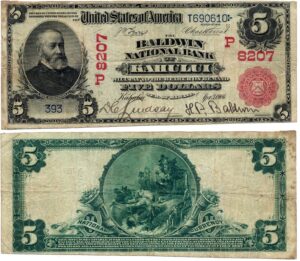
To appreciate what was lost, you need to picture what rural Oklahoma and Kansas banking looked like in the 1920s. Towns with populations of 400 or 600 people routinely chartered their own national banks. Alva, Oklahoma. Meade, Kansas. Woodward, Oklahoma. Hugoton, Kansas. Each held a federal charter, each maintained a bond deposit with the U.S. Treasury, and each printed its own distinctive National Bank Notes bearing the bank’s name, town, state, and charter number in bold black ink against the familiar brown-seal reverse of the Series of 1929 issues.
The National Banking Acts of 1863 and 1864 had created this system, and by 1920 there were over 8,000 nationally chartered banks spread across the United States. Oklahoma alone had 520 operating national banks in 1921. Kansas had more than 640. Many of these institutions had been in continuous operation since territorial days, issuing notes under successive series from the Original Series of the 1860s all the way through the large-size Federal Reserve Bank Notes and eventually into the small-size Series of 1929 format that standardized currency dimensions in July 1929.
When researching a specific Oklahoma or Kansas charter, always cross-reference the Comptroller of the Currency Annual Reports from 1929 through 1935, which are freely available through the FRASER database at the St. Louis Federal Reserve. These reports list exact receivership dates, outstanding circulation figures, and bond redemption amounts, all of which help you estimate the surviving population of notes from a given bank.
The Mechanism of Collapse: Drought, Debt, and Deposit Runs
The crisis did not arrive overnight. It built in overlapping waves. Cotton and wheat prices had already fallen sharply after 1927, squeezing farmers who had borrowed heavily to purchase mechanized equipment and expand their acreage during World War One. When the stock market crashed in October 1929, credit markets froze almost immediately. Rural banks that had extended seasonal agricultural loans suddenly faced mass default. A farmer who owed $1,200 on a wheat crop that sold for $0.25 per bushel instead of the expected $0.60 could not repay his note, and the bank could not absorb the loss.
Then the rains stopped. Rainfall across southwestern Kansas dropped to less than half the annual average in 1931 and again in 1933. The topsoil that had been broken by the plow since the 1890s began to lift. Dust storms reduced visibility to zero and deposited grit inside locked bank vaults. Depositors who still had money grew frightened and withdrew it. A classic bank run, already common across America after 1930, was supercharged in the Dust Bowl region by the very real possibility that the entire local economy might simply cease to function.
The First National Bank of Boise City, Oklahoma, charter number 10327, had opened in 1912 and issued notes under the large-size Series of 1902 Plain Back as well as the small-size Series of 1929. It closed in receivership in October 1932, with only $14,000 in outstanding circulation at the time of failure. The Citizens National Bank of Meade, Kansas, charter 4660, which had operated since 1892, suspended operations in June 1931. The Farmers National Bank of Woodward, Oklahoma, charter 5889, closed in September 1933 with an estimated print run under 3,000 notes across all denominations in the Series of 1929. Notes from all three of these institutions are genuinely rare today, with Fine examples selling for $400 to over $1,200 at specialized currency auctions depending on denomination and serial number.
The Series of 1929: The Last Notes These Banks Ever Printed
For collectors, the Series of 1929 National Bank Notes occupy a special position because they represent the final expression of the entire national currency era. Introduced in July 1929, they came in two types. Type I notes (Fr. 1800 for $5, Fr. 1801 for $10, Fr. 1802 for $20, and higher denominations) have serial numbers printed twice on the face, once in the bank’s own series and once in a second position, with the charter number appearing in brown ink. Type II notes, introduced in mid-1933, have the charter number printed in larger numerals as part of the serial number block itself.
For Dust Bowl region banks that failed before 1933, only Type I notes were ever issued. That constraint matters enormously for collectors. A bank that opened in 1929, printed 2,400 Type I notes, and failed in a receivership in 1932 will never have a Type II note in existence. The only question is how many of those 2,400 notes survived 90-plus years. In most cases, the answer is fewer than you might expect. Circulation was heavy in rural communities. Notes were worn, torn, and redeemed through the Treasury’s destruction process. Surviving Gem Uncirculated examples from failed Dust Bowl banks are almost impossibly rare.
Type I and Type II notes from the same charter can look nearly identical at a glance. To distinguish them quickly, look at the serial number on the right side of the face. On Type I, the charter number appears separately in brown ink below the serial. On Type II, the charter number is incorporated into the serial number block in larger, bolder digits. This distinction is critical when cataloging Dust Bowl-era survivors because it can tell you precisely when a note was issued relative to a bank’s closure date.
Charter-by-Charter: The Roll Call of Failure
The failures spread geographically along the same corridors that the dust storms traveled. In Oklahoma, the hardest-hit counties for bank closures between 1930 and 1936 were Cimarron, Texas, Beaver, Harper, Woodward, and Ellis, all located in the western Panhandle and northwestern sections of the state. In Kansas, Seward, Meade, Clark, Comanche, and Stevens counties saw near-total elimination of their independent national banking presence.
Some specific charters worthy of collector attention include the First National Bank of Liberal, Kansas, charter 7720, which survived the early Depression but finally closed in 1934 after three consecutive crop failures. Its Series of 1929 notes in $10 and $20 denominations appear at auction perhaps once or twice per decade in any grade above Very Fine. The Security National Bank of Guymon, Oklahoma, charter 9533, issued notes from 1910 through its 1932 failure. Only a handful of its Series of 1929 Type I $5 notes are confirmed to exist in collector hands, with one example graded PMG Very Fine 25 realizing $1,850 at a Heritage Auctions sale in 2018.
The Exchange National Bank of Elk City, Oklahoma, charter 7016, deserves particular mention. Elk City sat squarely in the Dust Bowl impact zone, and the bank closed in July 1933, placing it in the small window where a Type II note might theoretically exist but almost certainly does not, given the timing of the Type II transition. Any collector claiming to hold a Type II from charter 7016 should subject it to extremely careful authentication.
Notes That Never Came Home: Redemption and Destruction
When a national bank failed, the Comptroller of the Currency appointed a receiver who took control of remaining assets and liabilities. Outstanding notes became a liability of the United States government, backed by the bond collateral the bank had deposited with the Treasury. Holders of those notes could redeem them at face value, which meant that circulated notes from failed banks had strong economic incentive to be turned in and destroyed.
This redemption pressure is why survival rates for failed Dust Bowl bank notes are so much lower than for notes from banks that simply liquidated voluntarily or were absorbed into larger institutions. A bank that merged its operations with a neighboring institution might have some notes retire naturally through wear, with others saved as souvenirs. A bank that went into federal receivership in 1932 had almost all its outstanding circulation redeemed within a few years, because holders who kept the notes were leaving money on the table. The Treasury’s currency destruction records from the 1930s confirm that hundreds of millions in national bank notes from failed banks were received and macerated between 1930 and 1940.
When evaluating a note from a failed Dust Bowl-era bank, pay close attention to the back of the note for any pencil or rubber stamp annotations that might indicate it passed through a receiver’s hands. Some notes redeemed by the Treasury but pulled from destruction as specimens carry faint markings from this process. While such marks reduce technical grade, they can actually authenticate a note’s provenance and add to its historical narrative for condition-tolerant collectors.
The Roosevelt Bank Holiday and Its Permanent Impact
President Franklin Roosevelt’s Emergency Banking Act of March 1933 and the ensuing Bank Holiday temporarily froze every bank in the United States between March 6 and March 13. When banks reopened, only those certified as solvent by federal examiners were permitted to resume operations. Across Oklahoma and Kansas, dozens of rural national banks that had limped through 1931 and 1932 on the thinnest possible capital margins failed this solvency test and never reopened.
The Banking Act of 1935 then fundamentally restructured federal supervision and deposit insurance through the FDIC, which had been provisionally established in January 1934. For the national bank note system specifically, the most significant blow came from the Tax on National Bank Circulation, embedded in the Revenue Act of 1935, which made it unprofitable to issue new national bank notes. By 1935, the Bureau of Engraving and Printing had effectively stopped printing new Series of 1929 sheets for distribution. The last deliveries of national bank notes to still-operating banks trickled out through 1935, with a small handful of stragglers receiving notes as late as 1936.
For Oklahoma and Kansas banks that had survived the Dust Bowl’s worst years, this meant their Series of 1929 notes represented a closed chapter. No new notes would follow. Banks that had been issuing currency since the 1880s would never print another note. The era was over, ended by drought, economic collapse, and federal policy reform arriving almost simultaneously.
| Charter / Bank | Location and Closure | Est. Series 1929 Print Run | Rarity |
|---|---|---|---|
| Charter 9533, Security National Bank | Guymon, OK (closed 1932) | Approx. 1,800 notes | Key Date |
| Charter 5889, Farmers National Bank | Woodward, OK (closed 1933) | Approx. 2,400 notes | Key Date |
| Charter 7720, First National Bank | Liberal, KS (closed 1934) | Approx. 3,600 notes | Rare |
| Charter 10327, First National Bank | Boise City, OK (closed 1932) | Approx. 1,200 notes | Key Date |
| Charter 7016, Exchange National Bank | Elk City, OK (closed 1933) | Approx. 4,800 notes | Rare |
| Charter 4660, Citizens National Bank | Meade, KS (closed 1931) | Approx. 2,000 notes | Key Date |
| Charter 8134, First National Bank | Hugoton, KS (closed 1932) | Approx. 3,000 notes | Rare |
| Charter 6543, State National Bank | Alva, OK (closed 1935) | Approx. 6,000 notes | Scarce |
| Charter 5312, Farmers and Merchants National | Coldwater, KS (closed 1933) | Approx. 2,800 notes | Rare |
| Charter 3615, First National Bank | Dodge City, KS (survived Depression) | Approx. 18,000 notes | Common |
What Survivors Look Like: Grading Realities for Dust Bowl Notes
Collectors new to this area sometimes arrive with unrealistic grade expectations. These were working notes in farming communities. They rode in the pockets of men who spent their days in fields and feedlots. They absorbed oil, grit, and the humidity swings of Oklahoma summers and Kansas winters. A note from Charter 9533 grading VG-10 or F-12 is not a compromise. It is a legitimate survivor of extraordinary circumstances, and in many cases it represents the only example of its denomination that will appear on the market in a decade.
PMG and PCGS Currency both maintain population reports that are invaluable for these issues. Before paying a premium for any Dust Bowl-era charter note, check the registry for that charter number. You may discover that the $280 Fine example in front of you is literally one of four known graded examples, which would make it substantially undervalued. Conversely, you might find that a note being sold as rare is actually the twelfth graded example and easily replaceable at patience and fair market price.
Building a Dust Bowl Collection: A Strategic Framework
For collectors interested in assembling a thematic collection around this historical moment, several approaches have proven successful. A county-focused collection attempts to acquire at least one note from every national bank that operated within a specific Dust Bowl county, documented against a map of that county’s bank failures. A timeline collection arranges notes chronologically by closure date, telling the story of the collapse bank by bank across the 1930 to 1936 period. A denomination-focused collection might concentrate exclusively on $5 notes from failed Oklahoma charters, allowing for deeper specialization within a more manageable budget.
Auction houses including Heritage Auctions, Stack’s Bowers, and Lyn Knight Currency Auctions have all offered significant Dust Bowl charter material over the past 20 years. Building relationships with dealers who specialize in territorial and obsolete notes from the southern plains states is equally valuable, as private treaty sales handle a significant share of the rarer material that never reaches major auction podiums.
Don Kelly’s reference work on National Bank Notes remains the essential starting point for charter-by-charter research. The Society of Paper Money Collectors (SPMC) library also maintains state-specific charter records that can help collectors identify whether a specific bank ever issued Series of 1929 notes at all, since some banks that failed in 1930 or early 1931 never received their Series of 1929 allocations before closure.
A Final Accounting
By 1940, the number of national banks in Oklahoma had fallen from 520 to fewer than 180. Kansas had dropped from over 640 to under 220. The small-town charter note, that uniquely American artifact that put the name of a 400-person farming community on the face of federally issued currency, was gone. The Federal Reserve System, consolidated deposit insurance, and the New Deal’s restructuring of American finance had replaced it with a more centralized, more stable, but decidedly less individualized monetary system.
What remains for collectors are the notes themselves, worn and creased, smelling faintly of age, bearing the names of towns that sometimes no longer exist and banks that failed in the worst economic and environmental catastrophe in American history. They are not merely currency. They are primary source documents of a specific failure, a specific community, a specific moment when the sky turned black and the banks closed and the era of small-town charter notes blew away with the topsoil. Collecting them is an act of historical preservation as much as it is numismatics, and the research required to do it well connects you directly to one of the defining events of the twentieth century.