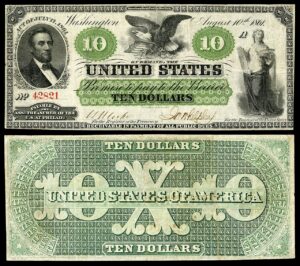
Pick up a well-worn 1902 Date Back $10 note from a small Wyoming territorial bank and you are holding something that no coin, no modern Federal Reserve note, and frankly no other collectible quite replicates. National Bank Notes were issued from 1863 through 1935, produced by over 14,000 individual chartered banks across every state and territory, and each one carries the name of the issuing institution right on its face. That single detail transforms what would otherwise be a routine grading exercise into a nuanced negotiation between paper condition and institutional rarity. A Fine-12 note from the First National Bank of Tonopah, Nevada might be worth more than a Gem Uncirculated example from a common New York City bank. Understanding why, and how to properly evaluate both, is what this guide is all about.
Why Grading Nationals Is Different
Standard currency grading, whether you use the Sheldon-derived 1-to-70 numeric scale or descriptive adjectives like Very Fine or Extremely Fine, was built around the idea that two notes of the same series and denomination are functionally equivalent. That assumption collapses with National Bank Notes. Two 1902 Plain Back $10 notes may be identical in design and federal printing, but one issued by Charter 9999 from a major Chicago bank with thousands of survivors and one issued by Charter 6517 from the Miners and Merchants National Bank of Goldfield, Nevada, which has perhaps three known examples, are not remotely comparable objects for collecting purposes.
This does not mean grade is irrelevant. It means grade must be considered in tandem with at least three other variables: the issuing bank’s surviving population, the geographic or territorial significance of the charter, and the specific series or type of the note. Master these interactions and you will buy and sell Nationals with genuine confidence.
The Standard Grading Scale Applied to Nationals
Third-party grading services PMG and PCGS Currency both apply the standard 1-70 numeric scale to National Bank Notes, and their holders are the baseline for any serious transaction. Here is how the key grades translate to real-world condition descriptions that matter specifically for Nationals:
Poor (P-1) through About Good (AG-3)
Notes in this range have heavy circulation wear, possible missing corners, and may be barely identifiable. For common large-size Nationals from New York, Boston, or Philadelphia banks, these grades hold little premium. But for truly unique issues, a P-1 example of a note from a bank with zero other known survivors is still significant. The 1882 Brown Back $5 from the First National Bank of Guthrie, Oklahoma Territory (Charter 4473) in VG would be a landmark find; in Poor it would still set records.
Very Good (VG-8) through Fine (F-12)
This is the sweet spot for many territorial and rare-bank collectors. A VG note from a one or two-known bank is legitimately exciting, and Fine examples from frontier western banks routinely bring $5,000 to well over $50,000 depending on the charter. The paper fibers at this grade still retain enough detail to confirm signatures, charter numbers, and territorial designations clearly.
When evaluating a note in VG or Fine, pay particular attention to the clarity of the bank’s name panel and the charter number overprint. These features, more than the vignettes, confirm the note’s identity and are the first areas to suffer damage from folding and handling. A note with a sharp, legible name panel grades more cleanly than one where that panel is rubbed to illegibility, even if the overall paper body looks better.
Very Fine (VF-20 through VF-35)
The most traded grade range for collectible Nationals from secondary-rarity banks. At VF-20, a note shows multiple folds but retains original paper sheen in protected areas. VF-35 is a near-EF note with only light circulation evidence. Many collector budgets target VF examples of scarce state and territorial issues, because the jump in price to Extremely Fine can be dramatic. A 1902 Date Back $5 from a Montana territorial bank might be $1,800 in VF-20 and $6,500 in EF-40.
Extremely Fine (EF-40 through EF-45)
These notes saw only light circulation. Corner folds may be present but paper body is bright and margins are clean. For small-size 1929 Type I and Type II Nationals, EF is quite achievable even from smaller banks, since many were saved by collectors upon the series’ issue. For large-size issues from before 1910, EF is genuinely uncommon from any small-town charter.
About Uncirculated (AU-50 through AU-58)
Almost no evidence of circulation, possibly just the slightest corner crease from counting. Large-size Nationals in AU from small banks are rare finds. When they appear in major auctions, such as Heritage or Stack’s Bowers sales dedicated to currency, they generate significant bidding competition even from common charters, simply because the condition is so unexpected for the era.
Uncirculated (MS-60 through Gem CU-65 and above)
Crisp, never-circulated notes with full original paper body. PMG-65 EPQ (Exceptional Paper Quality) and PCGS PPQ (Premium Paper Quality) designations matter enormously here. A 1929 Type I $10 National from a common bank might grade PMG-65 EPQ routinely, while a PMG-64 without the EPQ qualifier from a rare territorial bank is the more significant note by many orders of magnitude. Do not let a high numeric grade automatically overshadow rarity considerations.
Special Considerations Unique to Nationals
Original Series and Series of 1875 Large-Size Notes
The earliest National Bank Notes, printed under the Original Series commencing 1863 and the subsequent Series of 1875, feature the American Bank Note Company and Continental Bank Note Company imprints and elaborate engraved vignettes. Notes from this era in any grade above Fine are genuinely scarce across most charter numbers. The red-ink serial numbers, charter numbers overprinted in red, and the distinctive Treasury seal in red or blue are critical authentication and grading points. Fading of these red inks, sometimes called “ink fade” or “ink weakness,” is a common problem that PMG and PCGS will note as a qualifier and that reduces technical grade.
Original Series and 1875 Series notes frequently appear with evidence of pen cancellations, stamp cancellations, or punch holes where banks redeemed and cancelled them before returning the notes to the Treasury. A lightly pen-cancelled example from a rare charter is still highly collectible, and many reference catalogs specifically note whether known survivors carry cancellations. PMG and PCGS will indicate cancellations on the holder label and they do affect grade.
The 1882 Series: Brown Backs, Date Backs, and Value Backs
The 1882 series produced three visually distinct types across its print history. Brown Backs (1882-1908) feature a brown ink reverse with the charter number prominently displayed. Date Backs (1908-1916) show the years “1882-1908” on the reverse. Value Backs (1916-1922) display only the denomination. Each type was printed for the same charters but across different years, meaning some banks appear on all three types while others, particularly those that closed or reorganized early, appear only on Brown Backs. A 1882 Brown Back from a bank that closed in 1895 may be the only type available for that charter. Always check Friedberg catalog numbers when evaluating series-specific rarity.
The 1902 Series: Plain Backs, Date Backs, and Red Seals
The 1902 Red Seal notes, printed only from 1902 to 1908, are the scarcest of the three 1902 types for most charters simply because of their shorter print window. Friedberg numbers 613-615 (Red Seal $5, $10, $20) carry significant premiums. The 1902 Date Back and Plain Back types have much higher survivors, especially for active banks in eastern states, but even within these common types, the $50 and $100 denominations are genuinely scarce from smaller banks because high-denomination notes circulated more heavily in commerce.
Small-Size 1929 Nationals: Type I vs. Type II
The small-size National Bank Note era ran from July 1929 through May 1935. Type I notes carry the charter number in black ink in two positions on the face, while Type II notes add a third charter number impression in the serial number area. For common banks, Type II notes are slightly scarcer. But for banks that closed shortly after 1929, only Type I notes may exist, making any Type II from that charter a genuine rarity. The Friedberg numbers 1800-1804 (Type I) and 1800A-1804A (Type II) are the reference points, and the Hickman-Oakes catalog provides bank-by-bank population data that is essential reading before any purchase.
For 1929 small-size Nationals, serial number position on Type II notes is a common point of confusion even among experienced dealers. The third charter number appears within the serial number itself, replacing the first two digits of the serial with the charter number printed in the same black ink. If you are unsure whether a note is Type I or Type II, look at the serial number block on the face: Type II serials begin with the charter number digits, while Type I serials follow a standard sequential format without the charter number embedded.
Geographic and Territorial Premiums in Grading Context
Certain geographic origins command dramatic premiums that can make a technically lower-graded note worth far more than a higher-graded common-state example. Hawaiian, Alaskan, Puerto Rican, and mainland territorial issues from states like Oklahoma Territory, Indian Territory, Arizona Territory, New Mexico Territory, and North and South Dakota Territory before statehood are the most actively pursued. A Fine-12 $10 note from the First National Bank of Prescott, Arizona Territory (Charter 2639, organized 1883) is a different category of rarity than a Gem $10 from a 1929 Massachusetts bank. PMG and PCGS holders will note “Territory” in the bank name transcription, which is a key detail to verify on any territorial purchase.
State-level geographic collecting also drives premiums. Notes from Alaska are extremely scarce in any series. The First National Bank of Fairbanks (Charter 7718) and the Washington-Alaska Bank (which never received a national charter) are frequently confused in the market. Only two national banks ever operated in Alaska: Charter 7718 in Fairbanks and Charter 10705, the First National Bank of Juneau, chartered in 1913. Notes from either carry five-figure premiums in grades as low as Good.
Population Reports and the “Known” Factor
Unlike Federal Reserve Notes where millions of examples survive, many National Bank Note issues are known in populations of one to ten examples worldwide. The Hickman-Oakes rarity scale runs from R1 (common, over 200 known) through R7 (unique, only one known). For notes rated R6 (3-5 known) or R7, grade becomes secondary to mere existence. It is important to check both the PMG Population Report and the PCGS Currency Population Report before purchasing any note claimed to be rare, because “rare” is frequently applied loosely by sellers. Cross-reference against the Hickman-Oakes census and the National Numismatic Census maintained by the Society of Paper Money Collectors (SPMC).
| Series / Friedberg No. | Charter / Bank | Known Examples (Approx.) | Rarity |
|---|---|---|---|
| 1929 Type II, Fr. 1802A ($10) | First NB of Juneau, Alaska (Ch. 10705) | 4-6 known | Key Date |
| 1882 Brown Back $5, Fr. 466 | Any Indian Territory charter, pre-1907 | Fewer than 20 total across all charters | Rare |
| 1902 Red Seal $10, Fr. 613 | Small-town western banks (under 5,000 issued) | Varies: 2-15 per charter | Rare |
| 1902 Date Back $5, Fr. 590 | Common eastern state charters (NY, PA, OH) | Hundreds per charter | Common |
| 1929 Type I $20, Fr. 1802 | Major city banks: Chicago, New York, Boston | Thousands surviving | Common |
| Original Series $1, Fr. 380 | Any surviving charter, any state | Under 50 total known | Key Date |
| 1882 Value Back $50, Fr. 578 | Any small-state bank (under $500K capitalization) | Fewer than 10 per state in many cases | Rare |
| 1902 Plain Back $5, Fr. 598 | Mid-size Midwest charters (IL, IN, MO) | 50-200 per common charter | Scarce |
| 1929 Type II $5, Fr. 1800A | Banks open fewer than 3 years post-1929 | Often unique or 1-of-2 | Key Date |
| 1875 Series $20, Fr. 431 | New England charters (MA, CT, RI) | 10-40 per active charter | Scarce |
Practical Grading Checklist for National Bank Notes
When you have a National Bank Note in hand, work through these checkpoints in order before assigning or accepting a grade:
1. Paper Integrity: Check for splits, tears, or missing pieces. Even tiny margin tears reduce grade significantly. A split along a vertical fold that has been expertly repaired will be noted by PMG or PCGS as “repaired” and carries a drastically reduced value relative to an unrepaired example in the same technical condition.
2. Folds and Creases: Count the folds and assess their depth. A single vertical and single horizontal fold puts a note in the VF range if no other issues are present. Multiple diagonal folds suggest heavier circulation and push toward Fine or Very Good.
3. Margins: National Bank Notes were printed in sheets and hand-cut, so margins can vary. Unusually narrow margins are not considered a defect if they result from sheet cutting rather than trimming. Trimmed notes, where someone has deliberately cut the margins to make the note appear wider or sharper, are a serious problem and will result in a “trimmed” designation from grading services.
4. Ink Freshness: The red or blue Treasury seals, red serial numbers on large-size notes, and the charter number overprints should appear sharp and saturated. Faded or smeared ink reduces technical grade and may trigger an “ink smear” or “faded ink” qualifier.
5. Signatures: National Bank Notes carry two federal signatures (Register of the Treasury and Treasurer of the United States) and two bank officer signatures (president and cashier). Faded or missing bank officer signatures are unfortunately common on worn notes and will affect grade. Some bank officers signed in pencil rather than ink, and these signatures are particularly vulnerable to wear.
Conclusion: Grade Is One Chapter, Not the Whole Story
Grading National Bank Notes correctly means mastering the standard condition scale and then layering on the contextual knowledge that makes these notes genuinely irreplaceable artifacts of American economic history. A PMG VF-25 label on a note from a two-known territorial bank is not the same object as a PMG VF-25 on a common 1929 Type I from a Philadelphia bank with five hundred survivors. Both deserve respect, but they serve completely different collecting goals and carry completely different market values. Invest time in the Hickman-Oakes catalog, consult the SPMC census resources, study third-party population reports, and approach every National Bank Note with the dual mindset of a condition purist and a historical detective. That combination is what separates great National collectors from casual ones.